Lacy’s Death1186 CE
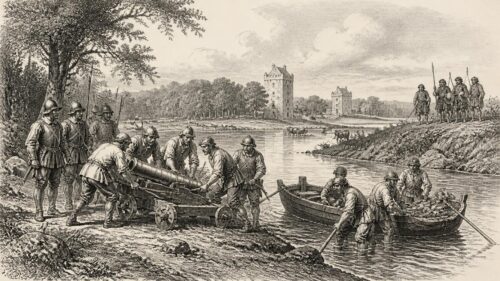
In 1186, Ireland remained politically fragmented despite expanding Anglo-Norman settlement. Hugh de Lacy, lord of Meath, was killed while inspecting castle works at Durrow, an act Irish annals portrayed as vengeance for violation of Columcille’s sanctuary. His death weakened colonial authority while Crown withheld Meath from heir. In Connacht, Conchobar Máenmaige displaced his father, Ruaidrí Ua Conchobair, amid dynastic warfare. Northern factions deposed Domnall Mac Lochlainn, causing violence. Churches, pilgrimage, hagiography, trade and castle-building shaped life. Gaelic and settler economies interacted, but warfare disrupted communities. The year demonstrated that competing Gaelic, royal, ecclesiastical and Anglo-Norman lordships prevented any unified conquest.
Dateline
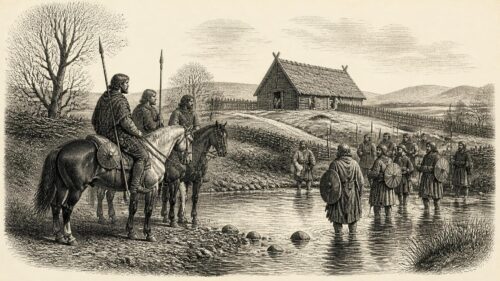
Ireland in 1186 was neither conquered nor politically united. Seventeen years after the first Anglo-Norman landings, power remained divided among Gaelic kings, immigrant lords, maritime towns, church communities and the representatives of Henry II of England. Castles and colonial settlements were spreading through parts of Leinster, Meath and the south-east, yet their reach was uneven and frequently contested. The year’s most dramatic event—the killing of Hugh de Lacy at Durrow—exposed both the remarkable extent of one magnate’s power and the fragility beneath it. At the same time, a bitter succession struggle in Connacht and factional violence in the north showed that Ireland’s older kingdoms were being reshaped by internal rivalries as well as foreign expansion.
After Prince John’s Failure
The political background to 1186 was the troubled expedition of Prince John, Henry II’s youngest son, during the previous year. John had been designated lord of Ireland and arrived in April 1185 with a substantial following. His campaign produced new fortifications, including those recorded at Ardfinnan and Tibberaghny, but resistance in Munster, poor relations with Irish rulers and rivalry among the newcomers undermined the venture. John returned to England before the end of 1185.
Contemporary Irish accounts presented Hugh de Lacy as the real power who had frustrated John’s efforts to receive tribute and hostages. This explanation was partisan, but it reflected de Lacy’s extraordinary position. Granted Meath by Henry II in 1172, he had developed Trim as his principal centre, distributed lands among followers and extended his influence into Bréifne and Airgialla. He had also married a daughter of Ruaidrí Ua Conchobair, an alliance that linked him to the dynasty of Connacht and encouraged suspicions at Henry’s court that his ambitions exceeded those of an ordinary royal servant.
The Death at Durrow
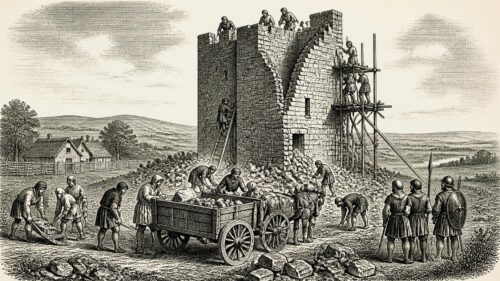
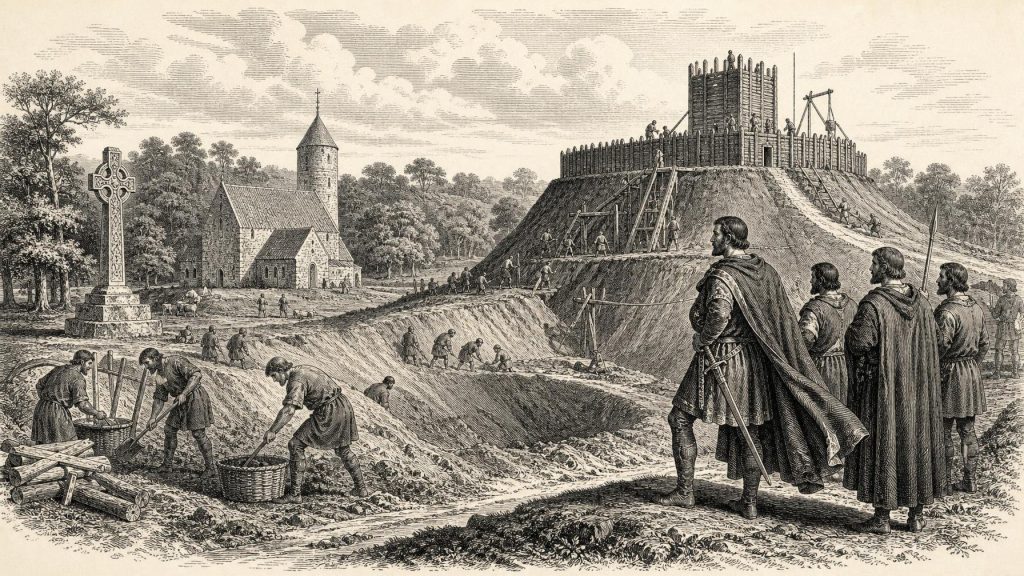
De Lacy spent 1186 continuing the construction of fortifications. Irish annalists declared that Meath, from the Shannon to the sea, was full of the castles and settlers associated with him. The statement was rhetorical, but it captures the scale of change within his lordship. Many early castles were earth-and-timber strongholds: mottes carrying wooden towers, often accompanied by defended baileys containing halls, workshops, stores and accommodation. They served not merely as refuges but as centres for military command, estate management, justice and the collection of rents.
At Durrow, now in County Offaly, de Lacy placed such a fortification beside one of Ireland’s most revered ecclesiastical landscapes. The monastery there had been associated with Columcille since the sixth century and remained a place of burial, devotion and inherited local rights. The annals accused de Lacy of violating churches and represented the castle as an intrusion into the saint’s sanctuary. Their account was therefore more than a record of political murder: it interpreted the event as sacred retribution.
De Lacy’s death is traditionally dated to 25 July 1186. While inspecting the completed or nearly completed work with only a few companions, he was approached by Gilla-gan-inathar Ua Miadhaigh, a young man from the local population. The Annals of Loch Cé describe an axe concealed about him and a single fatal blow. Other annalistic versions name Sinnach Ua Catharnaigh—the Fox—as the instigator, while the Four Masters also associate Ua Braoin with the plot. These details cannot all be independently verified, but the main event is secure: Hugh de Lacy was killed at the Durrow castle works, and his death was remembered as vengeance for Columcille.
A Vacuum in Meath
De Lacy’s removal abruptly deprived the Anglo-Norman colony of its most influential resident magnate. English chroniclers reported that Henry II welcomed the news, apparently because he feared de Lacy’s independence. Plans were considered for John to return and take control of the dead lord’s Irish possessions, but continental crises within the Angevin dominions intervened. John did not make another Irish expedition during Henry’s reign.
The immediate result was uncertainty rather than a simple restoration of royal authority. De Lacy’s heir, Walter, did not immediately receive the Irish lordship, which the crown withheld until 1194. Garrison commanders, tenants, clerics and local Irish rulers therefore had to reassess agreements previously guaranteed by de Lacy personally. His castles survived, but medieval lordship depended upon relationships, hostages and reputation as much as walls. The annalists’ description of Meath as crowded with foreigners and castles consequently recorded both an achievement and a warning: an extensive colonial landscape had lost the man who held much of it together.
Father Against Son
Connacht experienced a separate crisis. Ruaidrí Ua Conchobair, former high-king of Ireland and king of Connacht, was driven out by his son Conchobar Máenmaige. The chronology is not perfectly tidy. The Annals of Loch Cé say that Conchobar had assumed the kingship in 1185, whereas several other annals place Ruaidrí’s decisive expulsion in 1186. It is safest to understand the change as a struggle extending across both years, with 1186 marking the father’s clear political defeat.
The Four Masters report that Ruaidrí was expelled into Munster and that Connacht suffered severely as the rival parties fought. Síl Muiredaig, the principal dynastic community of the Ua Conchobair kings, eventually mediated. Ruaidrí was allowed to return and received a trícha cét, a substantial territorial division, but Conchobar retained the superior position. This was not retirement freely chosen by an elderly ruler. It was a negotiated reduction of his authority after armed conflict.
Conchobar then worked to secure recognition beyond the royal heartland. At Mucart, according to the Annals of Loch Cé, Áed Ua Ruairc entered his house, gave hostages and transferred Tír Tuathail to the Connachtmen. The Four Masters also record Conchobar killing Murchad son of Tadc Ua Cellaig, lord of Uí Maine. These actions show the practical business of kingship: compelling submission, taking hostages, controlling territories and removing opponents. They also demonstrate that Gaelic politics did not stand apart from Anglo-Norman affairs. Both Ruaidrí and Conchobar had previously employed foreign soldiers or negotiated with immigrant lords when circumstances required it.
Disturbance in the North
The Annals of Ulster open their entry for 1186 with “great disturbance” in northern Ireland. Domnall son of Áed Mac Lochlainn was deposed, and a faction of Cenél nEógain at Tullaghoge installed Ruaidrí Ua Flaithbertaig. Tullaghoge was an important inauguration place, but enthronement there did not guarantee universal acceptance. The episode illustrates how kings were selected and sustained through support from leading kindreds rather than by automatic succession.
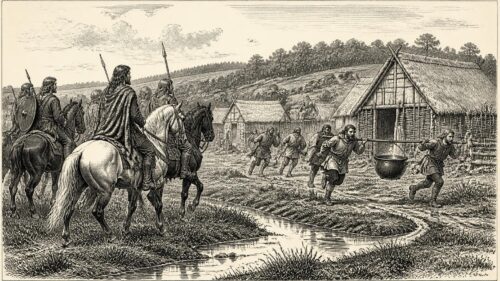
Further violence followed. Conn Ua Breisléin, chief of Fanad and praised as a model of hospitality and northern valour, was killed by men associated with Mac Lochlainn and Cenél nEógain. Inishowen was then ravaged even though, the annalists insisted, its people bore no guilt. Such retaliatory attacks commonly struck livestock, settlements and dependants beyond the immediate circle responsible for a killing. Political warfare was therefore experienced by ordinary communities as lost cattle, burned buildings, disrupted cultivation and forced movement.
Church, Memory and Learning
Religious institutions were deeply involved in these contests. Durrow’s community interpreted de Lacy’s death through the honour of Columcille, asserting that saints and their churches possessed rights which secular lords violated at their peril. Elsewhere, Derbfhorgaill, daughter of Murchad Ua Máelshechlainn and widow of Tigernán Ua Ruairc, is recorded making a pilgrimage to Drogheda. Remembered too often only in connection with her removal by Diarmait Mac Murchada in 1152, she was also an important aristocratic patron with long-standing links to Mellifont and Clonmacnoise. Her appearance in the annals in 1186 reveals pilgrimage and religious benefaction as fields in which a noblewoman could exercise public agency.
The period around 1186 also saw the production of Jocelin of Furness’s Life of Saint Patrick, commissioned through the shared interests of John de Courcy, Archbishop Tomaltach of Armagh and Bishop Malachy of Down. Its exact completion year is uncertain, and some scholarship places the commission before 1185, but the work belongs closely to this moment. It promoted Patrick, Armagh and Down while helping de Courcy present his northern lordship as the protector of established Irish sanctity. The text demonstrates that conquest involved patronage, historical writing and the cultivation of sacred legitimacy as well as warfare.
Work, Trade and Settlement
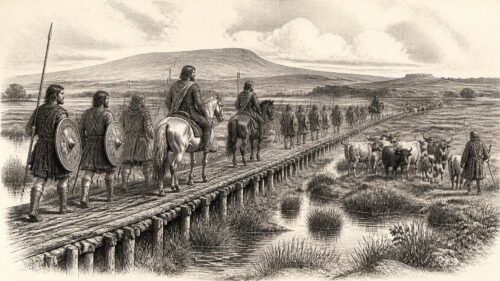
For most inhabitants, daily life continued to centre upon farming, kinship and local obligations. Cattle remained stores of wealth, sources of food and major units of payment, while grain cultivation was especially important in fertile districts and around towns or manorial estates. Warfare endangered both systems: raiders sought herds, and castle garrisons required food, fodder, timber and labour. The building at Durrow itself implies organised digging, carpentry, transport and provisioning involving far more people than the warriors named in chronicles.
Anglo-Norman settlement encouraged new estates, boroughs, markets and ecclesiastical foundations, but it did not erase existing communities. Dublin, Waterford, Wexford and Cork remained gateways for seaborne commerce, while Trim and the developing settlements along the Boyne connected fortified lordship with local exchange. Imported goods, coin and urban crafts circulated most strongly through these centres; much of rural Ireland still relied upon payments in livestock, produce and service. Gaelic and settler societies remained legally and linguistically distinct, yet their economies increasingly overlapped through trade, employment, tribute and war.
An Unfinished Conquest
The events of 1186 exposed the limits of every claim to supremacy. De Lacy’s castles could dominate landscapes but could not make him invulnerable. Conchobar Máenmaige could depose his father but still required dynastic consent and hostages. Northern kings could be inaugurated and removed by competing factions. Ireland was changing rapidly, yet no single authority controlled that change. The year is best understood not as a stage in an inevitable conquest, but as a moment when several forms of lordship—Gaelic, Anglo-Norman, royal and ecclesiastical—collided, cooperated and struggled to endure.
Source References
Hover over a number to see the source. Select it to open the source.

- [1] The Annals of Ulster — Year U1186
- [2] Annals of Loch Cé — Annals 1185–1186
- [3] Annals of the Four Masters — Annal M1186
- [4] Lacy, Hugh de (I) — Dictionary of Irish Biography
- [5] Ua Conchobair, Ruaidrí — Dictionary of Irish Biography
- [6] Ua Conchobair, Conchobar Máenmaige — Dictionary of Irish Biography
- [7] Courcy, John de — Dictionary of Irish Biography
- [8] Derbfhorgaill — Dictionary of Irish Biography
- [9] Ua Briain, Domnall Mór — Dictionary of Irish Biography
- [10] ‘Lord of the Foreigners of Ireland’: 1177–86
- [11] From Kingdom to Colony: Framing the English Conquest of Ireland
- [12] Durrow Abbey, County Offaly: Conservation Plan
- [13] Durrow Church and High Cross
- [14] Trim Castle
- [15] Medieval Ireland 1150–1550
- [16] 950–1450: Vikings, Normans and Medieval Mints
- [17] Mottes and Moated Sites
- [18] Discover the Walled Towns of Ireland
- [19] Brú na Bóinne World Heritage Site Research Framework
- [20] Derbforgaill: Twelfth-Century Abductee, Patron and Wife
- [21] Irish Ecclesiastical Politics and Anglo-Norman Sponsorship: The Patronage of the Vita S. Patricii
- [22] Hagiography at the Frontiers
- [23] People: Hugh de Lacy
- [24] St Laurence’s Gate, Drogheda
- [25] Gerald of Wales: The Conquest of Ireland
Primary Sources
- The Annals of Ulster — Year U1186
- Annals of Loch Cé — Annals 1185–1186
- Annals of the Four Masters — Annal M1186
- Lacy, Hugh de (I) — Dictionary of Irish Biography
- Ua Conchobair, Ruaidrí — Dictionary of Irish Biography
- Ua Conchobair, Conchobar Máenmaige — Dictionary of Irish Biography
- Courcy, John de — Dictionary of Irish Biography
- Derbfhorgaill — Dictionary of Irish Biography
- Ua Briain, Domnall Mór — Dictionary of Irish Biography
- ‘Lord of the Foreigners of Ireland’: 1177–86
- From Kingdom to Colony: Framing the English Conquest of Ireland
- Durrow Abbey, County Offaly: Conservation Plan
- Durrow Church and High Cross
- Trim Castle
- Medieval Ireland 1150–1550
- 950–1450: Vikings, Normans and Medieval Mints
- Mottes and Moated Sites
- Discover the Walled Towns of Ireland
- Brú na Bóinne World Heritage Site Research Framework
- Derbforgaill: Twelfth-Century Abductee, Patron and Wife
- Irish Ecclesiastical Politics and Anglo-Norman Sponsorship: The Patronage of the Vita S. Patricii
- Hagiography at the Frontiers
- People: Hugh de Lacy
- St Laurence’s Gate, Drogheda
- Gerald of Wales: The Conquest of Ireland