Dungannon Raid, Galway Fire1500 CE
In 1500, Ireland experienced local conflicts, disasters and environmental hardship rather than a single national crisis. Aodh Ruadh Ó Domhnaill raided Tír Eógain, burning Dungannon and its strongholds, while Kildare’s intervention in Ó Néill territory proved temporary. Succession changed Breifne’s rulership, and killings, livestock raids and castle-building marked Fermanagh. Galway was largely destroyed by fire, threatening an important trading port. In Munster, the Barry family feud brought murder and posthumous punishment, while John Maguire executed a notorious horse thief. Prolonged wet weather damaged wheat. The death of Derry’s Franciscan bishop also reflected active religious networks across fragmented but connected lordships.

Dateline
The surviving record for 1500 does not offer a single, island-wide drama. Instead, it preserves a sequence of local shocks: a succession disputed in Breifne, killings and castle-building around Fermanagh, a destructive incursion into Tír Eógain, a major fire in Galway, violence among Munster magnates, and a season of exceptional wetness that damaged wheat. Taken together, these firmly dated annalistic notices show an Ireland governed through many competing lordships and jurisdictions, where political authority depended on kinship, military followings, fortified places, cattle and horses, and the capacity to protect cultivation.
A Year Recorded from Ulster
The principal contemporary-style narrative source for the year is the Annals of Ulster. Its entries are especially rich for the north and north-west, and should not be mistaken for a complete census of Irish affairs. They favour elites, warfare, ecclesiastics and unusual events. Yet their very selectiveness is revealing. In 1500, the chronicler recorded not an abstract struggle between ‘English’ and ‘Irish’ Ireland, but clashes among the Ó Néills, Ó Domhnaills, Maguires and other lordly families, alongside the intervention of Gerald FitzGerald, eighth earl of Kildare and the king’s deputy.
This was still the Lordship of Ireland, held by Henry VII of England rather than a separate Tudor kingdom of Ireland. The Dublin administration’s dependable reach was greatest in and around the Pale, but Kildare’s power rested on far more than formal office. His landed strength, alliances and military reputation allowed him to intervene well beyond the Pale. Conversely, Gaelic and Gaelicised lordships retained substantial autonomy, fielded their own forces, negotiated shifting relationships, and maintained political centres marked by castles, crannógs, churches and client settlements.
Dungannon Laid Waste
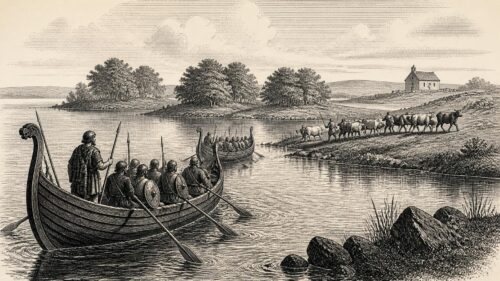
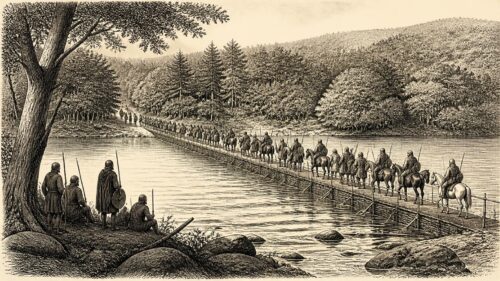
The most conspicuous campaign assigned to 1500 was an expedition by Aodh Ruadh Ó Domhnaill, lord of Tír Chonaill. The annals state that he entered Tír Eógain, burned the Ó Néill town of Dungannon, demolished the Old Castle, burned the crannóg on Lough Laoghaire, and returned safely home. The wording is precise about the destruction but gives no day or season, nor does it explain the immediate provocation. It nevertheless demonstrates that Dungannon was already a political centre worth attacking and that strongpoints in the landscape were deliberate targets.
Aodh Ruadh was an elderly but formidable ruler whose lordship in north-west Ulster had been shaped by prolonged dynastic rivalry. His 1500 raid belongs to that wider contest for influence between Tír Chonaill and Tír Eógain. It should not be read as the fall of Dungannon or the permanent conquest of Tyrone: the annal records a successful strike, not a lasting occupation. Burning a lord’s settlement, castle and lake dwelling was a powerful assertion of reach. It endangered stores, buildings, dependants and prestige while challenging an opponent’s ability to defend his own heartland.
Another entry shows Kildare acting within the same unstable world. The justiciar took Cennard Castle, a stronghold of the sons of John ‘the Tawny’ Ó Néill, and handed it to Toirdelbach, son of Conn Ó Néill. Within a short time, Domnall Ó Néill captured Toirdelbach in the Ó Néill castle itself, seized his cattle, and, according to the annalist, a great war arose in Ulster. The episode is a useful corrective to any simple map of power. Kildare could take and redistribute a castle, but the settlement did not endure merely because the deputy had imposed it. Local competitors could reverse it rapidly.
Breifne and Fermanagh
Succession was equally unsettled in Breifne. Feidhlimidh Ó Ruairc died in 1500, and Eóghan, son of Tighernan Ó Ruairc, was made king in his place. The annal’s language of being ‘made king’ reflects a Gaelic political order in which lordship was not simply automatic inheritance. Eligibility rested in a ruling kindred, but acceptance required the support and force to prevail. A death could therefore become an opening for negotiation, rivalry or violence, even when the chronicler records the outcome tersely.
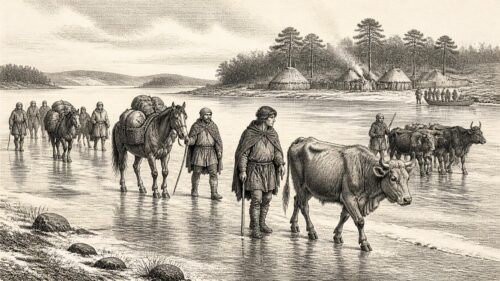
In the Maguire lordship of Fermanagh, the year brought repeated killings among rival branches and neighbours. Feradhach Maguire and Brian Maguire were slain by the sons of Conn Ó Néill at Bél Átha na Marcach; other Maguires and Mac Gilla Ruaidh men died in raids and reprisals. One notice even counts five or six good horses carried away after an attack. Such details matter. Horses were valuable military and economic assets, while cattle seizures supplied food, wealth and a means of humiliating opponents. Raiding was not peripheral disorder but one of the ways lordship was contested and resources redistributed.
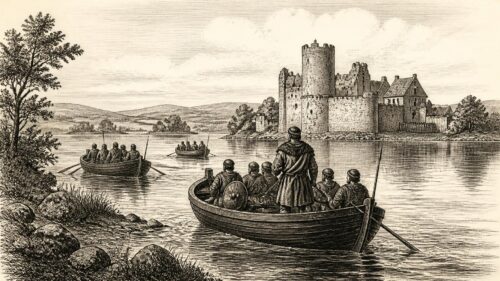
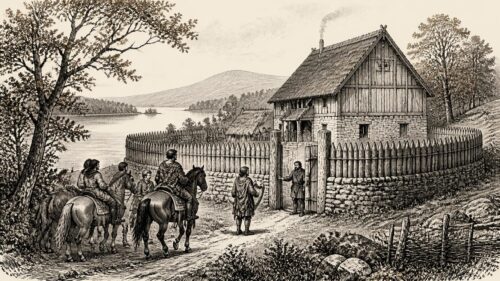
Amid this violence, Philip Maguire began a castle on the Rock of Lough an Tarbh in his own territory. The annals do not tell us whether work was completed that year, but the decision to begin it is securely dated. A new castle was both a defensive investment and a claim made visible in stone: a base for a household and garrison, a place for storing goods, and a statement that its builder expected to exercise authority over surrounding land and routes.
Fire in a Trading Town
The annalist also records that Galway was burned ‘for the greater part’ in 1500. No cause, date, casualty figure or named quarter survives in this notice, so none should be supplied. Still, the scale of the wording makes it one of the year’s most consequential urban events. Galway was a walled port and a chartered town whose merchants connected western Ireland with Atlantic and Irish Sea commerce. A large fire in a timber-rich town threatened houses, warehouses, workshops, food stocks and trading capital, as well as the municipal routines of the burgesses.
The entry is a reminder that Ireland’s economic life was not confined to cattle country or lordly exactions. Ports and towns were places of markets, craft production, shipping, credit and exchange. They were also exceptionally vulnerable to accidental fire. Galway’s rebuilding cannot be dated from this single notice, but its continued importance in regional trade indicates that the town endured. The annal gives us the disaster; later history warns against treating it as an ending.
Munster Feud and Public Punishment
In Munster, the annals describe a brutal dispute within the Barry family. The Barrymore was killed by his brother David Barry, archdeacon of Cloyne and Cork. David himself was then slain by Thomas Barry and the Callaghan people. Twenty days later, the earl of Desmond had David’s body disinterred and reduced to ashes. The account is unusually stark, but it does not provide the motives or legal proceedings behind these acts. What it does show is that ecclesiastical office did not remove a member of a powerful lineage from secular conflict, and that a great lord could make punishment extend beyond death.
Justice also appears in a very different register in Fermanagh. During Lent, John Maguire hanged Máel Sechlainn Ó Flannagáin, described as a thief. The condemned man reportedly acknowledged stealing thirty-five horses from clergy and laity that had not been recovered or claimed, apart from other livestock. The annal’s total is probably meant to underline the offender’s notoriety, but it also illuminates everyday insecurity. Clerical households, lay households, herds and stables all stood within a world where livestock theft was sufficiently serious to invite exemplary punishment.
Weather, Wheat and Religious Life
The environmental entry for the year is unusually clear. From the Feast of the Cross in Harvest, 14 September 1500, until after St Patrick’s Day, 17 March 1501, wet weather and severe inclemency continued, damaging husbandry, especially wheat. The long spell crossed into the following calendar year, but began in 1500 and is placed by the annals under that year. For cultivators, prolonged rain could impede ploughing and sowing, flatten or rot grain, and make roads, fords and transport more difficult. The source does not quantify hunger or mortality, so it cannot responsibly be turned into a general famine. It does, however, preserve direct evidence that weather damaged a staple crop and intensified the pressures faced by rural households.
Religion remained central to this society, not an isolated sphere. Domnall Ua Fallamhain, bishop of Derry, died in 1500. The annals identify him as a Franciscan friar of the Strict Observance and praise three decades of labour in preaching across Ireland. That description places his death within the energetic late-medieval reform currents of the Franciscan order. Observant friars emphasised a stricter interpretation of their rule, while preaching connected churches and friaries with lay communities across political boundaries. The entry offers firm evidence for one preacher’s reputation, though not a complete measure of religious practice throughout the island.
A Fragmented but Connected Island
These entries make 1500 appear fragmented, but fragmentation did not mean isolation. Kildare’s intervention at Cennard, Ó Domhnaill’s raid on Dungannon, and the crisis in Galway all reveal links between regional politics, fortified landscapes and commercial centres. Irish was the dominant vernacular across much of the countryside and among many lordly households, while English had a stronger institutional position in towns and the Dublin administration. Learned clerics and hereditary scholarly families sustained written culture, and the annals themselves are evidence of that labour.
The year’s most secure conclusion is therefore modest. Ireland in 1500 was not waiting passively for a later Tudor transformation. Its communities were already responding to local succession crises, raids, public punishments, urban disaster and damaging weather. Great lords could launch destructive campaigns and build castles; a deputy could seize a fortress but not guarantee a settlement; a town could burn while remaining part of an Atlantic-facing economy. In these tightly dated notices, political power, material survival and the natural world repeatedly meet.
Primary Sources
- The Annals of Ulster: Year U1500
- The Annals of Ulster
- Annals of the Kingdom of Ireland
- Annals of the Four Masters, Volume 5: English Translation
- Annales Breves Hiberniae
- FitzGerald, Gerald (Gearóid Mór)
- O'Donnell (Ó Domhnaill), Aodh Ruadh
- O'Neill (Ó Néill), Conn ‘Bacach’
- FitzGerald, Gerald (Gearóid Óg, Garrett McAlison)
- O'Donnell (Ó Domhnaill), Sir Aodh Dubh
- Tudor Policy and the Kildare Ascendancy in the Lordship of Ireland, 1496–1534
- English Lordship of Ireland and the Irish Sea World: Re-assessing the Origins of the Kildare Ascendancy, c.1390–c.1513
- The Rise and Fall of the Clann Éinrí Aimhréidh Uí Néill: Dynastic Feuding and Geopolitics in the Late Medieval Irish Sea World
- Richard II and the Wider Gaelic World: A Reassessment
- The Legacy of History: Women and the Ownership of Land in Ireland
- Food and Power in Sixteenth-Century Ireland: Studying Household Accounts from Dublin Castle
- Decline and Revival
- A History of the Franciscan Order in Ireland
- The Franciscans in Medieval Ireland: Sources / Introduction
- Mendicant Orders and Vernacular Irish Learning in the Late Medieval Period