

O’Donnell’s Long Circuit1475 CE
In 1475, Aodh Ruadh O’Donnell of Tír Chonaill led a major circuit through Breifne, Meath, Offaly and Connacht, combining armed pressure, alliance-building and peace-making. His host aided Brian O’Reilly, O’Farrell allies and Connacht friends, devastated parts of Meath, burned Delvin, and crossed the Shannon using local boats. Elsewhere, Réamonn MacMahon was defeated and captured in Oriel, while Henry O’Neill raided Fermanagh. Disputed successions in Annaly, castle transfers in Clanricard, and local battles revealed unstable lordship. Deaths of clerics, rulers and learned men, alongside monastic burials and literary remembrance, illustrate a politically connected, violent yet culturally resilient Ireland in the period.
Dateline
In 1475 the most conspicuous movement in Irish politics was a long military and diplomatic circuit led by Aodh Ruadh O’Donnell, lord of Tír Chonaill. The annals place his progress firmly in this year, though they differ in emphasis and in the precise order of some stages. What is clear is that O’Donnell travelled with a substantial host from the north-west through Breifne, Meath, Offaly and Connacht, resolving disputes where it suited him, fighting where agreement failed, and returning home with his standing enhanced. His expedition offers an unusually vivid view of a late-medieval Ireland governed not from one centre but through overlapping lordships, alliances, tributary claims and negotiated peace.
A Circuit of Power
The immediate object of O’Donnell’s march was the affair of Brian, son of Feidhlimidh O’Reilly. The Annals of Ulster say that O’Donnell moved to rescue Brian from the O’Reillys; the Annals of the Four Masters describe him as O’Donnell’s friend and confederate. At Bel-atha-Chonaill, the later Ballyconnell area, O’Donnell made peace with the O’Reilly lord. This was not merely a settlement between neighbours. East Breifne lay on the dangerous meeting ground of Ulster, the Irish midlands and the English lordship around Meath. A leading Tír Chonaill ruler able to intervene there demonstrated reach well beyond Donegal.
O’Donnell then assisted allies among the O’Farrells of Annaly. The Connacht annalist traces the force through Fenagh, past Sliabh Cairbre, Mag Tethba and Moybrawne, where the column camped at Cuircne in Meath. The detail matters. Armies did not simply appear at named battlefields: they travelled along known routes, stopped overnight, drew in local supporters and depended upon food, forage and intelligence. During this stage, the abbot of Abbeylara was killed by an arrow in the followers’ train near Rathreagh. The incident is a sobering reminder that a lordly hosting endangered clerics, dependants and travellers as well as armed men.
At Cuircne, the Dillons and Daltons made peace with O’Donnell. He proceeded into Offaly and Cairbre in Leinster, where O’Conor Faly came to meet him. Meath forces opposed the advance and fighting brought destruction to the surrounding lands, before another peace was arranged. The Annals of Ulster add that much of Meath was devastated and that the castle-town of Delvin was burned. They present this as vengeance for O’Donnell’s father, Niall Garbh, who had earlier fallen in conflict with the ‘Foreigners’—the annalists’ term in this setting for the Anglo-Irish and English settlers of the lordship. O’Donnell’s route was therefore both practical politics and a public assertion of inherited grievance.
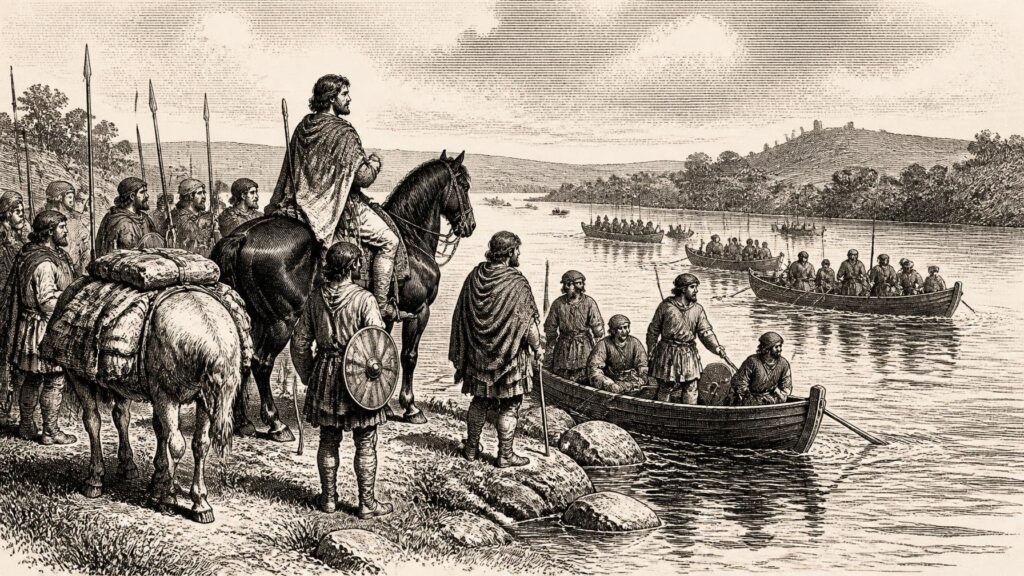
The hosting did not end at the midlands frontier. O’Donnell went south and west to support friends in Uí Maine, Clannricard and Connacht before turning north. The Four Masters state that O’Kelly men gathered local vessels so that the army could cross the Shannon into Hy-Many, then rest and recover after its long journey. This is one of the year’s best glimpses of military logistics. Rivers could hinder or protect, but boats commandeered or assembled from the neighbourhood could transform them into routes of movement. O’Donnell had begun with a dispute in Breifne and finished by displaying influence across a broad arc of the island.
Peace Made and Lands Damaged
It would be misleading to call the expedition a national campaign. O’Donnell’s authority rested on personal lordship, kinship and alliances, not on a single Irish state. Yet the year shows why contemporaries treated major rulers as more than local chiefs. He made peace between O’Rourke and O’Reilly, received submissions or agreements from magnates in Meath, confronted the English of the lordship, and assisted Connacht allies. His capacity to move across so many jurisdictions depended on consent as well as force. Peace-making was not the opposite of war; it was one of the outcomes that a credible army could secure.
For communities in the path of the host, the consequences were immediate. Annalists commonly record that ‘lands were destroyed’, a compressed phrase which may encompass burned crops or stores, seized cattle, damaged dwellings and the disruption of cultivation. Such warfare was normally directed at resources and obedience rather than at holding every piece of ground permanently. A force carrying men, horses and followers had to be supplied; meanwhile, ravaging an opponent’s country imposed a cost on resistance. The agreements that concluded O’Donnell’s advance probably mattered as much to local households as the fighting, because they determined whether further raiding might follow.
Oriel’s Captured King
Another decisive conflict occurred in Oriel, broadly the region of modern County Monaghan and neighbouring districts. Réamonn Mac Mathghamhna, or MacMahon, faced the sons of Aodh Ruadh MacMahon in a struggle for the kingship. The sons of Aodh Ruadh entered Fearnmhagh, while a force described as English or ‘Foreign’ came to their assistance. Réamonn moved against them but was overtaken by the combined force of his dynastic rivals and the men of Machaire Oirghialla. He was defeated, captured with his kinsman Brian, and many of his followers were killed or taken.
This was a major reversal in MacMahon politics. Modern biographical scholarship identifies Aodh Óg MacMahon as the rising challenger who, with Anglo-Irish allies, defeated and delivered Réamonn into colonial custody. The result did not instantly settle Oriel: dynastic competitors remained powerful, and Réamonn’s descendants continued to contest the position. But the capture removed a reigning lord from the field and showed how easily a succession quarrel could draw in neighbouring communities and Anglo-Irish military support. The boundary between ‘Gaelic’ and ‘English’ Ireland was thus neither fixed nor simple. Local rulers could seek assistance across it when doing so advanced a family claim.
Conflict also reached Fermanagh. Henry O’Neill, lord of Tír Eógain, led a hosting there and burned the house of Toirdelbach, son of Philip Maguire, at Srathferlure near the River Arney. The event was a targeted raid rather than evidence of a complete conquest of Fermanagh. Nevertheless, it speaks to continuing competition among the O’Neills, Maguires and their neighbours for security, prestige and leverage in the north. The same annal records the death of Aodh O’Neill, a notable lord of the Fews in south Armagh, praised for learning, hospitality and leadership. His death removed an experienced figure from a particularly contested borderland.
Succession, Castle and Household
The year’s annals repeatedly return to the uncertainty of succession. At Granard, Seaán O’Farrell, chief of Annaly, died after celebrating the feast associated with assuming the chieftainship but before enjoying its benefits. Another claimant died at what the annalist called the threshold of lordship, and Ruaidhrí O’Farrell was proclaimed in opposition to Seaán’s descendants. The language is revealing: lordship was publicly made through inauguration, feasting, recognition by leading men and the ability to protect a following. It was never guaranteed solely by direct descent.
In Connacht, MacWilliam of Clanricard took Callow Castle and handed it to a son of Maelsechlainn O’Kelly, who was also MacWilliam’s grandson through his daughter. The brief notice records a concrete transfer of a fortified place, but also the importance of marriage in political geography. Castles could be captured in war and assigned through family connection; control of them provided a base for levies, protection, storage and local command. Elsewhere, a night battle in which Eogan Caech O’Conor defeated Clanconway killed more than forty men, including members of prominent families. Such episodes underline the human cost concealed behind the larger movements of famous rulers.
Learning, Religion and Memory
1475 was not recorded only through war. Donnchadh Mac Suibhne, prior of Derrane, died, while Seaán O’Farrell was buried at the monastery of Abbeylara. Religious houses remained places of worship, burial, learning and regional memory, woven into the political world around them. Their clergy could be exposed to violence, as the death of Abbeylara’s abbot during O’Donnell’s march demonstrates, but monasteries also offered status and commemoration to ruling families.
The death of Cormac Ó Cuirnín, called ‘teacher of the learned of Ireland’, was a notable loss to the professional learned culture sustained by Gaelic and Anglo-Irish patrons. The annals also note Gilla na Naem Ó hUiginn, a member of a celebrated learned family. These notices should not be treated as proof of a school session or a particular manuscript produced in 1475. They do, however, firmly show that poets, historians, teachers and hereditary learned lineages were sufficiently important for their deaths to be remembered alongside those of kings and warriors. In the same year Ruaidhrí Mag Carmaic, a composer of óglachas, or martial verse, died in May. Literary skill and political life were closely connected: poetry preserved reputations, articulated obligations and judged conduct.
The year closes, therefore, not with a single island-wide turning point but with evidence of a politically connected, often violent and culturally confident Ireland. O’Donnell’s circuit bound distant districts together through force and negotiation. Oriel’s crisis altered a dynastic balance. Raids, deaths and disputed accessions exposed the precariousness of local rule. Yet monasteries, learned families, inauguration feasts, boats on the Shannon and castles passed through marriage all reveal the institutions and habits that made society endure amid conflict.
Primary Sources
- The Annals of Ulster: Year U1475
- Annála Connacht: Annal 1475
- Annals of the Four Masters: Annal M1475
- Annals of the Four Masters, Volume 4: English Translation
- The Annals of Ulster: CELT Project Edition
- Annála Connacht: CELT Project Edition
- O'Donnell (Ó Domhnaill), Aodh Ruadh
- O'Neill (Ó Néill), Aodh
- MacMahon (Mac Mathghamhna), Réamonn
- MacMahon (Mac Mathghamhna), Aodh Ruadh
- O'Kelly (Ó Ceallaigh), Aodh
- O'Rourke (Ó Ruairc), Donnchadh
- O'Reilly (Ó Raghallaigh), Eóghan
- O'Connor (Ó Conchobhair), Ruaidhrí
- O'Neill (Ó Néill), Conn
- O'Neill (Ó Néill), Aodh Buidhe
- O'Donnell (Ó Domhnaill), Sir Aodh Dubh
- Nugent, Richard
- The Later Middle Ages
- James IV, the O’Donnells of Tyrconnell and the Road to Flodden
- List of Published Texts at CELT