

Finola’s Donegal Friary1474 CE
In 1474, Aodh Ruadh Ó Domhnaill and his wife Finola Ó Briain began Donegal’s Franciscan friary, intended as a dynastic mausoleum and declaration of Ó Domhnaill power. Its dating remains uncertain within 1472–74, but annals associate its foundation with 1474. Elsewhere, Ireland remained politically fragmented: Ó Domhnaill fought Ó Neill and Clann Aodha Buidhe; succession, raiding and castle destruction destabilised the midlands; and failed negotiations produced warfare in Connacht and Thomond. Dublin officials feared Scottish intervention. Deaths of bishops and hereditary scholars underline religion’s cultural role. The friary endured as a religious institution amid violence, dynastic competition and weak authority.
Dateline
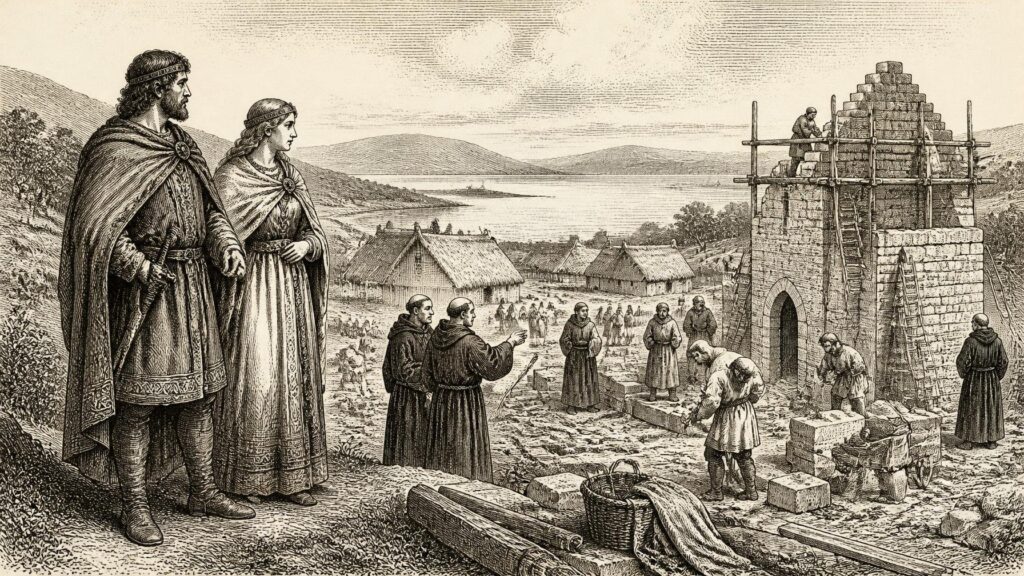
For Ireland, 1474 is remembered above all for a building begun at the mouth of the River Eske: the Franciscan friary of Donegal. The entry in the Annals of the Four Masters is unusually direct. It says that Aodh Ruadh Ó Domhnaill, lord of Tír Chonaill, and his wife Fionnghuala or Finola, daughter of Conor na Srón Ó Briain, commenced the monastery and granted it to God and the friars of St Francis. They intended it to serve both their souls and their descendants, as a dynastic burial place, and added further gifts.
That record gives the year a focal point, but 1474 was not a quiet year gathered around a single religious foundation. Across the island, annalists registered contested successions, predatory expeditions, broken negotiations, local war and the deaths of churchmen, poets and learned officials. The pattern is important: Ireland was not governed as one political unit. The English crown’s administration was strongest in and around Dublin, while Gaelic and Gaelicised lordships exercised power through their own dynasties, alliances, client networks and armed followings.
A Friary at the Lordship’s Centre
The Donegal foundation was an act of devotion, commemoration and politics at once. A new Observant Franciscan house close to the Ó Domhnaill lordship’s principal settlement gave its patrons a place of prayer and burial, but also displayed their capacity to command land, labour, materials and ecclesiastical connections. Its intended future as an Ó Domhnaill mausoleum made the project explicitly hereditary. Such patronage was a public declaration that a ruling family expected its authority to endure beyond an individual lord’s lifetime.
The precise building chronology deserves care. The Four Masters, compiled in the seventeenth century from earlier materials, place the commencement in 1474. Other evidence cited by modern researchers has suggested that construction may have begun in 1473, or perhaps around 1472–74. It is therefore safest to say that the friary was being founded or begun in this narrow period, while recognising that the annalistic entry firmly associates it with 1474. It should not be imagined as a fully completed complex appearing in one season: a friary required sustained construction, endowment and the arrival and maintenance of a religious community.
Finola’s role matters. The annal names husband and wife jointly, rather than leaving her as an unnamed consort. Later Franciscan tradition gave her a particularly active role in securing friars for Donegal. That tradition cannot securely be dated to 1474 itself, but the annal’s wording establishes that she was a co-founder in the historical memory of the foundation. Her marriage also connected the Ó Domhnaills of north-west Ulster with the Ó Briains of Thomond, a major dynasty across the island’s western seaboard.
The location bound religious life to an expanding regional power. Aodh Ruadh had rebuilt Ó Domhnaill strength in Tír Chonaill after taking power in 1461. By 1474, broader evidence indicates that he had made peace with the Ó Briains, while the annals record his continuing rivalry with the Ó Neills. The friary was thus established not in a secluded world apart from politics, but beside a lordship active in the military and diplomatic affairs of Ulster, Connacht and the Irish Sea.
War Across Ulster
The year’s annals make clear that the new friary did not signal peace in the north. The Four Masters report major depredations by Ó Domhnaill against the people of Hugh Ballach Ó Néill. In retaliation, forces associated with the Ó Neills marched into Tír Chonaill, burned Tírhugh and returned home unharmed. Annála Connacht similarly compresses the situation into “a great war” between Ó Néill, Ó Domhnaill and Clann Aodha Buidhe, saying that the parties inflicted considerable damage upon one another.
“Depredations” and “preys” were not minor incidents of rural theft. They usually meant organised raids intended to seize cattle, foodstuffs and movable wealth, impose punishment, weaken rivals and demonstrate a lord’s ability to protect or reward followers. Burning a district struck homes, stores and the productive resources on which tenants, dependants and soldiers relied. The sources do not permit a reconstruction of every farm or casualty, but they leave little doubt that ordinary communities bore the immediate cost of elite conflict.
Across the North Channel, Scottish politics added another anxiety. A report sent from the Irish council to Westminster in 1474 warned that James III of Scotland supposedly intended to bring the whole land into obedience to the Scottish king. No Scottish conquest followed, and the wording reflects alarm as much as reliable intelligence. Yet the warning is revealing. It shows Dublin officials saw Gaelic lordships, Scottish sea power and the weakened reach of English government as parts of one strategic problem. The north-western Ó Domhnaill lordship was particularly significant in that Irish Sea setting.
Succession and Destruction in the Midlands
In the autumn, Conn Ó Conchobair Fáilghe died and his son Cahir was inaugurated in his place. This was a firmly dated succession within the year, and it mattered well beyond one family. The Ó Conchobair Fáilghe lordship lay in the midlands, between the English Pale and powerful Gaelic neighbours. Inauguration did not work like automatic hereditary succession under modern rules: a claimant needed acceptance among the ruling lineage and the military capacity to sustain his position.
Violence quickly accompanied the regional struggle. Cú Choicriche Mac Eochagáin, lord of Cenél Fiachach, was killed by Aodh Mac Eochagáin. The annals then say that Ó Conchobair Fáilghe ravaged the country, destroyed Newtown Castle and banished the descendants of Fergal Ruadh. A castle’s demolition was a calculated political act. It removed a rival’s defensible base, advertised dominance and altered the security of everyone who depended upon the defeated lineage. The episode also cautions against viewing Gaelic Ireland as a landscape without castles: masonry or defended residences were integral to power on both sides of the Pale’s shifting frontier.
Further north-east, John Ó Fearghail assumed the chieftainship of Annaly in preference to his blind brother. The wording is blunt evidence that bodily capacity could be judged politically relevant in selecting a lord. In Meath, Edward Plunket, described by Annála Connacht as the best of the Meath English, died. Together these notices show a region where Gaelic and English-descended families were not separated into isolated worlds. They competed, allied and negotiated in a densely contested middle ground.
Broken Peace in Connacht and Thomond
Connacht’s annals provide one of the year’s clearest examples of diplomacy collapsing into war. A meeting was arranged between Félim Ó Conchobair Donn and Ó Ceallaigh. Instead of settlement, the gathering broke up and battle followed. Ó Conchobair was defeated and wounded; his son Eoghan Caech was captured; prominent Mac Suibhne fighters were killed or taken; and the gallowglasses serving the defeated side were destroyed, slain or captured. Ó Conchobair later died of his wounds, after which Donnchadh Dubhshúileach and Tadhg, son of Eoghan, were both proclaimed lords.
The episode demonstrates why meetings and truces were dangerous but necessary. They were opportunities to settle claims, exchange assurances or display relative strength; they could also become occasions for ambush, argument or a decisive test of armed support. The prominence of gallowglasses, heavily armed professional soldiers of Gaelic-Norse background or descent, points to the military resources that magnates could retain. Their loss was more serious than a fleeting battlefield reverse, reducing a lord’s ability to enforce future claims.
Moylurg, in modern County Roscommon, suffered a “terrible war” that the annals say ruined the country. Mac Diarmata brought in Mac William Burke, who ravaged it again before the parties separated without peace. In Thomond, a quarrel over land between Tadhg, son of Conor Ó Briain, and Dermot, son of Bishop Ó Briain, ended in Tadhg’s death and Dermot’s subsequent hanging. This was a family dispute, but it was also a reminder that ecclesiastical kinship did not put men outside secular rivalries over land and lordship.
Church, Learning and Memory
Religion in 1474 was therefore inseparable from power, yet it also sustained institutions of prayer, education and remembrance. The death of Nicholas, bishop of Derry, is recorded alongside the Donegal foundation. At the same time, the deaths of Gilla Finn Mac Aodhagáin, ollamh to Ó Conchobair Fáilghe, and Tomás Ó Cobhthaigh, together with that of Cairbre Ó Dálaigh of Meath, register losses within hereditary learned families. An ollamh was a master or professional scholar, a title associated with disciplines including law, history and poetry. These notices show that lordship rested not solely on fighting men but also on specialists who preserved legal knowledge, genealogy, praise poetry and political memory.
The evidence does not justify claims of a nationwide harvest crisis, epidemic or environmental disaster in 1474; the surviving Irish annals do not record one for this year. What they do show is a society repeatedly shaped by local warfare and by the movement of armed companies. Against that background, the beginning of Donegal friary acquires added force. It was an investment in a permanent religious and cultural institution amid political conditions that were often anything but permanent.
By the end of the year, Ireland had not moved towards a unified peace or a single government. Instead, 1474 left a revealing combination of realities: a Franciscan foundation intended to outlive its patrons; regional lordships reinforced or unsettled by succession; territories burned in warfare; and a Dublin administration worried by forces beyond its reach. Finola and Aodh Ruadh’s friary was the year’s most durable undertaking, but it was built in an Ireland where devotion, dynastic ambition and conflict were closely intertwined.
Primary Sources
- Annals of the Four Masters, Annal 1474 (English translation)
- Annals of the Four Masters, Annal 1474 (Irish text)
- Annála Connacht, Annal 1474
- Annála Connacht: edition information
- James IV, the O’Donnells of Tyrconnell and the road to Flodden
- An Irish context to a Scottish disaster: James IV, the O’Donnells of Tyrconnell and the road to Flodden
- Donegal Franciscan Friary
- Ross Errilly Franciscan Friary
- The Friary of Ross — Foundation and Early Years
- The Diamond, Donegal Co. Donegal: Archaeological Impact Assessment
- Donegal Castle Highlights
- Rory and Cathbharr O’Donnell
- The friars and friary of Donegal, 1474–1840
- Statute Rolls of the Irish Parliament: Edward IV, 1472–1473
- Statute Law Revision Act 2007
- The Reduction of Leinster and the Origins of the Tudor Conquest of Ireland, c.1534–46
- The Fitzgeralds of Kildare and Desmond, c.1390–c.1534
- Tomás Ó Cobhthaigh
- Donegal Franciscan Friary: local history and foundation summary
- Donegal Friary, 1474–1974
- Donegal Franciscan Friary: heritage study
- Beatha Aodha Ruaidh Uí Dhomhnaill
- Beatha Aodha Ruaidh Uí Dhomhnaill: project bibliography and edition details
- National Archives reference C 47/10/29: Irish council report cited in scholarship