Public Streets
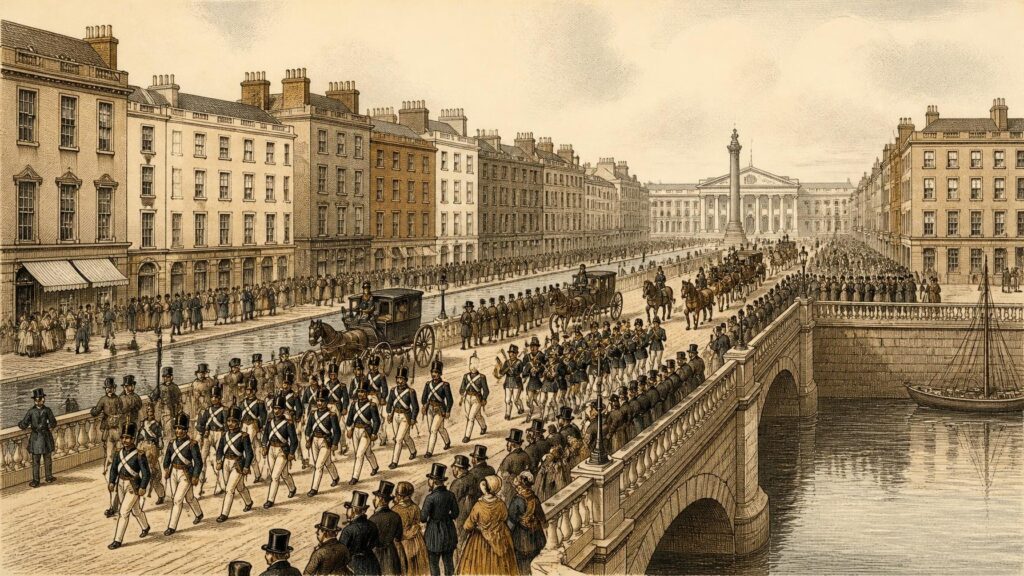
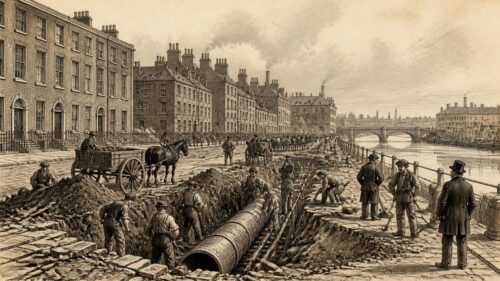
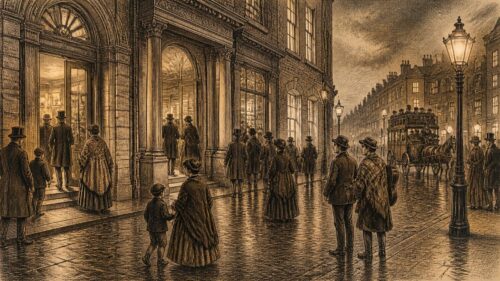
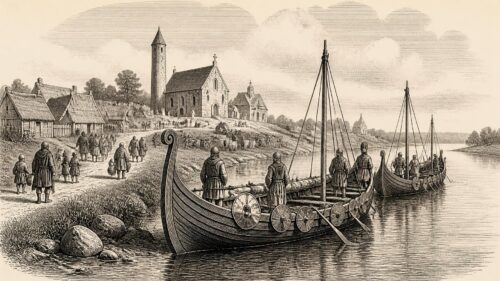
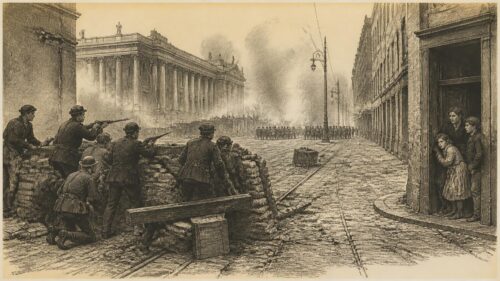
AI generated historical illustration, not a contemporary photograph.
At a Glance
Dublin’s parade culture is a history of people making meanings in public space. Processions have carried saints’ images, civic dignitaries, soldiers, trade emblems, political banners, festival floats and demands for equal rights through the same streets. They have been devotional acts, entertainments, assertions of authority and occasions of confrontation. The evidence shows no single, uninterrupted ‘Dublin parade tradition’; rather, successive groups repeatedly adapted the city’s streets, squares and bridges to demonstrate who belonged, what should be remembered and what kind of Ireland ought to be visible.
Ritual Routes
The word ‘parade’ can misleadingly suggest a uniform modern spectacle: a planned route, barriers, bands, floats, stewards and a passive crowd. Dublin’s historical evidence points instead to a much broader family of public movements. Religious processions, military reviews, coronation celebrations, guild displays, political demonstrations, funerals, commemorative marches and commercial festivals each had different organisers and purposes. What they shared was a movement through visible civic space. A procession did not merely travel from one place to another. Its route joined places of authority—churches, barracks, Dublin Castle, the General Post Office, College Green, the river crossings and later civic offices—to an audience of householders, workers, visitors and onlookers.
The earliest specific Dublin example commonly cited by historians is a Corpus Christi procession recorded in 1498. Neil Jarman’s survey of Irish parading culture uses that report cautiously: it is the earliest surviving report, not proof that public religious processions began in that year. This distinction matters. Medieval Dublin was a walled, ecclesiastical and commercial town in which liturgical calendars, guild life and civic authority were closely entangled. A surviving reference offers documentary evidence for one occasion, whereas assumptions about an unbroken popular custom before and after it remain interpretation. It is safer to say that late medieval Dublin possessed the institutional and devotional settings in which formal processions could occur, and that the 1498 reference demonstrates their recorded presence.
Religious processions established several enduring features of parade culture. They made a route sacred or symbolically charged; they ordered participants by office, age, gender, craft or religious role; they used sound, colour, vesture and emblem; and they invited spectatorship. Yet the relationship between marcher and watcher was not fixed. Spectators might pray, cheer, mock, withdraw, obstruct or simply observe. The street therefore became a contested medium even when an event was presented as devotional. Later political parades would inherit this grammar: banners replaced or accompanied religious images, bands supplied an amplified public sound, and the chosen route became an argument about access, ownership and legitimacy.
Dublin’s physical form gave such arguments particular force. The city was both a port and a seat of government, and its expansion beyond medieval limits produced new ceremonial corridors. College Green, Dame Street, the approaches to Dublin Castle and, later, Sackville Street—renamed O’Connell Street—were not neutral scenery. They connected institutions of political authority, commerce and transport. A procession passing through them made itself difficult to ignore. The broadening and remodelling of central streets in the eighteenth and nineteenth centuries also created vistas suitable for military display and large crowds, while bridges made the River Liffey a line to be crossed, watched from, or used to divide a route.
Ascendancy Display
In eighteenth-century Dublin, processional culture was inseparable from the constitutional order of the Protestant Ascendancy. Public ceremony expressed power not only through declarations and laws but through bodies arranged in space: troops, civic corporations, officials, clergy and elite spectators. Williamite commemoration was especially important. The equestrian statue of William III in College Green, erected in 1701, became a focal point for official and popular observance. Scholarship on Orange ritual notes that early Dublin commemorations of William’s birthday were shaped by military and state control, with Anglican gentlemen, corporations and companies prominent in the formal observance. This was display as hierarchy: the dignified procession did not simply honour a monarch; it represented a political order that claimed to embody civil and religious liberty while excluding much of the population from full power.
The familiar contrast between elite ceremony and ‘the crowd’ should not, however, be made too neat. Crowds supplied noise, attention and sometimes disorder; bonfires, drinking, fireworks and street gatherings could turn an official commemoration into something less manageable. The public character of a parade meant that authorities could not wholly determine its meaning. A royal or Williamite anniversary might be intended as a demonstration of loyalty, but it could be received as a provocation by those outside the governing political culture. In this sense Dublin’s parade history already contained the tension that would become more explicit in the nineteenth century: organisers treated the street as a venue for legitimate memory, while opponents could experience the same display as an assertion of dominance.
St Patrick’s Day offers a useful corrective to later assumptions about Irish national celebration. The saint’s feast had long religious significance, and 17 March was recognised as a Christian feast day in the early seventeenth century. But the modern civic street parade is not an ancient Irish survival. Dublin Castle’s account of a St Patrick’s Day fancy ball in 1789 demonstrates that elite celebration could take forms quite unlike a modern public march. Likewise, the National Gallery of Ireland’s material on eighteenth- and nineteenth-century Irish art shows that the date was represented within social and visual culture, rather than proving that a large annual Dublin parade already existed. The distinction is crucial: a feast day, a ball, a church observance and a public parade may be related, but they are not interchangeable.
Pedestrian Politics
The nineteenth century made processional politics more frequent and more dangerous. Ireland’s constitutional conflicts were increasingly conducted through voluntary associations, public meetings and symbolic demonstrations. Marching was a practical means of gathering dispersed supporters, but it was also a visual claim to numbers, discipline and courage. Participants could show that they were organised; opponents could see a cause occupy a locality; newspapers could report an impressive crowd even where photography was absent. The repeated use of the same public spaces meant that political identity was literally mapped onto the city.
This was not only a Dublin story, and one should avoid treating the capital as a complete proxy for Ireland. Much of the most sustained conflict over routes and commemorative marches occurred in Ulster and other provincial towns. Nevertheless, Dublin mattered because it was the administrative and symbolic centre. It hosted parliamentary politics before the Union, government after it, major newspapers, large associational networks and some of the island’s most visible public thoroughfares. A Dublin demonstration could therefore claim national relevance even when its participants represented only part of the country.
Orange and nationalist or Catholic processions developed in this charged environment. Jarman notes that Orange parades emerged from the late 1790s and that, by the 1820s, Catholic Ribbonmen were also organising regular St Patrick’s Day parades. The bare chronology should not be mistaken for moral equivalence or for a claim that every procession had the same purpose. Organisations differed in ideology, social composition, local circumstances and relationship to violence. The more useful historical point is that public marching became a shared political technology. Rival communities used banners, music, anniversary dates and disciplined movement to announce distinct readings of Irish history.
Government responses reveal how seriously such performances were taken. The nineteenth-century Party Processions Acts attempted to prohibit Orange and Green processions, and later legislation restricted the wearing of specified party emblems. Neil Maddox’s legal history traces the changing Acts, their connection with sectarian violence and their uneven effectiveness. Prohibition was never simply an administrative matter. A ban could calm a locality, but it could also turn a proposed march into evidence of grievance or state partiality. Moreover, law could regulate an event’s public form without dissolving the associational networks, memories and resentments that had produced it.
For Dublin, this history warns against a comforting image of parade as harmless colour. A band, sash or flag is never inherently violent; its significance depends on context, speaker, audience and route. Yet visual symbols can make historical claims with exceptional economy. To march to a monument, past a church, across a bridge or through a neighbourhood is to suggest a right of presence. It is precisely because parades can be festive that they can carry such power. Music and spectacle attract crowds; crowds make the claim visible; visibility lends an organised group an appearance of public authority.
National Spectacle
By the late nineteenth and early twentieth centuries, nationalist cultural politics added another repertoire to Dublin’s streets. The Gaelic revival, sporting organisations, language movements, labour activism and paramilitary volunteering all cultivated collective display. Not every event was a parade, but drilling, uniforms, ceremonial gatherings and commemorations accustomed Dubliners to seeing political identity performed by disciplined bodies. The line between a procession, a demonstration, a funeral cortège and a military review could be deliberately blurred. Such ambiguity was useful. It allowed organisers to communicate resolve while retaining, at least sometimes, the language of cultural or civic association.
The Dublin Volunteers on College Green in 1779, depicted by Francis Wheatley, is an earlier reminder that public military display had a long genealogy in the city. The painting cannot stand for all Dubliners’ experience, and it should not be treated as a photographic record. It is, however, strong visual evidence that a public display of armed civic bodies could be presented as a significant urban event. The National Gallery’s contextual material identifies the scene and date. Its later reception also illustrates a recurrent Irish habit: images of marching volunteers can acquire meanings beyond the immediate circumstances of their production, becoming available to later patriotic memory.
The revolutionary decade intensified the political charge of ceremonial movement. Volunteer parades and funerals became occasions at which numbers, discipline and national allegiance could be read by supporters and authorities alike. Yet care is needed with retrospective storytelling. Later commemorative culture has sometimes made the road to Easter 1916 appear inevitable, as though every uniformed gathering directly anticipated the Rising. Documentary records instead show a landscape of competing organisations, uncertain strategy and changing loyalties. The value of the parade lay partly in its ambiguity: it could be a display of civic training, a nationalist spectacle, a memorial act or an implicit threat, depending on who watched.
After independence, the new state inherited not only buildings and administrative problems but a visual language of public ceremony. State occasions needed uniforms, standards, guards of honour, routes and crowds. Military parade could demonstrate order and sovereignty, while commemorative parade could bind the state to a particular narrative of sacrifice. The risk was equally apparent: official ritual might narrow the remembered past to those elements most useful to present authority. This was not unique to Ireland, but it was especially sensitive in a state born from revolution, civil war and partition.
Civic Invention
Dublin Civic Week in 1927 shows how explicitly parade and pageant could be used to reimagine the capital. The event included a ‘Grand Pageant of Dublin History’, for which press photographs show costumed historical tableaux. A recent scholarly account describes the wider Civic Weeks as exercises in modernity, art and industry rather than simple antiquarian entertainment: the Irish Army participated in military tattoos, while An Garda Síochána helped provide security and personnel for pageants. The pageant form made history visibly sequential. Past inhabitants, rulers, artisans and heroic episodes could be arranged into a narrative that led towards a modern capital.
That historical sequence was necessarily selective. Pageants are not neutral archives; they are interpretations made physical. Costume, casting, script, route and publicity decide who appears as a founder, invader, victim, citizen or outsider. The National Library of Ireland catalogue confirms contemporary publication on Dublin Civic Week, while press and photographic evidence allows parts of the event to be reconstructed. But the sources cannot provide a complete account of every spectator’s response. We may reasonably interpret Civic Week as an effort to produce civic confidence in the young Free State. We should be more cautious before claiming that Dubliners as a whole accepted its version of the city’s history.
The tension between commerce and culture was not a defect in such events; it was often their point. Cities sought visitors, investment and favourable press while also offering residents an image of themselves. Parades and pageants condensed that ambition into a form that could be photographed and exported. A crowd lining a route testified to vitality; decorative streets implied order and prosperity; costumed history made the city marketable without abandoning claims to depth and tradition. These were modern techniques of civic promotion, even when their imagery drew on medieval, Gaelic or eighteenth-century motifs.
Patrick Recast
The modern Dublin St Patrick’s Day parade developed comparatively late. Several reputable historical summaries state that the first public parade in Dublin was held in 1931, while the feast had been made a public holiday in 1903. The precise terminology deserves care: ‘first public parade’ does not mean the first public observance of the saint, nor the first march by any organised group on 17 March. It refers to the emergence of a civic parade recognisable as a public event in the capital. The important historical irony is that the parade format most closely associated with St Patrick’s Day was developed powerfully in the Irish diaspora, particularly in North America, before becoming central to the Dublin celebration.
This does not make the Dublin parade inauthentic. It demonstrates that national traditions are often transnational. Irish emigrant communities used St Patrick’s Day processions to create solidarity, seek recognition and negotiate prejudice in their adopted cities. When a large public parade became established in Dublin, it brought back a form that had been shaped abroad and adapted it to the capital’s own religious, civic and national settings. The result was neither an ancient custom recovered intact nor a foreign import without local roots. It was a modern Irish ritual formed through exchange between Ireland and its diaspora.
St Patrick’s Day has consequently carried several meanings at once: a religious feast, a school holiday, a family occasion, an opportunity for civic display, a tourist attraction and a diplomatic symbol. The Department of Foreign Affairs has explicitly treated the day as an opportunity to promote awareness of Ireland’s history, culture and values through its overseas missions and the global Irish family. That official language belongs to the modern era of cultural diplomacy, but it rests on an older understanding that the saint can function as an inclusive emblem across regional and political differences. Whether that inclusiveness is fully achieved is a matter for interpretation, not an automatic consequence of the symbol itself.
Festival State
An Tóstal, inaugurated in 1953 and run until 1958, made the connection between national culture, tourism and organised spectacle unusually explicit. RTÉ Archives describes it as a series of festivals intended to celebrate Irish life and attract visitors, with parades, sporting events and arts activity. Colour film from the Hodgson Collection records preparations in central Dublin and a parade on O’Connell Street; a radio report described the crowd gathering from the vantage of the General Post Office. This is valuable primary audiovisual evidence for what the event looked like and how it was publicly narrated.
An Tóstal also illustrates the limits of spectacle. A festival can announce a desired national self-image—hospitable, cultured, distinctive and open to visitors—without resolving economic hardship, emigration or political division. Its elaborate programming should not be read as evidence that all Irish people experienced the 1950s through festive optimism. Rather, it reveals an official and civic effort to create occasions where culture could serve economic and diplomatic ends. In Dublin, O’Connell Street once more provided the setting in which a national story could be seen to take place.
Mid-century state commemoration used similar methods for more solemn purposes. The fiftieth anniversary of the Easter Rising in 1966 included major events in Dublin, and RTÉ Archives preserves colour material from commemorations in the city and elsewhere. Such footage has special historical importance: it records choreographed crowds, military presence, official platforms and the spatial organisation of remembrance. But film alone cannot tell us what an anniversary meant to every participant or viewer. The interpretation that 1966 marked a high point of state-centred Rising commemoration is well supported; any assertion that it represented a unanimous national memory would overreach the evidence.
The difference between An Tóstal and a Rising commemoration should not obscure their common structure. Both turned central Dublin into a temporary theatre. Both required permits, policing, transport planning, performers or marchers, a viewing public and media circulation. Both selected images of Irishness for public display. Yet one was designed around tourism and cultural animation, while the other attached state authority to revolutionary memory. Parade culture can therefore be understood as infrastructure as much as symbolism: it depends upon an urban administration capable of opening, closing, securing and narrating streets.
Protest Presence
From the later twentieth century, protest marches made Dublin’s ceremonial geography available to groups excluded from older state narratives. Civil-rights, feminist, peace, labour, housing and anti-racist demonstrations have each used the city centre to demand attention. Their histories cannot be compressed into one unified story, since aims and social bases differed. What they shared was an understanding that collective movement through the capital transformed private grievance into public speech. A march could connect a government department to a symbolic square, a workplace to a parliament, or a neighbourhood to the city centre. It could also insist that those normally represented as a ‘problem’ were political actors with a right to appear.
Dublin Pride is a particularly important example because its history makes visible the movement from small protest to major civic occasion without erasing the protest. Sources differ in how they label early events. The most careful account is that on 27 June 1974 the Sexual Liberation Movement organised a small public demonstration in Dublin against the criminalisation of homosexuality; it is widely remembered as the first Dublin Pride march or demonstration. In 1979 a formal Pride Week was organised. In March 1983, following the killing of Declan Flynn and outrage at the response to it, a large march travelled from Liberty Hall to Fairview Park, and is often identified as the first official Pride parade. The variation in terminology reflects historical development rather than necessarily a contradiction.
The early Pride movement’s choice of march was politically consequential. At a time when many lesbian, gay, bisexual and transgender people faced criminalisation, hostility or enforced privacy, public visibility was itself a demand. The route and the bodies on it disputed the idea that queer life belonged only behind closed doors. As Dublin Pride’s own retrospective material emphasises, the event has continued to understand its history through protest, remembrance and celebration rather than treating celebration as the replacement for politics.
Here, too, historical interpretation must avoid a simple progress narrative. Later large and colourful parades may suggest that social acceptance arrived smoothly or completely. The archive records a harder process: small demonstrations, violence, legal struggle, community organising and gradual institutional recognition. The increase in scale is meaningful, but it does not cancel continuing debates over equality, safety, inclusion or commercial sponsorship. Pride’s distinctive contribution to Dublin parade culture has been to show that a celebratory procession can retain the memory of danger and dissent within its music, banners and public joy.
Memory Methods
Dublin parade history is unusually vulnerable to folklore. Repetition tends to make a claim sound older and firmer than it is. The most common example is the belief that the Dublin St Patrick’s Day parade is a direct continuation of an immemorial Irish rite. Documentary evidence instead supports a layered history: an old feast day, varied forms of religious and social observance, diaspora processions, and a twentieth-century public parade in Dublin. Likewise, an evocative photograph of a packed street does not establish the motives of everyone present, and a later anniversary account can preserve memory while smoothing over conflict and contingency.
Good historical method therefore asks several questions of every parade source. Who organised the event? Who paid for it? What route was approved or contested? Which symbols and music were used? Who was invited to participate, and who was absent? Did the report come from organisers, police, journalists, filmmakers or opponents? Was the event called a religious procession, a demonstration, a pageant, a review or a parade at the time, and has that description changed since? These questions do not diminish the emotional force of public ritual. They help explain why ritual mattered.
The surviving record is uneven. Official files and newspapers often describe organisers and dignitaries better than ordinary spectators. Photographs favour moments of visual order, although they may also preserve accidental details of the street. Broadcast archives offer sound and movement but commonly frame events through a presenter’s narrative. Community archives can correct omissions in official collections, yet may preserve their own commemorative priorities. The historian’s task is not to find a source with no viewpoint, but to compare viewpoints and state where certainty ends.
Shared City
Across five centuries of fragmentary evidence, Dublin’s parade culture reveals continuity at the level of practice rather than ideology. The city has repeatedly supplied routes along which institutions, communities and movements could turn conviction into public form. Medieval religious processions, Ascendancy ceremonies, nineteenth-century party marches, nationalist displays, Civic Week pageants, St Patrick’s Day festivals, state commemorations and Pride marches did not tell the same story. Often they told incompatible stories. Yet each relied on the expressive possibility of a shared street.
That is why parade culture belongs to Dublin’s political history as much as to its cultural history. A procession does not only decorate the city; it tests the terms on which people may inhabit it together. It asks others to look, listen and make room. At its best, it can create recognition across difference. At its worst, it can make exclusion appear festive, natural or inevitable. The documentary record does not permit a sentimental conclusion that public display always produces unity. It does show, however, that Dubliners have repeatedly returned to procession because walking together through the city remains one of the most powerful ways to argue about memory, belonging and the public life of Ireland.
Street Governance
A parade becomes historically significant not only when people march, but when a street is made available—or unavailable—for marching. Dublin’s public thoroughfares have never been empty stages awaiting a procession. They are working spaces of traffic, trade, residence, policing and government, temporarily reorganised when an event passes through them. The practical acts behind that transformation—clearing a route, arranging transport, providing security, illuminating buildings, gathering spectators and recording the occasion—help explain how public ceremony acquires authority. They also reveal that the right to appear in the city has never been distributed evenly.
The earliest procession in the available record already suggests this problem of access. Neil Jarman describes the 1498 Corpus Christi procession through Dublin as formally religious, but also as an occasion organised by the city guilds to display their wealth and power; for spectators, it could be a holiday spectacle. Jarman’s account is valuable because it resists the idea that an event has one stable meaning. The guild member, cleric, passer-by and household watching from a doorway did not occupy the same position in the ceremony. A public street joined them spatially, but not necessarily socially. Procession created visibility, while its ordered ranks also made differences of office, resources and standing conspicuous.
That distinction remained important when public movement became entangled with party conflict. The nineteenth-century Party Processions Acts did more than address noise or obstruction: as Neil Maddox’s study explains, they prohibited Orange and Green party processions and later restrictions extended to specified emblems. The legislation touched Twelfth of July marches, St Patrick’s Day parades and Daniel O’Connell’s mass meetings. Maddox’s abstract therefore indicates the breadth of activity that could be treated as politically dangerous when it gathered people in public. Regulation was an acknowledgement that a march was not simply movement along a road. It was a claim to assemble visibly, to carry symbols and to make others encounter a political community in space.
The issue was not resolved by distinguishing a peaceful spectacle from a contentious one. Jarman observes that parades may mark anniversaries, assert political power or serve as social events, and that religious, political, cultural and social purposes cannot readily be separated. His survey also stresses that parades have different meanings for different observers. This is especially useful for reading Dublin’s central streets. A procession might promise entertainment to visitors, civic pride to municipal leaders and belonging to participants, while others could experience the same street occupation as inconvenience, exclusion or a reminder that public authority was being performed without them.
The Civic Weeks of 1927 and 1929 demonstrate how deliberately city government could organise that performance. Dublin Corporation’s events aimed to foster civic engagement while involving business, tourism and the local population. They combined pageants, lectures, exhibitions, tours, music, dances, sporting occasions and parades. History Ireland’s account notes that subsidised transport was used to bring visitors to the capital, the Irish Army participated in military tattoos, An Garda Síochána supplied security and personnel appeared in pageants. These details matter because they show that a supposedly festive public occasion depended on co-operation between municipal administration, state bodies and transport systems. The street was not merely decorated; it was administered.
The same source makes clear that Civic Week promoted a particular kind of historical and political settlement. Its pageants offered a heritage for the Free State, and one 1929 narrative moved from the Viking invasion of Dublin to Easter 1916 while excluding the preceding century and a quarter of colonial rule, as well as avoiding the Treaty negotiations and Civil War. The Civic Weeks programme thus demonstrates how a public street could become an editorial medium. Costumes, military tattoos and crowds did not simply bring history to life; they selected which past could be made collectively visible. That selectivity was politically useful in a city and state still marked by recent division.
Mid-century spectacles continued to make O’Connell Street and the city centre into places where the nation could be watched as well as narrated. RTÉ Archives’ record of An Tóstal in 1953 preserves preparations and a parade in central Dublin, including contemporary radio coverage from the General Post Office. Its surviving film and sound are important not because they provide an unmediated view of the crowd, but because they preserve the official and broadcast framing of the occasion. Likewise, RTÉ’s colour material on the 1966 Golden Jubilee of the Easter Rising records a commemorative Dublin in which organised bodies, ceremonial spaces and audiences were brought into a single national picture. In both cases, the city was presented as a place capable of receiving and displaying a public story about Ireland.
Yet spectatorship should not be mistaken for consent. Photographs and newsreels readily show density, order and colour; they are less able to reveal why individuals attended, what they thought of the event or whether they felt represented by it. The Civic Weeks attracted large crowds despite bad weather in 1927 and a Dublin tram strike in 1929, but attendance alone cannot tell us whether viewers embraced the official historical message, came for entertainment or simply encountered the occasion while moving through town. The evidence for the Civic Weeks supports an account of ambitious public programming, not a claim of unanimous civic agreement. This caution is central to the history of public streets: visibility is powerful, but it is not identical with persuasion.
Pride offers a different model of public presence, one in which appearing openly was itself a challenge to legal and social exclusion. The Government of Ireland’s historical overview dates the first large public demonstration against anti-gay violence to March 1983, when activists marched from Liberty Hall to Fairview after the murder of Declan Flynn; it identifies the unified response as leading to the first official Pride parade. Ireland.ie’s account places that march in a longer struggle that included decriminalisation in 1993 and the marriage-equality referendum of 2015. Here the public street was neither a neutral festival route nor simply an official ceremonial corridor. It was a means by which people whose lives had been pushed towards secrecy could insist on safety, recognition and collective political standing.
Contemporary Pride’s own language preserves the connection between celebration and vulnerability. Dublin LGBTQ+ Pride describes streets closed and crowds gathering in colour and joy, but also recalls earlier, smaller and more cautious forms of moving through the city. Its 2026 theme, “One Story – Many Voices”, explicitly rejects reducing a diverse community to a single experience. That statement provides a useful corrective to any account that sees a large parade as proof that the work of inclusion is finished. Public visibility can create solidarity, but it can also expose differences of race, gender, faith, migration history and personal safety within the communities represented.
Seen through access rather than spectacle alone, Dublin’s streets emerge as civic institutions in their own right. They have enabled display by guilds, municipal authorities, state bodies, political organisations and movements for equality; they have also required rules, security, transport and a public prepared—or compelled—to encounter what passes by. The historical question is therefore not merely who marched. It is who could organise, who was protected, who was expected to watch, whose symbols were authorised and whose presence changed the meaning of an ordinary route. Public streets have given Dublin’s ceremonial life its reach, but they have also made its conflicts impossible to keep private.