Thomond Kingdom
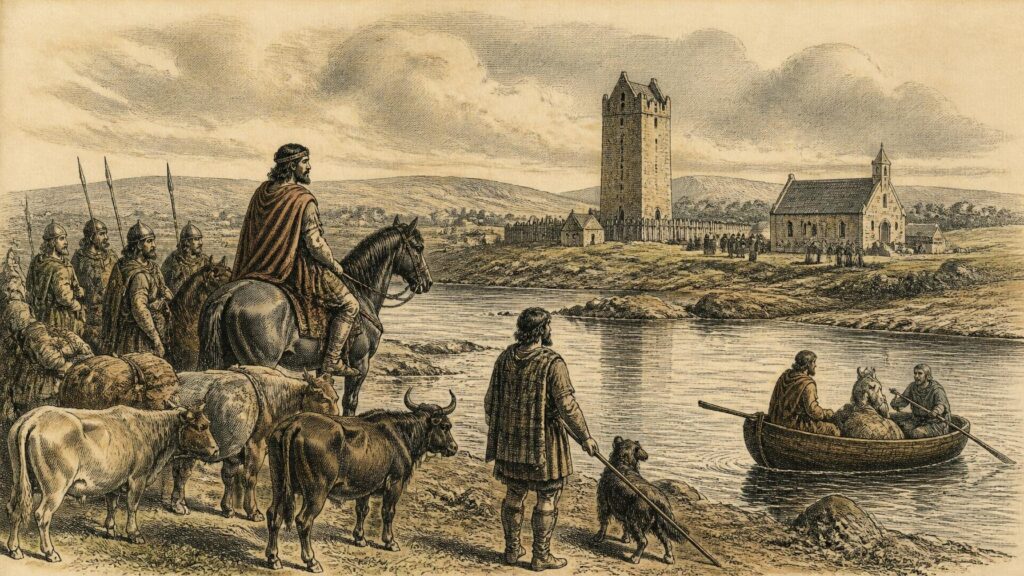
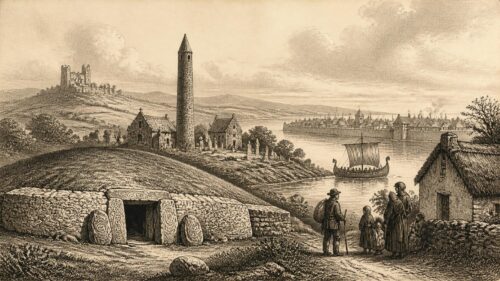
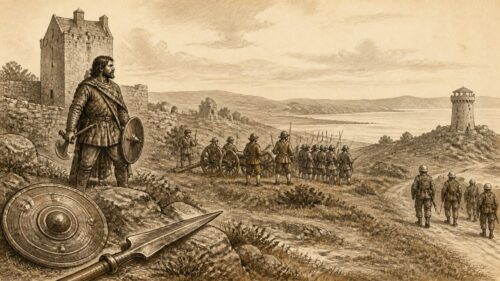
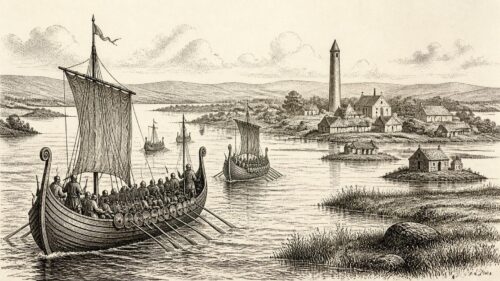
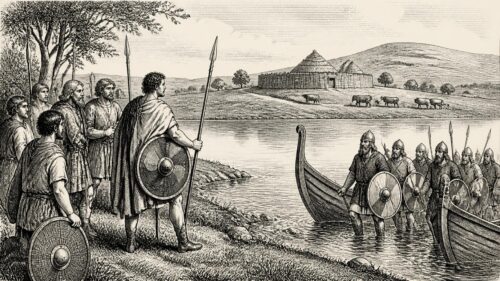
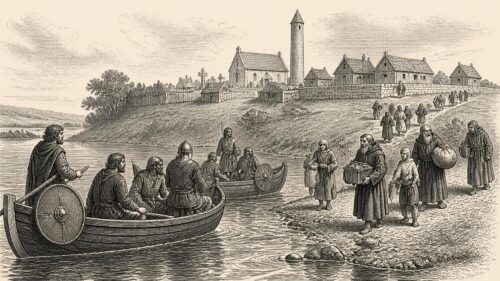
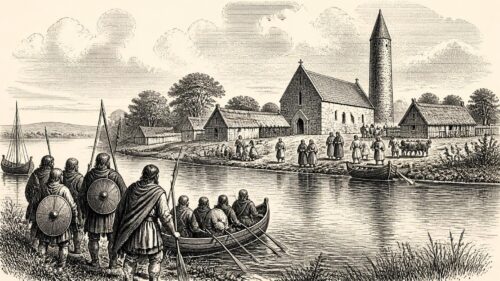
AI generated historical illustration, not a contemporary photograph.
At a Glance
Thomond was not merely an old name for County Clare, nor simply the hereditary possession of the O’Brien dynasty. It was a changing political world in north Munster: a Gaelic kingdom shaped by the River Shannon, religious institutions, kinship, warfare, lordly patronage, towns and castles, and repeated negotiation with external powers. For several centuries its rulers stood among the most consequential figures in Ireland, yet their authority was never absolute, their territory never entirely fixed, and their history survives through sources that require careful reading.
Thomond Geography
The name Thomond derives from Tuadmumu, meaning North Munster. It emerged as a political designation when the older province of Munster was divided between rival dynasties in the twelfth century. In broad terms, Thomond comprised much of modern County Clare, the territories around Killaloe and the lower Shannon, and lands extending into north Tipperary and the Limerick hinterland. Its reach varied considerably with military success, marriage alliances, succession disputes and agreements with neighbouring rulers. It should therefore not be treated as if it possessed the stable borders of a modern county or state.
The Shannon was central to Thomond’s political geography. It was a barrier, a highway and a frontier at once. Crossings at Killaloe, Limerick, O’Brien’s Bridge and elsewhere were strategically valuable because they linked the western lands of Clare with the more fertile and contested country to the east. The estuary connected the lordship with Atlantic and Irish Sea trading routes, while the river corridor exposed it to intervention from Limerick and from rulers or colonial interests based in the east. The Burren, the limestone country of north Clare, presented a different environment: thin soils, upland grazing and a dense concentration of ecclesiastical and later medieval remains. The diversity of this landscape helps explain why the political cohesion of Thomond depended upon alliances rather than geography alone.
Modern historical writing often uses “Thomond” for a wide cultural region as well as a lordship. That can be useful, but it risks obscuring change over time. The political Thomond of Domhnall Mór Ó Briain in the late twelfth century, the war-torn Thomond contested by the de Clares in the late thirteenth and early fourteenth centuries, and the earldom fashioned under Tudor rule in the sixteenth century were related but not identical entities. The name endured because it described a region of memory and lordship; the institutions beneath it were repeatedly remade.
Origins Evidence
Any account of Thomond must distinguish between archaeology, near-contemporary records, later learned tradition and modern interpretation. Archaeological evidence demonstrates a long human presence in the Shannon region and in Clare, but it does not by itself identify a prehistoric “Thomond”. That political name belongs to the medieval record. Likewise, the prominence of places such as Killaloe, Inis Cealtra, Dysert O’Dea, Quin and Ennis reflects changing ecclesiastical, dynastic and economic circumstances rather than one uninterrupted political order.
The principal written sources include Irish annals, genealogies, poems, legal and ecclesiastical material, English royal records, papal evidence, later compilations and local traditions. Annals are indispensable, particularly for deaths, battles, raids, inaugurations and successions. Yet they are selective and often brief. Their chronological framework can be difficult, their vocabulary carries political assumptions, and surviving versions were sometimes copied or compiled centuries after the events described. They should not be read as neutral newspapers. The Book of Mac Carthaigh, for example, records Domhnall Mór Ó Briain’s accession to the kingship of Thomond in 1167; its value lies both in the event it preserves and in its place within a learned Munster historical tradition.
One especially rich but problematic source is Caithréim Thoirdhealbhaigh, a fifteenth-century Irish narrative usually translated as The Triumphs of Turlough. It recounts warfare in Thomond from the Norman arrival through the fourteenth century, concentrating on the career and dynasty of Toirdhealbhach Ó Briain. It preserves detail unavailable elsewhere, including routes, assemblies, local allies and military manoeuvres. But it is also a work of dynastic advocacy, written long after many of the episodes it narrates. Its dramatic speeches and moral judgements cannot simply be accepted as verbatim reportage. The University College Cork edition makes both its extraordinary richness and its partisan character available for scrutiny.
Folklore adds another layer. Stories of Brian Boru, O’Brien strongholds, hidden treasure, saints, battles and ruined castles have long attached people to this landscape. Such tradition can preserve place-names and social memory, but it is not equivalent to contemporary evidence. The historian’s task is not to discard folklore contemptuously, but to identify its genre and avoid turning later stories into unqualified medieval fact.
Dalcassian Ascendancy
The ruling dynasty of Thomond, the Uí Briain or O’Briens, traced its descent from Brian Bóruma, generally known as Brian Boru, who died in 1014. Brian’s rise from the Dál gCais, a Munster grouping associated with the region around Killaloe, transformed Irish politics. His career and the later claims made for him are entwined with the ambition of his descendants. It is important, however, not to imagine that his later prestige automatically guaranteed their control of all Munster. Dynastic authority in medieval Ireland rested on armed followings, client relationships, ecclesiastical patronage, control of resources and the ability to prevail in recurrent succession struggles.
During the later eleventh and early twelfth centuries, members of the Uí Briain held extensive power in Munster and intermittently participated in contests for wider Irish supremacy. By the middle of the twelfth century, that dominance was challenged by the Mac Cárthaigh of southern Munster. The division between North Munster and Desmond, or South Munster, was therefore not an ancient natural partition but the result of political competition. Thomond became the principal sphere of O’Brien power, while Desmond was associated with the Mac Cárthaigh.
Domhnall Mór Ó Briain, who became king of Thomond in 1167, stands at the beginning of the lordship’s better documented medieval history. The annalistic notice of his accession comes just before the arrival of Anglo-Norman forces in Ireland. The coincidence matters. Thomond’s rulers were not passive observers of events beginning in Leinster in 1169; they had to assess how the new military and political actors might alter the balance among Irish kingdoms. In the following decades Domhnall Mór was involved in the turbulent politics of Munster, Limerick and the wider island. His power rested on more than a royal title. It depended on the cooperation, submission or containment of other leading families, including the Mac Conmara, Ó Deá, Ó Grádaigh and Ó Lochlainn.
The term “king” can mislead modern readers if it suggests a centrally administered territorial monarchy. A king of Thomond was expected to lead in war, distribute reward, protect dependants, uphold honour, patronise religious communities and manage relationships among powerful kindreds. His succession was not governed by simple automatic primogeniture. Gaelic political practice allowed a wider royal kin-group to produce eligible candidates, although the exact workings of tanistry varied and were often shaped by force. This flexibility could produce capable adult rulers; it could also generate bitter and enduring conflict among close relatives.
Ecclesiastical Lordship
Thomond’s political order was inseparable from its religious and learned institutions. The ecclesiastical landscape of Clare and the Shannon region contains Romanesque churches, monastic foundations, high crosses, tomb sculpture and later mendicant houses that speak to centuries of patronage and devotion. Killaloe’s importance derived partly from its association with the Dál gCais and Brian Boru, but also from its place as an episcopal and riverine centre. Inis Cealtra in Lough Derg, later known as Holy Island, was an established religious site whose significance long predated the medieval lordship.
By the thirteenth and fourteenth centuries, friaries and other religious communities were woven into the social and political life of Thomond. Ennis Friary, associated with the O’Briens and founded in the thirteenth century, became a major dynastic burial place. Corcomroe Abbey in the Burren is another striking monument to the region’s religious culture and aristocratic patronage. These places were not simply quiet refuges from politics. They received patronage, held land and resources, offered burial and commemoration, and could provide literate networks through which lordly memory was recorded and reproduced.
Professional learned families were equally important. Poets, genealogists, historians, lawyers and clerics did not merely decorate lordship with praise. They helped define descent, rights, rank, obligations and political legitimacy. A genealogy could be an argument about authority. A praise poem might preserve a political ideal while seeking reward from its patron. Later traditions surrounding the “Contention of the Bards”, a literary dispute in the early seventeenth century, show how vigorously questions of precedence, ancestry and the standing of regional dynasties could be debated. The intellectual life of Thomond was not an afterthought to its military history; it was one of the means by which power was explained and contested.
Nevertheless, patronage should not be romanticised. Lordship relied on exactions, military service and unequal social relations. The evidence more readily preserves kings, chiefs, churchmen and prominent families than the experiences of tenants, labourers, women, captives or those displaced by warfare. Their lives are often visible only indirectly: in references to cattle raids, burned settlements, rents, church lands, mercenary service and famine or disease. A history focused solely on dynastic succession risks reproducing the silences of the sources.
Norman Frontier
The Anglo-Norman arrival did not produce an immediate conquest of Thomond. Rather, it created a long frontier zone, especially around Limerick and the Shannon crossings. The capture and colonisation of Limerick gave English royal power and Anglo-Norman settlers a base beside the O’Brien sphere. Grants of land, the construction of castles, military expeditions and alliances with rival Irish claimants repeatedly altered the pressure on Thomond.
The late twelfth and thirteenth centuries saw both resistance and accommodation. O’Brien rulers could cooperate with royal government when it suited their interests, while also attacking settlements or opposing grants that threatened their position. The Dictionary of Irish Biography’s account of Conchobar Ó Briain, king from 1242 to 1268, describes how colonist expansion on the west bank of the Shannon and the establishment of settlements at Bunratty and Clare placed him under acute pressure. He attempted at times to maintain terms with the crown, including payment of rent, but conflict became increasingly difficult to avoid.
Bunratty was particularly significant. Located close to the Shannon estuary and routes into the interior, it became a focal point of Anglo-Norman ambition and Gaelic resistance. The modern castle is largely the product of later rebuilding, and it is essential not to project it unchanged into every phase of medieval conflict. Yet the site’s strategic importance was real. Control of Bunratty offered access to the river and a bridgehead in the heartland of Thomond.
The conflicts of the 1260s and 1270s demonstrate that “Gael” and “English” were not fixed military blocs. Conchobar’s son Brian Ruad initially fought settlers and took the castle of Clare in 1270. He then faced a formidable rival in his nephew Toirrdelbach. As the civil war intensified, each side sought outside assistance. Brian Ruad entered an alliance with Thomas de Clare, an Anglo-Norman magnate who had acquired a royal grant aimed at bringing Thomond under his authority. Such alliances were tactical and could be disastrous. The Dictionary of Irish Biography records that Brian Ruad’s association with de Clare ended in his death in 1277.
The episode does not show a straightforward choice between national loyalty and collaboration. Medieval rulers faced immediate calculations of kinship, inheritance, territory and survival. To appeal to an external power against a cousin was a recognisable, if risky, political strategy. It could enhance a claimant’s resources; it also invited that external power to establish a more permanent foothold. The de Clare intervention grew precisely because O’Brien divisions created opportunities which colonial authority could exploit.
Clare Recovery
From the late thirteenth century into the early fourteenth, Thomond underwent prolonged warfare among competing O’Brien branches, their supporters and the de Clare lordship. Thomas de Clare’s interests centred on the Bunratty region and on the prospect of turning royal grants into real territorial control. His heirs continued the project. Their position, however, remained dependent on military strength, alliances and the divisions of the local polity.
The contest was not simply a clash between an advancing colonial state and a united Gaelic resistance. The Mac Conmara and other leading lineages had their own interests; O’Brien claimants competed fiercely; the de Burghs, Butlers and Munster powers all influenced the balance. The later Caithréim Thoirdhealbhaigh presents a strongly O’Brien-centred account of these struggles, celebrating the endurance of Toirdhealbhach and his descendants. Used alongside annals and administrative evidence, it offers an invaluable picture of how the restoration of O’Brien authority was remembered.
In 1311, Diarmait Cléirech Ó Briain, supported by de Clare, defeated Donnchad Ó Briain and gained the Thomond kingship. The victory did not settle the matter. Muircheartach Ó Briain, a member of the opposing dynastic branch, emerged as the principal figure in resistance to the de Clare settlement. The Dictionary of Irish Biography characterises him as a powerful warrior who overturned that arrangement. The details of campaigns must be treated carefully, especially where sources are retrospective, but the broad outcome is secure: de Clare power in Thomond collapsed after the battle of Dysert O’Dea in 1318.
The battle has acquired an understandably prominent place in Clare historical memory. It is often presented as a decisive Irish victory that expelled the Normans from the region. That description contains an important truth but needs qualification. Richard de Clare was killed, the de Clare lordship was shattered, and Bunratty was abandoned by that dynasty. Yet Anglo-Norman influence did not disappear from the Shannon world, nor did warfare cease. Limerick remained an important colonial city, English royal claims endured, and political connections across the frontier persisted. The event was decisive for the de Clare project, not an uncomplicated end to all external influence.
After 1318, the O’Briens recovered a stronger position within Thomond. Muircheartach’s rule, followed by that of his brother Diarmait, is described in Caithréim Thoirdhealbhaigh as a period in which order was restored after destructive conflict. Such language is formulaic and dynastically favourable, but it points to a significant political reality: O’Brien authority was reconstituted and the de Clare territorial venture did not return. The fall of the de Clare power also illustrates a broader fourteenth-century pattern in Ireland, in which colonial lordships could be vulnerable when their local alliances failed and Gaelic political networks proved resilient.
Lordly Governance
Thomond remained a major lordship through the fourteenth and fifteenth centuries, but it was not immune to internal fracture. Successions repeatedly divided the O’Briens. Rival brothers, cousins and branches competed for the kingship, often mobilising support from the Mac Conmaras, Burkes, FitzGeralds, Butlers and other regional powers. These conflicts could be destructive, yet they also demonstrate the continuing political weight of Thomond. Its rulers mattered because they controlled men, cattle, strategic crossings and a territory positioned between Connacht, Munster and the English lordship of Limerick.
The language of “decline” sometimes applied to late medieval Ireland is too crude for Thomond. English royal administration was limited in much of the island, but that did not mean political emptiness. Gaelic lordships developed sophisticated networks of alliance, clientship, fostering, marriage, tribute and military service. Their political structures differed from English common-law assumptions, but they were neither static nor isolated. Thomond’s rulers engaged with towns, Anglo-Irish earls, Scottish and western seaboard connections, churchmen and royal officials when advantageous.
The mid-fifteenth-century career of Tadhg an Chomhaid Ó Briain illustrates this dynamism. According to the Dictionary of Irish Biography, he succeeded to the kingship in 1459, built a castle in the Burren, and after 1461 undertook an ambitious programme of expansion east of the Shannon. The Annals of the Four Masters record that in 1466 he crossed the Shannon, campaigned in Desmond and west Munster, and had secured claims to territory and tribute in the Limerick region before his death. Annalistic claims of tribute should be read as evidence of political assertion, not as proof of a modern-style taxation system administered uniformly across a mapped territory. They nonetheless reveal the scale of O’Brien ambition.
Castles were important instruments in this world, but their meanings varied. They could be residences, storehouses, defensible centres, statements of rank and anchors for local administration. Many surviving tower houses associated with late medieval Thomond belong to powerful families as well as to the O’Briens. Their distribution reflects a landscape of multiple lordships rather than one ruler’s unchallenged command. The construction and occupation of castles also blur an overly rigid distinction between “Gaelic” and “Anglo-Norman” cultures: building forms, military practices and material styles circulated across political boundaries.
The economic foundations of lordship included cattle, pastoral resources, agricultural rents, fisheries, passage across rivers, hospitality and rights over land and people. Raiding was not merely random violence. It could be a method of extracting wealth, punishing enemies and demonstrating authority. That does not make it harmless. Annalistic accounts of burnings, killings and the seizure of cattle show the acute human cost borne by communities. Mercenaries, including gallóglaigh from Gaelic-speaking Scotland and Ireland, added another dimension to warfare and to the burden placed on local resources.
Tudor Settlement
The sixteenth century brought a profound constitutional change, though not an instant transformation of daily life. Tudor government sought to extend royal authority across Ireland through a mixture of military pressure, diplomacy, legal incorporation and the granting of English titles. The policy later known as surrender and regrant encouraged Gaelic and Gaelicised rulers to surrender their claims to the crown and receive lands and dignities back under English law. In practice, arrangements varied, and the policy depended heavily on local circumstances.
In Thomond, dynastic conflict created an opening. Conchobar Ó Briain’s death and the contested position of his nephew Donnchadh enabled Murchadh an Tánaiste Ó Briain to assert himself. Murchadh had been involved in the politics and conflicts of the 1530s, including alliances connected with the FitzGeralds and confrontation with the lord deputy Leonard Grey. His decision to negotiate with Henry VIII should be understood within this setting of family rivalry and regional calculation, rather than as a simple ideological conversion to English government.
On 1 July 1543 Murchadh was created earl of Thomond at Greenwich, while Donnchadh was made Baron Ibrackan. The National Library of Ireland’s guide to the Inchiquin papers records both the date and the unusual succession arrangements: the earldom was granted to Murchadh for life, with a special remainder favouring Donnchadh. The arrangement translated a Gaelic kingship into the language of an Irish peerage, but it did not erase the political habits or competing claims of the old order overnight.
It is inaccurate to say that Murchadh simply “gave up” Thomond. He accepted royal overlordship and an English title, and the change had major long-term consequences. Yet he retained considerable local power, and the title itself preserved the regional name. The Dictionary of Irish Biography cautions against assuming that acceptance of the earldom meant immediate obedience to English law in every respect; Murchadh’s conduct after 1543 was still shaped by regional warfare and local priorities. The settlement was a negotiated adaptation by a powerful dynasty under pressure.
Nor did the new peerage end rivalry. Murchadh died in 1551. Donnchadh’s position and the succession of later earls were contested, while branches of the O’Brien family retained alternative claims to lordship and regional influence. The Annals of the Four Masters record the disorders of 1558, when Donnchadh was displaced and English officials placed the country in the hands of a rival claimant. Such episodes show the limitations of Tudor constitutional solutions. A patent issued in London could not by itself resolve competing notions of kinship, right and local allegiance.
Estate Transformation
Over the later sixteenth and seventeenth centuries, the earls of Thomond became increasingly integrated into the structures of the English and then British state, while other O’Brien branches, including the Inchiquin line, followed related but distinct trajectories. This was a long process rather than a single event. It involved English legal forms, estate management, religious change, political service, military involvement and new relations between landlords, tenants and towns.
Donough O’Brien, fourth earl of Thomond, is especially associated with the transformation of the region’s social and economic order around the turn of the seventeenth century. The documentary record of the Thomond Papers, discussed by historian Luke McInerney in the 1640 register of the Thomond Papers, is valuable for tracing this transition. McInerney emphasises that the earls’ adoption of English titles and primogeniture formed part of an anglicising process, while also noting the importance of local initiative: market towns, estate policies and the settlement of English and Dutch newcomers were not simply imposed from Westminster.
This development had uneven consequences. Towns and commercial links could offer opportunity, but estate consolidation and changes in tenure also altered older relationships to land. The language of “improvement” in later sources often reflects the viewpoint of landlords and administrators. It should not be assumed that what increased rental income or administrative order benefited every inhabitant. The surviving documentation, richer for elites than for ordinary people, makes this a difficult history to reconstruct fully.
Religious identity complicated political allegiance. The Reformation and the establishment of the Church of Ireland did not map neatly onto family, language or region. Members of the extended O’Brien world could serve the crown, conform to the established church, retain Catholic connections, support different sides in war, or change position as circumstances dictated. During the seventeenth-century wars, Murrough O’Brien, earl of Inchiquin, became notorious for his military role in Munster, while other members of the wider family participated in Catholic and Confederate politics. Thomond’s old dynastic landscape had not vanished; it had become entangled with the confessional and imperial conflicts of the Atlantic archipelago.
Enduring Memory
The political kingdom of Thomond did not survive unchanged into modernity, but the name retained extraordinary cultural power. It lived on in the earldom and later marquisate of Thomond, in place-names, historical writing, sporting and institutional identities, and the many sites associated with O’Brien, Mac Conmara and other regional families. In County Clare in particular, “Thomond” continues to signal a historical region larger and older than the county itself.
This persistence has encouraged romantic narratives. Brian Boru’s reputation, the ruins of castles and abbeys, and the dramatic defeat of the de Clares invite stories of ancient national resistance and unbroken clan authority. Those stories can express genuine attachment to place, but they must be balanced against the historical evidence. Thomond was neither a timeless nation-state nor a homogeneous Gaelic community. Its rulers fought one another, made alliances across cultural lines, negotiated with kings of England, patronised churches and poets, and governed through relationships that were at once local, regional and international.
The monuments themselves demand caution. A castle may have been altered repeatedly; an abbey may preserve later restorations alongside medieval fabric; a burial tradition may rest on early modern family memory rather than secure medieval evidence. Archaeology, architectural history, documentary research and local tradition are strongest when used together. None alone can answer every question.
There is also a moral dimension to how Thomond’s history is told. Dynastic narratives can make warfare appear glamorous. The annals’ compressed notices of raids and killings, however, point to repeated dispossession and insecurity. Lordship provided protection to some and imposed burdens on others. The historical significance of Thomond lies not only in its famous rulers but in the communities that sustained, endured and sometimes resisted the systems through which those rulers exercised power.
Historical Legacy
Thomond’s history is the history of a durable regional polity adapting to profound change. It emerged from the fragmentation of Munster and became the chief arena of O’Brien authority. It confronted Anglo-Norman expansion without being reducible to a simple story of resistance; its own dynastic divisions shaped the course of intervention. It recovered after the collapse of de Clare power, remained influential in later medieval Ireland, and entered the Tudor state through a negotiated but disruptive conversion of kingship into peerage.
The most reliable account of Thomond must therefore hold several truths together. The O’Briens were central, but they were never the only makers of its history. Gaelic institutions were resilient, but they were contested and adaptable. English intervention was consequential, but it depended on local alliances and could fail. Sources preserve an exceptional record of war, lordship and memory, but they are uneven, partisan and often silent about much of the population. Read critically, they reveal Thomond not as a relic at the edge of Irish history, but as one of the places where medieval and early modern Ireland was made.
Documentary Afterlife
Thomond’s history can also be read through the changing language used to describe authority. The terms “king”, “lord”, “earl”, “nation”, “vassal” and “O’Brien” were not interchangeable labels for the same office. Each belonged to a particular political setting and carried assumptions about kinship, service, land and jurisdiction. Reading those terms closely helps prevent a familiar mistake: treating the region’s movement from Gaelic kingship to Tudor peerage as either a clean conquest or an uncomplicated continuity. It was, rather, a succession of translations in which older claims were adapted, disputed and recorded in new forms.
The crisis surrounding Brian Ruad Ó Briain in the 1270s shows how personal relationships could cross political frontiers without dissolving them. Brian Ruad had fought the colonists north of the Shannon and captured the castle of Clare in 1270, yet he later allied himself with Thomas de Clare in an attempt to overcome his O’Brien rival, Toirrdelbach. The biography’s use of the contemporary relationship of spiritual kinship—Brian became de Clare’s “gossip”, or brother in Christ—reveals that political partnerships could be framed through obligations intelligible to both sides. The arrangement proved catastrophically fragile: after Brian’s defeat in 1277, de Clare had him executed at Bunratty. The episode is therefore evidence neither of permanent “collaboration” nor of fixed ethnic blocs, but of a lordship in which dynastic competition could make outside intervention seem temporarily useful.
That instability persisted into the career of Muirchertach Ó Briain. Between 1311 and 1317 he gained and lost footholds in Thomond through alliances with the Mac Conmaras, the de Burghs and, at different moments, Richard de Clare. Attempts to divide Thomond between rival O’Brien claimants did not end the conflict because a territorial settlement could not by itself settle competing dynastic rights. The negotiations associated with Limerick in 1317 are especially revealing: the County Clare Heritage Office account traces Muirchertach’s departure from the city for Tulla after a proposed truce failed. Its reconstruction relies on Caithréim Thoirdhealbhaigh, a later O’Brien-centred military narrative. The incident is valuable not because the narrative supplies a transparent transcript of negotiation, but because it preserves a political landscape in which meetings, escorts, safe routes and sanctuary were essential parts of lordship.
The annals provide a different political vocabulary. Their brief notices do not offer an administrative map of Thomond, but they register the reach of its rulers through military service, tribute and campaigning. In 1463, the Annals of the Four Masters note that Tadhg Ó Briain, lord of Thomond, received wages from Ó Néill. Three years later the same text records his crossing of the Shannon with a great army, campaigning in Desmond and west Munster, and securing demands from the English of Leinster as well as territory in the Limerick region. Such entries should not be converted into a modern claim of uniform administration over all the places named. They do, however, show that Thomond’s political horizon extended far beyond present-day County Clare and that an O’Brien lord could operate within a network spanning Ulster, Munster and the English lordship.
The Tudor settlement changed the idiom rather than simply ending these practices. According to the Dictionary of Irish Biography’s account of Murchadh Ó Briain, when he treated with the lord deputy in 1541 he asked for time to consult the leading men of his “nation” and his vassals before limiting his influence. That detail matters. It indicates that his authority was understood as relational: a ruler could not necessarily dispose of political obligations without reference to the people whose support sustained him. On 1 July 1543, Henry VIII created Murchadh earl of Thomond, while his nephew Donnchadh became Baron Ibrackan. The new dignity brought Thomond into the crown’s legal language, but it was designed around a family problem rather than imposed upon a politically blank landscape.
The resulting ambiguity is unusually clear in the Annals of the Four Masters’ notice of Murchadh’s death in 1551. The annalist describes him as earl of Thomond according to English and royal usage, but as O’Brien according to Irish custom, and then records Donnchadh’s inauguration in his place. The paired designations do not show two entirely separate worlds; they show overlapping claims to legitimacy. English peerage could coexist with inauguration, dynastic identity and the political expectations attached to the name O’Brien. This is why it is misleading to regard the earldom as merely a decorative replacement for the lordship, or alternatively as proof that the older order remained untouched.
The documentary legacy preserves the next stage of that translation in material form. The National Library of Ireland’s catalogue of the Inchiquin Papers records the 1543 letters patent granting Murchadh the earldom and barony, with the earldom to pass to Donnchadh, and notes that a new patent of 7 November 1552 made Donnchadh’s title hereditary in the male line. Later deeds, leases, wills, rents and estate records show “Thomond” functioning not only as a remembered kingdom but as a peerage and a body of landed interests. The earldom itself became extinct on the death of Henry O’Brien, eighth earl, in 1741; the regional name, by contrast, outlived the title.
These records therefore add a necessary caution to the grand narrative of conquest, recovery and adaptation. Thomond was made not only in battles and at inaugurations, but also in negotiations, temporary partitions, patents, genealogies and archives. Its political history is best understood as a continuing argument over who could speak for the region, what form that authority should take, and which language—Gaelic, colonial, legal or dynastic—would make the claim endure.