Domnall Claen’s Captivity979 CE
Dateline
For Ireland, 979 is a year best approached through a small but unusually revealing cluster of annalistic notices. No surviving source supplies a continuous narrative, and none explains every motive or consequence. Yet the recorded capture of Domnall Claen, king of Leinster, by the foreigners of Dublin exposes the political weight of the Hiberno-Norse town at the mouth of the Liffey. Deaths and killings among rulers in Offaly, Dál Araide and Cenél Conaill show, at the same time, that power remained fragmented across many regional kingdoms. Notices of a Kildare church leader, a Clonmacnoise scholar-cleric and a foremost man of learning reveal another Ireland: one sustained by religious institutions, literacy and remembered expertise.
A Year of Careful Dating
The year requires a preliminary caution. Medieval Irish annals were copied, rearranged and sometimes chronologically displaced over centuries. The Annals of Tigernach and Chronicon Scotorum place Domnall Claen’s capture, the death of Conchobor of Uí Fhailge, and the killings of Leathlobar of Dál Araide and Tigernán of Cenél Conaill under 979. The Annals of Ulster preserve closely related notices under an entry headed “AD 978 alias 979”. Such variation is a feature of the sources, not a licence to move events freely. The events discussed here can responsibly be treated as belonging to 979 in modern historical convention, but no month, season or day can be assigned to them.
This distinction matters especially because later annalistic compilations associate Domnall Claen’s captivity with a dramatic campaign against Dublin by Máel Sechnaill. Other principal annals place that campaign, the battle of Tara and the death of Domnall ua Néill in 980. They should not be pulled back into 979 merely to make a more exciting story. In 979, the firmly recorded fact is narrower, but significant: the king of Leinster was taken by Dubliners.
A Leinster King Taken
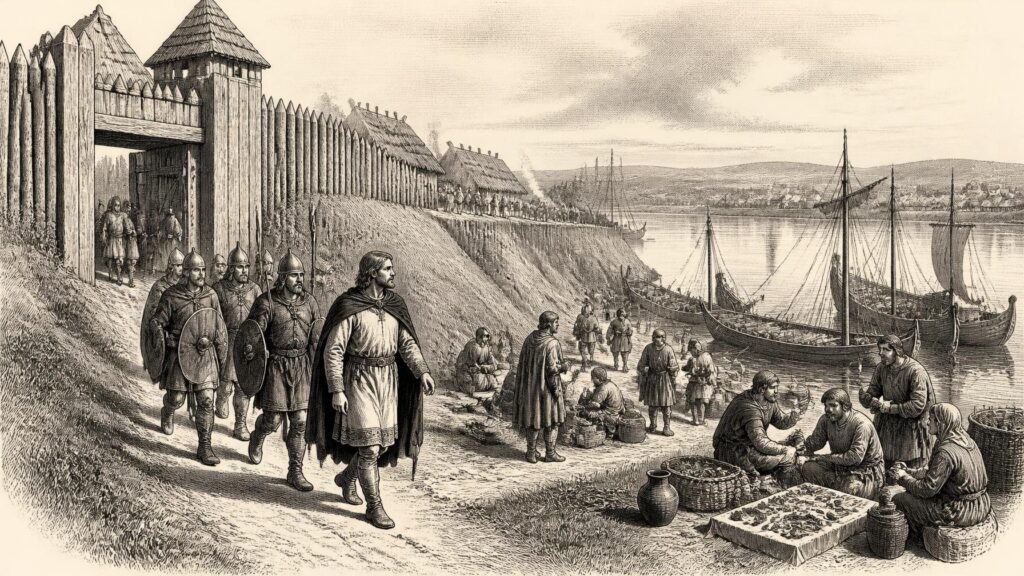
Domnall Claen, or Domnall “the Squinting”, belonged to the Uí Dúnlainge dynasty that dominated Leinster’s kingship. His capture by the Gall, the annals’ customary term for the Scandinavian-descended inhabitants and rulers of Dublin, was a public humiliation as well as a personal danger. The sources do not say where he was seized, whether he had entered Dublin voluntarily, how long he was held, or what terms accompanied his release. They do not justify a tale of a raid, a betrayal or a ransom. What they do establish is that Dublin possessed sufficient military and political authority to hold a neighbouring provincial king.
The episode belongs to the strained relationship between Leinster and the Hiberno-Norse regime. Dublin was ruled in this period by Amlaíb Cuarán, a king whose family connections reached across the Irish Sea and whose political alliances also reached into Leinster. Such connections did not make relations peaceful. The preceding year had brought a Dublin victory over Leinster at Bithlann, where King Úgaire of Leinster and other leading men were killed. Domnall Claen’s detention in 979 therefore came amid a violent reshaping of Leinster’s leadership, not in a settled partnership between town and province.
Nor should “Dublin” be imagined as a foreign enclave detached from Irish affairs. Its rulers made alliances, took hostages, raided, traded and intermarried within the political world of Ireland. The capture of Domnall Claen shows a town-based kingship acting directly upon provincial succession and diplomacy. It also shows the limits of any simple opposition between “Irish” and “Viking”. The Dublin polity was already Hiberno-Norse: Scandinavian in dynastic origin and maritime connections, but deeply involved in Irish language, kinship and regional politics.
Many Kingdoms, No Single Peace
Elsewhere, 979 brought losses among smaller but consequential rulerships. Conchobor son of Finn, king of Uí Fhailge, died. Uí Fhailge lay in the central plain, in territory later associated chiefly with County Offaly. Its king controlled neither all Ireland nor even a modern county, but the death of such a ruler could alter local alliances, clientship and the distribution of land, cattle and tribute. Ireland’s political map was made from these numerous kingdoms as much as from the claims of powerful overkings.
Further north, Leathlobar, king of Dál Araide, was killed. The Annals of Ulster add the pointed detail that he was killed deceitfully. Dál Araide, in eastern Ulster, was a significant rival within a region where kingship could be fiercely contested. Tigernán, king of Cenél Conaill in the north-west, was also killed in 979. The annals place both deaths in the same year but do not state that they occurred in one battle, that one caused the other, or who was responsible. Their juxtaposition instead conveys a wider condition: authority was personal, dynastic and vulnerable. The death of a king could create an immediate opening for kinsmen, rivals and neighbouring rulers.
These notices do not demonstrate island-wide disorder. They do show that peace was never a general background condition. A ruler’s standing depended on relationships maintained by force, protection, fosterage, marriage, tribute and negotiated submission. Political change often appeared in the annals as a death or killing because those were the moments at which a local balance of power visibly broke.
Kildare, Clonmacnoise and Learning
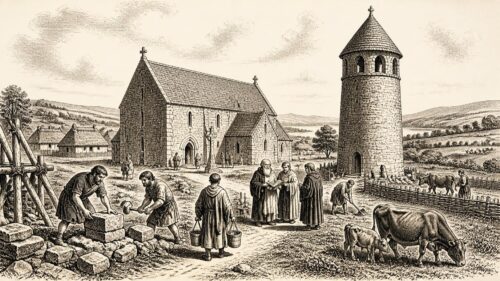
The record for 979 also preserves important ecclesiastical losses. Muirenn daughter of Congalach, described as successor of Brigit, died. Her title identifies her as head of the ecclesiastical community associated with St Brigit at Kildare. “Successor” was no empty devotional label: it conveyed inherited authority, prestige and claims over a major religious establishment. Muirenn’s notice is a reminder that women could hold prominent institutional office in early medieval Irish Christianity, even though the annals generally offer frustratingly little detail about their daily work or political influence.
Chronicon Scotorum records the death of Flann son of Máel Michíl, lector of Clonmacnoise, bishop and superior of Cluain Deocra. The accumulation of titles matters. A lector was responsible for teaching and learned activity; a bishop held sacramental and pastoral status; an airchinnech, often rendered “superior”, managed a church community and its interests. Rather than fitting neatly into later diocesan or monastic categories, Irish ecclesiastical centres combined worship, education, landholding, hospitality and political connection. Flann’s career linked the great Shannon-side centre of Clonmacnoise with another church community, illustrating the mobility of ecclesiastical personnel and offices.
The Annals of Ulster additionally mark the death of Airechtach ua Caráin, “the head of Irish learning”. The phrase is an exceptional tribute. It does not tell us precisely what texts Airechtach taught, copied or composed, nor where he worked. It does, however, confirm that learning was a recognised form of high status. Latin Christian scholarship, vernacular legal and genealogical knowledge, historical memory, poetry and the technical mastery of written language all depended on trained people and institutional settings. The death of an acknowledged leader in learning was therefore worth recording beside the deaths of kings.
Town, Hinterland and Daily Livelihood
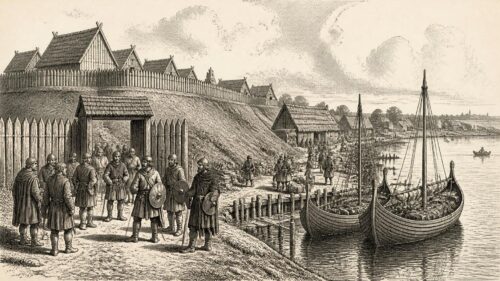
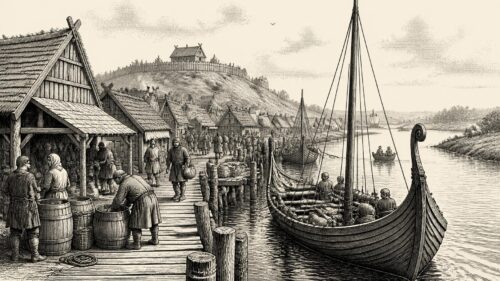
Archaeology supplies a fuller impression of the material setting than the terse annals can offer. By 979 Dublin was an established defended settlement on the ridge above the Liffey and Poddle, near the later Christ Church area. Its earthwork enclosure, timber buildings and waterfront access served a population of merchants, craftspeople, households, retainers and rulers. Finds from Viking-age Dublin include tools, leatherwork, textiles, comb-making debris, metalworking evidence, weights, scales, coins and imported materials. They reveal a community in which craft production and exchange were integral to power.
Trade made Dublin strategically different from most Irish royal sites. Maritime links connected it to western Britain, northern England, the Isles, Scandinavia and the European mainland; exchange also joined it to its Irish hinterland. Silver, textiles, luxury goods and imported raw materials mattered, but the town relied equally on food, timber, animal products and labour from surrounding districts. The political leverage visible in Domnall Claen’s capture was thus supported by ships, armed followers, fortified space and access to wealth that was both local and overseas.
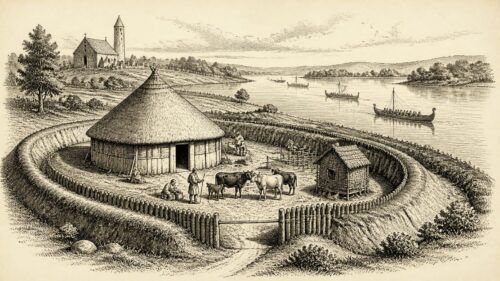
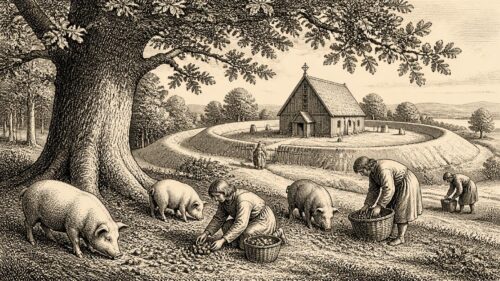
Most people in Ireland, however, lived beyond Dublin’s streets. Their work centred on cattle, dairying, grain, woodland resources and seasonal labour, within landscapes of dispersed farms, enclosed settlements and church lands. Cattle remained a crucial store of wealth and a common unit in tribute and compensation, while grain production and milling were increasingly important in many areas. This was not an economy without trade or money, but neither was it one in which coin displaced livestock, obligation and gift-giving. A political shock in Dublin could touch rural communities through levies, raiding, demands for food, the taking of hostages or disruption to routes of exchange.
The Meaning of a Sparse Record
979 should not be made into a false turning point. The annals do not record a decisive battle, a general famine, a church reform or an island-wide settlement for this calendar year. Their silence on such matters is not proof that ordinary life was tranquil, only that it did not produce an entry that survived. What survives instead is a sharply focused picture of vulnerability and connection: a Leinster king in Dublin’s custody; rulers dying or being killed across several regions; and leading figures of Kildare, Clonmacnoise and Irish learning passing from the scene.
That combination is historically valuable. It shows an Ireland of multiple centres of authority, in which a maritime town could seize a provincial king and religious communities could preserve offices, scholarship and prestige across generations. The year’s few entries are not a complete portrait of the island. They are, nevertheless, a clear glimpse of the pressures under which its people, kingdoms and institutions lived.
Primary Sources
- The Annals of Tigernach: English Translation
- Annals of Tigernach, Part 15
- Chronicon Scotorum: English Translation
- Chronicon Scotorum: Irish Text
- The Annals of Ulster: English Translation
- The Annals of Ulster: CELT Project Edition
- Annals of Inisfallen, Part 53
- Annals of Inisfallen, Part 6
- Annals of the Four Masters, Part 8: English Translation
- Annals of the Four Masters, Part 8: Irish Text
- Ua Néill, Domnall | Dictionary of Irish Biography
- Amlaíb (Óláfr) Cuarán | Dictionary of Irish Biography
- Gormlaith | Dictionary of Irish Biography
- Sitriuc Silkbeard | Dictionary of Irish Biography
- Dublin City Urban Archaeology Survey 1986: Preliminary Report
- Dublin City Urban Archaeology Survey 1988
- Religion and Society in Ireland
- Money in Early Christian Ireland According to the Irish Laws
- Reassessing the Irish ‘Monastic Town’
- Exploring the Irish Annals
- Vikings in Ireland