Bees, Cattle and Kings993 CE
Annals conventionally place 993 amid a major mortality of people, cattle and bees, though its cause, scale and chronology remain uncertain. This crisis threatened subsistence, wealth and ecclesiastical resources. Political violence killed several local rulers in the midlands, Connacht and west, revealing fragmented lordship and Máel Sechnaill’s interventions. Brian of Munster led a naval expedition from Lough Ree towards Bréifne, while Mide suffered devastation and Dublin’s Norse-Gaelic politics remained unsettled. Meanwhile, Muirecán, Patrick’s successor, visited Cenél nÉogain and publicly affirmed Áed’s royal standing. The notices portray interconnected warfare, church authority, riverine mobility and vulnerable rural life throughout Ireland in 993.
Dateline
The Irish annals preserve 993 as a year of unusually stark contrasts: a kingdom-making ecclesiastical progress in the north, killings among local dynasties across the midlands and west, manoeuvres by the island’s greatest rivals, and, above all, a reported mortality affecting people, cattle and bees. These notices do not form a continuous narrative, and medieval annalists did not date events with the precision expected of a modern calendar. The Annals of Ulster heading itself signals a chronological complication, giving its entry as “AD 992 alias 993”. The safest approach is therefore to treat the notices as events conventionally placed in or closely attached to 993, while resisting claims about particular days or seasons that the evidence cannot support.
A Mortality Across Ireland
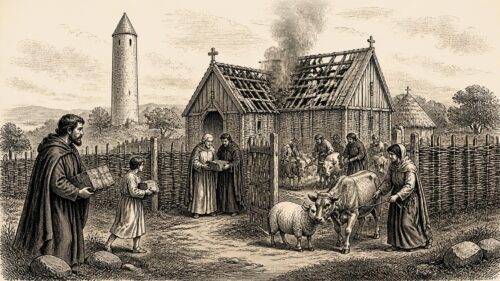
The most consequential statement is also the briefest. The Annals of Ulster record “a great mortality of people, cattle, and bees throughout Ireland this year”. Chronicon Scotorum, a related annalistic compilation, narrows its corresponding notice to a great mortality at Clonmacnoise. Together, the entries establish that severe loss of life was remembered in association with 993, but they do not identify a disease, duration, death toll or cause. It would be irresponsible to call it plague in the modern diagnostic sense. Nor can the surviving text prove that every region suffered equally.
Nevertheless, the combination of human, bovine and bee mortality conveys the breadth of the crisis as contemporaries understood it. Cattle were central to wealth, status, food production and political exchange in early medieval Ireland. They supplied milk, butter, cheese, hides, traction and, when slaughtered, meat; they were also prominent in rents, fines, gifts and tribute. A substantial loss of cattle could thus diminish household subsistence, weaken a lord’s capacity to reward followers, and reduce the movable wealth on which warfare and lordship depended. Archaeological and documentary research shows that cattle remained dominant within the livestock economy, even as cereal production became increasingly important in the later early medieval period.
The inclusion of bees is equally revealing. Honey was a valued foodstuff, while beeswax mattered to churches and monasteries for candles, writing tablets, seals and adhesives. Early Irish law devoted a specialised tract, Bechbretha or “Bee Judgements”, to the ownership and movement of swarms. The annalist’s decision to name bees alongside people and cattle suggests that their loss was recognised not as a curiosity but as material damage to households and ecclesiastical communities. For ordinary people living on dispersed farmsteads, the year’s troubles would have been felt in byres, fields, food stores and church lights as much as in royal halls.
Violence in the Midlands and West
The annals also show how fragmented Irish politics remained. Ireland was not a unitary kingdom in 993. It consisted of many overlapping lordships, petty kingdoms and provincial over-kingships, bound together by kinship, clientship, tribute, fosterage, hostage-taking and ecclesiastical influence. The high kingship claimed by Máel Sechnaill mac Domnaill of Clann Cholmáin rested on real military and political strength, especially in Mide, but it was neither a modern national monarchy nor an uncontested command over every district.
Several deaths entered under the year expose the violence at this local level. Máel Ruanaid ua Ciarda, king of Cairpre, was killed by the men of Tethba. Two members of the Uí Channanáin were killed. Cléirchéne son of Máel Dúin, king of Uí Echach, was killed by his own people. Such terse notices rarely explain motives. They may reflect disputes over succession, territory, tribute or alliances; the sources do not allow a confident choice between them. What they do show is that kingship could be precarious even below the provincial level, and that political change was often registered in a death notice rather than in a formal accession record.
The killing of Éicnech ua Leocháin, king of Luigne, was especially charged. The Annals of Ulster state that Máel Sechnaill killed him in the abbot’s house at Domnach Pátraic; the Annals of Tigernach calls the act treacherous and names Cathal son of Labraid alongside Máel Sechnaill. Whatever the immediate circumstances, the location placed a conflict involving a local king inside an ecclesiastical setting. It demonstrates that churches and their leading personnel stood close to secular power: they could offer prestigious venues, protection, mediation and legitimacy, but could also become entangled in coercion.
The same northern Connacht–midland borderland produced another significant casualty. Chronicon Scotorum and the Annals of Tigernach record the killing of Ruaidrí son of Coscrach, king of southern Connacht, by Conchobar, son of Máel Sechnaill, with the son of Comaltán. The Munster-centred Annals of Inisfallen likewise places a great Connacht slaughter in its annal for 993. Its wording differs, as annalistic accounts often do, but the converging evidence indicates serious conflict in Connacht and the participation of the high king’s family. Máel Sechnaill’s influence was therefore exercised not only through grand claims at Tara but through armed intervention and the fortunes of his kin in contested regions.
Brian’s River Route
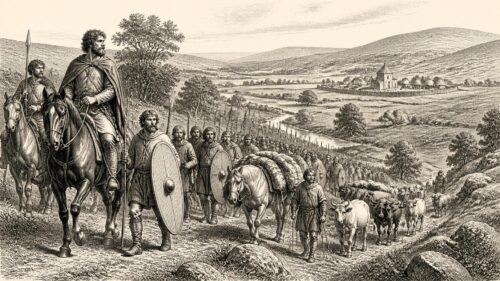
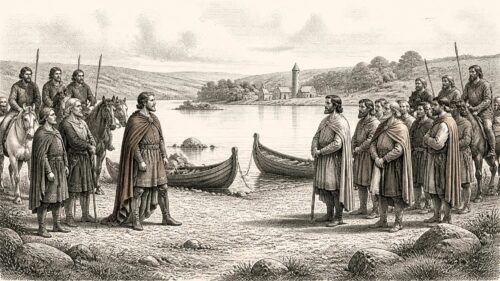
The same year’s Inisfallen record brings Brian, son of Cennétig, later celebrated as Brian Bórama or Brian Boru, into view. It reports a naval expedition by Brian which reached Bréifne from Lough Ree by way of Áth Liac, travelling northwards. This is a firm annalistic notice of movement, but not a full battle report: the source does not say whom Brian fought, what he demanded, or whether the expedition achieved submission. It should not be inflated into a conquest of Bréifne.
Even so, the route mattered. Lough Ree lay on the Shannon system and near the heart of Mide, Máel Sechnaill’s power-base. A fleet moving from there towards Bréifne was a practical expression of long-range royal capacity. Ireland’s rivers and lakes were not barriers at the edge of politics; they were strategic corridors, carrying war bands, livestock, goods, ecclesiastical travellers and messages between regions. Brian had previously demonstrated his ability to deploy vessels on inland waters. In 993, the Inisfallen entry shows that maritime and riverine mobility remained an important part of his contest with the established Uí Néill order.
Brian was already king of Munster, the leading figure of the rising Dál Cais dynasty, but he was not yet high king of Ireland; that development belongs to 1002. Nor had the later agreement between Brian and Máel Sechnaill to divide their respective spheres of authority been made; that belongs to 997. In 993, their rivalry was still open-ended. The annals preserve no single decisive encounter between the two men for this year. Instead, the evidence points to a volatile political landscape in which rival over-kings tested routes, allies and borderlands while lesser rulers paid the most immediate price.
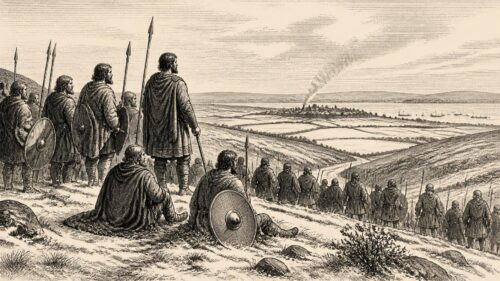
Inisfallen further records that Gilla Pátraic son of Donnchad went into Mide and that its churches and forts were devastated. It also says that Ímar left Dublin with three ships in flight before Amlaíb’s son. These notices are too compressed to yield a secure reconstruction of one coordinated campaign, and the identities and relationships of the Dublin contenders must not be over-simplified. Yet they underline two realities. First, Mide itself was vulnerable to raids despite its ruler’s pre-eminence. Secondly, Dublin was a politically active Norse-Gaelic port whose ships, warriors and dynastic quarrels were inseparable from Irish provincial affairs. The city was not an isolated “Viking” enclave but a node in Irish Sea networks and Irish power politics.
Patrick’s Successor in Cenél nÉogain
While warfare reshaped local authority, the church furnished another language of rule. The Annals of Ulster report that Muirecán of Both Domnaig, successor of Patrick, made a visitation in Cenél nÉogain. In the presence of Patrick’s community, he conferred “kingly orders” on Áed son of Domnall and made a great visitation of the north of Ireland. The later Annals of the Four Masters preserve a closely comparable account.
“Successor of Patrick” was no merely devotional description. It designated the head of Armagh’s Patrician ecclesiastical federation, a position with claims to island-wide religious prestige. A visitation involved travelling with clerics and sacred authority through dependent or allied territories, reinforcing relationships and collecting ecclesiastical dues. The notice does not describe a modern-style coronation, and “kingly orders” should be understood cautiously as a public ecclesiastical act acknowledging or authorising Áed’s royal standing. Its political importance lay in the presence of Patrick’s community: dynastic authority was being displayed and validated through the foremost church associated with St Patrick.
This event helps explain why religious and secular history cannot be separated in 993. Churches were places of worship, burial, learning, hospitality and record-keeping, but also landholders and centres of regional influence. The deaths of Tuathal, successor of Finnén and Mo-Cholmóc, and Máel Finnia ua hAenaig, successor of Feichíne and bishop of the people of Luigne, recorded in the same Ulster annal, are reminders of the dense network of local churches and hereditary ecclesiastical offices. Their communities preserved saints’ cults, controlled resources and connected rural populations to wider political worlds.
An Uneasy Landscape
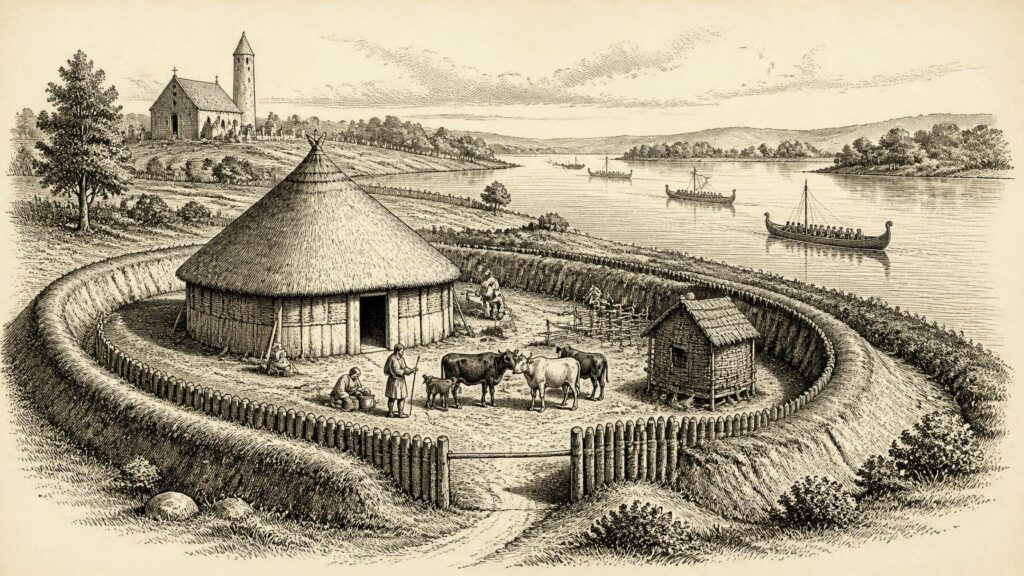
For most inhabitants, 993 was not experienced as a contest between two future textbook figures. Daily life remained rooted in rural settlements: enclosed farmsteads, crannogs, ecclesiastical sites and the increasingly important trading settlements of the coast and rivers. People herded cattle, sheep and pigs; grew barley and oats alongside other crops; processed dairy foods; ground grain; maintained fences and buildings; and travelled to churches, seasonal gatherings and markets. The mortality notice makes clear how exposed this world was to sudden ecological or epidemic shocks.
Yet the year’s entries also show connections across the island. A killing in Luigne, a death in southern Connacht, a fleet on Lough Ree, a raid through Bréifne, disruption in Mide, uncertainty at Dublin and a Patrician visitation in Cenél nÉogain belonged to one interlocking political environment. In 993, Ireland was neither politically unified nor socially isolated. Its rulers competed through force and ceremonial recognition; its churches travelled and negotiated; and its economy depended on animals, crops and skilled labour vulnerable to loss. The annals’ spare sentences preserve that difficult conjunction of ambition, violence and everyday fragility.
Primary Sources
- The Annals of Ulster: Year U993
- The Annals of Ulster: CELT Project Record
- Annals of Inisfallen: Annal AI993
- Annals of Inisfallen: CELT Project Record
- The Annals of Tigernach: Annal T993
- The Annals of Tigernach: CELT Project Record
- Chronicon Scotorum: Annal CS993
- Chronicon Scotorum: CELT Project Record
- Annals of the Four Masters: Annal M993
- Annals of the Four Masters: CELT Project Record
- Brian Bórama (Bóruma, Boru)
- Agriculture, Settlement and Society in Early Medieval Ireland
- The Archaeology of Livestock and Cereal Production in Early Medieval Ireland, AD 400–1100
- Brehon Law
- Early Medieval Farming and Food Production: A Review of the Archaeobotanical Evidence from Archaeological Excavations in Ireland
- Human–Bovine Plagues in the Early Middle Ages
- Ireland, Scotland and Wales to the Early Eleventh Century
- Perception and Reality: Ireland c.980–1229
- The Dynamics of Politics in Early Medieval Ireland: Some Thoughts
- Queen Gormlaith, Brian Boru and the Northmen of Dublin