Leinster’s Fiery Arrow961 CE
Conventionally assigned to 961, though annalistic chronologies differ, the year is chiefly marked by a reported fiery arrow travelling across Leinster from the south-west towards Áth Cliath, killing people and livestock. Its nature and stated thousand deaths remain unverifiable, but the notice records an exceptional environmental shock affecting agrarian communities and Dublin’s hinterland. The annals also note deaths of rulers in Uí Briúin Seóla, Dartraige and Cashel, the latter two killed by their own people, revealing unstable regional lordship. Ecclesiastical leaders at Clogher, Cork and Lismore died, underscoring churches’ institutional importance. Together, the entries depict politically fragmented, interconnected tenth-century Ireland.
Dateline
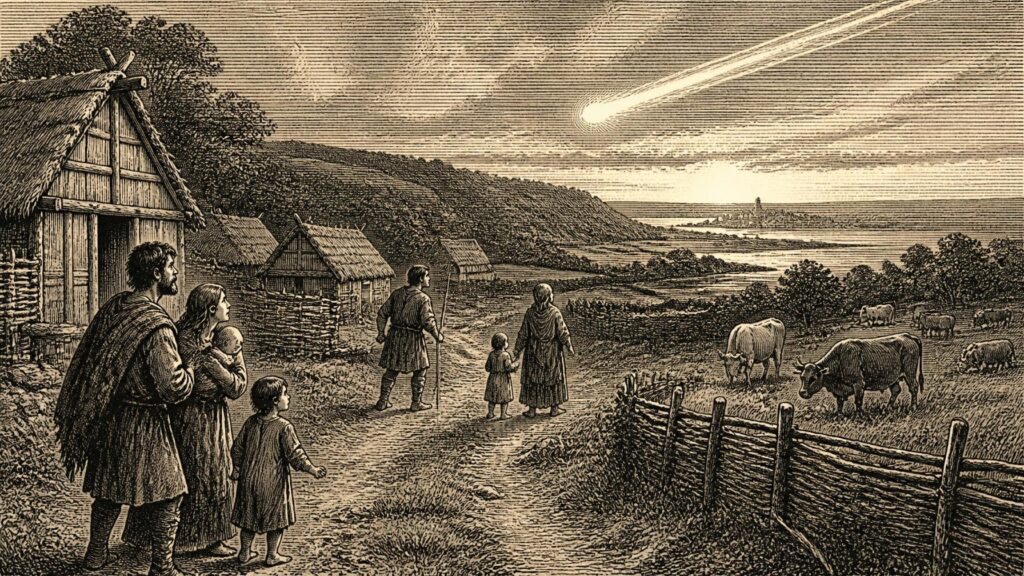
The year conventionally indexed as 961 in the Annals of Ulster is remembered above all for a startling, violent report: a saiget tenedh, literally a “fiery arrow” or bolt of fire, travelled across Leinster from the south-west towards Áth Cliath, later Dublin. The annalist says that it killed a thousand people and animals. It is among the most dramatic environmental notices in tenth-century Irish historical writing, yet it must be handled with care. The source supplies neither day nor season, no named locality beyond Leinster and Dublin, and no explanation of what was seen. It may preserve memory of an extraordinary atmospheric or celestial phenomenon, a destructive fire associated with violent weather, or an event whose physical character is now unrecoverable. What is firm is that an annalist considered it important enough to record alongside the deaths of kings and churchmen.
A Date with a Warning
Even the year needs a small qualification. The manuscript heading of the Annals of Ulster places the entry under 961, while its internal Latin synchronism reads 960; the later Annals of the Four Masters place a closely corresponding group of notices under 959. The Annals of Inisfallen, compiled in Munster and especially valuable for southern affairs, gives a much briefer entry for 961. These differences reflect the difficult transmission and alignment of Irish annalistic chronologies, rather than evidence for several identical disasters. For a year-by-year account, the safest course is to treat the fiery-arrow notice and its associated Ulster entries as material conventionally assigned to 961, while not pretending that the modern calendar date can be fixed more finely.
That caution is not a technicality. Irish annals were not newspapers arranged by a uniform national calendar. They were compilations, copied and augmented over generations, often drawing upon local records. Their compact notices preserve names, places and political outcomes with remarkable value, but their year headings occasionally slip in relation to one another. The disagreement itself reveals something important about historical memory: events circulated between learned ecclesiastical centres, but did not always retain one uncontested chronological position.
The Reported Bolt of Fire
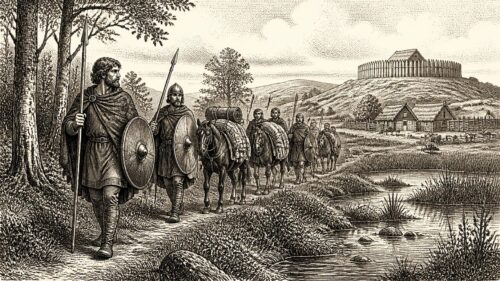
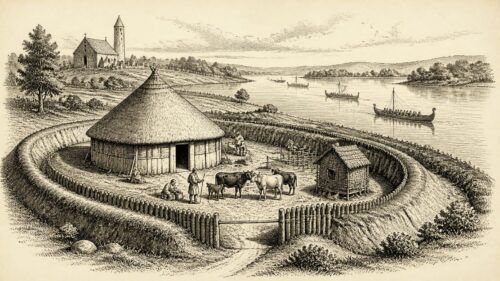
The wording is stark. A fiery projectile came “throughout Leinster” from the south-west and killed “a thousand” humans and altaibh, a term rendered in English editions as herds or flocks, as far as Áth Cliath. The route matters. Leinster was not a single town or a narrow corridor, but a populous eastern province of scattered royal territories, farming landscapes, monasteries and routes leading towards the Liffey crossing. Áth Cliath was both a long-established ford and, by the tenth century, closely bound to the nearby Hiberno-Norse settlement of Dublin. The annalist’s geographical sweep therefore connects rural communities with Ireland’s most important eastern port and market.
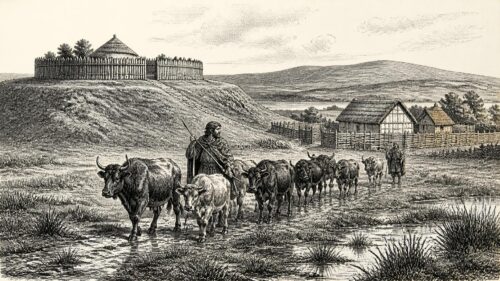
The figure of one thousand should not be treated as a modern casualty count. Medieval annalists could use large rounded numbers to convey devastation, and there is no independent list of victims. Yet the coupling of people and livestock is revealing. Cattle were central to wealth, tribute, food and social standing; other animals supplied dairy produce, meat, wool, hides, traction and breeding stock. A calamity that killed both households and animals, whether recorded literally or expressed in heightened language, represented more than a moment of terror. It implied losses to labour, subsistence and the capacity of local rulers to levy renders from their dependants.
No responsible identification of the phenomenon is possible. A modern reader may think of a meteor, meteorite fall, lightning, wildfire or even an annalist’s compressed account of a storm, but none can be demonstrated from the text. Nor should the “arrow” be pictured as a weapon fired by a human hand: it is the writer’s image for a fiery object or discharge moving across the landscape. Its importance lies precisely in its ambiguity. For people in Leinster, the event was remembered as a destructive intrusion from the sky or air; for the historian, it is a rare glimpse of how an early medieval community registered environmental shock.
Deaths and Fractured Lordship
The same annal sequence records the death of the ruler of Uí Briúin Seóla, a kingdom on the eastern side of Lough Corrib in what is now County Galway. The Annals of Ulster names him in a form that differs from the account in the Four Masters, which calls the dead ruler Donnchadh son of Aurchad. The discrepancy advises restraint over personal identification, but not over the larger point: a significant Connacht lordship was losing its king. Uí Briúin Seóla occupied a strategic region of waterways, islands and fertile lake-margin land. Its rulers stood within the competitive politics of Connacht, where kin-groups could claim royal rank but had to maintain it through alliance, force and control of resources.
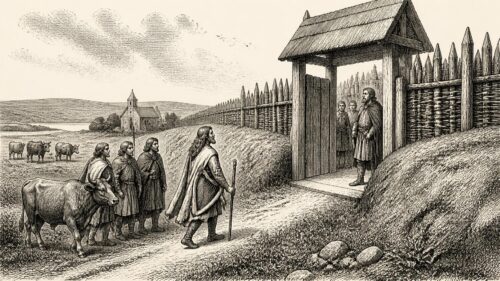
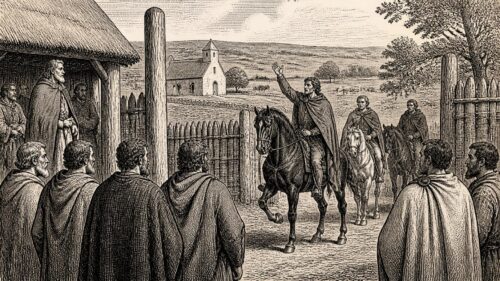
Further north, Ualgarc, king of Dartraige, was killed “by his own people”. Dartraige lay in the broad frontier world of modern Monaghan, Fermanagh and neighbouring districts, where the interests of Airgialla, northern Uí Néill rulers and local dynasties overlapped. The phrase does not tell us whether Ualgarc died in a coup, feud or wider conflict. It does, however, underline a recurring reality of tenth-century politics: royal authority was personal, kin-based and vulnerable. Kingship brought access to tribute and prestige, but it also made a ruler the focus of rivalry within his own people.
Fer Graidh, king of Cashel, likewise died at the hands of his own followers according to the Annals of Ulster. Cashel was the chief royal centre of the Eóganachta-associated kingship of Munster, and the killing came during a period when that province’s political balance was changing. It would be wrong to make 961 the beginning of the later rise of the Dál Cais: Mathgamain son of Cennétig did not emerge as king of Cashel until later in the decade. Nonetheless, Fer Graidh’s death belongs to the unstable background against which old Munster dynasties and ambitious rivals competed. The annals’ terse verdict—killed by his own—again puts internal division, not foreign invasion, at the centre of the story.
Churches, Learning and Local Continuity
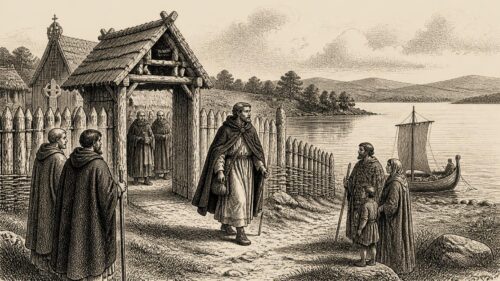
Amid these disruptions, the death of Conaing Ua Domnalláin, airchinneach of Clogher Mac Daiméne, was entered in the northern record. Clogher was an important ecclesiastical centre in Airgialla. An airchinneach, often translated “erenagh”, was not simply a parish priest in the later sense: the office involved the leadership and management of a church community and its lands, and could be deeply entangled with powerful local families. Conaing’s notice therefore marks the passing of a figure whose responsibilities joined religion, property, hospitality and regional influence.
The southern annals add a quieter ecclesiastical loss: Cathmug, bishop of Cork and abbot of Lismore, is recorded as having died in the entry headed 961 in the Annals of Inisfallen. The combination of titles points to the overlapping networks of church authority in Munster. Cork and Lismore were not remote spiritual islands; their communities possessed landed resources, cultivated learning, received travellers and participated in the politics of their surrounding kingdoms. Such notices are brief because annals assumed their original audiences understood the stature of the people named.
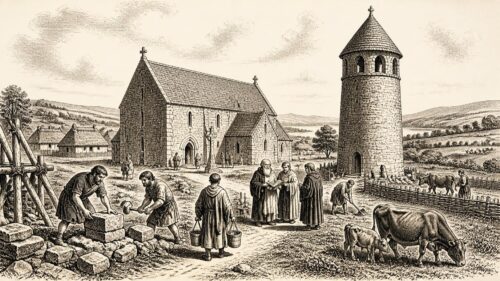
Monasteries and churches remained among the places where writing was produced, copied and preserved. They made the very record through which 961 is known. But their role should not be romanticised. Ecclesiastical sites were also estates, centres of craft and food production, places of assembly and repositories of portable wealth. Their leaders negotiated with kings; their tenants worked fields and tended animals; their learned personnel maintained Latin and Irish textual culture. The annals’ mixture of royal death, environmental calamity and clerical obituary reflects this interconnected world rather than separate “secular” and “religious” spheres.
Dublin at the Eastern Edge
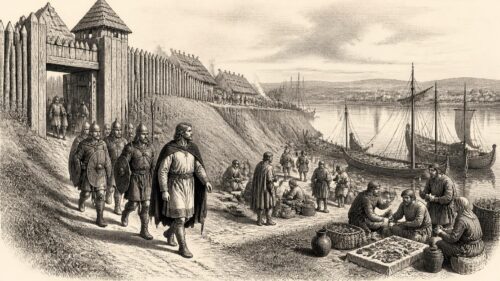
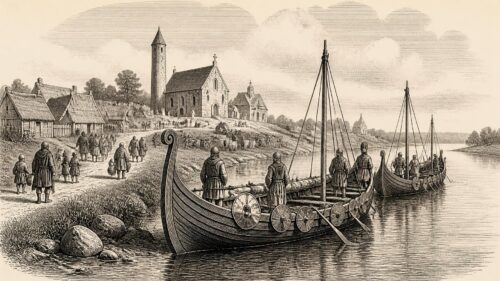
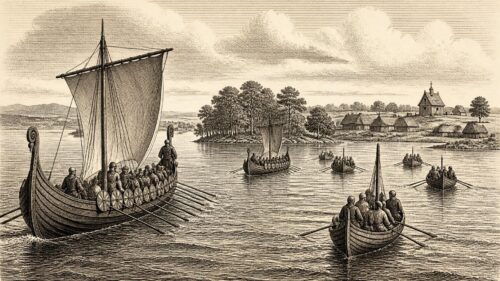
Áth Cliath marks the eastern limit of the fiery-arrow report. By this date Dublin was a fortified Hiberno-Norse town on the Liffey–Poddle confluence, rebuilt after the Scandinavian return of 917 and linked by sea to Britain, the Irish Sea world and more distant trading networks. Archaeology shows a community of merchants and craftspeople: shipwrights, metalworkers, comb-makers, woodworkers and textile producers, handling silver, coins and imported materials alongside goods from the Irish interior. The annal does not say that Dublin itself was struck, only that the devastation reached as far as Áth Cliath. Still, its mention locates the episode at the meeting point of Leinster’s countryside and an increasingly urban maritime economy.
Domnall ua Néill, king of Tara, was the dominant claimant to wider authority in Ireland at this time. His position, however, did not turn the island into a unified kingdom. He was an overking whose influence depended on kinship, hostages, campaigning, marriage alliances and the acknowledgement of lesser rulers. The deaths at Cashel, Dartraige and Uí Briúin Seóla show the limits of any ruler’s reach. In 961, the annals do not record a decisive all-Ireland battle or treaty. Instead, they preserve a more characteristic pattern: regional kingships exposed to internal violence, ecclesiastical offices maintaining local institutions, and a disaster remembered across Leinster to the threshold of Dublin.
A Year of Uneasy Memory
For that reason, 961 deserves attention not as a turning point invented after the fact, but as a sharply observed fragment of tenth-century life. Its extraordinary “fiery arrow” cannot be securely explained, and its mortality figure cannot be verified. Yet the entry conveys the vulnerability of people and animals in a largely agrarian society. The accompanying obituaries reveal a political order in which rulers could be removed by their own communities and churches remained crucial nodes of authority and record-keeping. Seen together, these notices offer an Ireland of regional complexity: fields and herds, lake kingdoms and frontier lordships, Cashel and Clogher, Leinster roads and Dublin’s waterside town—held in the annals by one alarming streak of fire.
Primary Sources
- The Annals of Ulster
- Part 6 of Annals of the Four Masters
- Annals of Inisfallen, Part 52
- Annals of Inisfallen
- The Annals of Tigernach
- Chronicon Scotorum
- CELT Project: Chronicon Scotorum
- Translated Texts at CELT
- Irish Texts at CELT
- Irish Annals Edition Directory
- Ua Néill, Domnall
- Fergal
- Mathgamain
- Amlaíb (Óláfr Godfridsson)
- Congalach Cnogba
- York Lost And Dublin Reorientated: Amlaíb Cúarán, 941–980
- Amlaíb Cuarán and the Gael, 941–981
- Dublin City Urban Archaeology Survey 1988
- Dublin Archaeological Background: The Discussion
- Woodstown Working Group Final Report
- Dublin Castle Highlights
- Logainmneacha na hÉireann: Cá Bhfuil a dTriall