Rebel Republic
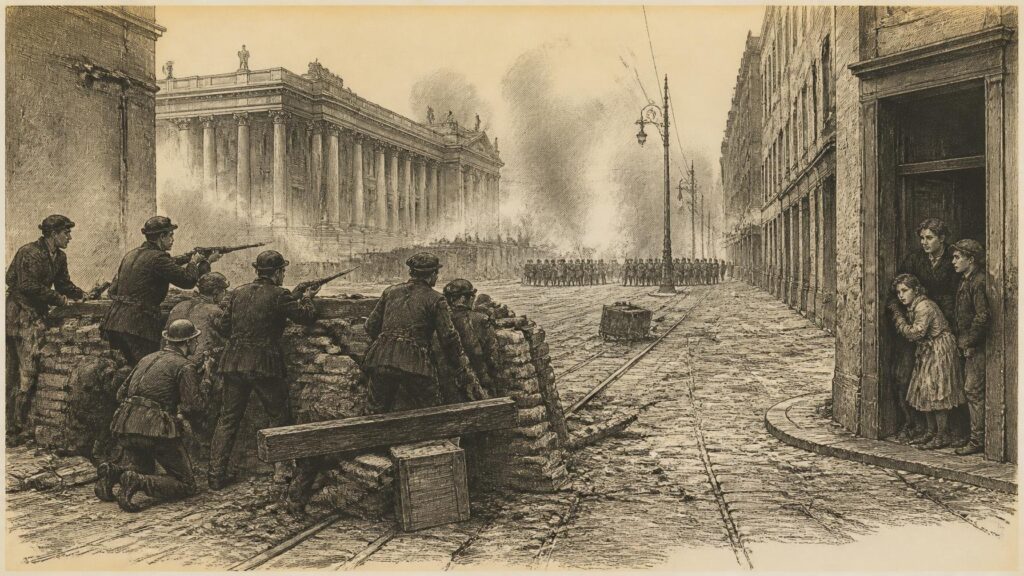
AI generated historical illustration, not a contemporary photograph.
At a Glance
The Easter Rising was a short, fractured and militarily defeated rebellion, yet it became one of the most consequential events in modern Irish history. Between Easter Monday, 24 April, and Saturday, 29 April 1916, Irish republicans, labour militants, nationalists and women auxiliaries challenged British rule in Dublin and at several smaller sites elsewhere. Its immediate outcome was destruction, death, surrender and severe repression. Its longer consequence was less direct but immense: it altered political language, created martyrs, discredited an established constitutional settlement for many people, and supplied a founding episode for the revolutionary years that followed.
Historical Setting
In 1916 Ireland remained within the United Kingdom. The constitutional question had nevertheless reached an extraordinary pitch. The third Home Rule Bill had received royal assent in September 1914, promising a devolved Irish parliament, but its operation was suspended at the outbreak of the First World War. Home Rule had divided Ireland profoundly. Many nationalists expected it to provide meaningful self-government; unionists, particularly in Ulster, regarded it as a threat to their political and religious position. Both sides had organised armed volunteer forces before the war: the Ulster Volunteer Force and, in response, the Irish Volunteers. Thus the Rising did not erupt into an otherwise peaceful constitutional landscape. It occurred in a society already militarised, politically polarised and subjected to wartime emergency rule.
The war intensified every uncertainty. John Redmond, leader of the Irish Parliamentary Party, called on the Volunteers to support Britain and the Allies. The majority followed him into the National Volunteers, though only a minority enlisted. A smaller body retained the name Irish Volunteers and rejected participation in the British war effort. That minority contained people of varied outlooks: cultural nationalists, advanced nationalists, Irish Republican Brotherhood members and idealists persuaded that a British war created an Irish opportunity. The 1916 insurgency was therefore not a popular mobilisation of all Irish nationalism. It was the work of a relatively small network operating within a wider field of competing Irish allegiances, including constitutional nationalism, unionism, imperial service, labour politics and pacifism. The Defence Forces historical survey notes both the 1914 Volunteers’ split and the small anti-war remnant from which the rising force was drawn.
Dublin’s labour conflict also mattered. The 1913 Lockout had exposed the antagonism between employers and organised workers, while James Connolly and the Irish Transport and General Workers’ Union built the Irish Citizen Army from workers who had defended themselves during that dispute. Connolly’s socialist politics cannot be reduced to a decorative contribution to a purely nationalist revolt. He envisaged national independence alongside a fundamental social transformation. Yet neither the Citizen Army nor the Irish Volunteers was ideologically uniform, and the Proclamation deliberately spoke in broad national terms. The Rising brought together people who shared a willingness to break British authority but did not hold an identical vision of the Ireland that might follow.
Secret Planning
The decisive planning body was the Military Council of the Irish Republican Brotherhood, a secret revolutionary organisation with long Fenian roots. Its members planned an armed rising without informing all of the bodies whose names, members or resources would be employed. Thomas Clarke, Seán Mac Diarmada, Patrick Pearse, Joseph Plunkett, Éamonn Ceannt and later Thomas MacDonagh formed its core; Connolly was brought into the plan after negotiations with the Citizen Army. The council’s secrecy was purposeful. Earlier Irish revolutionary ventures had been undermined by surveillance, informers and failed coordination. But secrecy also created a grave practical weakness: Eoin MacNeill, chief of staff of the Irish Volunteers, understood the Easter manoeuvres as defensive preparation and was not initially told that they concealed an imminent rebellion. The National Library of Ireland’s account of the preparations makes clear that even Denis McCullough, head of the IRB, was outside the final circle.
The organisers hoped for arms from Germany, then at war with Britain. Roger Casement, who had sought German assistance, attempted to prevent what he believed would be a hopeless rising when the expected arms shipment failed. The vessel Aud, carrying weapons, was intercepted and scuttled off the Kerry coast; Casement was arrested soon afterwards. These events did not merely deprive the rebels of guns. They helped trigger the crisis that unravelled the intended nationwide mobilisation. British intelligence and naval control constrained the enterprise, while the organisers’ ability to communicate securely with scattered Volunteer units proved limited. Later accounts sometimes turn the lost arms into a simple explanation for defeat. The evidence supports a more complicated conclusion: the rising was already dependent upon secrecy, uncertain mobilisation and a striking imbalance between its limited forces and the military power Britain could deploy.
MacNeill’s intervention was pivotal. On Saturday, 22 April, he learned more fully of the planned rising and the failure of the arms landing. He issued a countermand cancelling the Volunteer manoeuvres. Printed in the Sunday newspapers, it led many Volunteers across Ireland to stand down. The Military Council resolved to continue, postponing the outbreak until noon on Easter Monday so that couriers could reach those prepared to act. The postponement preserved the rising in Dublin but made an all-Ireland insurrection impossible. The National Library records both the publication of MacNeill’s countermand on 23 April and the Council’s decision to proceed the next day. Its exhibition account is especially useful because it preserves the contingency rather than presenting the event as an inevitable national awakening.
Republican Language
On Easter Monday, copies of the Proclamation of the Irish Republic were posted and read in central Dublin. Its authors addressed “Irishmen and Irishwomen”, proclaimed the right of Ireland’s people to ownership of Ireland, declared an Irish Republic and named a Provisional Government. It invoked the support of “gallant allies in Europe”, an unmistakable reference to Germany, but its language extended beyond military alliance. It promised religious and civil liberty, equal rights and equal opportunities, and spoke of cherishing all the children of the nation equally. The wording has endured because it could accommodate several traditions: republican sovereignty, democratic aspiration, cultural nationalism and labour-inflected social justice.
It is important, however, to distinguish text from achievement. The Proclamation was a revolutionary claim, not a constitution applied to a liberated territory. Its language did not erase the severe inequalities of contemporary Ireland or resolve differences among its signatories. Nor should it be treated as proof that the Rising was modern in every respect. The rebels’ political culture combined radical democratic assertions with religious imagery, martial honour, romantic nationalism and ideas about sacrifice that many modern readers find troubling. Its equal-citizenship language was genuine and historically important, but the document’s later constitutional prestige can make it tempting to read a settled programme into a proclamation written under clandestine wartime conditions. The Irish government’s 1916 Rising collection reproduces the central egalitarian clauses and provides useful context for their continuing public importance.
The physical production of the document also reveals the improvised character of the enterprise. It was printed in Liberty Hall on the press used by the Irish Transport and General Workers’ Union. A shortage of sufficiently large type meant that the upper and lower portions were set separately, producing the familiar variation in ink density. That material detail matters. The Proclamation was not an object emerging from a secure state apparatus; it was a hurried declaration made in a city the rebels could not expect to hold. Surviving copies, including one preserved by Trinity College Dublin after being taken from a city wall, are historical artefacts as well as national symbols. Trinity’s description of its copy reminds us that the document circulated amid posters, wartime recruitment appeals and the competing visual languages of empire and rebellion.
Dublin Garrisons
At noon on 24 April, the insurgents occupied a series of buildings and strongpoints in Dublin. The General Post Office on Sackville Street, now O’Connell Street, served as the headquarters of the Provisional Government. Pearse, Connolly, Clarke, Mac Diarmada, Plunkett and other headquarters staff operated there. Elsewhere, Thomas MacDonagh’s men held Jacob’s Biscuit Factory; Éamonn Ceannt commanded at the South Dublin Union; Edward Daly held the Four Courts area; and Eamon de Valera’s battalion occupied Boland’s Mills. The Citizen Army, under Michael Mallin and Constance Markievicz, occupied St Stephen’s Green and the Royal College of Surgeons. Seán Heuston’s small force held the Mendicity Institution near the Liffey.
These were not random seizures. The sites sought to command roads, bridges and approaches into central Dublin, to impede troop movements and to create defensible enclaves. Yet the plan had serious geographical limitations. Dublin Castle, the seat of British administration, was not effectively captured. Major railway termini and other communications were not all secured. The rebels held separated positions rather than a continuous territory, and many were difficult to reinforce or resupply. Their strongest asset was the determination and local knowledge of small garrisons; their weakness was their inability to turn occupation into control of a large modern city. The Rising was consequently a set of related sieges rather than a conventional campaign for Dublin.
Numbers are often repeated with unwarranted precision. Contemporary reports, later veteran testimony and official estimates differ, while the countermand made mobilisation uneven. A commonly accepted broad estimate is that a little over one thousand insurgents were active in Dublin, facing rapidly expanding British forces numbering many thousands. Fearghal McGarry’s scholarly overview stresses that the rebels faced more than 20,000 British soldiers during the week and had little prospect of a purely military victory. The Oxford Bibliographies survey is a prudent guide to the scale of the confrontation, but figures should be understood as approximations shaped by changing deployments and imperfect records.
Urban Warfare
The first day brought surprise, confusion and uneven resistance. Some British personnel were caught off guard; others, including troops in Trinity College, soon became important parts of the Crown response. Reinforcements arrived, artillery and machine guns were brought into use, and the military gradually isolated the rebel positions. The city’s layout turned streets, quays, railway lines and commercial premises into tactical obstacles. Civilians found themselves trapped between armed groups, unable to obtain reliable information and exposed to fire, shelling and the spread of flames. The popular shorthand of a heroic contest between rebels and empire can obscure this central fact: Dublin’s ordinary inhabitants bore a large share of the danger.
The GPO headquarters became the Rising’s most resonant site, but it was not the only severe battlefield. Heuston’s small garrison at the Mendicity Institution held up British troop movements for days before surrendering. At Mount Street Bridge, Volunteer positions inflicted heavy casualties on soldiers advancing from Kingstown, now Dún Laoghaire, though the rebel force could not retain the position indefinitely. At the South Dublin Union, Ceannt’s garrison resisted attacks across a sprawling institutional complex. The Four Courts and North King Street district saw sustained fighting, while the forces in Boland’s Mills prevented an easy route into the city centre. Such episodes show why the rising lasted almost a week despite its weak strategic position.
British artillery was decisive, particularly against the headquarters area. The gunboat Helga fired from the Liffey; field guns placed around the city struck buildings in and near Sackville Street. Fires engulfed much of the commercial centre, including the GPO. The destruction was not a side issue. It transformed the material experience of the rebellion: streets filled with rubble, homes and shops were damaged, livelihoods disappeared and families were displaced. It also affected political perception. To some Dubliners, the rebels had brought ruin upon the city; to others, the scale of official bombardment and later punitive measures helped recast the insurgents as victims of disproportionate power. Neither response can be assumed for all inhabitants or for all moments of the week.
Civilian Experience
Any serious account must resist treating civilians merely as scenery behind famous leaders. The dead included children, women and men with no military role, as well as British soldiers, police and insurgents. Establishing a final total has been difficult because records vary in definition and completeness. Later research has generally placed the total fatalities at roughly 485, with civilians forming the largest single category; older official lists were incomplete. The Military Archives’ records and roll material demonstrate both the richness and limits of official reconstruction. A contemporary press-cutting preserved by the Bureau of Military History itself warned that early official casualty figures were obviously inadequate. That archival item is a caution against using casualty totals as if they were settled beyond dispute.
People experienced Easter Week through immediate necessities: finding food, shelter, relatives and a route through dangerous streets. Some watched from windows; others sheltered in cellars. Some assisted wounded people or carried messages. Some looted shops amid the disorder, behaviour that attracted intense condemnation in contemporary accounts and later nationalist retellings. Looting should neither be exaggerated into a portrait of a lawless city nor ignored because it complicates commemorative narratives. Wartime deprivation, opportunity, fear and the collapse of routine policing all formed part of the context. UCD’s research on crime and society in Dublin notes that newspapers and witness statements reveal both the disorder and the efforts of people navigating it.
Public feeling was not fixed. There were hostile comments directed at captured rebels, anger at ruined property and widespread anxiety about casualties. There were also expressions of sympathy, admiration or curiosity. To say that the Rising was initially unpopular is an oversimplification if it suggests a measurable and unanimous verdict. There was no opinion polling, and people’s views could change rapidly as news emerged of executions, mass arrests, deportations and threatened conscription. The most secure conclusion is that insurgents did not begin Easter Week with a settled popular mandate. The political meaning of their action was remade in its aftermath, in conditions that they did not fully control.
Women Participants
Women were integral to the Rising, though later imagery frequently placed them at its margins. Cumann na mBan members carried dispatches, organised food and medical supplies, gathered intelligence, treated casualties and, in some cases, bore arms within the garrisons. The Irish Citizen Army also included women in conspicuous military and political roles. Constance Markievicz served at St Stephen’s Green and the College of Surgeons; Dr Kathleen Lynn was the Citizen Army’s chief medical officer; Elizabeth O’Farrell carried communications from the GPO and played a vital part in the surrender process. Their work was not all identical, and it should not be categorised as merely supportive where evidence shows operational responsibility.
At the same time, women’s participation was constrained by gendered assumptions inside the movement. Individual commanders differed, and access to particular posts could be contested. The evidence is clearer about wide involvement than about a single uniform female experience. The Bureau of Military History collected many retrospective statements, including women’s testimony, but these must be read critically. The Bureau was established decades after the events, and recollections were shaped by later political loyalties, personal memory and the desire to establish service. They are invaluable sources, especially when compared with contemporary records, but not verbatim windows onto 1916. The Military Archives’ introduction to the Bureau explains the breadth of testimony and the subjects it covers.
O’Farrell’s partial absence from the famous surrender photograph has become a powerful symbol of women being “airbrushed” from public memory. The phrase is useful if it encourages scrutiny of visual framing and later commemoration, but it ought not to imply that women were wholly forgotten. They left records, appeared in public accounts and participated in revolutionary politics after 1916. The historical task is more demanding: to recover the variety of their actions without using a few celebrated names as substitutes for a broader social history. UCD’s centenary work on women of 1916 provides a valuable corrective by stressing women’s roles across garrisons, courier networks and medical work.
Provincial Actions
The Rising was chiefly a Dublin event, but it was never exclusively one. The countermand severely curtailed mobilisation across the country. In County Galway, Volunteers under Liam Mellows engaged Crown forces around areas including Carnmore and Athenry before dispersing. In County Wexford, small groups mobilised but did not sustain major operations. In Cork, confusion over contradictory orders prevented the planned mobilisation. In Kerry, the failed arms operation and arrests helped extinguish any prospect of a coordinated rising. These actions demonstrate the national reach of revolutionary networks while confirming the organisational collapse produced by the countermand and the loss of German weapons.
The most significant fighting outside Dublin took place at Ashbourne, County Meath, on 28 April. Volunteers led by Thomas Ashe attacked Royal Irish Constabulary barracks and fought a larger force sent from nearby Slane. The engagement resulted in deaths on both sides and concluded with the surrender of the police. It was tactically striking but could not alter the overall outcome once Dublin headquarters had surrendered. The Military Archives describes Ashbourne as the only major battle outside Dublin during the Rising. Its account of the battle is a useful institutional starting point, although local actions should be read alongside wider scholarly work rather than isolated as regional legend.
The uneven provincial record complicates later national myth. It would be wrong to describe the Rising as an island-wide military revolt in the ordinary sense. It would also be wrong to confine it to a few Dublin streets. Its intended scope was national; its effective operations were overwhelmingly urban and Dublin-centred, with important exceptions. This distinction between intention and outcome is essential. Revolutionaries claimed national authority, but their capacity to enact it varied sharply by locality, communication and the decisions of individuals who did or did not mobilise.
Surrender Decision
By Friday, 28 April, the GPO was untenable. Shelling and fire forced the headquarters garrison to evacuate through surrounding streets to Moore Street. Connolly had been badly wounded. Pearse, confronting the prospect of further civilian death and the collapse of the main position, agreed to surrender. On Saturday, 29 April, he issued the order directing the garrisons to lay down their arms. The surrender did not arrive everywhere at once, and some commanders initially doubted or resisted it. The image of a single command ending the revolt conceals the practical difficulties of reaching scattered forces in a damaged and occupied city.
Pearse’s surrender order cited the desire to prevent further slaughter of Dublin’s citizens. This language has often been treated either as self-evidently noble or as a retrospective excuse. The documentary setting suggests a more restrained judgement. Civilian casualties and urban destruction were real; the military situation was hopeless; the leadership had responsibility for men and women in separated garrisons. Surrender was neither an abandonment of republican conviction nor evidence that the Rising had been designed merely as theatre. It was the decision of commanders facing defeat and a worsening humanitarian crisis.
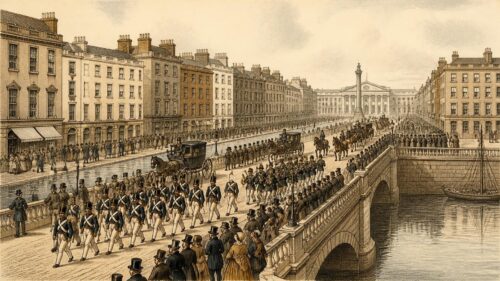
British troops took prisoners in large numbers. The treatment of captives was uneven, and crowds sometimes gathered as columns were marched away. The event then entered a second phase: investigation, detention, courts martial and selective execution. In political terms, the end of fighting did not settle the Rising’s meaning. In some respects it began the process through which the defeat would acquire a greater historical force than the rebellion’s battlefield achievement.
Military Justice
The British authorities acted under martial law and wartime emergency powers. Field general courts martial tried 159 men and one woman in the three weeks after the Rising. Proceedings were held in camera. Defendants lacked legal representation, could not call evidence in the ordinary manner, and faced tribunals composed of military officers rather than legally trained judges. The National Archives of Ireland’s court-martial project records that 90 death sentences were passed and 15 were carried out. Its database introduction is indispensable primary-source-oriented evidence for the procedures and their deficiencies.
Fifteen leaders were executed by firing squad between 3 May and 12 May 1916: Thomas Clarke, Patrick Pearse, Thomas MacDonagh, William Pearse, Joseph Plunkett, Edward Daly, Michael O’Hanrahan, John MacBride, Éamonn Ceannt, Michael Mallin, Seán Heuston, Con Colbert, Thomas Kent, Seán Mac Diarmada and James Connolly. Roger Casement, arrested before the Rising, was executed by hanging in London later that year. The list should not be recited as if it represented the whole human cost of repression. Thousands were arrested or interned, including people with tenuous connections to the rebellion. But the executions were politically distinctive because of their sequence, secrecy and symbolic potency. The Military Archives executed-leaders register supplies dates, affiliations and places of death.
Connolly’s execution, carried out after he was seriously wounded, became particularly notorious. The often repeated account that he was tied to a chair is supported by substantial contemporary and later evidence, though the emotional power of the image has encouraged embellishment. Historians should neither dismiss such testimony merely because it is memorable nor transform it into unrestricted legend. More broadly, the executions were not the sole cause of political change. They interacted with deportations, wartime hardship, the failures of constitutional politics, opposition to conscription and the growth of Sinn Féin. Yet they provided an unmistakable focus for grief and anger, especially because the authorities continued shooting prisoners day after day after military danger had ceased.
Political Aftermath
The Rising did not immediately create an independent Irish state. That claim would erase the complex years from 1916 to 1923: the reorganisation of republican politics, the 1918 general election, the establishment of Dáil Éireann, the War of Independence, the Anglo-Irish Treaty, partition and civil war. Still, 1916 changed the political landscape. The Irish Parliamentary Party, whose strategy had rested on Home Rule within the United Kingdom, became increasingly vulnerable. Sinn Féin, inaccurately blamed by many contemporaries for organising the Rising, became associated with its prisoners and its republican legacy and won a sweeping electoral victory in much of Ireland in 1918.
Internment mattered in this transformation. Prison camps, including Frongoch in Wales, brought together activists, facilitated networks and created a shared experience of repression. The authorities’ broad arrests could make people who had not taken part feel implicated in a collective political grievance. This was not an automatic conversion of the population to militant republicanism; many prisoners held varied views, and Irish politics remained divided. But the policy enlarged the Rising’s social and political reach. The National Archives of Ireland notes the scale of arrests and detentions, as well as the connection between repression, later disillusionment and electoral change.
The broader European war also remained central. Irish men continued to serve in British uniform, and many Irish families mourned losses on the Western Front, at Gallipoli and elsewhere. Their experience must not be written out of the nation’s story to make room for the Rising. In 1916, Irish political identities overlapped and conflicted: a person might support Home Rule, have relatives in the British Army, sympathise with labour, oppose the rebellion and later oppose the executions. The eventual dominance of the Rising in southern Irish public memory was historically produced, not preordained.
Memory Making
Commemoration transformed the Rising from contested event into national touchstone. The dead leaders acquired a martyrological status, aided by funeral imagery, prison letters, family testimony, nationalist ceremony and the retrospective knowledge that an independent state would emerge. Pearse’s language of sacrifice was particularly susceptible to devotional interpretation. Yet it is analytically unsafe to say simply that Pearse “wanted” death or that all participants sought martyrdom. Some leaders certainly used sacrificial rhetoric; many fighters concentrated on immediate military tasks, survival and comradeship. Motives differed between and within garrisons.
Folklore has attached itself to 1916 with unusual tenacity: stories of prophetic poems, whispered last words, miraculous courage and universally hostile or universally supportive Dublin crowds. Such stories may reveal how communities made sense of trauma, but they are not automatically evidence of what happened. The historical method requires comparison between contemporary newspapers, official reports, diaries, photographs, court-martial documents and later witness statements. A later memory can be deeply meaningful and still be inaccurate in detail. Conversely, an official record may be incomplete, self-serving or silent about experiences that witnesses preserve. No single category of source has a monopoly on truth.
The Bureau of Military History illustrates this challenge. Created by the Irish state between 1947 and 1957, it gathered nearly 1,800 witness statements concerning the revolutionary period. The collection is extraordinary: it preserves recollections from Volunteers, women activists, members of the Citizen Army, police and others. But its dates matter. A witness speaking thirty years after Easter Week did so after independence, civil war, state formation and decades of commemoration. Statements require corroboration and contextual reading. Their value lies not only in factual detail but also in showing how participants understood their past.
Contested Legacy
The Rising’s legacy cannot be confined to celebration. It poses difficult questions about political violence, democratic consent, civilian vulnerability and historical inheritance. Its leaders proclaimed a republic without having received an electoral mandate for rebellion. Their decision exposed Dubliners to a conflict they had not chosen. At the same time, they operated under a governing system in which Irish constitutional aspirations had repeatedly been delayed, constrained or subordinated to imperial priorities. To acknowledge the ethical problem of insurgent violence is not to deny the coercive realities of British rule; to recognise those realities is not to make civilian suffering politically irrelevant.
Interpretations have shifted with Irish politics. In the early Free State, official commemoration balanced reverence for 1916 with anxiety about militant republicanism. Later decades sometimes elevated the Rising into a near-sacred origin story, particularly in a state seeking symbols of unity. The Troubles in Northern Ireland complicated public remembrance by making any celebration of armed rebellion politically charged. Centenary commemorations in 2016 brought a wider and more plural historical approach, incorporating civilians, women, British soldiers, unionists, Irish service in the First World War and local histories alongside republican commemoration. Trinity College Dublin’s archival exhibition explicitly described the Rising as pivotal but also acknowledged its contentious legacy.
A mature historical account does not need to settle whether the Rising was simply justified or unjustified, successful or unsuccessful. It was unsuccessful in its immediate military purpose and successful in creating political consequences its organisers could neither wholly foresee nor control. It contained democratic ideals and authoritarian methods; social possibility and social limitation; courage, loss and miscalculation. Its force in Irish history lies partly in those contradictions. The Easter Rising remains important not because it supplies one uncontested national lesson, but because it obliges Ireland to confront how nations are imagined, how states use violence, and how memory turns a defeated event into a beginning.
Source Practice
The documentary record supports confidence about the broad chronology, principal participants, locations, surrender and executions. It supports more cautious conclusions about numbers, individual motives, crowd opinion and particular episodes of violence. Contemporary sources were produced in wartime and often under censorship, fear or partisan pressure. Official British records may prioritise security and prosecution; republican records may privilege commitment and sacrifice; later recollections may combine accurate observation with retrospective interpretation. Where sources conflict, uncertainty is not a defect to be concealed but part of the history itself.
For that reason, the strongest approach to 1916 is comparative. The Proclamation establishes what its signatories publicly claimed. Court-martial files reveal how the state punished them. Witness statements recover participant experience while demanding critical reading. Diaries, photographs and local accounts illuminate civilian life. Scholarly synthesis helps identify patterns without converting commemoration into evidence. The Rising was real enough in its dates, deaths and ruined streets; its meaning, however, was never fixed on Easter Monday. It was argued over in 1916, fought over in the revolutionary decade and continues to be reassessed in archives, classrooms, museums and families.