Tadc’s Dun Cow Penance900 CE
In 900, Irish annals recorded environmental strain, political deaths, ecclesiastical life and raiding across a fragmented island. A rainy year and scarcity among cattle, with related references to bread shortage, exposed dependence on pastoral and arable production, though they do not prove famine. Tadc son of Conchobor, overking of the three Connachta, died after penitential renunciation associated with Ciarán’s Dun Cow; Mac Étig of Dál Araidi also died. Scandinavian raiders plundered Kildare, a wealthy sacred centre. Deaths of prominent churchmen and an Alban king further reveal Irish Sea connections, while Clonmacnoise’s prestige linked lordship, learning and religious authority in Ireland.
Dateline
The surviving record for 900 is spare, but unusually revealing. It does not preserve a great battle, a royal assembly or a major treaty. Instead, the annals place side by side rain, failing livestock, a raid on Kildare, and the deaths or religious retirements of rulers and churchmen. That combination gives the year its character. Ireland was a patchwork of kingdoms, ecclesiastical federations and agricultural communities, joined by sea-routes and riverways but governed locally. In such a world, a wet season or shortage among cattle could be as consequential as a clash of armies.
There is an important warning about dating. The Annals of Ulster head their entry “AD 899 alias 900”, a reminder that annalistic year-numbering does not always coincide neatly with the modern calendar. Their notices of a rainy year and great scarcity among cattle belong to that rubric. Chronicon Scotorum, meanwhile, assigns the plundering of Cell Dara, Kildare, to 900, while the Annals of Inisfallen record several deaths and religious events under the same year. These are securely connected with the annalists’ 900, but few can be fixed to a particular day or season.
Rain, Cattle and Food
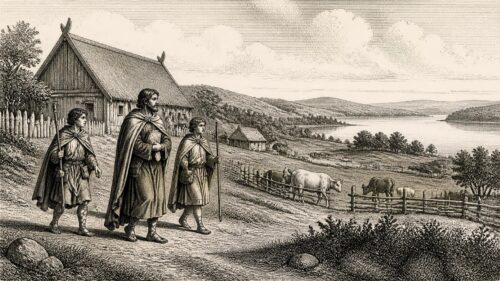
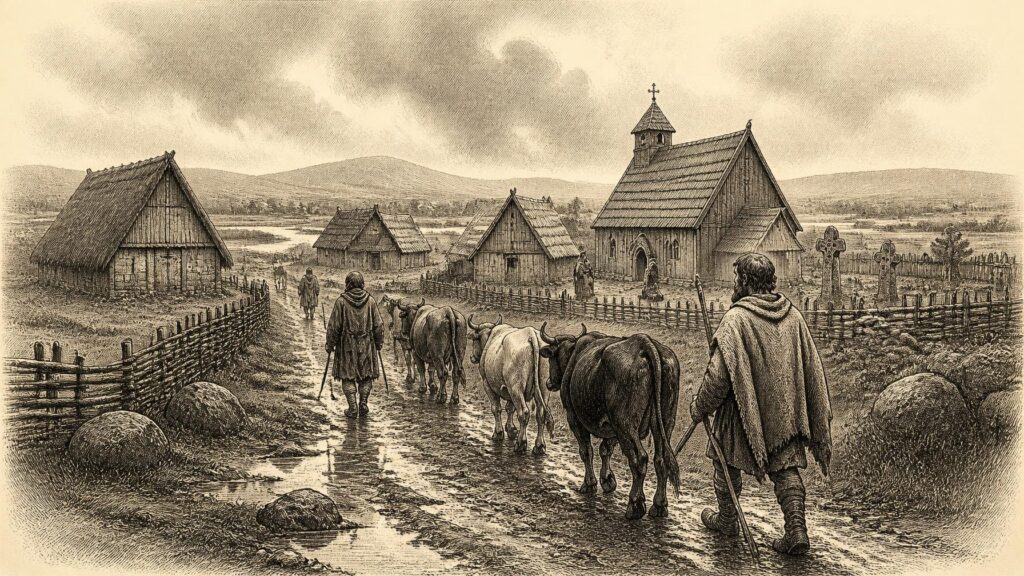
The most immediate testimony comes from the Annals of Ulster: “A rainy year”, followed by “Great scarcity affected the cattle.” The entries do not explain whether disease, poor pasture, flooding, failed fodder, disruption of movement, or a combination of these lay behind the shortage. It would be unsafe to turn the notice into a modern weather reconstruction. Yet its importance is plain. Cattle were not merely meat on the hoof. They supplied milk and dairy produce, hides, traction and breeding stock; they also remained a principal measure of wealth and a means through which rents, tribute, compensation and political loyalty could be expressed.
For ordinary households, whose work revolved around herding, dairying, sowing grain, repairing boundaries and preserving food, livestock scarcity could have consequences far beyond the byre or pasture. Fewer healthy animals meant less milk, poorer prospects for winter provisioning and diminished resources with which to meet obligations to a lord or church. The related annalistic tradition in Chronicon Scotorum places a “rainy year” and “shortage of bread” in its preceding annal-year, 899. Taken cautiously, these notices suggest that the turn of the century was remembered as a period of pressure on both pastoral and arable production rather than as an isolated inconvenience.
That does not mean famine can be claimed for 900. The sources do not say so, and they do not describe mass mortality. But they do show that environmental conditions entered the political record when they threatened the productive base of society. The annalists were recording a kingdom’s practical anxieties as well as its kings and clerics.
A King of Connacht Renounces the World
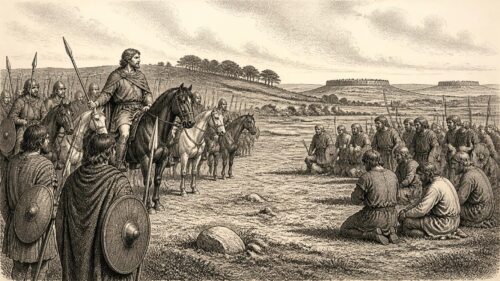
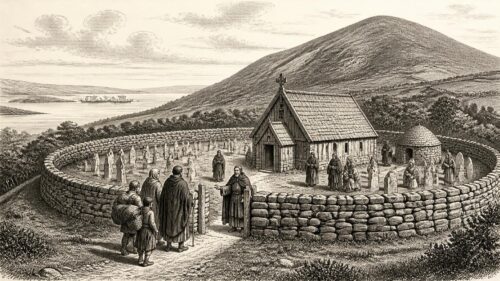
The most distinctive Irish notice for the year concerns Tadc son of Conchobor, king of the three Connachta. The Annals of Ulster say that he “rested after prolonged suffering”. The Munster-centred Annals of Inisfallen add a striking detail: Tadc had renounced the world on the hide of Ciarán’s Dun Cow. The phrase is difficult for a modern reader, but its force is clear enough. In his final illness or retirement, a regional king was associated with a penitential religious act and with the revered tradition of Ciarán of Clonmacnoise.
This was more than private piety. Kingship and church were deeply entangled in early medieval Ireland. Rulers endowed churches, sought the protection and prestige of saints, and dealt with ecclesiastical communities that were themselves landholders, political actors and custodians of learning. A king’s renunciation could help shape the memory of his death: not simply the end of a lordship, but a final turning away from worldly status. We should not imagine a formal abdication unless a source says so. Nevertheless, the wording chosen by Inisfallen shows that Tadc’s end was remembered through the language of penitence rather than violence.
Connacht itself was no unitary state. “The three Connachta” was an overkingship embracing competing dynastic interests across the west and north-west. Tadc’s death therefore mattered beyond one household, even though the annals do not set out the succession in this year’s entries. Its significance lies partly in contrast with the preceding years, when Connacht had faced expeditions and the taking of pledges by Flann Sinna, the Uí Néill overking based in Mide. In 900, the record marks transition and vulnerability rather than a decisive settlement.
Losses in the North-East
Another royal death concerned Mac Étig, son of Lethlabar, king of Dál Araidi. This kingdom lay in the north-east, within the wider and frequently contested political world of Ulaid. Its rulers had to contend with neighbouring dynasties, internal rivalries and the continuing reach of seaborne forces operating around the northern coasts and loughs. The annals record Mac Étig’s death without telling us its cause, successor or immediate consequences. That silence matters: it limits what can responsibly be said. Still, the entry is evidence that the regional kingship of Dál Araidi remained a recognised political office at the beginning of the tenth century.
Across the North Channel, the death of Domnall son of Constantine, king of Alba, was also noted in Irish annals. His inclusion is a small but valuable sign of the connected Gaelic and Scandinavian-influenced world around the Irish Sea. Ireland’s rulers and churchmen did not inhabit an enclosed island history. Political movements, dynastic connections, raiding fleets, pilgrims, clerics and news travelled between Ireland, western Britain and Alba. The notice does not establish an Irish intervention in Scottish affairs in 900; it shows instead that the death of an Alban ruler was considered worth entering in an Irish chronicle.
Kildare Plundered
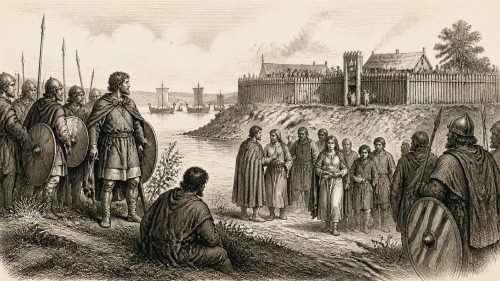
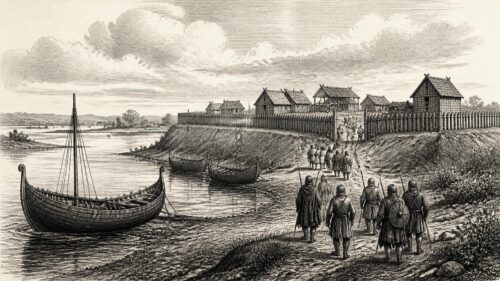
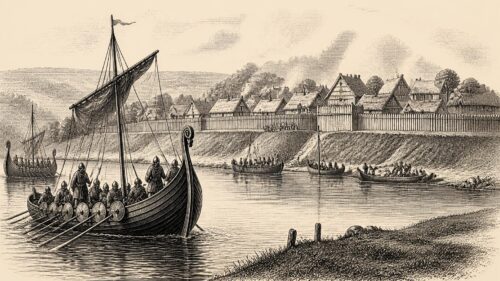
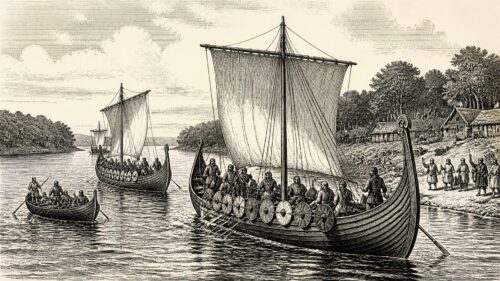
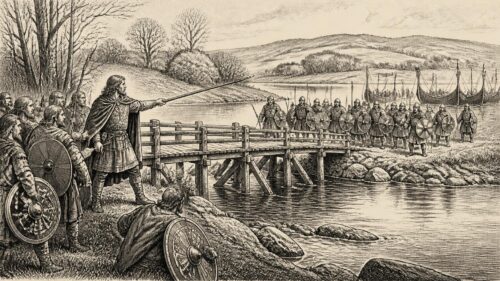
Chronicon Scotorum records that Cell Dara, Kildare, was plundered by heathens. It gives no date within the year, no names for the raiders, no casualty total and no inventory of losses. “Heathens” was the annalists’ conventional term for Scandinavian raiders, but the terse entry cannot identify the particular fleet or leader. What can be said is that Kildare was a prize of exceptional symbolic and material value. Associated with Brigid and Conleth, it was one of Ireland’s greatest ecclesiastical centres, with a large dependent community, landed resources, sacred treasures and visitors moving through it.
The attack should not be treated as a sudden return of Viking activity after a peaceful interval. The late ninth century had seen fluctuating Scandinavian power in Ireland: divisions among the foreigners of Dublin, attacks on major churches, alliances between Irish rulers and Scandinavian groups, and campaigns against them. In 893 one annal says that heathens departed Ireland, but other records show that this did not end seaborne raiding or Scandinavian political activity. The raid on Kildare in 900 belongs to that unstable setting. It also anticipates, without causing, the better-known expulsion of the Dublin longphort by Leinster and Brega forces in 902.
For Kildare’s community, plundering could mean the seizure of portable wealth, foodstores, livestock and captives as well as damage to buildings. Yet none of those outcomes should be asserted for this individual raid without evidence. The larger point is secure: an ecclesiastical settlement was simultaneously a sacred place, a centre of authority and an economic concentration, making it attractive to armed raiders and politically significant to those who defended or patronised it.
Churchmen and Sacred Landscapes
The year’s ecclesiastical notices reach from Ulster to Munster and the midlands. The Annals of Ulster record the death of Maenach son of Caemán, abbot of Damlíag. Chronicon Scotorum records the repose of Máel Brigte son of Proilech, chief bishop of Mumu. The Annals of Inisfallen remember Fíngen, an anchorite from Munster, who died at Clonmacnoise. These are not interchangeable titles. Abbot, bishop and anchorite denote different kinds of ecclesiastical standing, though one individual might combine spiritual, administrative and political authority.
Fíngen’s death at Clonmacnoise is especially suggestive. The great Shannon monastery was a centre of worship, burial, scholarship and dynastic patronage, drawing people from far beyond its immediate territory. Its association with Tadc’s final renunciation in the same annal reinforces the cultural reach of Ciarán’s community. Such centres were not isolated retreats. They stood amid settlements of craftspeople, tenants, dependants and travellers, while their churches, manuscripts, relics and learned personnel made them repositories of both spiritual and worldly prestige.
Learning continued despite insecurity. The very annals that preserve the raid on Kildare and the scarcity among cattle are products of literate ecclesiastical culture, compiled and copied over generations. They preserve formulaic notices of death, weather and conflict, but also distinctive phrases of devotion and memory. Their brevity should not be mistaken for indifference. To enter a king’s penance, an abbot’s death, a rainy year or a cattle shortage was to judge those things worthy of collective remembrance.
A Year of Exposure
For Ireland in 900, the evidence offers no single national narrative. Flann Sinna remained the leading Uí Néill ruler, but his authority depended on relationships with powerful provincial and local kings. Tadc’s death exposed a Connacht overkingship to succession politics; Mac Étig’s death removed a king of Dál Araidi; Kildare’s plundering demonstrated the vulnerability of even the most prestigious churches. Above all, rain and cattle scarcity reveal how closely political strength rested on productive countryside.
The year is therefore best understood as one of exposure rather than transformation. Its firmly attested events are modest in scale when compared with later tenth-century battles, yet they disclose the foundations on which those later struggles would be fought: livestock and grain, church wealth and sacred legitimacy, regional kingship, Irish Sea connections, and the ability of raiders to strike valued settlements. In 900, the annals record a society enduring pressure, mourning prominent figures and continuing to organise its memory through the intertwined worlds of lordship and faith.
Primary Sources
- The Annals of Ulster: Year U900
- Chronicon Scotorum: Annals CS897–CS910
- Chronicon Scotorum: Annals CS895–CS899
- Annals of Inisfallen: Annals AI900–AI909
- Annals of Inisfallen: Digital Edition and Introduction
- Vikings in Irish Chronicles, 794–902: Data
- Annals of the Four Masters, Volume 2 English Translation
- The Archaeology of Livestock and Cereal Production in Early Medieval Ireland, AD 400–1100
- The Archaeology of Livestock and Cereal Production in Early Medieval Ireland, AD 400–1100 (PDF)
- Early Irish Farming: A Study Based Mainly on the Law-texts of the 7th and 8th Centuries AD
- Reflections on Kingship, the Church and Viking-Age Silver in Ireland
- High Crosses
- Clonmacnoise Monastic Site
- County Kildare Urban Archaeology Survey
- Kildare
- The Vikings in County Kildare
- St Brigid’s Cathedral Before the Normans
- The Vikings in Ninth-Century Ireland: Sources and Settlements
- Vikings in Early Medieval Ireland: Church-Raiding, Politics and Kingship
- Animals and the Economy of Medieval Ireland: A Zooarchaeological Analysis of the Faunal Remains from Caherconnell Cashel, Co. Clare
- Changing Human-Cattle Relationships in Ireland: A 6000-Year Isotopic Perspective
- The Medieval Walled Towns of Kildare