Cenn Fuait and Dublin917 CE
In 917, amid severe frost, animal mortality and portents recorded by annalists, related Scandinavian fleets led by Sitriuc and Ragnall ua Ímair returned to Ireland. Munster forces inflicted notable defeats, while high king Niall Glúndub campaigned in Mag Femen, fighting the invaders on 22 August without destroying them. Niall sought Leinster’s aid, but Sitriuc routed its army at Cenn Fuait, killing King Ugaire, lesser rulers and a leading bishop. The victory shattered Leinster’s leadership; Kildare was subsequently plundered. Sitriuc then forcibly seized Dublin, restoring Uí Ímair power and establishing a durable maritime, military and economic centre on Ireland’s eastern seaboard.
Dateline
For Ireland, 917 is conventionally remembered as the year in which Sitriuc, grandson of Ímar, regained Dublin for the Scandinavian dynasty later called the Uí Ímair. It was also a year of hard weather, losses among livestock and wildlife, sharp regional fighting, and a disastrous defeat for Leinster. Yet the evidence needs careful handling. Medieval Irish annals do not always place events under identical year-headings: the Annals of Ulster label this sequence “916 alias 917”, while the later Annals of the Four Masters place much of it under 915. Modern synchronised chronology conventionally assigns the campaign to 917. One date is unusually precise: Niall Glúndub’s army was at Topar Glethrach in Mag Femen on 22 August.
Fleets on Two Coasts
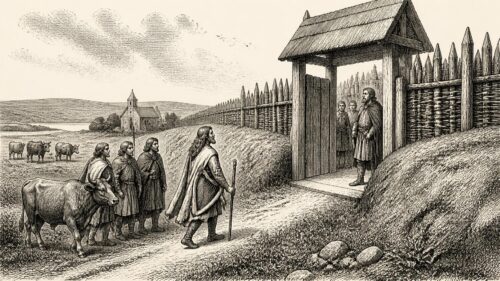
The year opened, or at least is introduced in the annalistic record, with a remarkable report of cold. Snow, extreme frost and “unnatural ice” made major lakes and rivers passable. The Annals of Ulster say that cattle, birds and salmon died; the southern-focused Annals of Inisfallen likewise records a mortality among cattle and birds, so severe that scarcely a blackbird or thrush was heard. For a society dependent on herds, dairy produce, seasonal movement and riverine food, this was no decorative notice. It describes environmental stress that could affect household stores, breeding stock, travel, fishing and the resources with which rulers fed followers.
The same annal also reports spectacular signs in the sky: comets, a fiery mass moving eastward over the sea, and thunder. These cannot responsibly be identified now as a particular astronomical or meteorological phenomenon. What matters historically is that the annalist regarded them as portents worthy of record in a year of invasion and killing. Weather, animal mortality and celestial disturbance were not separate categories in the moral imagination of an early medieval chronicler. They formed part of a troubled landscape in which human conflict was understood.
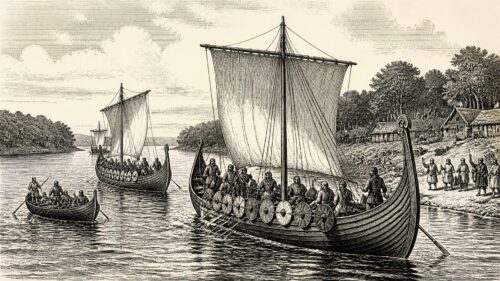
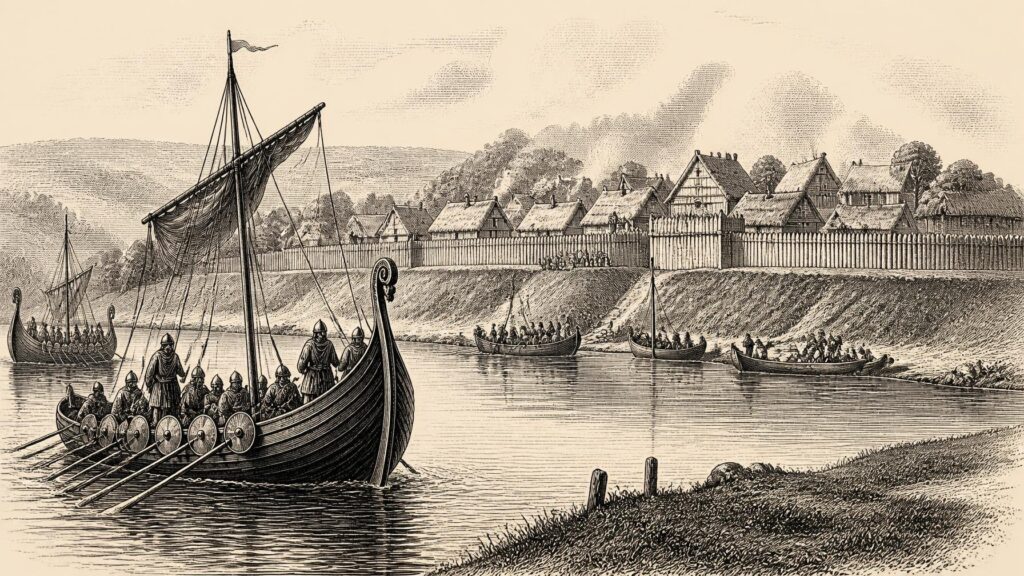
Into that landscape came two related fleets. Sitriuc ua Ímair landed at Cenn Fuait, described as being on, or towards, the coast of Leinster. Ragnall ua Ímair arrived with another fleet and moved against the foreigners of Loch Dá Chaech. The annals do not provide a narrative of their departure, ship numbers, or the size of their crews. Nor should “the foreigners” be treated as a single, uniform people: the sources use several inherited labels, including “heathens”, “dark foreigners” and simply foreigners, reflecting the vocabulary and viewpoint of Christian Irish writers rather than a straightforward ethnic census.
Even so, the co-ordinated appearance of Sitriuc and Ragnall reveals a political project larger than a fleeting raid. Both were grandsons of Ímar and members of a dynasty active around the Irish Sea. Their fleets could link coastal Ireland to wider Scandinavian and insular networks of movement, warfare and exchange. The return followed the expulsion of Dublin’s Scandinavian rulers in 902, but 917 was not merely a restoration of an abandoned camp. It marked the recovery of a strategically placed river-mouth settlement whose control could shape relations between Leinster, Brega, the midlands and the sea routes beyond Ireland.
Munster’s Uneven Defence
The invaders did not advance without resistance. The Annals of Ulster records a slaughter of foreigners at Neimlid in Munster, followed by another inflicted by the Eóganacht and the Ciarraige. The Annals of Inisfallen preserves a further notice of 700 foreigners slain by the Uí Chonaill Gabra and Fir Maige Féine at Ráithen Mór. These entries should not be welded into one imaginary campaign: the sources do not establish that they describe a single battle, nor do they securely supply a sequence. Together, however, they show that Munster communities and dynasties could assemble effective local opposition to seaborne forces.
Niall Glúndub, son of Áed, was newly king of Ireland in the language of the annals. That title denoted a claim to island-wide pre-eminence, not a centrally administered state. His practical power rested on alliances, military followings and the capacity to draw on both the northern and southern Uí Néill. In 917 he led men of both branches south into Munster to fight the heathens. This was an important assertion of kingship: a ruler whose authority was meant to extend far beyond his own northern base personally brought an army into the threatened province.
On 22 August, Niall encamped at Topar Glethrach in Mag Femen, in the fertile plainland of south Tipperary. The foreign force entered the district on the same day. According to the Annals of Ulster, the Irish attacked between terce, roughly mid-morning, and midday; fighting continued until evening. Around a hundred men fell, with more foreigners than Irish among the dead. The wording offers a rare sense of time passing on a battlefield, but it is not a full military report. We do not know the terrain of the clash, the weapons used, or the total strength of either army.
The engagement nevertheless exposed the limits of an initial success. Reinforcements emerged from the foreign camp, and the Irish withdrew towards their own encampment before a final relief force led by Ragnall, called king of the dark foreigners, arrived with a large following. Niall then advanced with only a small number, an action the annalist credits with preventing a greater slaughter. He remained camped against the foreigners for twenty nights. This was campaigning rather than a single encounter: it demanded provisions, guards, messengers, animals and the continued loyalty of men drawn from several kingdoms.
The Rout of Leinster
Niall sent to Leinster for help, asking the Leinstermen to besiege Sitriuc’s encampment from a distance. The response ended in catastrophe at Cenn Fuait. Sitriuc defeated the Leinster host; the Annals of Ulster gives a death toll of 500 or somewhat more, while Chronicon Scotorum says 600 or more. Such rounded figures should not be read as modern counts, but both sources agree on the scale of the defeat and on the exceptional loss of leadership.
Among the named dead were Ugaire son of Ailill, king of Leinster; Máel Mórda son of Muirecán, king of eastern Life; Ugrán son of Cennétig, king of Laígis; and Máel Máedóc son of Diarmait, described as both scholar and bishop of Leinster. Chronicon Scotorum additionally calls him the chief bishop and names other rulers among the fallen. A battle that removed a provincial king, lesser kings and a leading churchman was not only a military reverse. It disrupted kin groups, clientships, tribute claims and ecclesiastical patronage across Leinster.
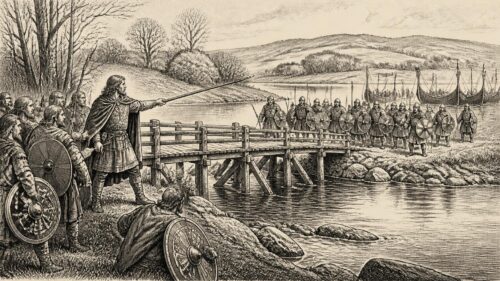
Cenn Fuait’s exact location remains disputed. The annals locate it in the Leinster coastal or eastern zone, and later traditions and modern proposals have placed it in different parts of the region. It is therefore better not to pin the fighting to a modern town or battlefield without qualification. Its military significance is clearer than its geography. Sitriuc had secured a defended base accessible to ships; an Irish force trying to contain him was routed; and the eastern political balance shifted abruptly.
The defeat also demonstrates why it is misleading to tell the year as a simple contest between “Irish” and “Vikings”. Niall’s mobilisation crossed provincial and Uí Néill divisions, but the resistance was assembled through separate kings and peoples with their own interests. The invaders themselves encountered rival foreign groups at Loch Dá Chaech and faced defeats in Munster. Alliances, local rivalries, sea power and access to fortified places mattered alongside religious language. The annals’ Christian framing is indispensable evidence, but it is not the whole explanation for the war.
Kildare Plundered, Dublin Taken
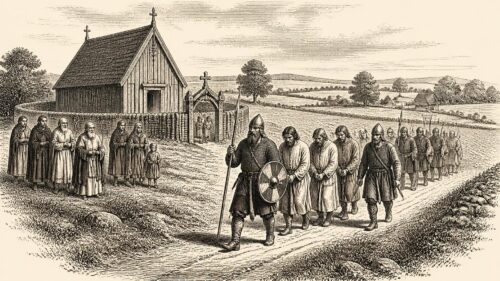
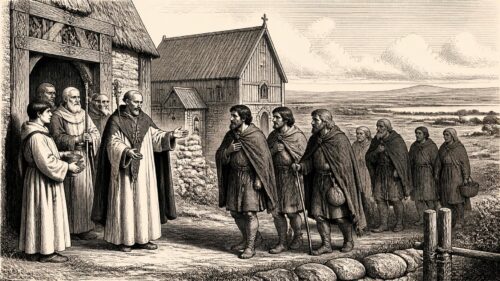
After Cenn Fuait, the foreigners from that base plundered Cell Dara, Kildare. The terse notice permits no inventory of what was carried away or damaged. Still, Kildare was a major ecclesiastical centre, and an attack on it was a blow at a community whose religious standing, landed resources and political connections gave it influence far beyond its enclosure. The death in battle of a Leinster scholar-bishop and the plundering of Kildare make 917 a particularly stark year for the province’s church as well as its secular rulers.
The pivotal annalistic statement follows: Sitriuc entered Áth Cliath, Dublin; Chronicon Scotorum says that the foreigners took it by force from the men of Ireland. The sources do not describe street fighting or identify the inhabitants displaced, allied with, or remaining under the new rulers. They do, however, establish the political fact of seizure. Archaeology supplies the broader context: settlement evidence around the Liffey and Poddle shows that Dublin had already been a Scandinavian-connected place in the ninth century, while the tenth-century town developed as a compact, defended settlement of houses, plots, workshops and waterfront activity. It would be wrong to project its later scale and organisation fully onto a single moment in 917, but Sitriuc’s entry is the conventional historical landmark for the renewed Dublin polity.
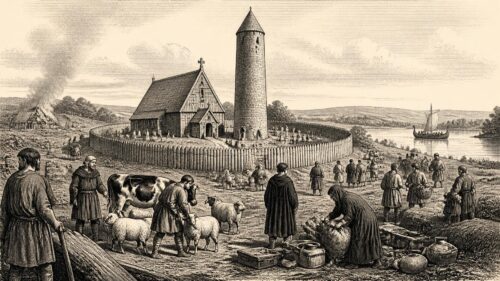
That mattered to everyday life as much as to dynastic prestige. A riverine port concentrated boats, labour, imported goods, food supplies, craft materials and captives, while demanding negotiated or coerced access to the surrounding countryside. Dublin was thus both a military position and an economic hinge. Its reoccupation gave the Uí Ímair a place from which ships could be maintained, men paid or provisioned, and contacts across the Irish Sea cultivated. For neighbouring rulers, it created a durable new centre of power on Leinster’s edge.
A Year of Loss and Reorientation
The year closed with another small but revealing annalistic notice. Eithne, daughter of Áed and queen of the men of Brega, died “truly penitent” on the feast of St Martin, 11 November. The formula records death within a Christian ideal of preparation and repentance. It also reminds us that annals, even in a year dominated by armies, continued to notice royal women, abbots, bishops, scholars and the rhythms of feast days.
What can securely be said of 917 is already momentous. Severe frost harmed animals and made waters traversable. Scandinavian fleets arrived and were resisted with mixed results in Munster. Niall Glúndub’s royal campaign produced hard fighting at Mag Femen on 22 August but did not eliminate the threat. Leinster then suffered a leadership-shattering rout at Cenn Fuait, Kildare was plundered, and Sitriuc ua Ímair forcibly took Dublin. The annalists did not know the later history that would flow from these events. They did know that Ireland’s eastern seaboard, and the relationship between provincial kingship, church power and maritime force, had been fundamentally altered within one exceptionally harsh year.
Primary Sources
- The Annals of Ulster: Year U917
- Chronicon Scotorum: Annal CS917
- Annals of Inisfallen
- Annals of the Four Masters: Annal M915 (English translation)
- Annals of the Four Masters: Annal M915 (Irish text)
- The Annals of Ulster
- Chronicon Scotorum
- Annals of the Four Masters
- Cogadh Gaedhel re Gallaibh: The War of the Gaedhil with the Gaill
- Vikings in Early Medieval Ireland: Church-Raiding, Politics and Kingship
- Vikings in Early Medieval Ireland: Church-Raiding, Politics and Kingship (review)
- The Vikings in Ninth-Century Ireland: Sources and Settlements
- The Vikings in Ninth-Century Ireland: Sources and Settlements (full text)
- Early Medieval Archaeology Project: Early Medieval Dwellings, Settlements and Landscapes
- Early Medieval Dwellings and Settlements in Ireland, AD 400–1100, Volume 1
- Early Medieval Ireland: Archaeological Excavations, 1930–2009
- Vikings in Ireland and Scotland
- Vikings in Ireland
- Viking Ireland: Further Thoughts
- The ‘Annals of Ulster’, 912–1100
- The Chronology and Sources of the Early Irish Annals
- The Dating of the Irish Annals
- The Chronological Apparatus of the Annals of Ulster AD 82–1019
- The Irish Annals: Their Genesis, Evolution and History