Flann’s Bréifne Rout910 CE
Dateline
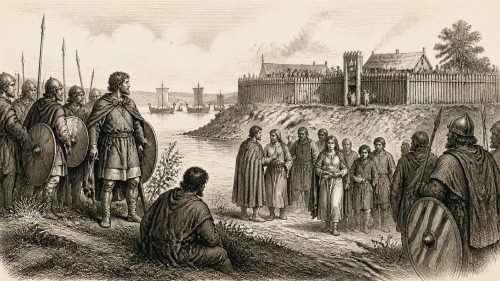
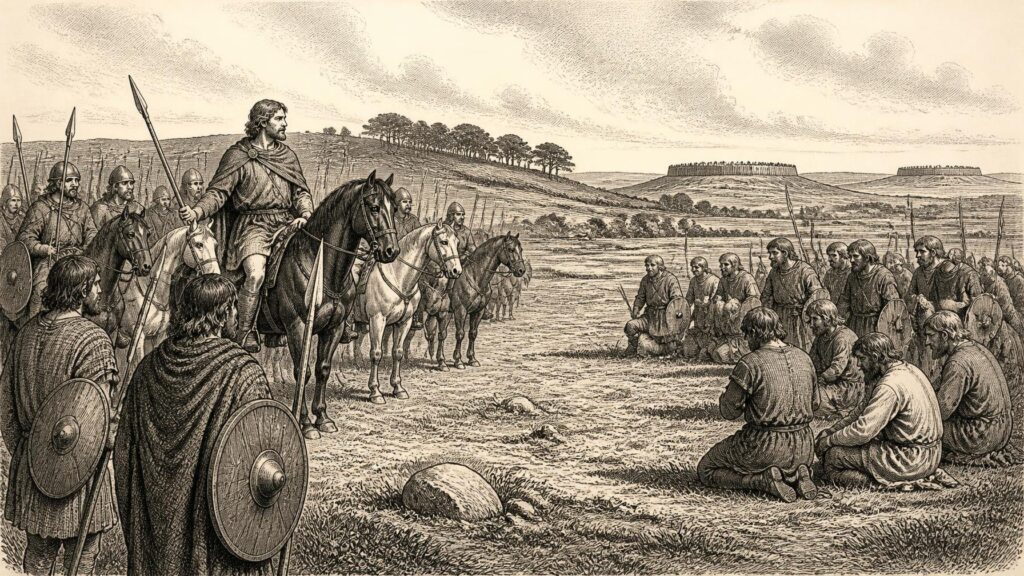
The securely dated core of 910 is not a Viking landing or a famous royal death, but a hard-fought assertion of power in Ireland’s central and western midlands. Flann Sinna, king of Tara and leading ruler of the southern Uí Néill, defeated the men of Bréifne with the help of his sons. The encounter, recorded in the Annals of Ulster and more fully in Chronicon Scotorum, cost the life of Flann son of Tigernán, king of Bréifne, as well as other nobles. It was a severe reverse for a kingdom situated on Mide’s north-western approaches, and a reminder that Flann’s authority rested not on a unified Irish state but on military success, kinship alliances and the ability to make neighbouring rulers acknowledge his superiority.
Dating a Difficult Year
Early Irish annals are invaluable, but their year-headings do not always align neatly with modern calendar years. The Annals of Ulster place Flann’s victory in an annal labelled “AD 909 alias 910”; Chronicon Scotorum gives it under 910. These independent traditions therefore allow the battle to be connected responsibly with 910, even if no day or season is supplied. The later Annals of the Four Masters preserve the same cluster of material under 905, illustrating why their headings cannot simply be read as exact modern dates. The event belongs to the opening years of the tenth century and is conventionally placed in 910; it should not be assigned a more precise date than the evidence permits.
That caution matters especially because the later annalists also place the arrival of foreigners at Port Láirge, modern Waterford, under 910. The contemporary sequence of Chronicon Scotorum, however, puts both that arrival and a northern expedition into Mide under 914. The Waterford settlement was an important development of the early 910s, but it is not soundly dateable to calendar year 910 itself. In 910, Ireland’s best-attested story is instead one of Irish dynastic rivalry, fought across the political frontier between Mide and Bréifne.
Flann and the Men of Bréifne
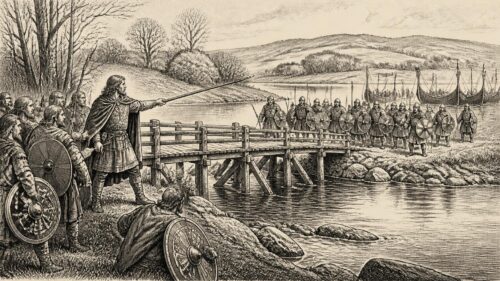
The annals give only a compressed account: Flann son of Máel Sechnaill “with his sons” inflicted a rout on the men of Bréifne. Their king, Flann son of Tigernán, fell, along with many nobles. Chronicon Scotorum adds the death of the Bréifne king’s son and gives a total of three thousand dead, naming the conflict the battle of Mag Cuma or a similarly spelled place-name. The manuscript reading is uncertain, and the location should not be treated as securely identified. Nor should the number be accepted uncritically. Round figures in annals can convey the scale and seriousness of slaughter rather than a counted casualty total. What is beyond doubt is that the chronicler considered the defeat catastrophic for Bréifne’s leadership.
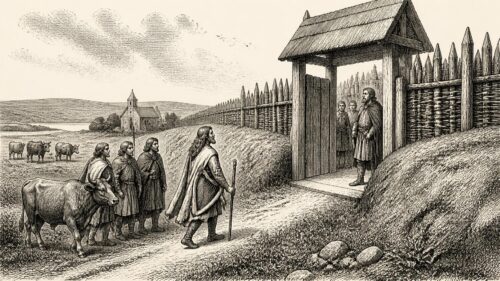
Bréifne was no marginal concern for the king of Tara. Its rulers belonged to Uí Briúin kindreds whose lands lay across the routes between Connacht, Ulster and the midlands. Pressure from that direction threatened the heartland of Clann Cholmáin, Flann’s own southern Uí Néill dynasty, based in Mide. A victory over Bréifne thus defended territory, but it also advertised Flann’s capacity to lead a wider political following. The explicit presence of his sons is significant. Royal sons were not merely heirs waiting in reserve: they commanded followers, held land and could become dangerous rivals. Campaigning alongside their father displayed family solidarity and strengthened their standing among the men whose service they sought.
Flann had suffered major political shocks in the preceding decade. His son Máel Ruanaid had been killed in 901, while the Munster king-bishop Cormac mac Cuilennáin had briefly challenged his position before dying in the great battle of Belach Mugna in 908. Flann’s Leinster ally Cerball son of Muirecán died in 909. Against that background, the Bréifne campaign was more than a local encounter: it helped sustain a kingship exposed to dangers from within his own kindred, from neighbouring provinces and from ambitious border dynasties. Yet it would be misleading to call Flann an unquestioned national monarch. His title “king of Tara” expressed a claim to pre-eminence; its reality had to be renewed repeatedly through hostages, tribute, alliances and armed force.
Fighting on Water
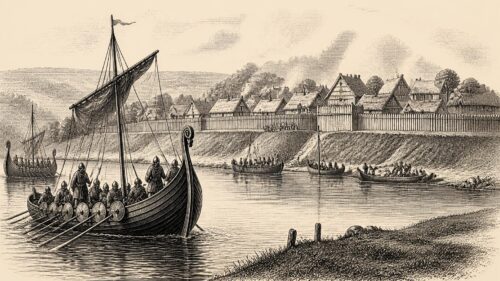
The same 910 entry in Chronicon Scotorum records a second conflict, this time involving ships. Domnall Ua Máel Sechnaill and Indrechtach son of Conchobor brought a fleet onto Loch Dergderc, encountered a Munster fleet and killed many men. The annal does not explain why the fleets met, who initiated the campaign, or what happened afterwards. It nevertheless offers an important corrective to any image of early medieval Irish warfare as wholly land-based. Lakes, rivers and estuaries were transport corridors. Fleets could move warriors, livestock, provisions and prestige goods, while control of water could expose shoreline settlements and limit an opponent’s freedom of movement.
Domnall’s name links the action to the wider Máel Sechnaill kindred, though the exact relationship and command structure cannot be reconstructed from this brief notice. Indrechtach was a Connacht royal figure, suggesting a coalition rather than a purely local naval quarrel. Munster’s involvement likewise shows that the political consequences of Flann’s dominance in Mide reached beyond its borders. The record does not permit a claim that this lake battle formed part of the Bréifne campaign. They may have been connected episodes in a wider season of competition, or entirely separate conflicts entered together by the annalist. Both possibilities should remain open.
Two Suns in May
Chronicon Scotorum also notes an extraordinary sign: “two suns” appeared to run together on the day before the Nones of May, 6 May. The phenomenon was probably an atmospheric display such as parhelia, or sun dogs, in which bright patches of light appear beside the sun under suitable ice-crystal conditions. The annalist supplies a date but no interpretation. Later readers should resist assuming panic, prophecy or political meaning where none is recorded. Its survival is nevertheless revealing. Monastic writers attended to unusual natural phenomena and set them beside battles and royal deaths, treating the visible world as worthy of historical notice.
Power, Production and Ordinary Lives
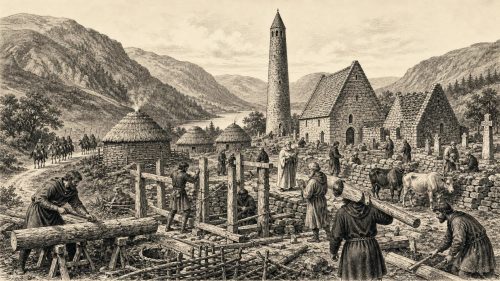
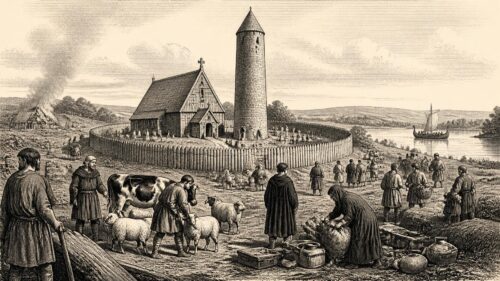
The people absent from the annals were those whose work sustained every campaign: farmers tending cattle, grain and dairy production; craftspeople repairing weapons, boats and buildings; dependants supplying food and labour; and religious households managing estates, hospitality and learning. Early medieval Ireland was made up of many small kingdoms or túatha, bound together unevenly under greater rulers. Landholding, cattle, clientship and kin were central to wealth and security. A king’s military following depended upon agricultural surplus, while victory could bring captives, cattle, tribute and control of routes. The loss of a king and nobles in Bréifne therefore had consequences far beyond the battlefield, disrupting households, fosterage ties and claims to land.
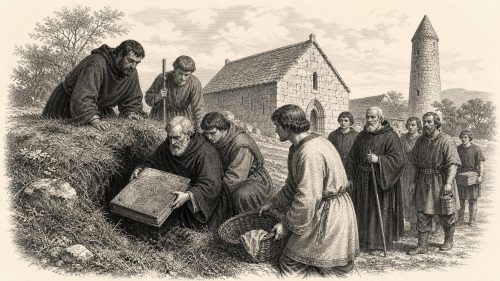
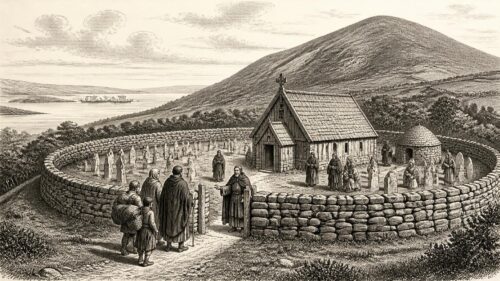
Churches and monasteries were deeply embedded in this society rather than separate from it. They held land, gathered dependants, offered religious authority and preserved literate records. Their leaders could be members of ruling families, while kings sought the prestige of church patronage. No major ecclesiastical foundation or reform is securely recorded for 910 itself, but the annals that preserve the year were products of that learned world. Their concise notices make clear what contemporaries thought worth remembering: royal succession, violent death, military defeat, unusual celestial events and the actions of powerful kin-groups.
A Year Before the Viking Return
There is a further reason not to force a Viking narrative onto 910. Dublin’s Scandinavian rulers had been expelled in 902, and the surviving annals are comparatively quiet about Viking activity in Ireland for more than a decade. Archaeology and later historical developments show that maritime commerce and Scandinavian mobility did not vanish from the Irish Sea. But the major recorded re-establishment of Viking power at Waterford and then Dublin belongs to 914 and the years after it. In 910, Flann Sinna’s victory over Bréifne and the clash of fleets with Munster show an island already fully capable of generating large-scale conflict from its own political rivalries.
The year therefore captures a decisive feature of tenth-century Ireland: authority was contested, layered and intensely personal. Flann could rout a neighbouring king, deploy his sons and see allies operate on the water, yet none of this removed the need for further campaigning. Bréifne’s losses strengthened the king of Tara in the short term. They did not create permanent peace, nor did they settle the recurring contest between regional dynasties that would shape Irish politics long after Flann’s death.
Primary Sources
- The Annals of Ulster
- Chronicon Scotorum, Part 96
- Chronicon Scotorum
- Annals of the Four Masters, Part 1
- Annals of the Four Masters
- Fragmentary Annals of Ireland
- Annals of the Kingdom of Ireland, Volume 2
- Flann Sinna
- The Vikings in ninth-century Ireland: Sources and settlements
- The Vikings in ninth-century Ireland: Sources and settlements (full text)
- Vikings in Irish Chronicles, 794–902: Introduction
- Vikings in Irish Chronicles, 794–902: Data
- Vikings in Early Medieval Ireland: Church-Raiding, Politics and Kingship
- Vikings in Early Medieval Ireland: Church-Raiding, Politics and Kingship
- The Historical Importance of Viking-Age Waterford
- Waterford Heritage Strategy 2025–2030
- Kingship, Society, and Sacrality: Rank, Power, and Ideology in Early Medieval Ireland
- Religion and Society in Ireland
- The Church and the World in Early Christian Ireland
- Transformation
- Britain and Ireland 900–1300
- Hiberno-Scandinavian Transculturation
- The Metrical Dindshenchas
- Annals of Inisfallen, Part 68