Flann at Loch Dá Chaoch896 CE
In the annalistic year conventionally rendered 896, Ireland experienced interconnected regional crises rather than a single national conflict. Flann son of Lonán, acclaimed as Ireland’s chief poet, was killed by the Uí Fhothaid in the Déisi. Norse leaders Sitriuc and Amlaíb, linked to Ímar’s dynasty, died in separate violence, revealing Scandinavian divisions and resistance by coastal peoples. Máel Achaid, Clonmacnoise’s designated successor, was killed amid retaliation involving Delbna Bethra, while senior clerics died peacefully. Brega, Ulaid, Osraige and Munster saw killings or rivalry; Cenn Gégáin assumed Cashel’s kingship. Sparse annals show cultural, ecclesiastical and political authority intertwined across fragmented lordships.
Dateline
The events conventionally placed in 896 offer an unusually concentrated picture of late ninth-century Ireland: a celebrated poet was killed in the Déisi; Norse leaders died in separate outbreaks of violence; an important monastic official was slain; and rulers or heirs disappeared in Brega, Ulaid, Connacht and Munster. Yet this was not a single national crisis directed by one king. Ireland remained a landscape of overlapping lordships, church federations and maritime connections. The annals preserve only brief notices, and none supplies a day or month for these events. Moreover, the Annals of Ulster label their entry “AD 895 alias 896”, a reminder that annalistic year-numbering must be handled cautiously. What can responsibly be said is that the events belong to the annalistic year normally rendered as 896 CE.
A Poet Killed in the Déisi
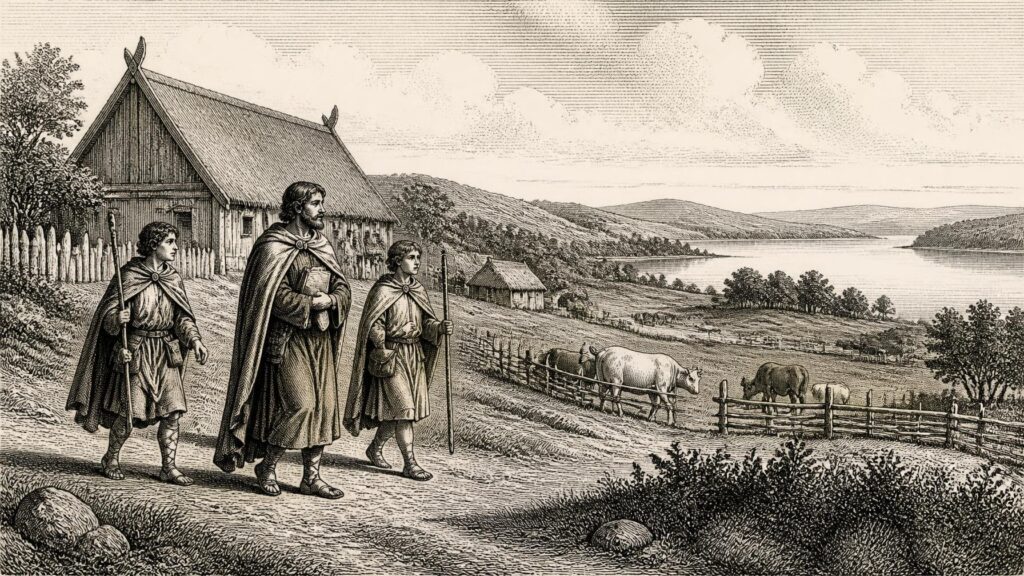
The most culturally resonant death was that of Flann son of Lonán. The Annals of Inisfallen call him rí filed Érenn, “king of the poets of Ireland”; the Annals of Ulster identify him more fully as Flann son of Lónán, grandson of Guaire. Such language was not casual praise. A leading poet was a learned professional whose work could preserve genealogies, commemorate rulers, formulate praise and satire, and attach political claims to remembered landscapes and ancestors. Poetry was therefore part of public authority, not a separate ornamental culture.
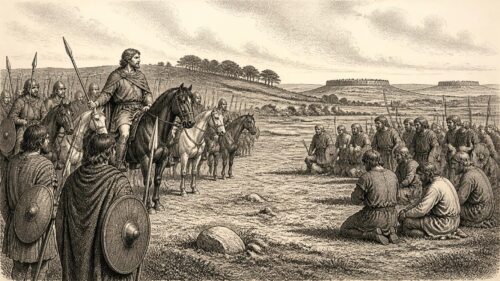
Flann was slain by the Uí Fhothaid in the Déisi of Munster. A fuller account in Chronicon Scotorum places the killing at Loch Dá Chaoch and calls him the “Virgil of the Irish”, as well as chief poet of the Gaels. The location and the identity of the killers make the episode a regional act of violence, though the surviving notices do not explain its cause. It would be unsafe to turn later stories about poets, satire or royal offence into an explanation for this particular death. What is firm is the esteem in which Flann was held by annalists and the fact of his killing; motive, circumstances and precise date are not recorded.
His death also shows the reach of learned culture. Flann’s associations in later tradition extend towards Aidne on the Connacht–Munster border, while his obit was remembered in annals whose surviving manuscripts derive from different ecclesiastical and regional traditions. His standing was intelligible across political frontiers. The loss of such a man mattered beyond the people immediately involved in his death, because a poet’s knowledge was a resource for courts, churches and kindreds seeking legitimacy.
Violence on the Irish Sea Frontier
In the same annalistic year, two men connected with the dynasty of Ímar were killed. Sitriuc son of Ímar died at the hands of “other Norsemen”, according to the Annals of Ulster. The entry gives no place, no named opponents and no explanation. It is nevertheless stark evidence that Scandinavian groups in and around Ireland were not a single force moving in unison. Competition within their own leadership could be as lethal as conflict with Irish kingdoms.
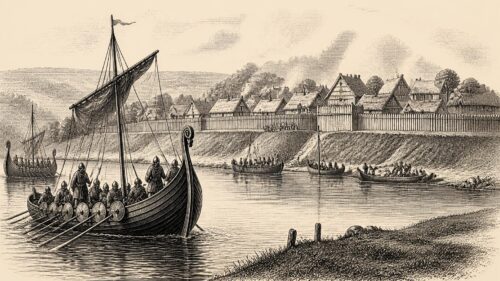
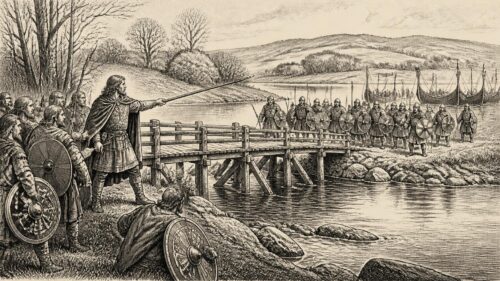
A second notice records a slaughter of “the foreigners” by the Conaille and the son of Láigne, in which Amlaíb, described as grandson of Ímar, fell. Chronicon Scotorum names the Irish ally as Aitíth son of Láigne and adds that Glún Tradna son of Glún Iarainn died with Amlaíb; it also gives the dramatic total of 800 dead. The shorter Annals of Ulster confirms the battle and Amlaíb’s fall but not that number. The figure should therefore be treated as a claim of the fuller chronicle, not as a securely demonstrable body count.
The Conaille were based in the north-eastern mainland zone later associated with south County Louth, close to routes linking the Irish Sea, the northern coast and inland territories. Their success demonstrates that coastal communities could organise effective resistance. It should not, however, be presented as the end of Scandinavian power in Ireland. Dublin and other maritime settlements remained bound into Irish political life, while Scandinavian leaders continued to make and break alliances with Irish kings. In 896 the most visible result was fragmentation: one Ímar-associated leader killed by fellow Norsemen, another in fighting with Irish opponents.
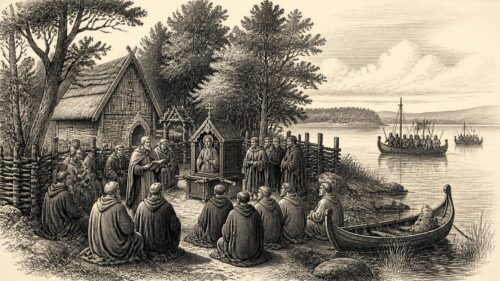
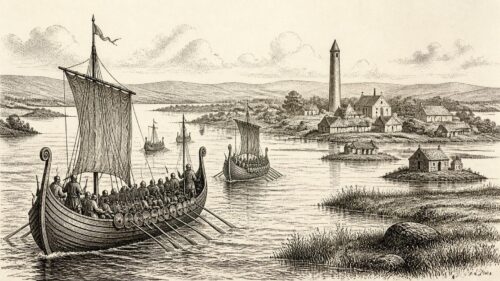
This was a world in which ships carried people, weapons, goods and intelligence as readily as they carried raiders. But the evidence for 896 is overwhelmingly military. No annal for the year records a market, a cargo or a harvest. It is reasonable to recognise the importance of sea routes and coastal contact; it is not responsible to invent a specific commercial transaction from a record that does not preserve one.
Clonmacnoise and Retaliation
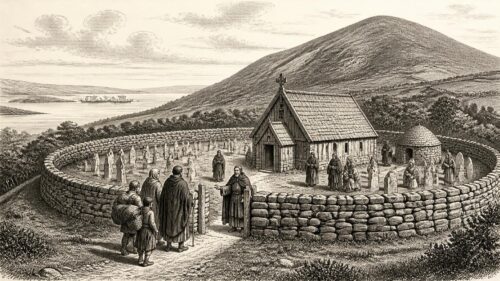
Ecclesiastical affairs were equally entangled with secular conflict. The Annals of Ulster report the peaceful deaths, “as old men”, of Blamac, superior of Clonmacnoise, and Mórán grandson of Buide, superior of Birr. These were not minor local appointments. Clonmacnoise stood beside the Shannon at a major crossing of Ireland’s north–south and east–west routes, and its religious community had substantial intellectual, political and material importance. Birr too belonged to the network of well-connected midlands churches. The paired notices reveal continuity as well as disruption: senior clerics died in old age even while violence was striking nearby institutions and lordships.
More troubling was the fate of Máel Achaid. The Annals of Inisfallen call his death a martyrdom and identify him as abbot of Clonmacnoise. The Annals of Ulster gives a more institutional description: he was tanist, or designated successor, of Clonmacnoise and superior of Daiminis, an island monastery in Lough Erne. His holding of authority in both places points to connections between major churches across considerable distance, rather than to isolated religious houses.
Chronicon Scotorum supplies a narrative absent from the briefer annals. It says that Scolaige son of Macán, king of Delbna Bethra, had been killed by the community of Clonmacnoise, and that Máel Achaid was then put to death by the Delbna in retaliation. The chronicler explicitly links his killing to vengeance for Scolaige. This account makes the political setting more intelligible, but it remains a terse annalistic explanation, not a full judicial record. We do not know who ordered the initial killing, whether Máel Achaid personally participated, or what negotiations may have failed. The contrast between “martyrdom” and “violent death” is revealing: the former commemorates a churchman’s suffering, while the latter exposes the feud-like political reality surrounding the monastery.
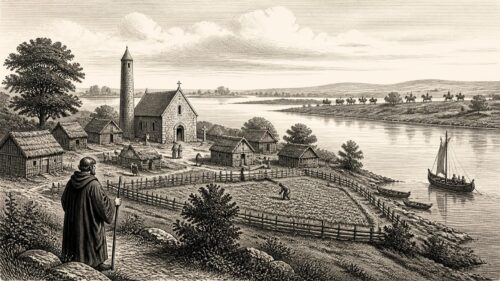
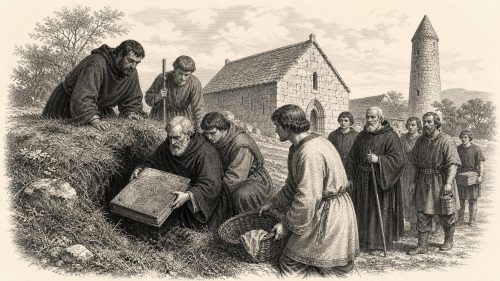
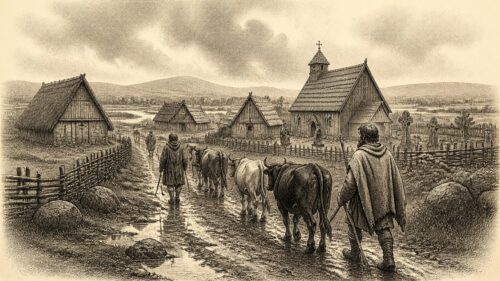
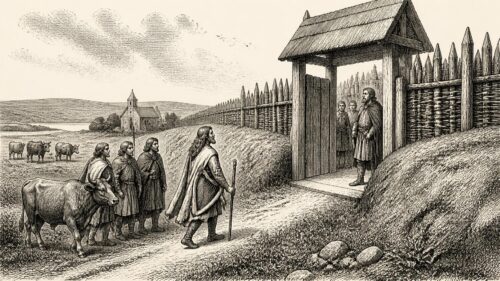
For ordinary members of a monastic settlement, these events were not abstract. A great church was a place of worship and learning, but also a community of clerics, dependants, craftspeople, tenants, travellers and people seeking protection. Its storehouses, livestock, manuscripts and skilled labour made it valuable; its links with rulers made it consequential. The death of its expected leader could affect governance, patronage and security far beyond the enclosure.
Kingships Under Pressure
The northern and eastern entries reinforce the picture of unstable authority. Cinaed son of Flannacán, heir-designate of Brega, died. His father Flannacán son of Cellach, king of Brega, was killed by Norsemen in the same annalistic year. Brega, the rich region north of the Liffey and Boyne, was strategically important to the Southern Uí Néill and exposed to the politics of Dublin and the coast. The loss of both a king and his designated successor threatened dynastic continuity, even if the annals do not describe the succession that followed.
In Ulaid, Máel Mochéirge son of Indrechtach, one of two kings, was killed by his own associates; Cumuscach son of Muiredach, king of Ard Cianachta, was killed by the Ulaid. These entries make plain that “Ulaid” was not a unitary state in the modern sense. It contained competing rulers and constituent peoples, and political murder could arise from associates as well as external enemies. Elsewhere, the Osraige inflicted a slaughter on the Éoganacht. The notice is too compressed to identify a battlefield or reconstruct a campaign, but it records continuing rivalry between the powerful kingdom of Osraige and Munster interests.
Munster’s own succession is one of the year’s clearer political developments. The Annals of Inisfallen state that Cenn Gégáin took the kingship of Cashel. His predecessor, Dub Lachtna son of Máel Guala, had died in the preceding annalistic year. Cashel represented the senior kingship of the Eóganacht heartland, but accession did not imply uncontested control over all Munster. The contemporaneous record gives no inauguration scene, agreement of subject rulers or campaign by the new king. It records only the change itself, which is important precisely because it occurred amid conflict involving Éoganacht interests and the Déisi.
A Year of Connected Local Crises
Flann Sinna, king of Tara, remained the foremost Uí Néill ruler in Ireland during this period, but the year’s notices do not show him directing every development. The deaths at Loch Dá Chaoch, in the north-east, around Clonmacnoise, in Brega and within Ulaid instead illuminate the limits of any island-wide kingship. Authority was negotiated through local dynasties, hostages, church alliances, kinship and armed followings. A king at Tara mattered; so did an abbot on the Shannon, a lord in the Déisi, a poet with prestigious patrons and a maritime war-band.
Thus 896 should not be reduced to a catalogue of killings. It reveals a society in which culture, religion and politics were closely joined. The murder of Ireland’s leading poet diminished a learned order that helped articulate power. The violent death of Máel Achaid exposed the vulnerability of a major ecclesiastical centre despite its status. The falls of Sitriuc and Amlaíb showed the fractured character of Scandinavian power, while the accession of Cenn Gégáin at Cashel marked continuity in Munster’s royal tradition. The annals are brief because they were not written to satisfy modern curiosity. Read carefully, their brevity shows a densely connected island living through a year of regional, but consequential, upheaval.
Primary Sources
- The Annals of Ulster: Year U896
- Annals of Inisfallen: Annal AI896
- Chronicon Scotorum: Annal CS896
- Vikings in Irish Chronicles, 794–902: Data
- Annals of the Four Masters: Annals M887–M896
- Annals of the Four Masters: Irish Text, Annals M895–M898
- Flann
- Flann Sinna
- Cormac
- Cerball
- Muiredach
- Máel-Mura
- Clonmacnoise Monastic Site
- Clonmacnoise Visitor Guide
- Irish School of Illumination, c. 650–1100
- High Crosses
- The Annals of Tigernach
- Chronicon Scotorum
- Vikings in Ireland and Scotland
- General Vikings in Ireland
- Exploring the Irish Annals
- The Chronology of Viking Church Raids
- Church-Raiding and Politics in the Later Ninth Century
- Appendix: The Chronicles as a Record of Literacy, 797–1002