Rath Cró’s Northern Rout897 CE
In annalistic 897, Máel Finnia of Brega defeated Ulaid and Dál nAraidi forces at Rath Cró, killing two kings and wounding Aidíth of Ulaid. Flann Sinna of Tara campaigned in Connacht, extracting pledges that demonstrated contested high-kingship. Uathmarán of Uí Fhailgi was killed by his own people, while Cormac of Mothail gained Déisi kingship after killing Máel Bennachta. Cathasach, tanist-abbot of Armagh, died. Aidíth was later murdered by associates. Dublin remained Scandinavian in 897; its expulsion belonged to 902. The sources reveal regional warfare, unstable succession and church politics, but cannot support broader claims about ordinary life or environmental conditions.
Dateline
For Ireland in 897, the surviving record is unusually revealing and unusually troublesome. It preserves a hard-fought northern battle, a royal killing in the midlands, the exertion of high-kingship over Connacht, a change of ruler among the Déisi, and the death of an Armagh churchman. Yet it also demonstrates why medieval annals must not be read as if their headings were modern newspaper datelines. The Annals of Ulster label one sequence “AD 896 alias 897” and the following one “AD 897 alias 898”; Chronicon Scotorum has related but not identical material. The events discussed here are therefore securely tied to the annalistic year conventionally called 897, but few can be assigned to a month or day in the modern calendar.
Rath Cró and the Northern Kings
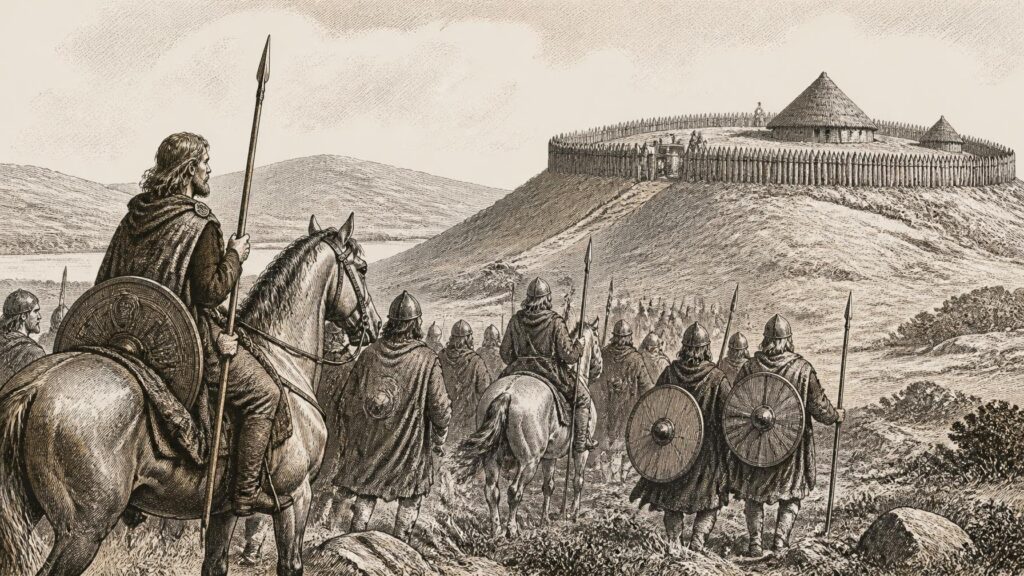
The year’s clearest episode was a victory by Máel Finnia son of Flannacán, ruler of Brega, at Rath Cró. Chronicon Scotorum says that Máel Finnia inflicted a “battle-rout” on the Ulaid and Dál nAraidi. The defeated side included several northern interests rather than one undifferentiated Ulster: the Ulaid were a powerful over-kingdom centred in eastern Ulster, while Dál nAraidi was a major Cruithin people and kingship west of Belfast Lough. The annalist names two rulers killed in the fighting: Muiredach son of Mac Étig, king of Dál nAraidi, and Aindiarraidh, king of Leth Cathail. Aidíth son of Laigne, king of Ulaid, was wounded but escaped.
The place-name Rath Cró cannot safely be pinned to a particular modern site from this notice alone. Its importance lies instead in what the account says about the scale of the encounter. Máel Finnia, whose own power-base was Brega in the Boyne valley and its hinterland, had struck a coalition or combined force in the north hard enough to kill two kings and wound another. Such warfare was not a clash between national armies. It was a contest among overlapping dynasties, client peoples and local lordships, in which a ruler’s standing depended on leading armed followers, protecting dependants and securing recognition from neighbouring kings.
The losses at Rath Cró mattered because kingship was personal and familial. The death of Muiredach opened Dál nAraidi to a succession struggle or, at minimum, to renegotiation among leading kindreds. The killing of the king of Leth Cathail likewise weakened one component of the wider Ulaid political world. Aidíth’s survival initially preserved continuity at the highest level, but the annals’ next sequence records his deceitful killing by his own associates. The Annals of the Four Masters, compiled much later from earlier materials, supplies a name for his killer, Maelbairne. This is useful evidence for the tradition surrounding the event, but it should not conceal the dating difficulty: the killing belongs to the annalistic boundary of 897–898, not to a securely recoverable day in 897 itself.
Máel Finnia’s Ascendancy
Rath Cró was not Máel Finnia’s only appearance in the historical record around this year. His later obituary describes him as king of Brega and a devout layman, while preserving praise that presents him as both peaceable and formidable in war. Such memorial verse is not neutral biography, but it indicates the stature he had acquired. His victories and alliances placed Brega at the centre of politics between the midlands, Leinster and the north. That position would prove consequential when Máel Finnia later joined Cerball son of Muirecán of Leinster in the expulsion of the Dublin-based Scandinavians.
That later episode must not, however, be placed in 897. The Annals of the Four Masters mistakenly carries the Dublin expulsion under its annal for 897, a consequence of its chronological displacement. Comparative work on the Irish chronicles places the event in 902: the Annals of Ulster and Chronicon Scotorum record it there, and the Dublin Institute for Advanced Studies’ concordance explicitly aligns the Four Masters’ notice with 902. Dublin was therefore still a Scandinavian power in 897, even if its politics had been weakened by earlier internal conflict and military setbacks.
This correction is more than a technicality. It changes the meaning of 897. Ireland was not enjoying the aftermath of a decisive liberation of Dublin. Instead, native rulers such as Máel Finnia were pursuing their own regional ambitions in a landscape where Scandinavian settlements, fleets and mercenary connections remained an important element. The annals do not record a Dublin raid for this particular year, but silence in a terse chronicle is not proof of peace, trade stagnation or Scandinavian inactivity. It merely limits what can responsibly be said about daily conditions in the port and its surrounding settlements.
Flann Sinna and Connacht’s Pledges
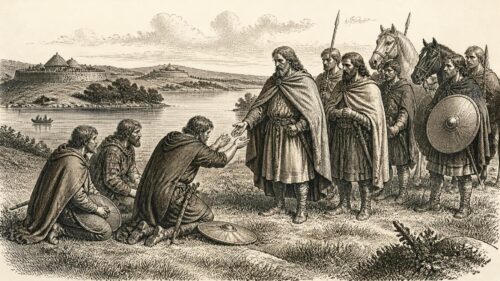
Chronicon Scotorum also records that Flann son of Máel Sechnaill attacked Connacht and exacted its pledges. This was Flann Sinna, king of Tara and the dominant claimant to Ireland-wide kingship. “Pledges” were not a casual diplomatic gesture. They were a political instrument through which a stronger ruler sought guarantees for obedience, peace or future service. The text does not specify who was handed over, how long they remained in custody, or what precise settlement followed. Still, the entry plainly records a successful assertion of Flann’s superior power over Connacht.
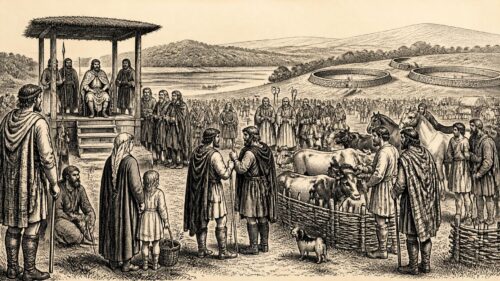
The campaign also illustrates the reach and limits of ninth-century high-kingship. Flann could lead a hosting into Connacht and compel an acknowledgement of authority, but he did not thereby erase regional kingship. Connacht retained its own rulers and political interests; Brega, Ulaid, Leinster, Munster and the various midland kingdoms did likewise. Authority was made visible through expeditions, hostages, church alliances, tribute and public submission, then had to be maintained. The very need to take pledges points to a negotiated and contested political order rather than a centrally administered kingdom.
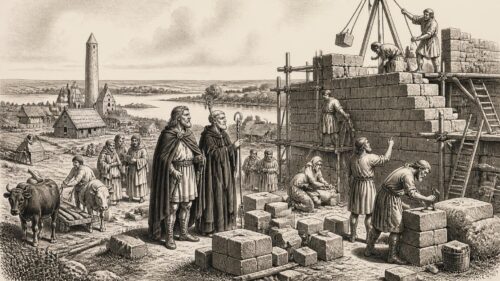
Flann’s position rested especially strongly in the southern Uí Néill midlands. His dynasty, Clann Cholmáin, was closely associated with Clonmacnoise, a major ecclesiastical and intellectual centre on the Shannon. Modern scholarship stresses the political value of this relationship: royal patronage could offer protection and resources to a church, while ecclesiastical prestige strengthened kingship. The surviving high crosses and the later stone church programme at Clonmacnoise show that these were not abstract ties. In 897 itself, there is no evidence for a new monument there, but the alliance between ruler and great church was already part of the political environment in which Flann campaigned.
Deaths, Succession and the Church
Royal violence was not confined to the north. The same annalistic year reports that Uathmarán son of Conchobor, king of Uí Fhailgi, was killed by his own people. Uí Fhailgi lay in the central Irish zone later associated largely with County Offaly. The formula is brief, but its meaning is stark: a king’s position depended on the support of his own political community, and internal opponents could remove him. Similar language surrounds Aidíth’s death. Medieval Irish annals repeatedly show that murder “by one’s own people” was a recurring mechanism of succession and factional rivalry, not an exceptional breakdown of an otherwise settled system.
In the south, the Annals of Inisfallen place Cormac of Mothail’s accession to the kingship of the Déisi in 897 and state that he killed Máel Bennachta. The Déisi were an important grouping in Munster, and the entry is a reminder that political change occurred well beyond the kingdoms named in the best-known narratives. The same source records the repose of Cathasach son of Fergus, abbot of Armagh; the Annals of Ulster calls him tanist-abbot and “a religious young man”. The variation reflects differing annalistic traditions and titles, but both agree that a senior figure within Armagh’s leadership had died.
Armagh was more than a place of worship. Its ecclesiastical community held lands, learning, relics and claims to authority associated with Patrick. To call Cathasach tanist-abbot indicates an office of recognised succession within a powerful institution. His death was therefore both a religious and political matter. The notices also show the texture of annal-writing: kings, abbots and battles are recorded because they affected recognised centres of authority. Farmers, craftspeople, women outside elite families, traders and unfree people are largely absent, even though their work sustained the households, churches, estates and armies that the annals do name.
What the Year Cannot Tell Us
The sources offer no reliable basis for a sweeping account of harvests, disease, prices or weather in calendar year 897. A “shower of blood” is recorded in the next Annals of Ulster sequence for Ard Cianachta, but it should be treated as an annalistic portent, not transformed into a verified environmental event. Nor should later reports of famine or of unusual infestations be casually imported into Ireland without contemporary Irish corroboration. The responsible picture is consequently narrow but vivid: warfare at Rath Cró, pressure on Connacht, violent changes among regional rulers, and institutional succession at Armagh.
In that constrained record, 897 emerges as a year of political movement rather than a single island-wide turning point. Máel Finnia’s northern victory showed the military reach of Brega; Flann Sinna’s Connacht expedition demonstrated the continuing ambitions of Tara; and the deaths of Uathmarán, Aidíth and Cathasach exposed the fragility of kingship and office. The year did not end Viking Dublin’s presence, nor did it settle the rivalries of Ulaid, Dál nAraidi, Connacht or the midlands. It did, however, reveal the tightly connected world from which the struggles of the early tenth century would grow.
Primary Sources
- The Annals of Ulster, Year U897
- The Annals of Ulster, Year U898
- The Annals of Ulster
- Chronicon Scotorum, Annals CS896–CS898
- Chronicon Scotorum, Annals CS899–CS901
- Chronicon Scotorum
- Annals of Inisfallen, Annals AI890–AI899
- Annals of the Four Masters, Annals M897–M901
- Annals of the Four Masters
- Vikings in Irish Chronicles, 794–902: Data
- The Chronology and Sources of the Early Irish Annals
- Vikings in Ninth-Century Ireland: Sources and Settlements
- Kingship, the Church, and Silver in Ireland
- Vikings in Ireland
- Vikings in Early Medieval Ireland: Church-Raiding, Politics and Kingship
- Fragmentary Annals of Ireland
- Fragmentary Annals of Ireland, English Translation
- CELT: Corpus of Electronic Texts, Published Texts
- CELT: Irish Texts
- Churches and Ecclesiastical Enclosures
- The Hill of Tara