Cottage State
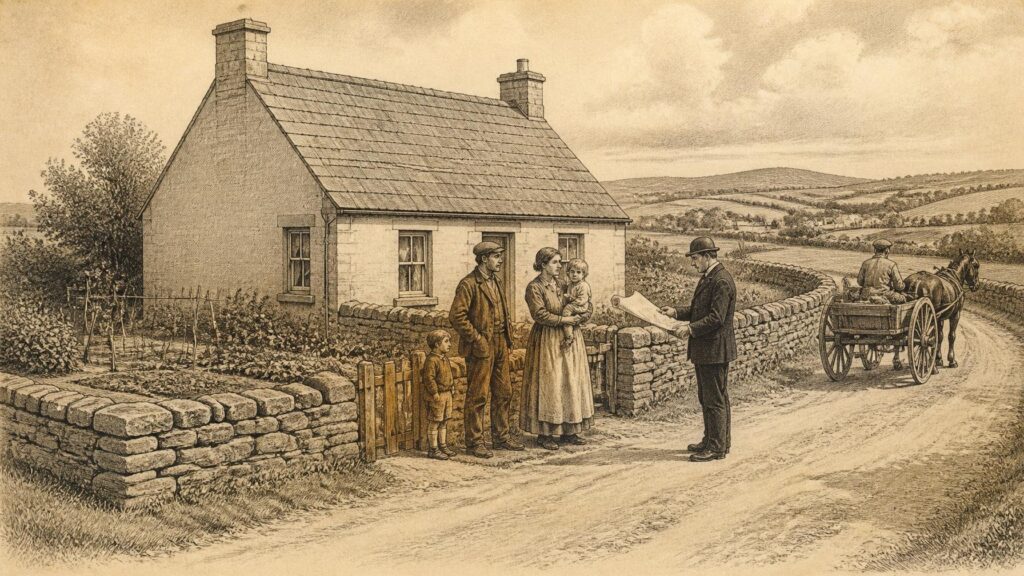
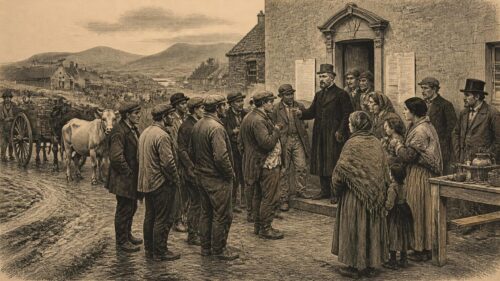
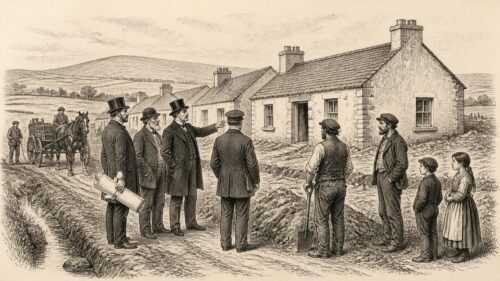
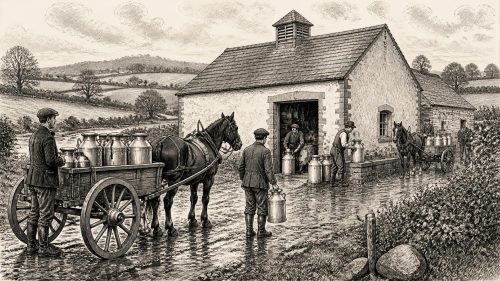
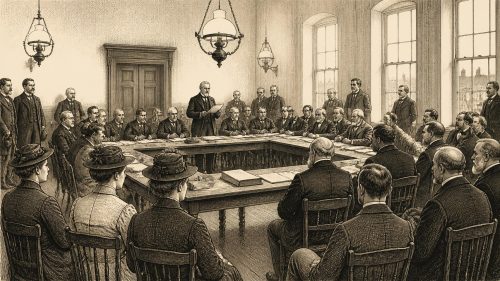
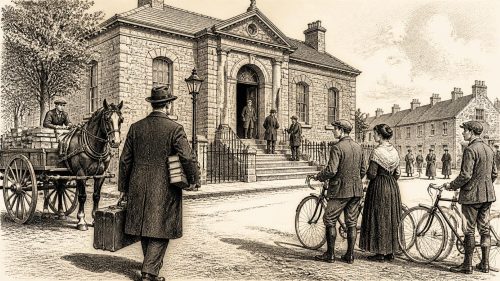
AI generated historical illustration, not a contemporary photograph.
At a Glance
In Ireland, the rural house has never been only a private shelter. It has been an arena in which land, labour, family security, public health, local influence and national policy met. The small roadside cottage, particularly the labourer’s cottage built under legislation from the 1880s, made the hand of government unusually visible across the countryside. Its history also warns against treating rural policy as a story of benevolent improvement alone: decisions about who qualified, where a house stood, what land accompanied it and who controlled the rent all expressed unequal social power.
Rural Foundations
Any history of rural housing policy in Ireland must begin with the uneven world that preceded it. Before the great nineteenth-century programmes of public provision, the rural population occupied a broad and unstable range of dwellings: farmhouses, estate cottages, cabins held with tiny plots, lodgings attached to work, and houses in small villages. The term “cabin” was used frequently by contemporary observers, but it should not be allowed to flatten the variety of household arrangements or building traditions. Some homes were durable vernacular structures, altered over generations; others were fragile, overcrowded and dependent upon insecure access to land. Surviving buildings, maps and census evidence all show that the Irish countryside was never architecturally uniform.
Nevertheless, the poorest agricultural households were especially vulnerable. Their homes could be tied to employment, to a landlord’s estate, or to a minute tenancy whose survival depended upon seasonal work. The catastrophic failure of the potato crop in the 1840s did not create rural poverty, but it exposed with terrible force the risks of a social order in which subsistence, housing and landholding were so closely entangled. Eviction, migration, mortality and the disappearance of innumerable small holdings transformed settlement patterns. It would be misleading to suggest that post-Famine Ireland simply replaced cabins with sound cottages. The process was longer, regionally varied and deeply conditioned by changes in agriculture, landownership and population.
After the Famine, tillage contracted in many districts and pasture assumed greater importance. That altered demand for labour and did not automatically improve workers’ housing. A farm labourer might be employed intermittently, live in a dwelling that was old or unhealthy, and possess little bargaining power over either conditions or location. In this setting, a rural housing policy was also a labour policy. A decent house could make it possible for a family to remain near employment; a plot could supply vegetables, fuel space or a small measure of independence; and a secure tenancy could lessen the immediate threat of removal.
There had been earlier official involvement in dwellings for labouring people. The Board of Works lent money under various nineteenth-century measures, and some landlords built cottages for estate workers. Such activity mattered, but it was piecemeal. Estate cottages remained dependent on the priorities of proprietors. Loans did not necessarily reach the poorest households. The later Labourers Acts were different in principle because they established a statutory route through which local public bodies could acquire sites, build houses and let them to agricultural labourers. They did not abolish local hierarchy, but they brought the provision of rural homes more firmly into public administration.
Cabin Conditions
Historical description must be careful here. Contemporary reports commonly portrayed the poorest dwellings as mud-walled, thatched, one-roomed cabins, and census material recorded severe crowding in parts of rural Ireland. These sources identify a real housing problem, but their language was often shaped by middle-class assumptions about cleanliness, morality and domestic order. Official concern with ventilation, separate bedrooms, drainage and household management was never wholly separable from the desire to reform the habits of poorer people. The records therefore document material hardship while also revealing the social attitudes of those who inspected it.
The significance of inadequate housing was practical rather than merely picturesque. Damp walls, smoke-filled interiors, insufficient sleeping space and poor water supply affected health, privacy and the work of daily life. Women’s domestic labour was particularly affected by distance from water, fuel preparation, washing and food storage, though official housing records often spoke more readily of heads of household than of women’s experience. Children, older people and seasonal workers also disappear easily from aggregate figures. A dwelling was a setting for a whole household, not simply a unit counted by a local authority.
Housing was bound to the question of land. A labourer who lived in a house supplied by an employer could face a difficult choice between protest and displacement. A person with an allotment and a public tenancy was not free from dependence, but the relation changed. This helps explain why the idea of attaching land to a cottage mattered so much. The plot was practical, enabling potatoes, vegetables, poultry or a cow in some cases; it was also symbolic, making the cottage a small stake in the countryside for people excluded from the larger gains of tenant land purchase.
That symbolism should not be romanticised. A half-acre or similar plot could not replace a viable farm, guarantee employment or end poverty. Nor did every tenant cultivate land in the same way. Still, it represented a deliberate policy choice. The state and local authorities did not merely intend to shelter workers; they intended to create a particular form of settled rural household. The cottage, garden and roadside site became a model of respectable domestic life as imagined by legislators and administrators.
Land Agitation
The Labourers Acts arose during the era of land agitation and land reform. Their timing was not accidental. The struggle over rents, tenure and ownership had made the condition of the rural poor politically conspicuous. Tenant farmers stood to gain most directly from schemes transferring land from landlords to occupiers. Agricultural labourers, often landless or nearly so, could not receive the same reward. Historians have therefore interpreted labourers’ housing as a partial answer to a problem created by the unequal distribution of the benefits of land reform.
This interpretation is persuasive, provided it is not treated as a complete explanation. Humanitarian concern, sanitary reform, electoral politics, administrative change and the waning confidence in laissez-faire also mattered. The 1883 Labourers (Ireland) Act allowed rural sanitary authorities, then commonly boards of guardians, to undertake improvement schemes after a specified process of local representation. Its early machinery was cumbersome. It required inquiries, approvals, financial arrangements and the negotiation or compulsory acquisition of sites. Landlords could object; local bodies could be reluctant; central oversight could delay proceedings. Thus the existence of legislation did not itself mean swift construction.
Local politics were crucial. Boards of guardians and later rural district councils were composed of people rooted in the local social order. They could champion labourers’ needs, but they could also reproduce patronage, favour relatives, employers or political allies, and take a restrictive view of eligibility. Applicants did not confront an abstract state. They encountered clerks, guardians, medical officers, engineers, inspectors, councillors and neighbours. The paper trail of applications, maps, inspections and tenancy records is valuable precisely because it restores this administrative texture.
Nationalist political culture played an important part in making rural workers’ housing a public issue. The claim that the countryside belonged morally to those who lived and worked in it could encompass labourers as well as tenant farmers, even when their interests did not perfectly coincide. Organisations and activists pressed for stronger measures. Yet there is no need to convert this into a simple tale of nationalist solidarity. Farmers who sat on local bodies could be employers; labourers could be dependent on those same farmers; and scarce cottages created new opportunities for influence. Policy created rights, but it also created gates through which people had to pass.
Statutory Cottages
The Labourers Acts developed through successive measures rather than a single decisive law. The Acts of 1883 and 1885 established the initial framework. The Local Government (Ireland) Act 1898 then altered the institutional landscape by creating elected county councils and rural district councils, shifting important responsibilities away from the older poor-law structure. The changes were political as well as administrative: local government became a wider arena for nationalist and popular representation, though its workings remained shaped by property, class and local reputation.
The major acceleration came with the Labourers (Ireland) Act 1906. It improved financial terms and broadened the programme at a moment when land purchase was also being advanced. Contemporary policy linked public loans and grants to building schemes, making construction much more feasible for local authorities than it had been in the 1880s. Later legislation continued this momentum. The scale was remarkable by the standards of the period. Frederick Aalen’s foundational study describes a programme that had produced close to 50,000 new dwellings by the interruption of building during the First World War. The precise total varies according to the date, definition and stage of completion counted, so it is wiser to speak of tens of thousands than to force a false numerical certainty.
The programme has often been called the first major public housing enterprise in the British Isles. That claim reflects its breadth, rural focus and early date, rather than an assertion that no earlier public or philanthropic housing existed anywhere. In Ireland, it was certainly exceptional: a national legislative system enabled local authorities to rehouse agricultural labourers in newly built dwellings across extensive rural districts. The cottages were generally modest, detached or semi-detached houses, usually positioned along roads and provided with an allotment. Their repetition made them one of the most recognisable built legacies of public policy in the Irish landscape.
The process of acquisition was fundamental. Local authorities could negotiate for sites or, under prescribed conditions, seek compulsory purchase. This power mattered because a programme for landless workers could not depend wholly on voluntary landowners offering suitable land. Yet compulsory acquisition was neither easy nor politically neutral. Arguments arose over valuation, site suitability, access and the inconvenience imposed on owners. The legal capacity to take land made the programme possible; local resistance helped determine its pace and geography.
Provision was uneven. Aalen found lower output in Connacht and Ulster than in some other regions before partition, although the causes were multiple and should not be reduced to a single cultural explanation. Population density, agricultural structure, administrative enthusiasm, availability of suitable sites, political organisation and finance all mattered. County figures can illuminate these differences, but they should not become a league table of compassion. A county’s output records its institutions and resources as much as it records the depth of local need.
Domestic Design
The labourer’s cottage was an architectural answer to social policy. Standard plans helped authorities reduce cost, speed approval and meet contemporary expectations about health. Rooms were arranged to provide more separation than a one-room dwelling; masonry walls and slate roofs promised permanence; windows, fireplaces, sculleries and outbuildings were assessed through the lens of sanitary improvement. Plans were amended over time, and conditions attached to particular schemes varied. It is therefore inaccurate to imagine one universal cottage design replicated without adaptation.
Surviving examples show both standardisation and local materials. Stone, brick, rendered walls, slate and corrugated coverings appear in different combinations. Some cottages were one storey, others one-and-a-half or two storeys; some were paired, others stood alone. Their siting alongside roads made them accessible and legible to inspectors, school attendance officers, priests, employers, neighbours and passers-by. This visibility could mean connection, but it could also mean surveillance. A house set apart from a landlord’s yard was not necessarily free from scrutiny.
Policy makers attached moral expectations to form. The cottage was supposed to be orderly, ventilated and properly kept; the garden was supposed to be cultivated; the household was supposed to be stable. These ideals were common in late Victorian and Edwardian social reform throughout Britain and Ireland. They deserve interpretation rather than repetition. Better dwellings could genuinely reduce hardship, while the official language of improvement could also judge poor people according to standards they had not chosen and could not always afford to meet.
Folklore has accumulated around these buildings. In some districts they are remembered as “Sheehan’s cottages”, associated with the labour organiser and parliamentarian D. D. Sheehan, while elsewhere local memory connects them to particular councillors, priests, landlords or engineers. Such memories are historically meaningful because they show how communities attached public works to named figures. They are not, however, substitutes for scheme records. A cottage’s style, family story or location may suggest a date, but the most reliable identification comes from county archives, valuation and estate material, Ordnance Survey mapping, tenancy registers, plans and the records of successor local authorities.
Local Power
Allocation was the programme’s most intimate political act. A new cottage was a scarce and valuable resource. Eligibility rules focused on agricultural labourers, but the category itself could generate dispute. Was an applicant sufficiently dependent on farm work? Did casual employment count? Could a smallholder qualify? Was a married household to be preferred? What happened when a tenant aged, changed occupation, inherited land or left the district? These were not technical questions alone. They determined who could establish a home in a particular locality.
The records suggest both need and negotiation. Applicants might emphasise overcrowding, poor health, family size or distance from work. Officials might inspect a dwelling, assess character, consult local knowledge or rank candidates. Such procedures could offer a route to redress, but they exposed families to assessment by more powerful people. The language of “deserving” tenants, which appears in many welfare systems, could enter rural housing decisions. A public cottage was consequently neither charity in the old sense nor an unconditional social right in the modern sense.
Tenancy terms preserved an element of discipline. Rent had to be paid. Houses and plots had to be maintained. Regulations could define occupancy and control use. The 1936 Labourers Act, which later enabled many tenants to purchase their cottages, also shows how policy sought to regulate transfer, mortgages and use during the payment period. Ownership was encouraged, but it was not initially unrestricted. The public authority attempted to preserve the social purpose for which the cottage had been built.
Gender is central to this history even where documents give women limited formal voice. Housing conditions shaped childbirth, illness, laundry, cooking, care work and children’s privacy. Yet tenancy normally appeared in the name of a male worker or household head. Widows, unmarried women and women whose household circumstances changed could face particular vulnerability. The archive may record them as dependants, tenants after a husband’s death, or applicants in their own right, but it rarely provides a full account of domestic experience. Historical interpretation should recognise that silence instead of assuming that a house allocated to a family distributed security equally within it.
Partitioned Systems
Partition created two jurisdictions after 1921, each inheriting elements of the previous legislative and administrative order but developing them differently. The history of rural housing therefore cannot be told as if all-Ireland policy continued unchanged. In the Irish Free State, later the Republic of Ireland, labourers’ cottages remained an important category within county administration. In Northern Ireland, housing developed under a distinct political system, and later debates about public housing became inseparable from discrimination, civil rights and the responsibilities of the Northern Ireland Housing Executive. The shared nineteenth-century inheritance should not obscure these divergent twentieth-century experiences.
In the Free State, state resources were constrained, population was declining and emigration remained a defining fact of rural life. Housing policy did not operate in a vacuum: it interacted with agricultural policy, migration, road building, public health and the ideal of a settled, property-owning rural population. The Labourers Act 1936 facilitated tenant purchase of cottages and plots provided under the earlier Acts. This was an important continuation of a broader Irish trajectory in which public policy moved many households from tenancy towards ownership.
That trajectory had significant consequences. Purchase could provide security and an asset for a family. It could also reduce the stock available for future low-income tenants. The policy’s success in creating owner-occupiers was therefore not identical to success in sustaining social rental housing. Later Irish housing policy repeatedly encountered this tension: a political culture strongly favoured ownership, while the need for affordable rental provision did not disappear.
Legal consolidation gradually dissolved the older separation between rural and urban housing codes. The Housing Act 1966 brought together much housing legislation and marked the end of the distinct statutory architecture that had long separated labourers’ cottages from urban working-class housing. This did not erase the countryside’s special problems. It did, however, indicate a changing policy language: agricultural labourer housing was becoming part of a broader system of local-authority housing, grants, planning and public services.
Postwar Renewal
The decades after the Second World War transformed the meaning of a satisfactory rural home. A cottage that had represented a major improvement in 1906 might by the 1950s lack the amenities increasingly regarded as normal. The Central Statistics Office’s 1946 census was the first Irish census to collect detailed information on occupancy, water supply and sanitary facilities in private dwellings. That decision itself is revealing. Housing policy was moving beyond the number of rooms towards the infrastructure that made domestic life healthier and less laborious.
Water, drainage, bathrooms and electricity altered homes more profoundly than external appearance alone suggests. The Rural Electrification Scheme began in 1946. The ESB organised rollout through designated rural areas, with community canvassing and staged connection. By the mid-1960s, the scheme had brought supply to a large majority of rural houses. Its effects were not instantaneous or evenly shared: connection charges, wiring costs and the price of appliances could deter poorer households. Yet electricity made possible electric pumps, lighting, refrigeration, radio, domestic appliances and changed forms of farm work. It recast the daily rhythm of household labour.
It is tempting to describe electrification as a clean break between darkness and modernity. Such a phrase captures something real, but it risks undervaluing the practical systems that preceded it: turf, candles, oil lamps, ranges, wells, hand pumps and family labour. The better historical judgement is that electrification changed the balance of effort, time and possibility. It did not eliminate poverty, migration or rural isolation. Nor did it reach every household at the same speed. But it helped turn housing policy into an infrastructure question as well as a building question.
Local authorities continued to build and manage housing, while grants assisted private construction and improvement. These policies suited a society in which self-provision on family land was common. Building one’s own house or securing a site through kin could lower direct land costs and sustain ties to place. In many areas, the detached rural house came to signify family continuity and independence. This pattern had deep roots in land purchase and cottage ownership, but postwar grants, roads, private cars and later mortgage credit amplified it.
Ownership Culture
Ireland’s high level of home ownership cannot be explained by temperament or tradition alone. It was shaped by policy. Land purchase transferred farms from landlords to occupiers; the Small Dwellings Acquisition Act 1899 enabled local-authority loans in particular circumstances; labourers’ cottage purchase schemes transferred public houses to tenants; grants supported new building and reconstruction; and family land offered a route to a site that urban households often lacked. The resulting culture of ownership was powerful because it was supported by institutions, not merely aspiration.
Rural ownership brought benefits, especially security against a landlord or employer. It also brought risks. Owners bore the cost of repair, insulation, water systems, roofs and later environmental compliance. A house inherited within a family could be an asset, yet inheritance might divide land, delay occupation or leave a dwelling empty while relatives lived elsewhere. The ideal of the owner-occupied rural home should therefore be treated historically as both a source of security and a framework of obligation.
By the later twentieth century, policy makers confronted a different version of the old question: how could people remain in rural communities without creating unsustainable patterns of dispersed development? One-off houses could meet a genuine local need, especially for people working farms, caring for relatives or returning to a home district. They could also place homes far from services and employment, increase car dependence, complicate water and wastewater management, and consume landscapes valued for agriculture, heritage or ecology.
The debate was often presented too crudely as a conflict between planners and rural people. In reality, planning controls emerged from several public interests: safe access to roads, protection of groundwater, efficient infrastructure, coherent settlement patterns and the long-term viability of villages and towns. At the same time, a rule that ignored kinship, farm succession or locally rooted employment could appear unjust. Irish rural housing policy has consequently been marked by recurring attempts to distinguish genuine local need from demand generated by urban expansion and speculative value.
Planning Conflicts
Modern planning did not invent public control over rural space; the Labourers Acts had already required state-sanctioned acquisition, site selection and building approval. But postwar planning expanded the scale and purpose of regulation. Development plans, building standards, road safety requirements and environmental assessment added new layers to the decisions once made largely through local housing schemes. The relevant policy question became not only whether a family needed a house, but where the house should be located and what systems would sustain it.
The countryside around cities and larger towns became especially contentious. In such areas, applicants could claim a rural connection while also participating in commuter growth. Detached houses multiplied along roads and in formerly agricultural landscapes. This could help individual households, but it could weaken village-centre vitality if population and spending were dispersed rather than concentrated. It could also make bus services, footpaths, broadband, water networks and social facilities harder or more expensive to provide.
National guidance has generally sought a differentiated approach rather than a total prohibition. People with social or economic ties to a rural area may be supported, while policy in areas under strong urban pressure directs more development towards towns and villages. That principle is easy to state and difficult to apply. Definitions of “local need”, “intrinsic rural community” and “urban-generated housing” require interpretation by local authorities. The older problem of local discretion thus persists in a new form.
Environmental questions intensified the debate. Many rural houses rely on private wells and individual wastewater treatment systems. The Environmental Protection Agency stresses that new systems require site assessment and compliance with technical standards. This is not an abstract bureaucratic concern. Poorly located or failing systems can endanger groundwater and surface water, while households may face substantial costs when remediation is necessary. Here again, the history of rural housing shows that the house cannot be separated from its land, water and infrastructure.
Heritage Meanings
Labourers’ cottages now occupy an ambiguous place in heritage. They are often valued as familiar elements of the landscape, yet they may be altered, extended, abandoned or demolished. Their modest scale can make them easier to overlook than country houses, churches or monumental sites. The National Inventory of Architectural Heritage and local authority records have helped establish that ordinary buildings can have architectural, social and historical significance. A cottage need not be ornate to be evidence of a major public programme.
Preservation also requires caution. A cottage is not automatically authentic because it has a thatched roof, whitewashed walls or a picturesque setting. Some labourers’ cottages were never thatched; many were modernised repeatedly; and owners have legitimate needs for warm, accessible, functional homes. Heritage policy should not freeze rural households inside an imagined past. The historical value of these buildings lies partly in their adaptation: they have been repaired, purchased, enlarged, rewired and incorporated into family life across generations.
Family memory can add dimensions missing from official sources. Stories about the first tenants, the garden, the building crew or the day electricity arrived often preserve emotional truth and local detail. They should be recorded, attributed and compared with documentary evidence. Where memory and records diverge, neither need be dismissed automatically. The discrepancy may reveal how public policy was remembered rather than how it was formally administered. For historians, that distinction is useful.
The material archive is unusually rich. County archives may contain plans, tender documents, minute books, rent books, maps, correspondence and tenant registers. The National Archives preserves relevant state and public-works records; the Irish Statute Book supplies the legal texts; the Central Statistics Office provides census evidence; and local studies collections can illuminate particular counties. Combining these sources enables a history that is more precise than a generic tale of “Irish cottages”. It can identify who built, who paid, who applied, who decided and how a particular settlement changed.
Enduring Questions
The long history of rural housing policy in Ireland offers no simple model for the present. It does, however, establish several durable truths. First, rural housing is inseparable from land. The allotment attached to a labourer’s cottage, the family site for a modern house and the percolation area for a wastewater system all show that a dwelling is also a territorial claim. Secondly, housing is inseparable from infrastructure. A sound roof without water, sanitation, power, transport or connectivity does not provide the full security implied by the word home.
Thirdly, local decision making is necessary but never neutral. The boards of guardians, rural district councils, county councils and planning authorities that shaped housing have been close enough to understand local circumstances, yet vulnerable to patronage, uneven standards and pressure from influential interests. National rules can restrain arbitrariness, but they can also fail to recognise lived connections to place. The challenge has always been to combine local knowledge with transparent and accountable criteria.
Finally, the labourer’s cottage should be remembered neither as a perfect gift from the state nor as an instrument of control alone. Documented evidence shows that it represented a substantial improvement for many households and a remarkable early commitment to publicly enabled rural housing. Interpretation shows that it also advanced particular ideals of order, ownership and rural settlement. Folklore shows how these houses entered communal memory, acquiring names and meanings beyond legislation. Holding those three forms of knowledge together gives the history its proper complexity.
Across Ireland’s roadsides, surviving cottages still make that complexity visible. They recall families who sought security near work, local bodies that argued over sites and rents, builders who followed model plans, and a state learning to intervene in the intimate geography of home. Later grants, electrification and planning altered the form of the question, but not its essence. Who can remain in the countryside, in what kind of dwelling, with what support, and at what public cost? That has been one of the enduring questions of Irish history.
Historical Afterlives
The survival of labourers’ cottages makes them unusually important historical evidence, but survival alone does not explain them. A cottage may have been enlarged, reroofed, rendered, divided internally, connected to new services or absorbed into a larger holding. These changes are themselves part of its history. They record rising expectations of comfort, shifts in household size, the spread of ownership and the practical effort required to keep a modest rural dwelling usable across generations. Treating every alteration as a loss would mistake a lived-in house for a museum object.
At the same time, adaptation can obscure the original relationship between house, plot and public authority. The cottage was not designed as an isolated picturesque building. Its small allotment, roadside position, boundary, outbuildings and access were integral to a scheme intended to settle a labouring household in a particular place. Where these features remain, they can reveal more about the programme than a façade alone. A row of cottages may preserve evidence of a local authority’s approach to land acquisition and layout; a detached house with a surviving garden may retain the spatial logic of tenancy and small-scale cultivation.
Careful identification therefore requires more than local tradition. The Office of Public Works archives demonstrate the range of material created by public projects: registers, minute books, correspondence and architectural or engineering drawings. Read alongside local-authority records, maps and later valuation material, such documents can connect a building to a particular scheme, site and administrative decision. They may also show the limits of official vision. Plans record rooms, measurements and costs with precision, but they rarely capture the work of furnishing a house, raising children in it, caring for sick relatives or making an inadequate water supply stretch through the week.
The 1946 census is valuable because it registered housing as a question of amenities as well as rooms. Its tables distinguished rural and urban areas and classified dwellings by water supply, sanitary facilities, density and size; separate tables considered farm dwellings. That framework makes visible a crucial point in the later history of the cottage: a house could be structurally sound yet still fall short of changing standards of domestic life. Modernisation was not simply an aesthetic preference. Piped water, a fixed bath and adequate sanitation redistributed time and physical labour within households, although access to such improvements remained uneven.
Conservation consequently involves choices rather than a single rule of preservation. Guidance on traditional rural buildings stresses the value of retaining roofs, windows, doors and historic fabric, and of using compatible materials in repair. Such principles matter where cement renders, sealed finishes or poorly considered replacement work can trap moisture or erase evidence of earlier construction. Yet a conservation approach that refuses insulation, safe wiring, accessible layouts or reliable drainage may make continued occupation harder. The more durable aim is not to freeze cottages at an imagined original moment, but to allow change without losing the features that make their origins intelligible.
Water and wastewater show why this balance remains demanding. Rural homes often depend on individual treatment systems, whose suitability depends on ground conditions, space, slope and the ability of wastewater to drain safely. The cottage’s historic connection to a plot is thus still materially significant. A repair, extension or new sanitary installation joins present environmental responsibility to an older history in which housing could never be separated from land. The continuing lesson of the cottage state is that rural homes are neither merely private property nor simply heritage: they are enduring arrangements between households, public power, infrastructure and place.