
Mayo Library and Geneva1930 CE
In 1930, the Irish Free State combined consolidation with unresolved social and economic strains. Its election to the League of Nations Council asserted an independent diplomatic role, while John Dulanty’s London appointment strengthened relations with Britain. Cosgrave’s government and Fianna Fáil maintained parliamentary rivalry, passing measures on constitutional procedure, monuments, pensions and administration. Mayo’s rejection of Protestant librarian Letitia Dunbar-Harrison exposed religious prejudice, cultural nationalism and conflict between local and central authority. Falling agricultural export values revealed dependence on British markets as depression advanced. Northern industry suffered unemployment. Cultural developments included Beckett’s Whoroscope and film censorship, highlighting creativity and regulation.
Dateline
In 1930 the Irish Free State was neither a finished nation nor a state in obvious crisis. W. T. Cosgrave’s Cumann na nGaedheal government retained office, Éamon de Valera’s Fianna Fáil was an energetic constitutional opposition, and the violence of the revolutionary decade had receded. Yet the year exposed difficult questions that could not be settled merely by restoring order or balancing the books: how independent was the Free State in international affairs; how far should central government override local opinion; whose religious and cultural values should shape public institutions; and how could an overwhelmingly agricultural country endure a gathering global slump? The answers were contested from Geneva to Castlebar, and in the markets, libraries, cinemas and farms of the island.
A Seat at Geneva
The clearest assertion of external independence came in September. On 17 September 1930 the Irish Free State began a three-year term on the Council of the League of Nations. This was more than ceremonial advancement. The League’s Council was a small body at the centre of interwar diplomacy, and the Free State’s presence there offered an international stage to a country that had entered the League only seven years earlier.
Patrick McGilligan, the Minister for External Affairs, made the political meaning explicit during the campaign for election. In an August statement he insisted that the Free State sought the Council seat solely as a League member, not as a representative of a British imperial grouping. The point was deliberately constitutional as well as diplomatic. Ireland remained a dominion under the 1921 Treaty settlement, but its ministers sought to demonstrate that membership of the Commonwealth did not erase an independent voice abroad. The Council term did not dissolve the Treaty’s constraints, nor did it alter partition, but it gave Irish diplomacy an arena in which equality of status could be practised rather than merely claimed.
Relations with Britain still required close attention. In December John Whelan Dulanty succeeded Timothy A. Smiddy as Irish High Commissioner in London. The title reflected the shared Commonwealth framework, but the post mattered because Britain remained the Free State’s indispensable commercial partner and the government with which unresolved constitutional questions would have to be handled. Dulanty’s long tenure would make him an important channel between Dublin and London; his arrival at the end of 1930 therefore marked a practical strengthening of the young state’s diplomatic machinery.
Parliamentary Government Under Pressure
At home, the Sixth Dáil continued under the constitution of 1922. Cosgrave’s administration was identified with fiscal caution, administrative consolidation and the defence of the Treaty settlement. Fianna Fáil, which had entered the Dáil in 1927 after abandoning abstention, challenged it from within the parliamentary system while presenting itself as the more republican alternative. The rivalry was sharp, but it was conducted through elections, debate and legislation rather than the civil-war battlefield.
The Oireachtas’s business in 1930 reveals a state refining its institutions. The Constitution (Amendment No. 12) Act, enacted on 24 March, adjusted the procedure for deciding whether a disputed bill was a money bill. Its subject was technical, but its importance lay in the continuing negotiation between Dáil and Seanad powers. The National Monuments Act provided a fresh statutory framework for the care, acquisition and protection of monuments of national and historical interest. Such measures made nation-building tangible: constitutional procedure and the material remains of the past both became matters for the Free State’s own legislature and ministers.
Other enactments reached into everyday administration. The State Lands (Workhouses) Act dealt with property inherited from the poor-law system, whose workhouse buildings and lands remained an awkward physical legacy of nineteenth-century poverty. The Military Service Pensions Act addressed obligations created by the revolutionary years. The Seanad Bye-Elections Act, hospital legislation, game-preservation provisions and local-government amendments likewise show that political independence meant the routine, sometimes unglamorous work of governing as well as grand declarations.
The Mayo Librarian Controversy
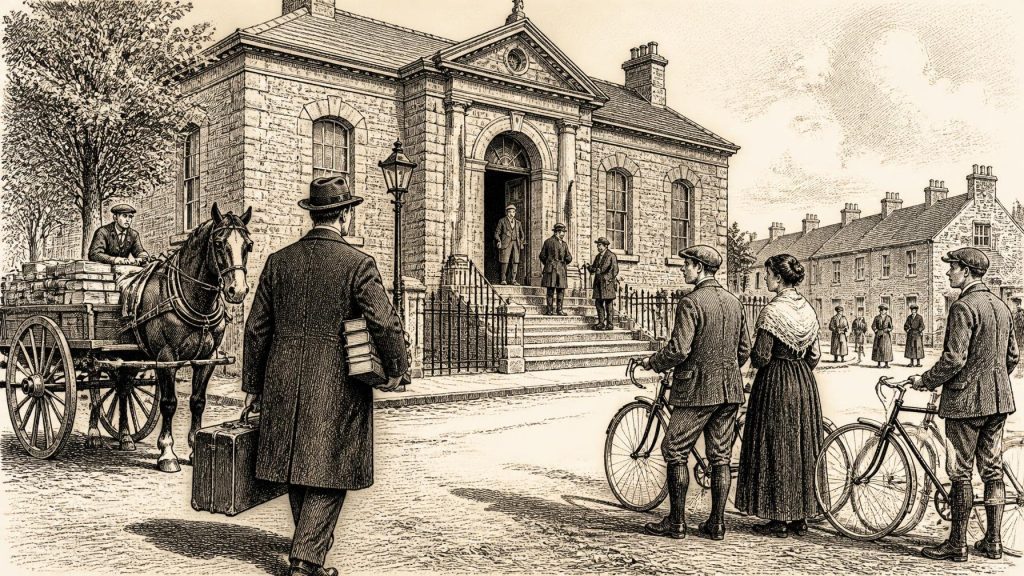
No event better exposed the social and religious tensions within the Free State than the dispute over the appointment of Letitia Dunbar-Harrison as Mayo county librarian. Dunbar-Harrison, a Church of Ireland woman educated at Trinity College Dublin and trained in library work, was appointed in 1930 through the Local Appointments Commission. She had not yet passed the Irish-language qualification, but the rules allowed an appointed candidate time to do so. Her selection nonetheless encountered fierce resistance in County Mayo.
The objection was not reducible to one cause. Critics invoked local control against the centralised appointments system, objected to the appointment of a non-Irish-speaker in a county containing Gaeltacht districts, and argued over the place of libraries in moral and denominational education. But religious prejudice was central to the affair. Catholic clergy and public speakers opposed the appointment, while national newspapers and political parties turned the dispute into an argument about the character of the state. The controversy became especially damaging because it involved a public service intended to distribute books and learning through rural communities.
On 30 November, a public meeting rejected Dunbar-Harrison’s appointment. On 27 December Mayo County Council voted, by 21 votes to 6, not to accept it. The council’s dissolution followed on 1 January 1931 and should not be treated as an event of 1930; nevertheless, the December decision brought the confrontation to its decisive point. The case showed both the Free State government’s willingness to uphold a central appointment and the fragility of minority confidence where Catholic social authority, local politics and cultural nationalism met. It also demonstrated that the formal end of revolutionary conflict had not removed the capacity for coercion through boycott, public pressure and institutional obstruction.
Farms, Exports and Falling Prices
The world depression was becoming visible in 1930, although its full Irish consequences still lay ahead. The Free State’s economy depended heavily on agriculture and on sales across the Irish Sea. Later official analysis recorded that Britain and Northern Ireland took 91 per cent of the Free State’s export trade in 1930. Cattle, pigs, sheep and foodstuffs dominated those exports. This made farmers and exporters unusually exposed to falling purchasing power and weak prices in the British market.
The annual figures captured an uneasy mixture of resilience and warning. Exports and re-exports fell in money value from about £47.9 million in 1929 to £45.7 million in 1930, though calculations at constant 1930 prices suggest that trade volume had not yet collapsed. Emigration to destinations outside Europe fell to 15,966, compared with 20,802 in 1929. That decline cannot simply be read as prosperity: worsening opportunities overseas could keep people at home just as surely as better employment in Ireland. For many rural households, the decisive experience was the weakening value of animals and dairy produce rather than a single dramatic national statistic.
Government policy still aimed to sustain an export economy rather than to seal it behind tariffs. The Agricultural Produce (Fresh Meat) Act of 1930 required registration, licensing, inspection, veterinary examination and certification in the export trade in fresh meat. It was a detailed intervention in the quality and reputation of Irish produce, designed for a trade in which access to markets depended on confidence in standards. The Finance (New Customs Duties) Act also indicated that the older free-trade assumptions were already under pressure. These were not yet the policies of the Economic War, which began only in 1932, but 1930 was a year in which market dependence and the search for protective or regulatory remedies were becoming harder to ignore.
A Divided Industrial Island
Partition remained a daily economic as well as constitutional fact. Northern Ireland was governed from Belfast by Lord Craigavon’s Unionist administration and remained within the United Kingdom. Its industrial economy was badly placed for the downturn. Linen, shipbuilding and associated engineering had already endured persistent unemployment in the 1920s; in a Westminster debate of March 1930, a Belfast representative stated that more than 16 per cent of workers in linen and allied trades were unemployed. The figure was offered in political argument, but it conveys the gravity of the employment problem.
The contrast with the predominantly pastoral Free State was real, though neither jurisdiction escaped insecurity. Belfast’s unemployed confronted the contraction of export manufacturing; rural families south of the border faced low farm returns, seasonal work and enduring pressure to emigrate. Cross-border commercial connections survived, but the island’s two administrations now responded to hardship through separate political systems, fiscal arrangements and public institutions.
Culture, Regulation and Memory
Culture in 1930 combined experimentation with official regulation. Samuel Beckett, then a young Dublin writer moving between Ireland and continental Europe, won the Hours Press prize for his poem Whoroscope. It was published in Paris in a small edition and became his first separately published work. The event was modest at the time, yet it marks the early appearance of a writer whose later work would become central to twentieth-century literature. Its setting also matters: Irish cultural life could not be contained within the language of national institutions or within the island itself.
The state, meanwhile, was enlarging its authority over mass entertainment. The Censorship of Films (Amendment) Act, enacted on 4 June, extended the existing film-censorship system to synchronised sound. A subsequent order required applicants submitting sound films to provide a script. The arrival of talking pictures thus prompted an administrative response shaped by the moral and cultural anxieties of the period. Alongside the National Monuments Act, it suggests two different official approaches to culture: safeguarding selected inheritances from the past and scrutinising a new, commercially powerful medium.
By the close of 1930, Ireland’s public life contained both confidence and apprehension. The Free State could take a seat at Geneva and legislate for its monuments, markets and media. Yet the Mayo dispute revealed severe limits to civic pluralism, while the downturn exposed the vulnerability of an economy tied to British demand. The year did not predetermine the political changes of 1932, but it made their conditions clearer: a parliamentary state was functioning, a more assertive diplomacy was emerging, and deep arguments over sovereignty, faith, culture and economic survival remained unresolved.
Primary Sources
- Timeline of Events, 1919–69
- Statement by Patrick McGilligan on the Irish Candidature for Election to the League of Nations Council
- The Embassy's History
- Extracts from a Memorandum by the Department of External Affairs on the Effects of the Economic Depression on the Irish Free State
- Chronological Table of the Statutes (1930)
- Constitution (Amendment No. 12) Act 1930
- National Monuments Act 1930
- Agricultural Produce (Fresh Meat) Act 1930
- Censorship of Films (Amendment) Act 1930
- Censorship of Films (No. 1) Order 1930
- Harrison, Letitia Dunbar- (Crawford, Aileen)
- Local Government Bill, 1931—Second Stage
- The Catholic Church and the Irish Free State 1923–1932
- Dáil and Seanad Terms
- The Irish Economy During the Century After Partition
- Studies: The Irish Economy
- Unemployment (Industrial and Fiscal Policy), 13 March 1930
- More Than a Game: Rugby and the Great Depression in Ireland
- Whoroscope: [Poem] / by Samuel Beckett
- Index to Samuel Beckett Letters: 1930 Timeline
- Hours Press
- Ireland Through the Decades
- Ireland Laws
- National Archives of Ireland: Women in 20th-Century Ireland, 1922–1966