Duke Street’s Television Shock1968 CE
In 1968, Northern Ireland’s civil-rights movement mobilised grievances over housing, employment, gerrymandering, policing and restricted local voting. Austin Currie’s Caledon protest, marches at Dungannon and Derry, and police violence against the banned 5 October Duke Street demonstration brought televised images to audiences across Ireland and Britain. Student activism produced People’s Democracy, while Terence O’Neill’s government offered reforms, though divisions within unionism and campaigners’ dissatisfaction persisted. In the Republic, voters rejected constitutional changes to electoral arrangements. Educational grants and student protests reflected wider social change, while Humanae Vitae intensified debate over contraception, conscience and Church authority in Irish society and politics.
Dateline
In 1968, the most consequential Irish events unfolded not in a general election or a cabinet crisis, but in streets, council chambers and university halls. Northern Ireland’s civil-rights campaign turned accumulated grievances over housing, local government, jobs, policing and political representation into a public movement. Its confrontation with the authorities in Derry on 5 October brought images of violence into homes across Ireland and Britain, transformed the scale of protest, and placed the Northern Ireland government under intense pressure. The year did not predetermine the conflict that later became known as the Troubles, but it exposed how fragile the political order created by partition had become.
Grievances Become a Movement
The campaign’s immediate issues were concrete. In several nationalist-majority or heavily Catholic districts, access to decent housing, work and local political influence was widely regarded as unequal. Local councils possessed substantial discretion in allocating homes and, because local-government voting rights depended in part on property qualifications, many adults had no vote. The drawing of electoral boundaries, especially in Londonderry, helped maintain unionist control of councils despite demographic realities. For campaigners, therefore, demands such as fair housing allocation, an end to gerrymandering, repeal or reform of exceptional security powers, and “one man, one vote” were demands for ordinary citizenship rather than simply constitutional nationalism.
These issues were not invented in 1968. The Campaign for Social Justice, founded in Dungannon in 1964, had documented alleged discrimination; the Northern Ireland Civil Rights Association (NICRA), formed in 1966, provided a wider umbrella. What changed during 1968 was the readiness to use disciplined public demonstration. The movement also included people with distinct political outlooks: constitutional nationalists, socialists, republicans, trade unionists, students and liberal unionists. Its language of civil rights deliberately connected local conditions to wider arguments about equal treatment within the United Kingdom.
Housing supplied the spark in County Tyrone. On 20 June, the Nationalist MP Austin Currie occupied a newly allocated house at Caledon in protest at the allocation of a council dwelling to a young unmarried Protestant woman while Catholic families were waiting. The action focused attention on the power of local authorities and on the human consequences of shortage and patronage. It also showed the value of an action designed for journalists and television: a dispute about tenancy was made into a question of public principle.
Dungannon and Derry
On 24 August, NICRA organised a march from Coalisland to Dungannon. It was the first major civil-rights march of the year and attracted roughly 2,000 participants. A counter-demonstration, associated with supporters of Ian Paisley, assembled in Dungannon, and the Royal Ulster Constabulary prevented the marchers from entering the Market Square. The demonstration was rerouted and some participants were injured, but it remained far less violent than the events that followed. Its importance lay in proving that a movement once centred on petitions, meetings and local complaints could assemble a sizeable crowd across county lines.
Derry presented the campaign’s central case. The Derry Housing Action Committee had already staged sit-down protests and challenged the corporation directly over housing. NICRA agreed to support a march from the Waterside towards the Diamond on 5 October, protesting housing conditions, unemployment, electoral arrangements and restrictions on assembly. The Apprentice Boys announced a parade for the same day. On 3 October, William Craig, Northern Ireland’s minister of home affairs, prohibited public processions and meetings in the Waterside and within the city walls for that Saturday under the Public Order Act.
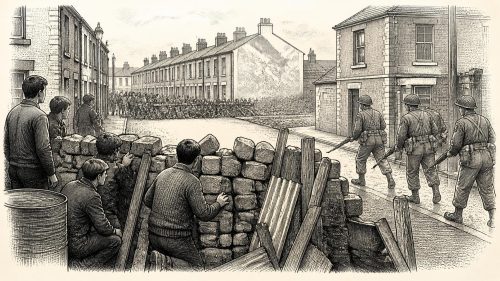
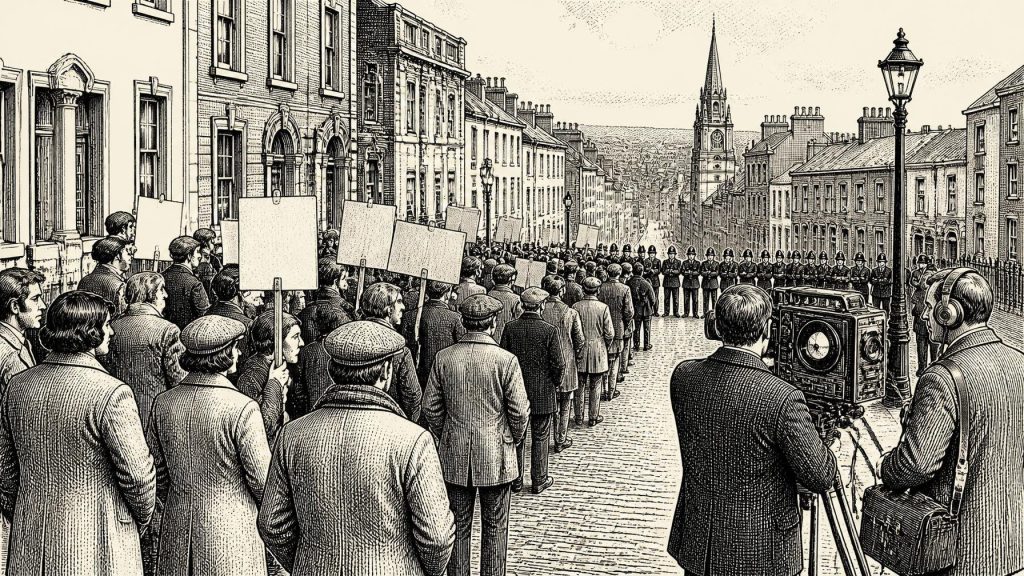
The march went ahead. Its numbers have been estimated differently, but it included local residents, NICRA activists, Stormont representatives, Gerry Fitt MP, visiting Labour MPs from Britain and camera crews, including RTÉ. Police blocked the route and, after confrontation at the cordon, used batons and water cannon. People were injured, including Fitt. Disorder continued in Derry’s Catholic areas over the following days. The later Cameron Commission found that the government’s routing ban had itself provoked strong resentment and greatly increased the number who joined the protest.
The immediate facts were disputed: officials and unionist politicians stressed alleged violence and the danger of disorder, while marchers and observers described an unnecessarily forceful police response to a civil-rights demonstration. Yet the pictures mattered beyond the argument over sequence. Television footage made the clash impossible to confine to Derry. Viewers in the Republic, Britain and further abroad saw police striking unarmed demonstrators; for many nationalists, the images confirmed a belief that normal democratic remedies were unavailable in Northern Ireland. For many unionists, the protests appeared a direct challenge to the state’s legitimacy and security.
Students, Protest and Reform
On 9 October, Queen’s University Belfast students held a protest against police conduct in Derry. From that gathering emerged People’s Democracy, a student-led body which pressed a sharper programme: universal adult suffrage in local elections, fairly drawn boundaries, fair allocation of jobs and houses, freedom of speech and assembly, and repeal of the Special Powers Act. Its formation marked an important generational change. Students were no longer only sympathetic observers; they had become organisers, producing leaflets, meetings and demonstrations that gave the campaign new energy.
Stormont could not ignore the pressure. Terence O’Neill, Northern Ireland’s prime minister, faced demands from London for a convincing response, opposition from hard-line unionists, and distrust among civil-rights activists. In October he established the Cameron Commission to investigate the disturbances. On 22 November his government announced a five-point reform programme: a Development Commission would replace the Londonderry Corporation; housing allocation would move towards a points system based on need; an ombudsman would investigate citizens’ grievances; local-government electoral arrangements would be reformed; and the Special Powers Act would be reviewed.
These concessions were significant, particularly the removal of the Derry corporation from its contentious housing and electoral role. But they did not include immediate universal adult suffrage in local elections, the civil-rights movement’s most resonant demand. Nationalist leaders such as Eddie McAteer urged that the package be tested, while many activists considered it incomplete. Hard-line unionists attacked O’Neill for yielding under pressure. Demonstrations and counter-demonstrations continued, including a sanctioned civil-rights march in Armagh on 30 November whose intended route was blocked by Paisleyite opponents.
On 9 December O’Neill used television to make his celebrated “Ulster stands at the crossroads” appeal. He asked opponents of reform and street demonstrators alike to step back from confrontation. The broadcast briefly mobilised public support for him, but did not resolve the underlying division in unionism or restore confidence among all civil-rights campaigners. Before the year ended, O’Neill dismissed Craig from the Home Affairs ministry after Craig publicly defied the prime minister’s reforming line. The quarrel revealed that the government itself was divided over whether accommodation or resistance offered the safer course.
The Republic: Democracy and Uneasy Attention
The crisis in the North was watched closely in the Republic, where Taoiseach Jack Lynch’s Fianna Fáil government had its own test of democratic confidence. On 16 October, voters rejected two proposed constitutional amendments. One would have altered the rules governing the formation of Dáil constituencies; the other would have replaced proportional representation by the single transferable vote with single-member, straight-vote constituencies. Each was defeated by roughly 61 per cent to 39 per cent on a turnout of almost 66 per cent. The verdict retained PR-STV and dealt Lynch a clear political setback.
The juxtaposition was striking. South of the border, citizens had just rejected a government proposal to reshape electoral practice through constitutional referendum. North of the border, civil-rights campaigners were demanding a fuller local franchise and impartial boundaries from a government they could not realistically expect to replace. The systems were not identical, and it would be wrong to reduce Northern Ireland’s crisis to a single voting question. Nevertheless, the contrast sharpened the political force of “one man, one vote”.
Lynch publicly condemned the conditions behind the Derry unrest and identified partition as its fundamental cause, while the British government retained sovereignty over Northern Ireland. His response in 1968 was diplomatic and political rather than the later language of emergency associated with 1969. The crisis nevertheless returned Northern Ireland to the centre of public discussion in the Republic after years in which economic development, education and European aspirations had often dominated government priorities.
Education, Church and Everyday Change
Social change was also visible in education. The Local Authorities (Higher Education Grants) Act 1968 strengthened grant support for students attending university and other higher-education institutions. Debates over access were particularly timely after the introduction of free post-primary education the previous year. At University College Dublin, overcrowding, library provision, the planned move towards Belfield and proposals for a Trinity–UCD merger fed student dissatisfaction. A large teach-in on the merger took place in November, and architecture students occupied their school premises on 29–30 November. Such actions were modest beside the upheavals of Paris or Prague, but they showed Irish students asserting a claim to participation in decisions affecting their education.
Religion remained deeply embedded in social life, yet 1968 brought a challenge with far-reaching implications. Pope Paul VI issued Humanae Vitae on 25 July, reaffirming Catholic teaching against artificial contraception. In the Republic, where the law restricted the sale and importation of contraceptives and Catholic moral authority was still formidable, the encyclical had immediate relevance to married life, medical practice and public discussion. The Irish bishops endorsed its teaching in October. Initial public dissent was more muted than in some European countries, but the document helped make questions of conscience, family limitation and the relationship between religious teaching and civil law more difficult to avoid.
By December, Ireland had not crossed irreversibly into violence, nor had any settlement been secured. What 1968 did produce was a new political visibility. Council housing, a ballot paper, a university hall and a city street became arenas in which authority was challenged. The events at Duke Street ensured that Northern Ireland’s inequalities, and the competing fears surrounding their redress, could no longer be treated as local matters beyond wider scrutiny.
Primary Sources
- The Cameron Report: Disturbances in Northern Ireland (1969), Chapters 1–9
- The Cameron Report: Appendices and Chronology
- The Cameron Report: Economic and Social Development up to 1968 and the Reforms of November 1968
- The Derry March (5th October ’68)
- The People’s Democracy March: Chronology of Main Events
- Northern Ireland Civil Rights Association: We Shall Overcome
- Copy of Document Received from Students Involved in Civil Rights, 9 October 1968
- The National Archives’ Reference PREM 13/2841
- Terence Marne O’Neill
- Edward Gerard (Eddie) McAteer
- Civil Rights Movement 1968–69
- William Craig on March
- Northern Ireland Civil Rights Association Poster
- Policy Initiatives Introduced During the Period of ‘the Troubles’
- Referendum on the Third Amendment of the Constitution Bill, 1968 – Formation of Dáil Constituencies
- Referendum on the Voting System (Fourth Amendment of the Constitution Bill, 1968)
- Fourth Amendment of the Constitution Bill, 1968
- Referendum (Amendment) Bill, 1968: Second Stage
- Irish Statute Book: Acts of the Oireachtas, 1968
- Local Authorities (Higher Education Grants) Bill, 1968: Second Stage
- UCD Archives: File of Material Relating to Student Disturbances in University College Dublin, 1968–1969
- How Revolutionary Was Ireland in 1968?
- Humanae Vitae
- ‘Too Many Children?’ Family Planning and Humanae Vitae in Dublin, 1960–72
- The Catholic Church and the Irish State, 1916–1973