Rotunda’s First Oireachtas1897 CE
In 1897, Ireland remained under the Union, with Home Rule stalled and nationalist parliamentary strength weakened after Parnell. Debate increasingly focused on prospective local-government reform, while Victoria’s Diamond Jubilee exposed competing loyalist, nationalist, republican and socialist allegiances. Cultural nationalism gained durable institutions: Gaelic League held first Oireachtas at Dublin’s Rotunda, and first Feis Ceoil promoted musical cultivation. Yeats, Lady Gregory and Edward Martyn planned an Irish Literary Theatre, while Bram Stoker published Dracula. Rural life depended on land and British markets; Horace Plunkett advanced agricultural co-operation. Anti-jubilee protests, cultural initiatives and practical reform reflected an increasingly organised, diverse national life.
Dateline
In 1897, Ireland remained part of the United Kingdom, governed from Westminster through Dublin Castle, but the year exposed how inadequate a single constitutional label was to describe the island’s public life. Unionist loyalty, parliamentary nationalism, agrarian reform, language revival, commercial ambition and a more uncompromising separatist mood all occupied the same political landscape. The most memorable events were often cultural rather than legislative: a new Irish-language gathering filled the Rotunda’s Round Room, a national music festival began, and plans were formed for an Irish literary theatre. Yet these initiatives belonged to a country in which land, local power and imperial allegiance remained intensely practical questions.
Government Without Home Rule
Irish self-government was not close in 1897. The second Home Rule Bill had been rejected by the House of Lords in 1893, and the Conservative and Liberal Unionist administration returned in 1895 showed no intention of reviving it. The Irish Parliamentary Party was still weakened by the division that followed Charles Stewart Parnell’s fall and death earlier in the decade. Its rival factions continued to send MPs to Westminster, but no longer possessed the disciplined authority which had made Parnell’s party such a formidable force.
That did not mean that Irish affairs were static. Gerald Balfour, Chief Secretary for Ireland, represented a Unionist policy which sought to address particular Irish grievances while preserving the Union. The Land Law (Ireland) Act of 1896 had added to the complicated body of land legislation governing rents, tenure and purchase. During 1897 the prospect of reforming local administration was increasingly discussed within official and political circles. The great Local Government (Ireland) Act would not be introduced until February 1898, so it would be wrong to place that measure in this year; nevertheless, its approach mattered. The old grand-jury system, dominated by property holders and responsible for county roads, rates and much local expenditure, was plainly becoming difficult to defend in an age of wider electoral politics.
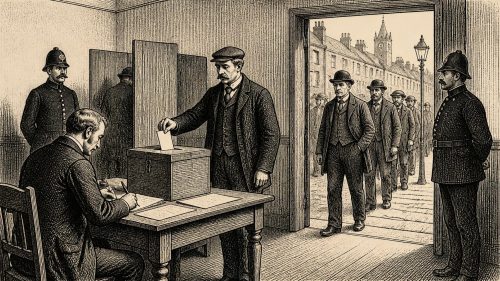
This anticipation was important because local government offered something different from Home Rule but potentially transformative in daily practice. County administration affected roads, public health, poor relief, asylums, bridges and the rates paid by occupiers and owners. Nationalists could regard elected county councils as a training ground in representative government; landlords and Unionists feared that a transfer of authority might reshape local influence. In 1897, therefore, constitutional politics were not only about the postponed question of an Irish parliament. They were also about who would exercise power in the counties and towns where people lived.
Jubilee and Counter-Jubilee
Queen Victoria’s Diamond Jubilee gave that conflict of allegiance a spectacular public setting. The sixtieth anniversary of her accession was celebrated across the empire in June 1897, and commemorative material survives for Irish events: programmes, tickets and fliers testify that jubilee observance was not merely a London affair. Loyalism had real constituencies in Ireland, particularly among Protestants, Unionists and many inhabitants of the industrial north-east, while the monarchy could also command more mixed and situational forms of popular respect elsewhere.
But the jubilee also prompted a deliberately nationalist counter-performance in Dublin. Maud Gonne and other advanced nationalists used the occasion to oppose imperial display with reminders of eviction, poverty and political subordination. Contemporary and later accounts describe lantern projections of eviction scenes shown to crowds on the night of the celebrations, alongside demonstrations and disorder directed at conspicuously loyalist premises. The point was not simply to insult the Queen. It was to insist that royal ceremony could not erase the human consequences of unequal landholding, emigration and the failure of self-government.
James Connolly’s Irish Socialist Republican Party likewise issued a fierce anti-jubilee address, rejecting both the Crown and the political order for which it stood. Such language was far removed from the constitutional methods of most Irish MPs. It nonetheless shows that republican and socialist critiques were already organised and audible. The year’s jubilee thus revealed several Irelands at once: communities willing to celebrate imperial connection, constitutional nationalists pursuing reform through Parliament, and radicals who treated imperial pageantry as an occasion for confrontation.
Music, Language and the Rotunda
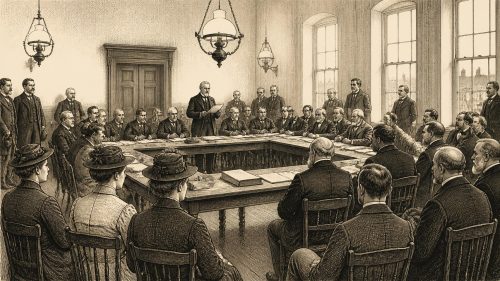
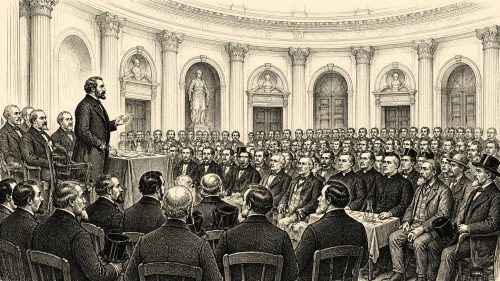
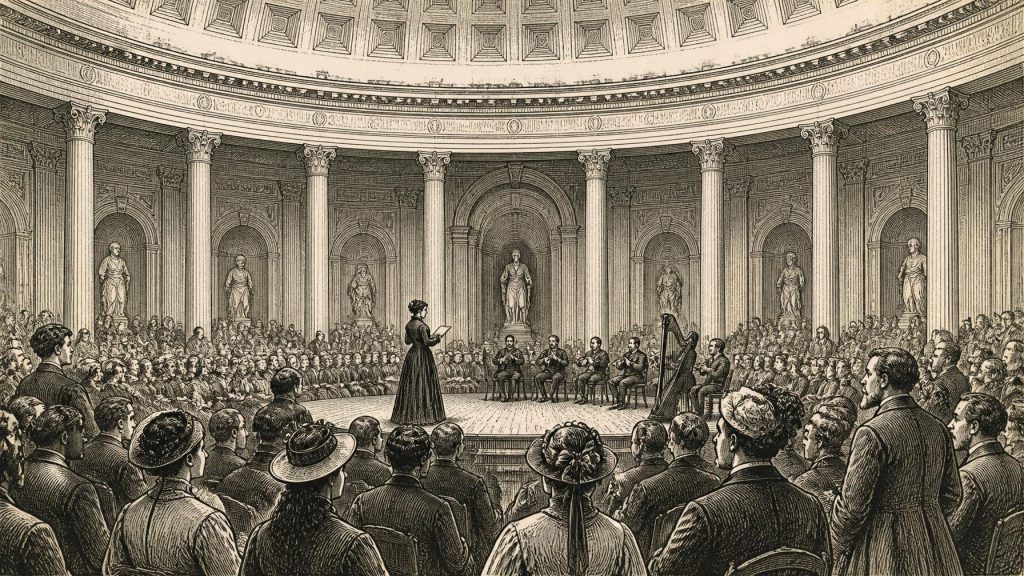
The most constructive public innovation of the year came in Dublin in May. On 17 May, under the auspices of the Gaelic League, the first Oireachtas—an Irish literary festival—was held in the Round Room of the Rotunda. Its published proceedings identify the occasion precisely, including prize pieces entered for competition. The name Oireachtas, literally an assembly, was deliberately resonant: this was not a legislature, but it was a public gathering that gave prestige, ceremony and a national stage to Irish language and literature.
The programme included addresses, prize essays and recitations, music and song. It placed Irish not solely in the schoolroom, antiquarian archive or surviving Irish-speaking districts, but at the centre of an urban public event. The gathering’s organisers envisaged an annual assembly in which readings, songs and dramatic sketches in Irish might be rewarded. That ambition was culturally radical. It assumed that Irish could be a living medium for new work, performance and learned discussion, rather than merely a relic to be collected before it disappeared.
Music formed an associated but distinct strand of this revival. The first Feis Ceoil met in Dublin on 18 May, with Annie Wilson Patterson as its prime mover. Patterson, a musician, teacher and composer from Lurgan, had promoted the revival of Irish music alongside the language movement. The Feis was not restricted to one narrow idea of traditional performance. Its organisers aimed to encourage musical study, competition, publication and the collection of Irish music, drawing together enthusiasts from the Gaelic League, literary circles and the wider musical profession.
The closeness in time between the Oireachtas and Feis Ceoil should not obscure their different emphases. One privileged Irish-language literary and performative culture; the other created a festival framework for musical cultivation. Together they made May 1897 a significant moment in the infrastructure of cultural nationalism. Their value lay not only in speeches or prizes, but in repeatable institutions: committees, programmes, choirs, judges, competitors, printed texts and audiences. Such apparatus enabled cultural revival to become regular public practice.
A Theatre Yet to Open
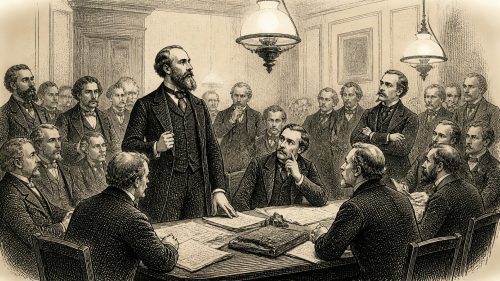
Another important development was still a proposal rather than a functioning theatre. During the summer at Coole, County Galway, W. B. Yeats, Lady Gregory and Edward Martyn discussed the need for an Irish stage able to present serious Irish work rather than the familiar stage caricatures of Irish life. In 1897 they produced a manifesto for what became the Irish Literary Theatre. Its founders proposed Irish and Celtic plays, Irish performers and artistic freedom to experiment.
The first Irish Literary Theatre season would take place only in 1899, and the Abbey Theatre did not open until 1904. Those later dates matter. The historical significance of 1897 is the formation of an intention and programme, not a completed institution. Edward Martyn’s willingness to finance future productions was crucial, while Yeats supplied poetic ambition and Lady Gregory organisational energy and intellectual partnership. The plan joined the language movement in asserting that national culture required institutions of its own, though it did so principally through English-language literary drama rather than Irish-language performance.
The year also connected Irish creativity to a far wider reading public. On 26 May, the Dubliner Bram Stoker’s Dracula was published in London. Stoker had long worked in the London theatrical world, and the novel was not a programme of Irish cultural nationalism. Even so, its appearance is part of Ireland’s literary history: an Irish-born writer, working across the Irish Sea, produced a book that would become one of the most durable works of late-Victorian fiction. Its international route was a reminder that Irish cultural life did not stop at the island’s shores.
Rural Livelihoods and Practical Improvement
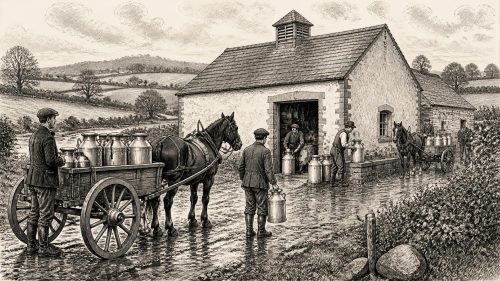
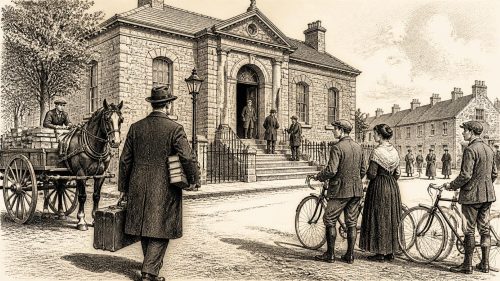
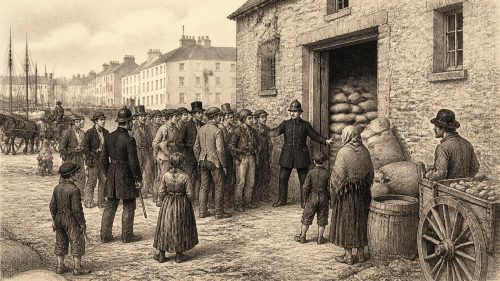
For most people, however, the year was governed less by festivals than by work, land and household security. Ireland remained predominantly rural, and cattle and other livestock were central to its economic relationship with Britain. Official statistical series for the late 1890s record very large annual livestock exports; the precise figures fluctuate and should not be treated as a complete measure of rural welfare, but they underline the dependence of many farmers, dealers, railwaymen and port workers on the British market. Land purchase was gradually altering ownership patterns, yet tenants and smallholders still faced uneven resources, debt, poor housing and vulnerability to market conditions.
Horace Plunkett’s activity in 1897 illustrates a developing response. Through the Irish Agricultural Organisation Society, founded a few years earlier, Plunkett promoted co-operation among farmers: creameries, shared marketing, better production and practical education. His diary for June records work on agricultural and industrial policy and an appeal urging Irish people to press the government for the promised programme. This was not yet the statutory Department of Agriculture and Technical Instruction, which would be created in 1899. It was, however, an important part of the thinking from which that department emerged: national improvement through organisation, technical knowledge and co-operative effort rather than through political rhetoric alone.
In October, the Scottish evangelist William Irvine began preaching independently in Ireland, a small but consequential religious development. His work became associated with the movement later known as the Two by Twos. Its beginnings were modest beside the established authority of the Roman Catholic Church and the Protestant denominations, but it is a useful reminder that religious life in 1897 was not wholly institutional or settled. Revival, dissent and itinerant preaching remained possibilities within a society in which faith shaped family, education, charity and public identity.
Institutions in the Making
Seen from a distance, 1897 can look like an interval between better-known milestones: the defeat of Home Rule, the local-government reforms of 1898, the agricultural department of 1899 and the later political upheavals of the twentieth century. That would miss its character. It was a year in which people created forums through which Ireland could speak, sing, compete, organise and argue. The Round Room assembly, the Feis Ceoil, the theatre manifesto, co-operative advocacy and the anti-jubilee protests all concerned representation—who could portray Ireland, in what language, before which audience, and under whose authority.
None supplied a single answer. Ireland in 1897 was neither uniformly loyal nor uniformly separatist; neither simply stagnant nor already revolutionary. Its politics remained constrained by the Union and by the fractured nationalist movement. Yet its cultural and associational life was becoming more self-confident, more organised and more visibly national. The institutions begun or imagined that year would outlast the immediate controversies, helping to equip later generations with languages, stages, networks and habits of public participation.
Primary Sources
- Imtheachta an Oireachtais [1897]: Full Report of the Proceedings at the Oireachtas, or Irish Literary Festival
- Introduction and Historical Note: An tOireachtas
- Stair | An tOireachtas
- Patterson, Annie Wilson | Dictionary of Irish Biography
- Feis Ceoil Association Records, 1897–1972 | National Library of Ireland
- Our History | Feis Ceoil Festival
- Sigerson, George | Dictionary of Irish Biography
- Martyn, Edward | Dictionary of Irish Biography
- Proposal for The Celtic Theatre | New York Public Library
- Modern Irish Theatre: A Chronology | Oxford Handbook of Modern Irish Theatre
- The Abbey Theatre | Routledge Encyclopedia of Modernism
- Dracula Manuscript Print | British Library
- Commemorative Material: Diamond Jubilee of Queen Victoria | National Library of Ireland
- Queen Victoria’s Diamond Jubilee, 1897 | CELT, University College Cork
- Marketing National Sentiment: Lantern Slides of Evictions in Late Nineteenth-Century Ireland | History Workshop Journal
- Maud Gonne | National Library of Ireland 1916 Exhibition
- 1897 Diary of Sir Horace Curzon Plunkett | National Library of Ireland
- Economy: Life in 1916 Ireland—Stories from Statistics | Central Statistics Office
- Land Law (Ireland) Act, 1896 | Irish Statute Book
- Civil Service Estimates, 1897–8 | Hansard
- Too Much Democracy | Carloviana
- The Celtic Revival: A Successful Festival in Dublin | New Zealand Tablet, 30 July 1897
- A Gallant Little ‘Tírín’: The Welsh Influence on Irish Cultural Nationalism | Irish Historical Studies