January Reckoning
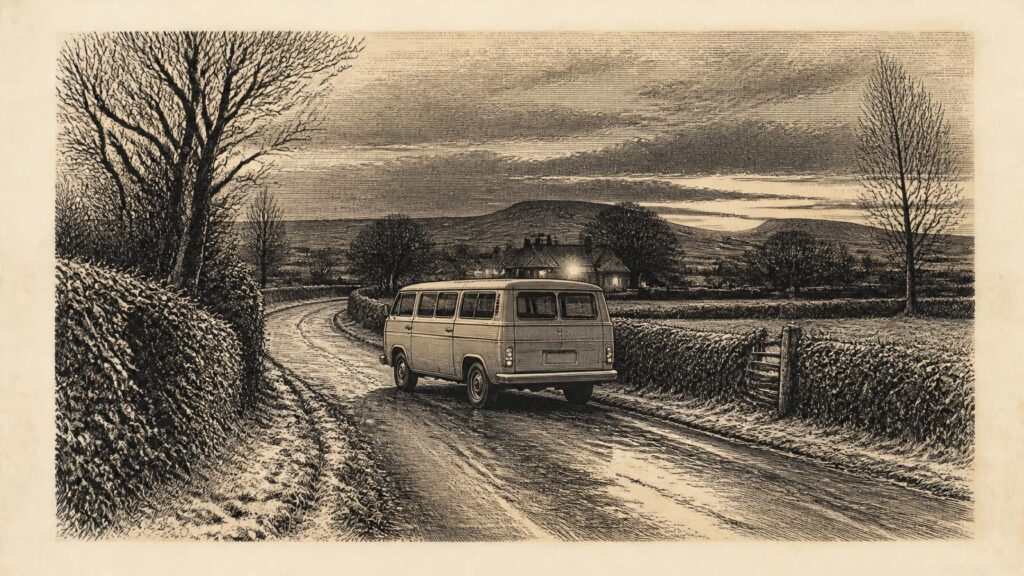
AI generated historical illustration, not a contemporary photograph.
At a Glance
Fifty years after the murders associated with the Reavey, O’Dowd and Kingsmill names, the events of 4 and 5 January 1976 remain among the starkest examples of sectarian violence during the Troubles. They were not a single incident, nor can they responsibly be reduced to a simple story of retaliation. Six Catholic civilians were attacked in their homes on 4 January; ten Protestant workmen were murdered on the road home from their factory on 5 January. The victims belonged to different families, places and communities, yet their deaths were rapidly bound together in public memory, political argument and the long search for truth.
Anniversary Frame
The fiftieth anniversary in January 2026 invited commemoration, but also demanded precision. Anniversaries can encourage a compressed version of the past: atrocity followed by reprisal, grief followed by hardened communal narratives. That shorthand has emotional force because the killings occurred so close together, in a small geographical area, amid an already escalating cycle of violence. It is nevertheless incomplete. It risks obscuring the particular humanity of those killed, the planning behind the attacks, the differing evidential positions of the cases, and the ways in which later investigations revised assumptions that had long circulated.
On Sunday 4 January 1976, loyalist gunmen attacked two Catholic family homes. At Greyhillan, near Whitecross in south Armagh, John Martin Reavey, aged twenty-four, Brian Reavey, aged twenty-two, and their seventeen-year-old brother Anthony were shot. John and Brian died at the scene. Anthony survived initially but died from his wounds in hospital on 30 January. Within roughly twenty minutes, gunmen entered the O’Dowd home at Ballydugan, near Gilford, County Down. Joseph O’Dowd, aged sixty-one, and his nephews Barry O’Dowd, aged twenty-four, and Declan O’Dowd, aged nineteen, were murdered. Other relatives were present in the house and survived.
The following evening, Monday 5 January, a minibus carrying textile workers home from Glenanne Mill was stopped on the Kingsmill Road near Bessbrook, County Armagh. The passengers were ordered out. Richard Hughes, the sole Catholic passenger, was identified and ordered away. The remaining men were fired upon; ten died and Alan Black survived with grave injuries. The victims were John Bryans, Robert Chambers, Walter Chapman, Robert Freeburn, Reginald Chapman, Joseph Lemmon, John McConville, James McWhirter, Robert Walker and Kenneth Worton.
It is important to describe the chronology plainly, while resisting an implication that one group of civilian victims somehow became explanatory currency for the deaths of another. Historical explanation is not moral mitigation. The Reavey and O’Dowd families were attacked because they were Catholic civilians; the Kingsmill workers were attacked because they were Protestant civilians. Later official findings have made that sectarian character unmistakable. The murders were acts of political violence, but their immediate targets were ordinary people in domestic and working lives.
Local Landscape
The geography of south Armagh and the adjoining parts of County Down matters to understanding the events, though it cannot explain them away. The roads connecting Whitecross, Bessbrook, Newry, Markethill, Gilford and the borderland ran through a landscape of farms, small villages, mills, family businesses and closely interwoven local knowledge. People often knew one another across political and religious divisions. That intimacy did not prevent violence; sometimes it intensified fear. An attack on a house or a workers’ bus was not an abstraction. It entered a network in which names, kinship, workplaces, school connections and funerals were immediately recognised.
By the opening days of 1976, the region had endured years of conflict. Republican armed organisations, loyalist paramilitary groups and state forces all operated in or around it. The Provisional IRA had been engaged in an armed campaign against British rule in Northern Ireland. The Ulster Volunteer Force and other loyalist organisations claimed to be defending the Union and Protestant communities, but repeatedly targeted Catholic civilians. The British Army, Royal Ulster Constabulary and Ulster Defence Regiment formed part of the security apparatus in a highly militarised environment. The border was both a real jurisdictional line and a factor in policing, intelligence, movement and refuge.
The area was also marked by what later became known as the “murder triangle”: a loose description of a zone in which a succession of murders and bombings generated enduring allegations about loyalist networks, weapons and collusion. The term can be useful as a description of a pattern, but it should not be used as if it settled every question of individual culpability. Some allegations have been investigated in official processes; some have remained unproven; some depend on testimony whose reliability must be carefully assessed. The history requires neither credulous acceptance nor dismissive indifference.
The winter of 1975–76 was particularly dangerous. On 19 December 1975, loyalists attacked Donnelly’s Bar at Silverbridge, County Armagh, killing three Catholic civilians. On the same day, Kay’s Tavern in Dundalk was bombed. Other shootings and bombings added to the sense that civilian life in border communities had become acutely exposed. The killings of the Reaveys and O’Dowds, followed by Kingsmill, were thus part of an accelerating sequence, not an isolated eruption from an otherwise settled landscape.
Family Homes
The attacks of 4 January were assaults on households. That fact is central. The Reavey brothers were shot after masked gunmen entered their family home at Greyhillan. John and Brian died there. Anthony, despite terrible wounds, managed to leave the house and seek help. His death later that month extended the family’s ordeal beyond the night of the shooting. Their parents and siblings had to move from the immediacy of attack to hospital visits, funerals and a lifetime of bereavement.
At Ballydugan, the O’Dowds had been gathered at home when gunmen entered and opened fire. Joseph O’Dowd was killed with his nephews Barry and Declan. Official accounts record the presence of many family members in the house. The setting is significant not as a sentimental detail, but because it reveals the method of the attack: armed men entered a private domestic space and selected men in a room full of relatives. Survivors carried memories of the gunfire and its aftermath, as well as the later burden of trying to obtain information about those responsible.
Contemporary reporting and later recollection often joined the two shootings as a co-ordinated double attack. The closeness in time, the comparable targeting of Catholic households and the political context all support that description. The Barron Inquiry’s examination of connected loyalist violence stated that the available information suggested that the Reavey attack involved a group including members of security-force bodies, while the O’Dowd attack was said to have been carried out by a group led by Robin Jackson. Yet the inquiry also made clear that limitations of reliable evidence prevented certainty about all participants. This distinction remains essential: a serious historical account can set out official findings and allegations without converting every allegation into a judicially proven fact.
The evidence concerning weapons demonstrates both the potential and the limits of retrospective investigation. Information examined by the Barron Inquiry indicated that a 9mm sub-machine gun was used in the O’Dowd murders and that it had been connected through ballistics to other loyalist attacks. Such links can establish patterns in the use of a firearm. They do not automatically identify every person who handled it on a particular night, nor do they remove the necessity for evidence capable of sustaining a prosecution.
The Reavey family’s experience acquired an additional, damaging public dimension. Eugene Reavey, brother of the murdered men, was later accused under parliamentary privilege of involvement in the Kingsmill killings. The Historical Enquiries Team review found no evidence that the Reavey brothers had criminal convictions or paramilitary links, and no verified link between the family and a paramilitary organisation. That finding mattered profoundly. It did not return the dead or solve the murders, but it formally challenged insinuations that had added reputational injury to bereavement.
False Equivalence
The phrase “tit for tat” has often been applied to the early days of January 1976. It captures a terrible dynamic of reciprocal sectarian killing, but it can also mislead. Its ordinary, almost casual sound risks implying symmetry, spontaneity and inevitability. None of those implications is adequate. The murder of civilians was not an automatic communal reflex. It involved decisions by armed groups and individuals: decisions to gather intelligence, acquire and transport weapons, choose targets, move through local terrain, issue claims and attempt to shape public interpretation afterwards.
The Kingsmill inquest, completed in 2024 after a lengthy process, addressed one of the most important historical questions directly. The coroner concluded that the attack occurred in the aftermath of the Reavey and O’Dowd murders and was ostensibly a response to them, but that it had been planned long before they occurred. This finding does not deny the catalytic significance of the killings of 4 January. It instead rejects the idea that a complex operation involving a false checkpoint, armed personnel, vehicles, an escape plan and multiple weapons could have been conceived and organised wholly within a day.
That distinction changes the historical picture. The murders of the Reaveys and O’Dowds became the immediate public rationale offered by those claiming responsibility for Kingsmill. But a rationale declared after an event is not necessarily the same thing as the operational origin of that event. Armed organisations may exploit an atrocity committed by an opponent to legitimise violence that had already been envisaged, prepared or facilitated. The inquest evidence suggests that this is the more accurate way to understand Kingsmill.
There is also a moral reason to avoid the language of mechanical reprisal. To say that Kingsmill was caused by the Reavey and O’Dowd murders can, however unintentionally, transfer explanatory weight from perpetrators to victims. The six men murdered in the family homes did not make the Kingsmill workers targets. The responsibility for Kingsmill lay with the people who selected, detained and shot the workers. Equally, the responsibility for the attacks on the Reavey and O’Dowd homes lay with the gunmen and organisers who carried them out, not with earlier republican attacks invoked by loyalists.
Interpretation must therefore retain two truths at once. First, events in the area were connected in a rapidly intensifying environment of sectarian violence. Secondly, each murder was a distinct crime against a distinct person, carried out by identifiable human agency. This is not a verbal nicety. It is the difference between historical understanding and the fatalistic language that armed groups have often used to blur responsibility.
Kingsmill Road
Shortly after 5.30 pm on 5 January 1976, the minibus carrying workers from Glenanne Mill travelled towards Bessbrook. A group of armed men stopped it by posing as a military patrol. The use of a bogus checkpoint was calculated to exploit a landscape accustomed to checkpoints and armed authority. The passengers could not know, until too late, that the apparent security operation was an ambush.
The men were ordered from the vehicle. Richard Hughes was identified as Catholic and told to run in the direction of Bessbrook. His removal has frequently been recalled as evidence of the overtly sectarian nature of the attack. The surviving Protestant passengers were then made to line up or lie alongside the minibus. Gunmen opened fire with automatic weapons. Alan Black survived, despite being seriously wounded. The others died at the roadside or from their wounds.
The 2024 inquest concluded that the initial shooting was followed by further shots intended to ensure that victims were dead. Its findings describe an attack carried out by a unit of at least twelve IRA members drawn from south Armagh and north Louth. The coroner found that the operation was carried out by the Provisional IRA, not by an independent organisation called the South Armagh Republican Action Force. This conclusion was based on the totality of evidence before the court, including ballistics, intelligence material, historical context and the organisational capabilities required for the attack.
In the immediate aftermath, a caller claimed the massacre for the South Armagh Republican Action Force. For years, that label created uncertainty and allowed a degree of organisational distancing. The 2024 finding was unequivocal: the claimed name did not alter responsibility. The coroner held that the attack was committed by the IRA, under the authority created by its Army Council’s strategic direction and the substantial operational autonomy of local units. It was not treated as an unauthorised act by a rogue group beyond the organisation’s authority.
The question of whether individuals have been named in public, suspected in intelligence records or associated with weapons should be handled with restraint. The historical record contains intelligence assessments and later allegations. Intelligence can lead investigators towards lines of inquiry, but is not itself necessarily evidence that can be tested in court. No person has been convicted of the Kingsmill murders. The absence of convictions should not be mistaken for an absence of official conclusions about organisational responsibility, but neither does an inquest finding supply the same result as a completed criminal trial against named defendants.
Witness Memory
Alan Black’s survival made him a central witness to the Kingsmill attack, though it would be wrong to imagine that survivors owe the public a permanent performance of trauma. His evidence, and the evidence of other witnesses, assisted investigations and the inquest. It also reminds historians that the event was not known only through police reports, weapons analysis or later political debate. One man lived through the firing and its aftermath. His life thereafter was shaped by physical injury and memory.
Richard Hughes’s experience was different but no less consequential. Ordered to leave because he was Catholic, he survived an attack that was directed at the men from whom he had just been separated. The fact that the gunmen made a religious distinction before killing the other passengers is among the clearest facts in the case. It defeats attempts to present Kingsmill as an indiscriminate military action or an attack chosen for any reason other than the perceived Protestant identity of the workmen.
For the Reavey and O’Dowd families, surviving relatives were witnesses to the intrusion of violence into home. Their testimony has mattered in a different way: it has preserved the ordinary family settings in which the attacks occurred and challenged later versions that sought to place political labels on the dead. Family memory, however, is not identical to archival proof. It is personal testimony rooted in loss. It deserves respect, while the historian should distinguish it from findings reached through documentary, forensic or judicial processes.
One often repeated account is that members of the Reavey family encountered the Kingsmill scene while travelling to Daisy Hill Hospital in Newry to collect the bodies of John and Brian Reavey, and that Eugene Reavey offered condolences to relatives of the Kingsmill dead. This account appeared in the Northern Ireland Assembly debate of June 2010 and has become important in local remembrance. It should be treated as testimony recorded in a political forum rather than as a substitute for a contemporaneous police record. Its historical value lies partly in what it conveys about the proximity of grief: families connected by no responsibility for one another’s losses were brought within sight of a second atrocity.
The story has sometimes been used to set compassion against communal division. That interpretation is reasonable, provided it does not turn individual kindness into a consoling resolution of deeper structures of violence. The killings were not undone by sympathy; nor did sympathy remove the obligation to investigate. But such encounters complicate narratives in which communities appear only as opposing blocs. The people most directly bereaved could recognise another family’s pain even amid profound fear and anger.
Official Record
The official record has grown substantially since 1976. It remains incomplete, but it is no longer limited to the first police investigation and early press reports. The Historical Enquiries Team reviewed both the Kingsmill case and the murders of the Reavey brothers. The Police Ombudsman for Northern Ireland examined the original Royal Ulster Constabulary investigation into Kingsmill. The coroner’s inquest provided the most extensive recent judicial consideration of the massacre. The Barron Inquiry, established by the Irish Government to investigate a series of loyalist attacks with cross-border dimensions, considered the Reavey and O’Dowd killings in the wider context of linked violence.
These processes did not all have the same purpose or legal power. An inquest investigates the circumstances of death; it is not a criminal trial. An ombudsman examines police conduct; it does not determine the guilt of every suspected perpetrator. A public inquiry may assess evidence and make findings or recommendations, but can be constrained by access to records, the passage of time and the standards needed to identify individuals conclusively. Understanding these differences helps prevent disappointment from being converted into cynicism.
The Kingsmill inquest established a detailed account of the method of the attack and its political attribution. It found that the IRA killed the workmen in a pre-planned, sectarian operation. Its conclusion placed the attack within the IRA’s organisational authority while acknowledging the operational autonomy of units in the area. It also rejected suggestions that the lack of prosecutions was explained by a deliberate effort to protect an informant. The coroner found that claim to be without foundation on the evidence before the court.
The Police Ombudsman’s report, published in 2025, reached a different but complementary set of findings. It did not criticise the first officers at the Kingsmill scene, noting their professional response in an extraordinarily difficult situation. It did, however, find serious shortcomings in the wider murder investigation. The Ombudsman concluded that the resources available were wholly insufficient by modern standards and that complaints about investigative failings were, in large part, legitimate and justified. The investigation team was small relative to the scale of ten murders and an attempted murder in a region already under severe pressure.
The Ombudsman identified failures to act adequately on certain intelligence, including information which named people or assigned roles. More than sixty individuals appeared in Royal Ulster Constabulary files as suspects at various stages. The report carefully differentiated between inaccurate, vague or unproductive intelligence and information that ought to have been pursued more effectively. Its significance lies not in promising a retrospective certainty that the evidence cannot sustain, but in showing that opportunities were missed and investigative choices had consequences.
Collusion Questions
Questions of collusion surround the Reavey and O’Dowd murders more directly than Kingsmill, though both cases have generated wider allegations about intelligence, policing and security-force knowledge. The word “collusion” should be used precisely. It can refer to direct participation by a state employee, the provision of weapons or information, the protection of agents, failures to prevent crimes, or the toleration of unlawful conduct. These are different propositions requiring different evidence.
The Barron Inquiry considered testimony by former Royal Ulster Constabulary officer John Weir and other material concerning a loose loyalist network commonly called the Glenanne group or Glenanne gang. It concluded that available information suggested that people associated with the security forces had been involved in the Reavey attack, and it recorded allegations regarding the O’Dowd murders. Yet its report also emphasised evidential limits. It did not turn every allegation about every named individual into a conclusive finding. That restraint is not a defect; it is an acknowledgement of the difference between plausible suspicion, intelligence, testimony and proof capable of meeting a legal standard.
Subsequent legal and investigatory developments have reinforced the importance of those questions without fully resolving them. In 2024, the Public Prosecution Service for Northern Ireland announced that it would not prosecute one former police officer in relation to a number of 1970s attacks, including the murders of the Reavey brothers. A decision not to prosecute is not a finding that the crimes did not occur, that no wrongdoing took place, or that family concerns lack legitimacy. It means that, on the material submitted and against the applicable test for prosecution, the service concluded that a prosecution should not proceed.
For families, this distinction can be painfully unsatisfying. The historical record may identify institutional shortcomings, establish that victims were innocent civilians, demonstrate links between weapons or document intelligence that was not acted upon, yet still produce no trial and no verdict against a living defendant. The language of “truth” is often used to cover these different outcomes. In practice, truth recovery is uneven: one question may be clarified while another remains unanswered.
There is an additional danger in treating unresolved allegations as material for partisan scorekeeping. Families have sought information not to build a hierarchy of victimhood but to understand why their relatives were murdered and whether state institutions failed them. An ethical history should neither suppress the evidence of possible collusion nor use it to diminish the unequivocal wrong of the Kingsmill killings. Recognition of one atrocity must not become an argument against recognising another.
Public Language
The vocabulary attached to these events has changed over five decades. Early accounts commonly used the language of “terrorism”, “massacre”, “reprisal” and “sectarian murder”. Each term has consequences. “Massacre” conveys the scale and asymmetry of the Kingsmill attack, while “murder” retains the individual legal and human reality of each death. “Reprisal” can describe a claim made by perpetrators, but should never be allowed to imply legitimacy.
The title “Kingsmill massacre” is widely used and historically intelligible. The murders of the Reavey and O’Dowd families have less often acquired a single shared title, perhaps because they occurred at separate homes in two counties, perhaps because Kingsmill overshadowed them in public discourse. The phrase “Reavey and O’Dowd killings” is therefore useful, but it should not strip the dead of their names. In each case, naming counters the tendency of political violence to make victims representative symbols rather than people.
Another problem is the careless use of collective labels. “Catholic” and “Protestant” accurately describe the sectarian selection of victims in these attacks, but they are not sufficient descriptions of whole lives. The men murdered at Kingsmill were workers returning from a mill. The Reaveys and O’Dowds were sons, brothers, an uncle and a father, members of households and local communities. The religious identity assigned to them by gunmen was decisive in their deaths; it should not become the only identity permitted to survive in history.
Public language also matters because misinformation has had consequences. The unsubstantiated allegation against Eugene Reavey was not merely an episode in political controversy. It placed suspicion on a bereaved man and could be repeated long after its evidential basis had been rejected. The historical record must be alert to such afterlives. Violence did not end at the roadside or in the sitting room; it could continue through accusation, silence, evasion and the failure to correct falsehoods.
Commemorative Burden
The fiftieth anniversary was not a neutral date on a calendar. It was a moment at which surviving relatives, neighbours and public representatives faced the question of how to remember without repeating the divisions that made the violence possible. Official statements in January 2026 named all sixteen victims and recognised Alan Black, the sole Kingsmill survivor. Such naming is a modest but important public act. It rejects the habit of referring only to totals or communal categories.
Commemoration can become competitive when one set of victims is mentioned only to qualify another. The particular lesson of 4 and 5 January 1976 should be the opposite. The Reavey and O’Dowd families do not need Kingsmill to validate their grief; the Kingsmill families do not need the prior murders to validate theirs. Each set of victims deserves to be remembered without an implied demand that their relatives first acknowledge a political counterclaim.
That does not mean separating the events completely. They belong together in historical study because the same regional crisis, patterns of sectarian targeting and public narratives connected them. They should not be merged morally or evidentially. The loyalist attacks on 4 January and the republican attack on 5 January had different perpetrators, methods, organisational histories and subsequent investigations. The closeness of the dates makes comparison necessary; respect for the dead makes false equivalence unacceptable.
There is a generational dimension as well. Many people born after 1976 encounter Kingsmill, the Reavey murders and the O’Dowd murders through family stories, memorial services, political speeches, news anniversaries or online argument. They may inherit names but not context. Historical work can offer context without offering excuses. It can explain the armed politics of the period, the security environment and the failures of investigation while holding to a simple conclusion: the deliberate targeting of civilians because of their religious identity was wrong.
Historical Responsibility
A responsible account of these events has to make room for uncertainty. Some central facts are firmly documented: six Catholic civilians were murdered in attacks on the Reavey and O’Dowd homes; ten Protestant civilians were murdered at Kingsmill; the Kingsmill attack was sectarian; the 2024 inquest attributed it to the Provisional IRA; and no one has been convicted for either set of murders. Other questions remain partly unresolved, especially the full identity of every participant in the loyalist attacks, the degree of collusion involved, and why investigative opportunities did not lead to prosecutions.
Uncertainty is not an invitation to relativism. It is instead a discipline. It requires historians to say “the evidence indicates”, “the inquiry found”, “a witness alleged” or “this remains unproven” where those are the honest formulations. Such language honours victims more than inflated certainty does. False confidence can be another form of exploitation, particularly when it supplies convenient villains or absolves favoured organisations without regard to evidence.
The evidence also supports a wider interpretation. The sequence of January 1976 reveals how paramilitary organisations used sectarian categorisation to turn civilians into symbols of an opposing community. Loyalist gunmen entered Catholic homes; republican gunmen stopped Protestant workers at a false checkpoint. In both cases, the victims’ supposed communal identity eclipsed their individuality in the killers’ calculations. The result was not defence, liberation or justice. It was bereavement distributed through families and neighbourhoods for decades.
The fiftieth anniversary is therefore not simply about the past. It concerns the standards by which the past is narrated in the present. It asks whether public institutions will be candid about investigative failures; whether political leaders will correct falsehoods; whether records will be made available where lawfully possible; and whether remembrance can resist the temptation to rank suffering. These are not abstract questions in places where the names remain local and the absences remain familial.
The January killings offer no redemptive ending. They do, however, leave a clear historical obligation. Remember John Martin, Brian and Anthony Reavey; Joseph, Barry and Declan O’Dowd; John Bryans, Robert Chambers, Walter Chapman, Robert Freeburn, Reginald Chapman, Joseph Lemmon, John McConville, James McWhirter, Robert Walker and Kenneth Worton as people killed in acts of sectarian violence. Remember Alan Black and the surviving relatives who carried wounds and grief. And remember that explanation must never become excuse.
Historical Reckoning
The events of 4 and 5 January belong together in history because they occurred within the same violent sequence, transformed neighbouring communities and became inseparable in public argument. They must nevertheless be remembered without allowing sequence to become equivalence. The six men killed in the Reavey and O’Dowd homes, and the ten men killed at Kingsmill, were civilians whose deaths exposed the capacity of armed organisations to turn religion, locality and ordinary routines into criteria for murder. A responsible account should hold that shared truth firmly while retaining the separate circumstances, perpetrators and unanswered questions of each crime.
The immediate official response illustrates the pressure under which the region was placed. The contemporary chronology records that a Special Air Service unit was moved into south Armagh on 7 January 1976, amid demands for a stronger security response; it was the first deployment of the regiment to be officially acknowledged. That decision was a consequence of a wider emergency, rather than proof that militarisation could supply either security or justice. The killings had demonstrated the vulnerability of family homes, rural roads and workplaces alike. They also showed how quickly armed violence could alter daily behaviour: a journey home, a visit to relatives or an evening indoors could no longer be assumed to be safe.
Later inquiries have made clear why the passage from atrocity to accountability was so difficult. The Kingsmill inquest examined intelligence, arrests, forensic work, lost or incomplete records, and cross-border investigative activity. Its account demonstrates that information received in the days after an attack can range from valuable lead to rumour, and that a name appearing in an intelligence file does not by itself establish criminal liability. Conversely, the inability to prove an allegation decades later does not mean that concerns about an investigation were unreasonable. Time weakens recollection, witnesses die, exhibits disappear and the original handling of material may itself become a subject of scrutiny.
The 2024 prosecution decision concerning a former police officer in connection with, among other attacks, the Reavey murders makes this distinction particularly sharp. The Public Prosecution Service concluded that the available material did not provide a reasonable prospect of conviction. It explained that central allegations appeared in documentary records rather than admissible witness testimony, and that problems of reliability and independent corroboration could not be overcome. Such a decision is legal, not exculpatory in a broader historical sense. It says that the evidential threshold for a criminal case was not met; it does not erase the murders, settle every allegation about state involvement, or relieve institutions of the duty to explain their actions as fully as possible.
Public remembrance has therefore had to carry more than grief. It has also carried disputes over attribution, reputation and apology. The Assembly debate on the Reavey murders in 2010 revealed both the persistence of partisan language and a recognition that bereaved families were entitled to truth, acknowledgement and the correction of false claims. That need is not confined to one community. The practical discipline demanded by January 1976 is to name victims accurately, distinguish established findings from allegation, and refuse accounts that make civilians bear responsibility for violence inflicted upon others. Memory becomes most trustworthy when it resists both denial and the temptation to turn the dead into instruments of political argument.