Castledermot’s First Parliament1264 CE
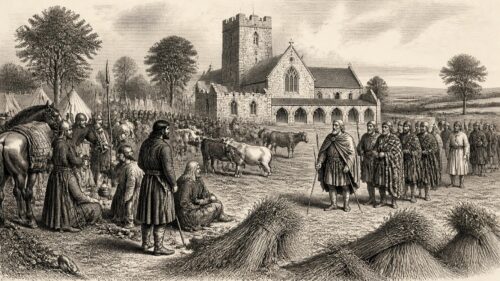
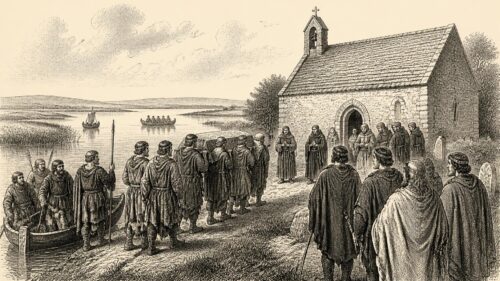
On 18 June 1264, an assembly at Castledermot became the earliest securely documented Irish gathering to call itself a parliament. Chaired by the justiciar Richard de la Rochelle, it investigated Dublin archbishops’ claimed criminal jurisdiction against Prince Edward’s rights, illustrating contested authority rather than representation. Meanwhile Walter de Burgh’s war with the FitzGeralds devastated Connacht and exposed weakness in royal administration. Anglo-Irish leaders negotiated peace with Fedlimid Ó Conchobair at Athlone, acknowledging Gaelic power. In Armagh, Archbishop Máel Pátraic Ó Scannail built defences and welcomed Franciscans. Together, these events vividly reveal competing lordly, royal, Gaelic and ecclesiastical powers in Ireland.
Dateline
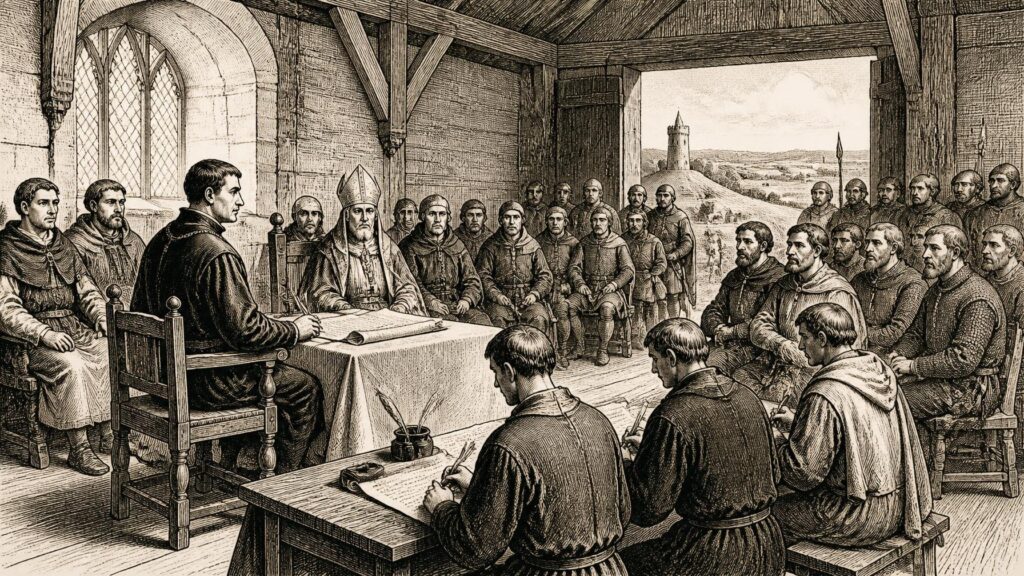
The surviving record of a gathering at Castledermot, Co. Kildare, on 18 June 1264 gives this year a special place in Irish constitutional history. It is the earliest securely documented Irish assembly to describe itself as a parliament. That does not make it a parliament in the modern, representative sense. It was an inquisition: a formal hearing before the chief officers of the Anglo-Irish administration, magnates and a panel of knights and jurors. Yet its surviving language, its named attendance and its concern with public authority offer an unusually sharp view of how power was argued over in thirteenth-century Ireland.
Elsewhere, 1264 was marked by political violence, negotiated peace and regional change. Walter de Burgh, newly established as earl of Ulster, fought the FitzGerald interest across Connacht. At Athlone, leading Anglo-Irish officials met Fedlimid Ó Conchobair, king of Connacht, and his son Áed, then made peace in the face of their formidable following. In the north, Archbishop Máel Pátraic Ó Scannail strengthened Armagh with a ditch and brought Friars Minor into the city. These were not disconnected developments. They show a country in which royal government, lordship, Gaelic kingship and ecclesiastical institutions all possessed real force, but none could simply dictate terms everywhere.
A Parliament at Castledermot
The Castledermot sitting is firmly dated to Wednesday, 18 June 1264: the Wednesday after Trinity Sunday in the forty-eighth regnal year of Henry III. It was held before Richard de la Rochelle, chief justiciar of Ireland, the king’s leading judicial and administrative officer in the lordship. Present were Hugh of Taghmon, bishop of Meath and treasurer of Ireland; the chancellor, Frenmund le Brun; Geoffrey de Geneville; the escheator William de Bakepiz; and twenty-six named knights and jurors. The record is preserved because it was copied into the Liber Niger, or Black Book, of Christ Church, Dublin, and later into Archbishop Alen’s register.
The matter before this body was not taxation, legislation or popular representation. It concerned the boundary between the temporal jurisdiction claimed by Fulk Basset de Sandeford, archbishop of Dublin, and the rights claimed for Prince Edward, Henry III’s son and lord of Ireland. The inquiry heard that grave pleas, including cases of homicide and other matters normally treated as pleas of the Crown, had been taken in the courts of Archbishop Luke, Fulk’s predecessor, and of Fulk himself. To royal officers, this was an encroachment upon the liberties of the lord of Ireland; to the archbishopric, long exercise of such jurisdiction was evidence of customary right.
The issue mattered far beyond a legal technicality. Courts generated authority, fines and influence. A lord who could summon tenants, hear disputes and punish serious offences exercised a powerful hold over people and land. The proceedings at Castledermot therefore expose a central tension of the colony: royal government sought to define and protect its jurisdiction, while one of Ireland’s greatest ecclesiastical lordships defended its own judicial reach. The assembly’s form was narrow, elite and administrative, but it was an important stage in the development of parliamentary practice in Ireland.
Its timing was striking. On 14 May 1264, only five weeks earlier, Henry III and Prince Edward had been captured by Simon de Montfort’s baronial forces at the battle of Lewes in England. The Irish parliament met while the lord of Ireland was a prisoner. This did not halt government in Ireland. Rather, the Castledermot record demonstrates that officials, churchmen and local landholders continued to transact affairs through established legal machinery. It also cautions against treating Ireland as a passive appendage of English politics: the crisis across the Irish Sea formed the wider setting, but the business at Castledermot arose from an Irish dispute over land, courts and authority.
Magnates at War
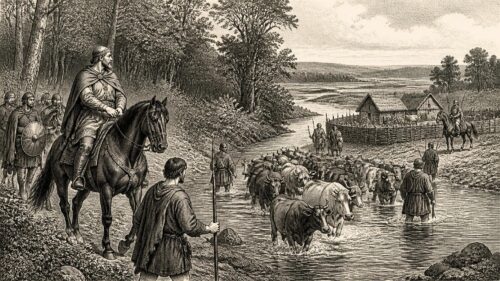
The most destructive struggle recorded in Ireland that year was between Walter de Burgh, Mac William Burke in the Irish annals, and the FitzGeralds. Walter had received the earldom of Ulster from Prince Edward in July 1263, a grant that elevated an already powerful lord of Connacht into the foremost Anglo-Irish magnate. The Irish annals for 1264 accordingly call him earl of Ulster. His new status sharpened rivalry with the Geraldine interest, which held castles, manors and followers in Connacht.
The Annals of Connacht say that “a great part of Ireland was ruined” in the conflict. This is annalistic language, not a measured survey of island-wide damage, but the specific actions recorded leave no doubt about its seriousness. Walter took all FitzGerald castles in Connacht, burned their manors and plundered their people. He also took the castles of Loch Mask and Ardrahan into his own hands. Castles were not merely military structures. They were centres from which lords stored supplies, received dues, controlled roads and waterways, and organised tenants and armed retainers. Their seizure changed the local balance of power at once.
The FitzGerald response was equally audacious. Maurice FitzGerald captured the justiciar, John de Cogan and Theobald Butler in a consecrated church. The annals’ emphasis on the setting underlines the breach of sanctuary as well as the political shock. Capturing the chief justiciar meant that a private feud had reached into the heart of the royal administration. It also shows why the language of a settled Anglo-Norman order can mislead: great lords who were meant to uphold royal rule could instead imprison its chief representative when rivalry made it useful.
There is no responsible basis for assigning the outbreak, the castle seizures or the capture to a particular day in 1264. Nor should the Castledermot parliament be presented as a proven settlement of the de Burgh–FitzGerald war. The surviving parliamentary record concerns Archbishop Fulk’s jurisdiction, while the annals independently record the feud. What can be said securely is that both occurred in the same year, revealing the strains placed on government when magnates disputed precedence and property.
Athlone and Connacht
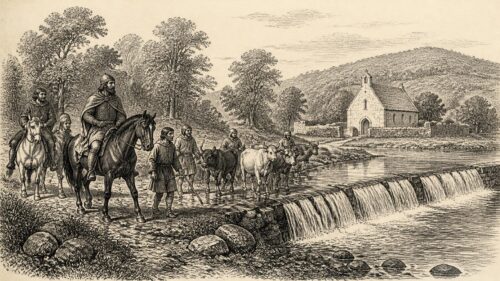
Even amid that conflict, diplomacy was possible. The annals record a “great meeting” at Athlone involving the justiciar, the earl of Ulster, Mac Gerailt—FitzGerald—and other leading Anglo-Irish figures, together with Fedlimid Ó Conchobair and his son Áed. Athlone, at the Shannon crossing between Meath and Connacht, was an obvious meeting place: a strategic fortress and river passage connecting the lordship’s eastern heartland with the contested west.
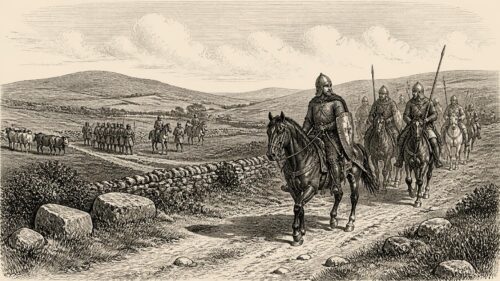
The chronicler states that the Anglo-Irish party was alarmed by the innumerable following of Fedlimid and Áed, took counsel, sued for peace and obtained it. The wording is partisan and should not be read as a literal count of an army. Its larger significance is nevertheless clear. Fedlimid’s authority could not be ignored, and the settlement was made with both father and son present. Gaelic kingship remained an active political force, capable of assembling armed support and compelling negotiation from officials and colonists.
That peace did not erase other violence. Art Ó Máel Sechlainn fought the Anglo-Irish of Meath around the Brosna; the annals report slaughter and drowning among those who fled. He also burned settlements in Delbna, Brawney and Calry, expelled the Galls—foreigners, normally Anglo-Irish settlers and lords in this context—and took hostages from the local chiefs. Such notices reveal warfare’s practical consequences: burned habitations, disrupted cultivation, displaced communities and hostages used to secure submission. In Síl nAnmchada, the Delbna raided and killed five sons of Ó Madadháin. Muirchertach Ó hAirt was killed and his people burned by Donn Mag Uidhir. These were regional struggles, but their accumulated human cost was substantial.
Armagh’s Ditch and Friars
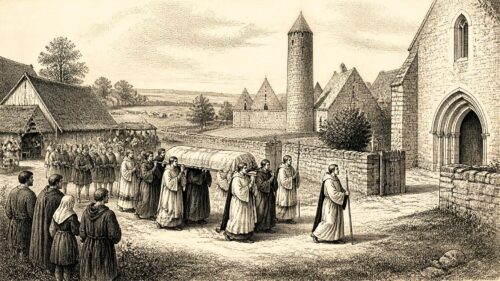
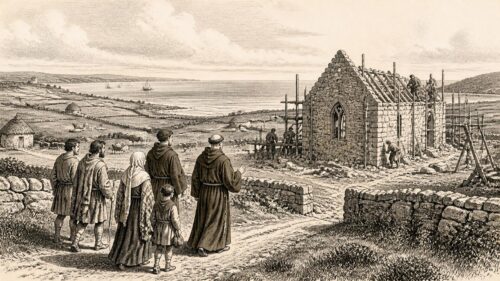
In Armagh, a different kind of authority was being consolidated. The Annals of Ulster state that Archbishop Máel Pátraic Ó Scannail had a ditch made around Ard Macha and brought Friars Minor, the Franciscans, into the ecclesiastical city. The annal dates both actions expressly to 1264. A ditch was a practical defensive work, marking and protecting an urban or ecclesiastical precinct in a region where lordship and warfare were unsettled. It also proclaimed the archbishop’s capacity to mobilise labour and resources.
The arrival of Franciscans connected Armagh more closely to an international religious movement already well established in Ireland. Mendicant friars differed from older monastic communities in their urban orientation, preaching and dependence upon alms. Their installation at Armagh indicates the continuing reshaping of religious life in a city whose prestige rested on the cult and inheritance of St Patrick. The same annal records the blessing of Friar Catholicus, precentor of the house of SS Peter and Paul at Armagh, as abbot of St Mary’s at Clogher, alongside changes in abbacy there. Religious institutions were therefore not remote from politics: appointments, communities, buildings and jurisdiction all formed part of the organisation of power.
A Year of Competing Powers
1264 does not yield a single national story. Castledermot shows officials and jurors defining the relationship between church and lordship in the English-held east. Athlone shows Anglo-Irish leaders making peace with the king of Connacht. The de Burgh–FitzGerald war demonstrates how readily aristocratic rivalry could wreck that order in the west. Armagh’s ditch and new Franciscan community show an Irish archbishop strengthening both the material and spiritual presence of his see in the north.
For ordinary inhabitants, these developments were felt less through constitutional language than through the immediate demands of lordship: labour on defences, dues to courts, armed followings on the road, plundered manors, burned settlements and hostage-taking. Yet the year also records negotiation, institutional continuity and religious expansion. The first recorded Irish parliament was not the birth of modern democracy. It was something more medieval and more revealing: a meeting of powerful men attempting to settle who had the right to govern, judge and profit in a land where authority was constantly contested.
Primary Sources
- The Annals of Ulster: Year U1264
- Annála Connacht: Annal 1264
- The Annals of Loch Cé: Annal LC1264
- Annals of Inisfallen: Annal AI1264
- Annales Hiberniae
- Annales Breves Hiberniae
- Castledermot 1264—the First Irish Parliament
- Who Attended?
- Trinity Plays Key Role in Marking 750th Anniversary of First Recorded Parliament in Ireland
- The Irish Parliament in the Middle Ages
- Calendar of Archbishop Alen’s Register, c. 1172–1534
- The Secular Jurisdiction of the Early Archbishops of Dublin
- The Civil Survey, AD 1654–56, Volume VII: County of Dublin
- Burgh, Walter de
- O’Connor (Ó Conchobair), Fedlimid
- Lacy, Hugh de
- Castledermot Franciscan Friary
- Seanad Éireann Debate, 18 June 2014
- Castledermot 1264—the First Irish Parliament
- ‘Divide and Rule’: Factionalism as Royal Policy
- The History of the County of Mayo to the Close of the Sixteenth Century
- Mark Hagger PhD Thesis