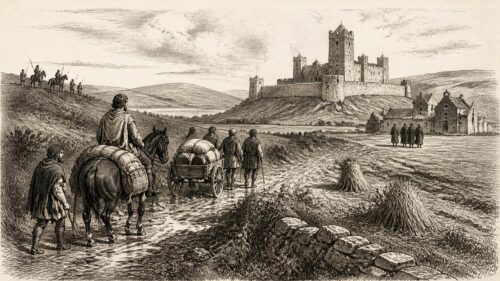
Mangerton’s Costly Victory1262 CE
In 1262, Ireland experienced interconnected conflicts and negotiations across Connacht, Annaly, Munster and church politics. Fedlimid Ó Conchobair and his son Áed resisted forces led by Mac William de Burgh, the justiciar and John de Verdun, safeguarding cattle, devastating enemy territory and making a temporary peace. Roscommon was selected for a future royal castle. In Annaly, Gilla na Naem Ó Fergail regained lordship after local defections. Mac Carthaig defeated an expedition at Mangerton, but Cormac Mac Carthaig died. Munster endured further raids. At Drogheda, Archbishop Máel Pátraic Ó Scannail reinforced Armagh’s jurisdiction over Meath, while Dublin disputes exposed urban tensions.

Dateline
In 1262, political power in Ireland was tested not by a single national contest but by several linked struggles across Connacht, the midlands and Munster. The year’s best-attested events show armies crossing rivers and uplands, cattle being moved out of danger, crops and settlements burned, a proposed royal castle site marked out, and peace made with striking speed after severe destruction. In Desmond, fighting around Mangerton brought a victory that was immediately shadowed by the death of a Mac Carthaig prince. Meanwhile, a provincial church council at Drogheda asserted Armagh’s authority at a moment when ecclesiastical jurisdiction was itself a matter of hard political negotiation.
Connacht Under Pressure
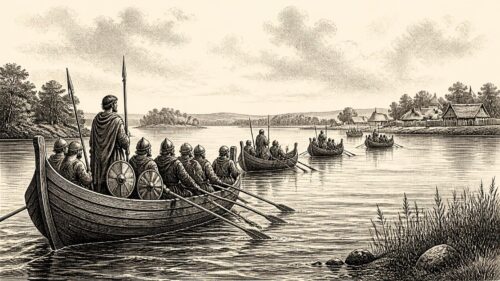
The most substantial record for 1262 concerns Connacht. Fedlimid Ó Conchobair remained king of Connacht, but his son Áed na nGall was already the principal military figure in the defence and expansion of their power. Their opponents were not simply an outside ‘English’ force. The annals use terms such as Galls or ‘Foreigners’ for the settler political world, which included great Anglo-Norman lords, locally established families, soldiers and allies drawn from Ireland itself. In this campaign, Mac William de Burgh approached from the west, while the justiciar of Ireland and John de Verdun advanced from the east through Athlone towards Roscommon.
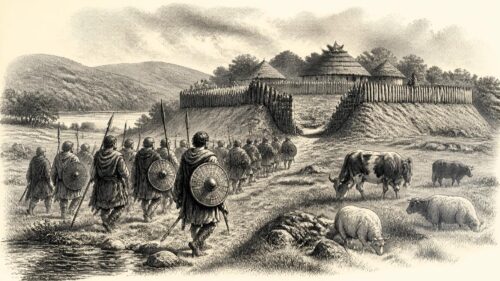
The campaign was built around control of food, stock and movement. Rather than risk the chief wealth of Connacht in the path of the advancing army, the Ó Conchobairs sent most of the province’s cattle north into Tír Chonaill. Fedlimid was said to have remained at Inis Samer, beside the Erne estuary at Assaroe, to protect both cattle and people. This was no incidental detail. Cattle were the chief movable store of wealth, a source of milk, meat, hides, tribute and political obligation. Removing them denied the invaders plunder and made a rapid advance harder to sustain. It also demonstrates the practical reach of Ó Conchobair alliances beyond Connacht, since a refuge in Tír Chonaill depended upon northern co-operation.
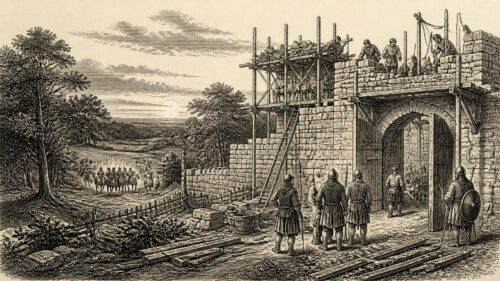
Mac William’s force crossed the Tochar Mona Conneda, a route through the boglands, and reached Elphin. The justiciar’s column and John de Verdun crossed at Athlone and reached Roscommon. Raiding parties then entered Cenél Dobhtha, taking what had not already been removed. The chroniclers report that, during this expedition, the invaders marked out a site for a castle at Roscommon. That wording matters. It records a strategic intention, not the completion of a fortress in 1262. Building work on the royal castle belongs to 1269 and later. Yet the choice of site in 1262 reveals how the Dublin administration envisaged the campaign: Roscommon, close to the Connacht heartland and to routes towards the Shannon, was to become a durable point of royal control.
Raiding, Burning and a Sudden Peace
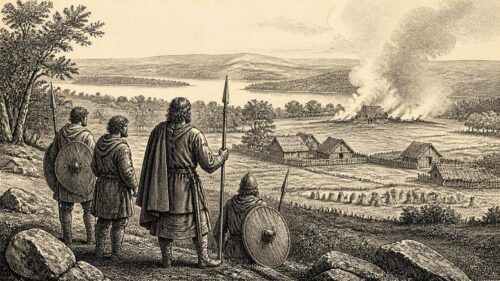
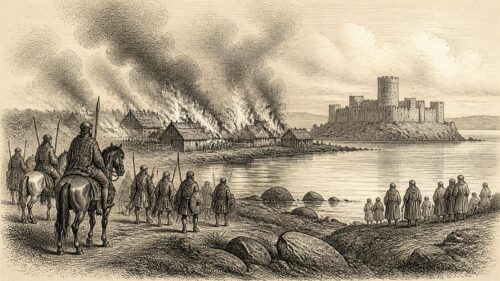
Áed Ó Conchobair answered the invasion with a large counter-raid. The Connacht annals place his attacks across western Connacht, from the areas of Mayo and Balla towards Sliabh Lugha. Towns and corn were burned and many people killed. A further force of princes and chieftains was sent through south Connacht, raiding from Tuam towards Athlone. Such notices are brutal, but they also show the mechanics of thirteenth-century warfare. Armies aimed to strip an opponent’s capacity to feed men and horses, collect rents, shelter dependants and reward followers. Burning grain in the fields was an attack on the coming year as well as the present one; destroying settlements pushed the burden of war onto tenants, labourers, herders and religious houses as well as fighting men.
The phrasing of the annals should nevertheless be handled carefully. One account says that all men encountered on the south-Connacht raid were killed; another specifies those able to bear arms. Neither permits a modern calculation of casualties, and neither should be converted into an unsupported claim that an entire district was emptied. What can responsibly be said is that the violence was wide-ranging, deliberately directed against settlement and food supply, and grave enough to force negotiation.
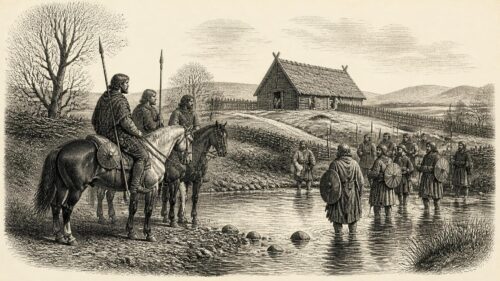
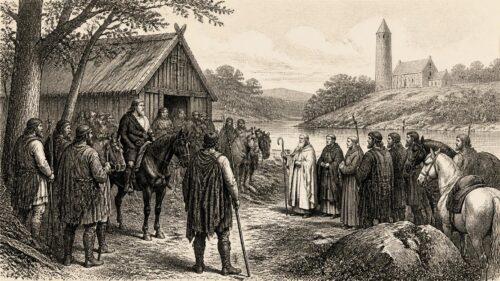
Despite the scale of the operations, neither side won a decisive field battle. Envoys from the settler army offered peace, and Áed met them at Áth Doire Chuirc, Derryquirk ford. The agreement was made without hostages or formal sureties being exchanged. The annals then preserve an unusually vivid gesture: Áed and Mac William de Burgh spent the night in the same room and bed, described as cheerful and content, before the army withdrew the next day. The detail should not be mistaken for permanent friendship. It was a public enactment of confidence after an agreement, valuable precisely because neither party had surrendered hostages. The peace was an expedient settlement between rivals who remained capable of renewed war.
Annaly and Local Authority
The conflict reached into Annaly, the Ó Fergail lordship centred broadly on modern Longford. Men of Meath made a major raid on Gilla na Naem Ó Fergail. His own eraght, or political following, abandoned him and went over to the attackers; with their support, a rival, the son of Murchad Carrach Ó Fergail, was installed. This was not a simple case of an outside force replacing an Irish lord. It was a contest in which local supporters calculated their interests, and in which intervention succeeded only while those supporters held together.
Gilla na Naem fought back through raids, attacks and plundering, eventually recovering the lordship by force and expelling the rival. The episode is a useful corrective to any map of 1262 divided into fixed English and Irish blocks. Lordship depended on kinship, clientage, cattle, land and armed followings. Outside backing could be decisive, but it could also evaporate when a displaced ruler retained enough allies and resources to return.
Mangerton and Desmond
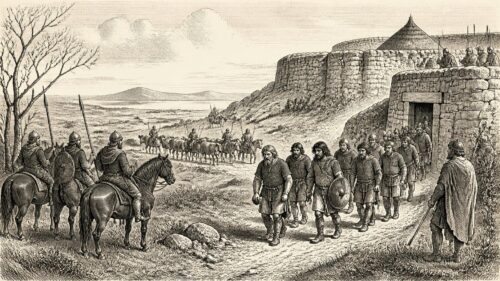
In the south-west, Mac William de Burgh and an army described as including the ‘Foreigners of Ireland’ campaigned against Mac Carthaig in Desmond. They reached Mangerton, near the lakes of Killarney. There Gerald Roche, praised by one annalistic tradition as among the foremost barons in Ireland, was killed by Mac Carthaig forces. But the success was, in the memorable judgement of the Annals of Loch Cé, a ‘joy with sorrow’: Cormac, son of Domnall Got Mac Carthaig, died on the same day. Both Gaelic and settler forces suffered heavy losses.
This was therefore not an uncomplicated triumph for Desmond. The death of Cormac deprived the Mac Carthaigs of a prominent member of their ruling kindred, and later evidence suggests that Domnall Ruad Mac Carthaig succeeded him during the year. The outcome at Mangerton checked the expedition at a high price, while leaving the wider succession and territorial rivalries of Desmond unresolved.
The Annals of Inisfallen give a broader picture of the year’s fighting in Munster. They record burnings at Dún na mBarc, Inis Eóganáin and several other places, as well as devastation in Uí Chonaill. They also note that Ó Briain made peace with the Foreigners. One entry dates the killing of Fíngen Mac Carthaig and other Desmond nobles at Rinn Róin to the night of Michaelmas, 29 September. This is a firmly dated episode within the annal, but it should not be casually merged with the undated Mangerton fighting: the sources establish a year of sustained conflict, not a single continuous campaign with a recoverable timetable.
Inisfallen further reports that Richard de la Rochelle came by sea to Ireland as justiciar, landing at Dún na Long in Desmond and being allowed to pass unmolested by Cormac and the Desmond men. Administrative evidence places de la Rochelle’s appointment by late 1261, so the annal may preserve his arrival or return rather than the beginning of his office. Either way, the notice captures an important reality: even the king’s chief governor moved through a landscape in which safe passage depended on practical accommodation with regional rulers.
Church, Jurisdiction and Urban Livelihood
Church affairs were prominent in 1262. Máel Pátraic Ó Scannail, the Dominican archbishop of Armagh, held a provincial council at Drogheda in January. The council brought together bishops of Armagh’s province, some churchmen from Tuam, representatives connected with Dublin, the justiciar and Irish magnates. Its business included the long dispute over whether Meath could escape Armagh’s metropolitan jurisdiction. The council affirmed Armagh’s primatial claims and accepted its right to visit the bishop and clergy of Meath. Its lost statutes reportedly dealt also with ecclesiastical discipline, penance and reform.
Later in the year, the Annals of the Four Masters record Ó Scannail celebrating Mass at Armagh while wearing the pallium, the vestment that visibly marked an archbishop’s authority, during the octave of the feast of St John the Baptist. The act had ceremonial force after the Drogheda council: authority was argued through papal rulings and councils, but also displayed in liturgy before clergy and laity. An Inisfallen entry saying that the archbishop of Armagh died in 1262 cannot safely refer to Ó Scannail, who is independently documented as archbishop until 1270; it is a reminder that annals must be compared rather than read in isolation.
Other clerical deaths included Máel Sechlainn Ó Conchobair, bishop of Síl Muiredaig or Elphin, and Áed Ó Riacáin, treasurer of Clonmacnoise. In Dublin, a dispute arose between the prior and convent of Christ Church and the civic community over the Liffey’s tithe-fish. Its settlement is unknown, but the quarrel offers a small, revealing view of urban life. Fishing in the tidal river was economically valuable, and the right to a share of its produce could set a wealthy religious corporation against townspeople whose work, diet and trade depended on the waterway.
Thus 1262 was a year in which force and negotiation were inseparable. Connacht avoided conquest but saw its countryside raided and Roscommon identified for future fortification. Desmond won at Mangerton while mourning one of its own. In Annaly, a deposed lord returned through local support and violence. At Drogheda and Armagh, ecclesiastical authority was defined in councils and ceremonies. Ireland’s political map remained fractured, but the year’s events show that its rulers, communities and institutions were far from passive: they protected stock, chose alliances, resisted armies, bargained for peace and asserted rights in church, town and countryside.
Primary Sources
- Annals of Loch Cé
- Annála Connacht: The Annals of Connacht
- Annals of the Four Masters, Part 10
- The Annals of Ulster
- Annals of Inisfallen, Part 78
- Annales Breves Hiberniae
- Annales Hiberniae
- Annals of Dublin from 1173 to 1500
- Ó Scanaill, Máel Pátraic (Patricius)
- O'Connor (Ó Conchobair), Fedlimid
- Rochelle (Rokele, Rokesle, Rupella, Rupellis), Richard de la
- MacCarthy (Mac Carthaig), Domnall Ruad
- Roscommon Castle: A Visitors Guide
- County Roscommon Urban Archaeology Survey: Roscommon Castle
- Roscommon Castle
- Calendar of Documents, Relating to Ireland, Preserved in Her Majesty's Public Record Office, London, 1252–1284
- The Annals of Loch Cé: A Chronicle of Irish Affairs from AD 1014 to AD 1590
- The 'Annals of Multyfarnham'
- A History of the Irish Dominicans, Volume I
- Chronological Synchronisation of the Irish Annals