Caimeirge and the Patrician Privilege1241 CE
Dateline
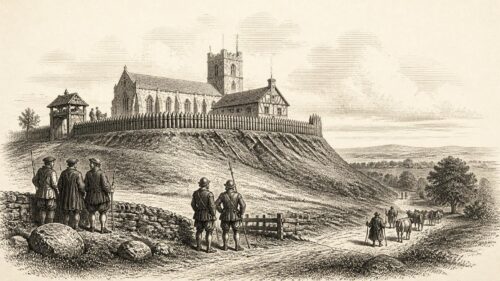
In 1241, Ireland’s political map did not suddenly become simpler, but decisive events in Ulster, Connacht and the midlands altered the balance of power. The most consequential was the battle of Caimeirge, where Brian Ó Néill and the newly installed Máel Sechnaill Ó Domnaill defeated and killed Domnall Mac Lochlainn, king of Tír Eoghain. In the west, Maurice FitzGerald, justiciar of Ireland, combined a damaging raid with a short-lived peace-making expedition. Meanwhile, the arrival of Albert Suerbeer, the German-born archbishop of Armagh, with papal authority over the churches associated with St Patrick made ecclesiastical jurisdiction an urgent political question. New mendicant churches at Athlone and Athenry showed another Ireland too: one in which friars, patrons, towns and religious institutions were becoming ever more prominent.
A Battle That Changed Tír Eoghain
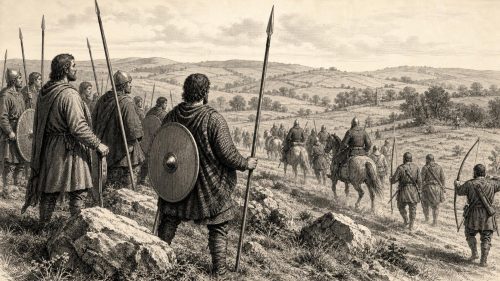
The annals place the battle of Caimeirge firmly in 1241. Brian Ó Néill, claimant to the kingship of Tír Eoghain, joined forces with Máel Sechnaill Ó Domnaill, who had succeeded his father Domnall Mór as king of Tír Chonaill. Their opponent was Domnall Mac Lochlainn, then king of Tír Eoghain. The coalition won comprehensively. Domnall Mac Lochlainn was killed, along with ten of his close kin; the annalists add that the chiefs of Cenél nEógain and many other notable men fell. Brian Ó Néill then took the kingship.
The scale of that report should not be reduced to a simple tale of one family replacing another. Tír Eoghain had long been contested between the Ó Néills and the Meic Lochlainn, both of whom could draw on deep dynastic claims and local followings. Domnall Mac Lochlainn had regained the kingship after a victory at Carnteel in 1239, while Brian had been forced from power. The annals’ statement that Brian came to Máel Sechnaill after being expelled by Mac Lochlainn makes the 1241 alliance intelligible: the Ó Domnaill king had reason to fear an enlarged Mac Lochlainn power, and Brian needed a route back into his own country.
Modern identification places Caimeirge at or near Cummery, in the townland of Erganagh north of Omagh, though medieval battle-sites cannot always be fixed with complete certainty. What is certain is the political result. Brian Ó Néill emerged as the undisputed ruler of Tír Eoghain, while the Mac Lochlainn position was shattered. This was not the creation of a united Irish kingdom, nor even a settled Ulster. It did, however, provide Brian with the authority from which he would become one of the most formidable Irish leaders of the middle decades of the thirteenth century.
Succession at Assaroe
The alliance at Caimeirge had been made possible by a succession in Tír Chonaill. Domnall Mór Ó Domnaill died in the autumn of 1241 and was buried at the monastery of Assaroe, beside the River Erne at Ballyshannon. The Irish annals portray his final days in strongly devotional language: he died after unction and penance, and the Annals of Loch Cé say that he had taken the habit of the Grey Order, meaning the Cistercians. Such descriptions were not neutral obituary notices. They presented the king’s retirement and burial in a religious house as evidence of a good death, while also associating the dynasty with a major monastic institution.
Domnall’s son Máel Sechnaill succeeded without the prolonged recorded succession struggle that might have weakened Tír Chonaill at once. Yet his accession and his military partnership with Brian Ó Néill were closely connected. The Annals of Ulster name Máel Sechnaill alongside Brian as victor at Caimeirge; the Annals of Connacht explain that the Ó Néill came to the new Ó Domnaill ruler after his expulsion. In practical terms, the new king used an alliance across the northern mountain and river routes to secure his own position and to help remake that of his ally.
Assaroe’s role is worth noticing. Monasteries were not remote from politics. They held land, received aristocratic burials, preserved memory and offered rulers both spiritual standing and useful networks. A royal burial there linked the Ó Domnaill succession to the authority of a church that stood at a strategic crossing between Tír Chonaill, Fermanagh and the western seaways. The surviving record cannot tell us what ordinary people thought of the succession, but it does show that lordship, warfare and religious patronage were inseparable parts of public life.
FitzGerald in Mag nAi
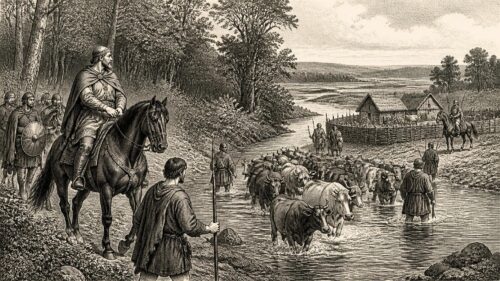
In Connacht, the chief firmly dated secular action was a raid by Maurice FitzGerald, justiciar of Ireland. The Annals of Connacht call it a “great raid” on Mag nAi, the important plain around Roscommon. FitzGerald’s forces plundered the territories of Fiachra Ó Flainn and Donnchad Mac Diarmata. A small party of the people of the Ó Conchobair caught up with the raiders and killed Nár Mac Gilla Cellaig and many others. The detail is revealing: royal government in Ireland possessed the capacity to mount a substantial armed incursion, but its forces were neither unopposed nor able to act without cost.
FitzGerald had been justiciar since 1232 and governed in the name of Henry III, lord of Ireland. His administration coincided with further colonial expansion in Connacht, where castles, land grants and incoming settlers altered local power. But the lordship was not a uniform territory under a single system. The justiciar’s raid struck an area where Gaelic lords, members of the Ó Conchobair dynasty and settler interests all had claims. Feidlimid Ó Conchobair, king of Connacht, had travelled to England in 1240 to seek redress and recognition from Henry III; by 1241, his position was also strained by energetic kinsmen and the pressures generated by settlement and partition.
Later in the same year FitzGerald led an army to Áth Leathan in Luighne and made peace with Tadc Ó Conchobair before turning back. The annals do not preserve the terms, duration or ceremony of that peace, so it would be unsafe to portray it as a comprehensive settlement. Its limits are suggested by the next notice: Tadc subsequently plundered Dartry and Clann Fhearmaigh. In thirteenth-century Irish politics, agreements could restrain a particular dispute or create breathing space without ending competition for cattle, land, clients and honour. Hosting, raiding and negotiation were complementary instruments of lordship rather than opposites.
Patrick’s Churches and Armagh’s Claims
Church affairs in 1241 were equally entangled with territory. Albert Suerbeer, a learned cleric from Cologne and recently consecrated archbishop of Armagh, arrived in Ireland with a papal privilege concerning the churches of St Patrick. The annals call him the “coarb of Patrick”, the successor in office and authority to Ireland’s pre-eminent saint. They also call him “the German”, a striking acknowledgement of his foreign origin. Albert’s position rested not on local descent but on papal provision, consecration in England and the claims of Armagh’s primatial tradition.
His privilege was not merely symbolic. In Connacht, Albert made peace with the archbishop of Tuam and other bishops over Patrician lands. The wording indicates a dispute over rights, property and jurisdiction: which churches or estates belonged under Patrick’s authority, and who controlled their revenues and ecclesiastical obedience? Albert had also obtained a royal mandate in February for the proposed union of the poor dioceses of Armagh and Clogher, though that union did not take effect. The year therefore records a determined attempt to extend Armagh’s practical reach as well as its prestige.
On 15 August, Albert consecrated the church of the Friars Minor at Athlone. The ceremony is securely placed in 1241 by the annalistic tradition, although the exact date at which the Franciscan community first settled there is less certain. Athlone’s position on the Shannon made it a valuable crossing-place between the Irish midlands and Connacht. A friars’ church there brought a new form of pastoral religious life into a settlement shaped by traffic, military movement and trade. Franciscans depended upon alms rather than large inherited estates, and their urban and frontier houses connected preaching, confession, burial and hospitality to the rhythms of nearby communities.
A Dominican Beginning at Athenry
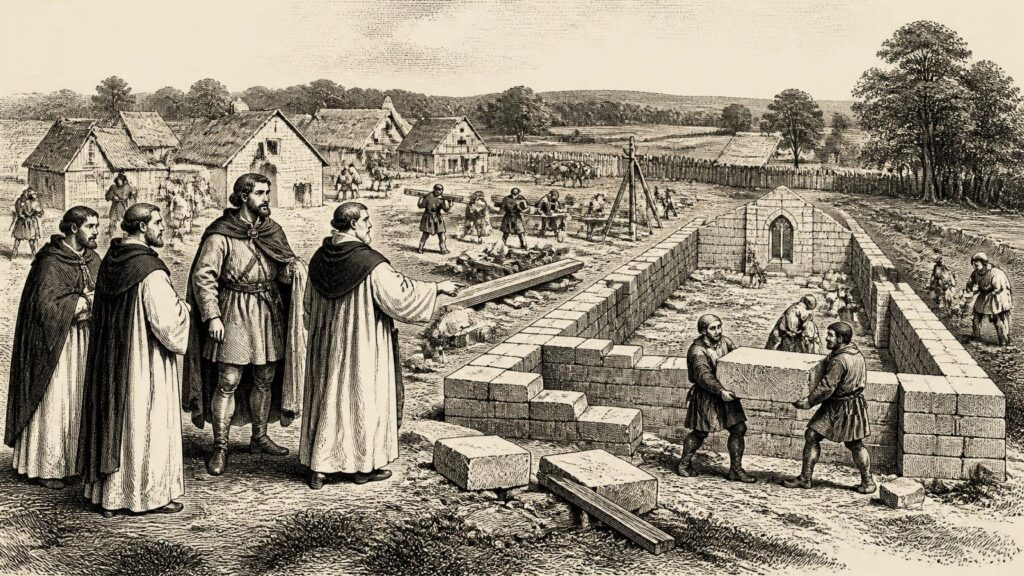
Another foundation belongs responsibly to 1241: Meiler de Bermingham began the Dominican priory of Saints Peter and Paul at Athenry. The surviving church is a later and altered remnant, but the initial nave and chancel belong to the foundation phase. This was the first Dominican house in Connacht. Its establishment should not be imagined as the instant completion of a great monastery; religious buildings and their precincts grew over time, as money, labour, gifts and patronage became available.
Even so, the decision mattered. Athenry was a developing settler town in eastern Connacht, associated with the de Bermingham lordship and the wider Anglo-Norman advance. A Dominican house placed preaching friars within that expanding urban landscape. Later tradition credits Gaelic as well as Anglo-Norman patrons with contributing buildings and resources, a reminder that religious foundations could become places where families of different political backgrounds sought status, commemoration and spiritual benefit. In 1241, however, the essential fact is the beginning: a new conventual community was planted in Connacht at the same moment that conflict and negotiation exposed how unsettled the province remained.
Thus 1241 was a year of sharp contrast. At Caimeirge, dynastic violence transformed northern kingship. In Mag nAi and Luighne, the justiciar’s army raided and bargained across a contested Connacht. At Athlone and Athenry, churches for new religious orders marked routes of movement and growing towns. Albert of Armagh’s papal privilege underlined that ecclesiastical authority, like secular lordship, was claimed through documents, land and the ability to make those claims effective. Ireland was not moving along a single path towards either conquest or recovery. It was being remade, region by region, through conflict, alliance, settlement and religious institution-building.
Primary Sources
- Annála Connacht: Annal 1241
- The Annals of Ulster: Year U1241
- Annals of Loch Cé: Annal LC1241
- Annála Connacht
- The Annals of Ulster
- Annals of Loch Cé
- O'Donnell (Ó Domnaill), Domnall Mór
- O'Neill (Ó Néill), Brian
- FitzGerald, Maurice fitz Gerald
- Lacy, Walter de
- Suerbeer, Albert (Albertus, Albrecht)
- O'Connor (Ó Conchobair), Fedlimid
- Athenry Dominican Priory
- Dominican Priory History
- Athlone
- Annales Dominicani de Roscoman
- The Rise and Fall of the Clann Éinrí Aimhréidh Uí Néill: Dynastic Feuding and Geopolitics in the Late Medieval Irish Sea World
- The Mendicant Orders of Medieval Dublin
- The Dominican Church at Athenry
- A Thousand Years of Church Heritage in East Galway
- Exploring the Irish Annals
- List of Published Texts at CELT