Tolorg at Loch Rí842 CE
In 842, Ireland experienced political turnover, local conflict and Scandinavian pressure. Máel Ruanaid of Mide, Fergus of Connacht and Cairbre of south Leinster died, raising uncertain questions of succession within a fragmented system of dynasties and overlordship. Annals record killings among Irish groups. Foreigners associated with Loch Rí killed Tolorg, chief of Féli, while his kinsman Finnacán escaped, demonstrating raiders’ reach along the Shannon. The Four Masters date their burning of Clonfert to 842, although Ulster places it in 843. Clerical deaths and an Irish scribe’s death in Italy reveal ecclesiastical networks amid insecurity, while sources remain incomplete and problematic.
Dateline
In 842, Ireland’s annals compress a year of political loss, regional violence and ecclesiastical disruption into a small number of notices. That economy of record can be deceptive. The deaths of rulers in Mide, Connacht and south Leinster mattered because kingship was personal, dynastic and local: the death of a king opened questions of succession, alliance and control over tribute. At the same time, a brief notice from the Shannon basin shows Scandinavian raiders reaching into the western midlands. Tolorg, chief of Féli, was killed by foreigners associated with Loch Rí; his kinsman Finnacán escaped. The same raiders were said to have burned Clonfert, the great monastery linked with St Brendan.
A Year in Difficult Sources
Dating is especially important for 842. Irish annals were copied, continued and synchronised over centuries, and their year-numbers do not always correspond neatly. The Annals of the Four Masters explicitly place Tolorg’s killing, the burning of Clonfert and the deaths of Máel Ruanaid of Mide and Fergus of Connacht in 842. In the Annals of Ulster, several of the same deaths appear under its annal U843, whose editorial calendar-equivalent is AD 842. The burning of Clonfert is entered in the following Ulster annal, calibrated to AD 843. That means the rulers’ deaths can responsibly be treated as events of calendar year 842, while the connection between Tolorg’s death and Clonfert’s burning rests principally on the later Four Masters’ grouping of them. It should not be inflated into a securely dated sequence of one campaign.
The annals are not diaries. They rarely tell us the season of an event, the size of a force, or what happened to non-elite people afterwards. They preserve what annalists considered consequential: rulers, churchmen, killings, seizures and attacks on famous churches. Their silences matter. We cannot recover a complete national narrative for 842, nor can we assume that every Scandinavian group was part of one coordinated army. Yet the surviving notices give an unusually revealing cross-section of the pressures on Ireland’s political and religious landscape.
Three Royal Deaths
The most consequential recorded death was that of Máel Ruanaid son of Donnchad, king of Mide. He belonged to Clann Cholmáin, a leading branch of the southern Uí Néill, whose power was rooted in the central plain around Uisnech and the approaches to Tara. His father Donnchad Midi had once held the kingship of Tara, but Máel Ruanaid ruled Mide while Niall Caille of Cenél nÉogain held the wider overkingship. This was not a united Irish monarchy in the modern sense. Authority worked through layered relationships between provincial kings, regional dynasties, churches and client peoples; prestige at Tara was important, but had to be continuously enforced.
Máel Ruanaid’s death did not automatically hand Mide to one uncontested heir. His son Máel Sechnaill was already an active member of the dynasty, but the family had experienced sharp internal conflict only shortly before. The annals record that Máel Sechnaill had defended his father’s position against a rival kinsman in 841. In 842, therefore, the loss of Máel Ruanaid removed an established ruler at precisely the point when Viking activity and competition between major Irish power blocs were increasing. Later developments would make Máel Sechnaill one of the most important kings of the century, but that outcome should not be read back as certainty at the moment of his father’s death.
Two other royal obits broaden the picture. Fergus son of Fothad, king of Connacht, died, and the Four Masters also record the death of Cairbre son of Cathal, king of south Leinster. Neither notice describes a battle or a succession, so cause and immediate political result remain unknown. Their inclusion nevertheless indicates the geographical breadth of elite turnover in the same calendar year: Mide in the centre, Connacht west of the Shannon and a Leinster kingship in the east. The Ulster annals further report the killing of Cinaed son of Cú Raí, king of Cenél Laegaire, by the Delbna, and the treacherous killing of Artacán son of Domnall by Ruarc son of Bran. Such notices are reminders that political instability did not arise only from overseas raiders. Rival Irish groups also fought for land, status and lordship.
Foreigners on Loch Rí
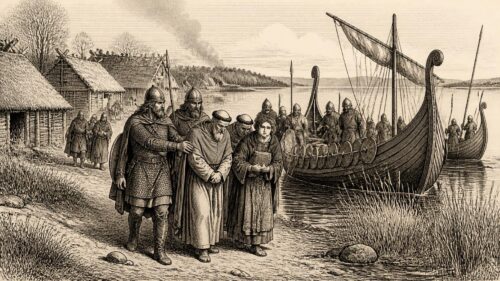
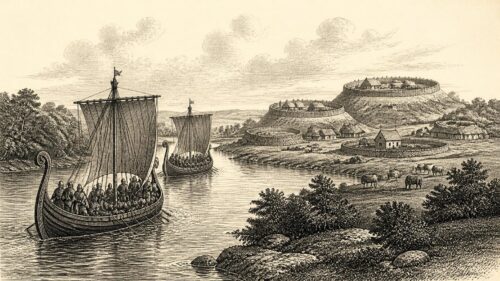
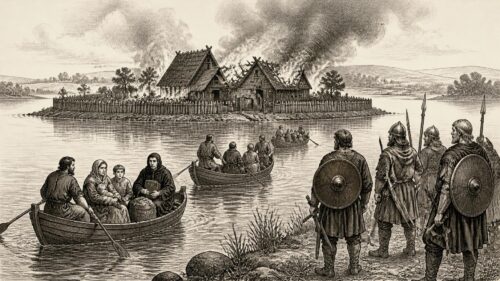
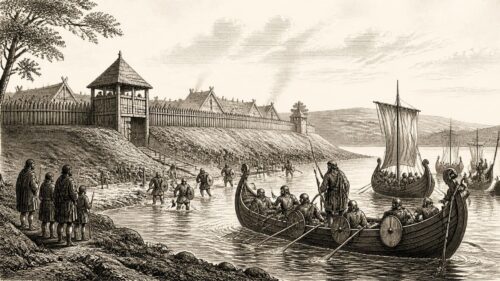
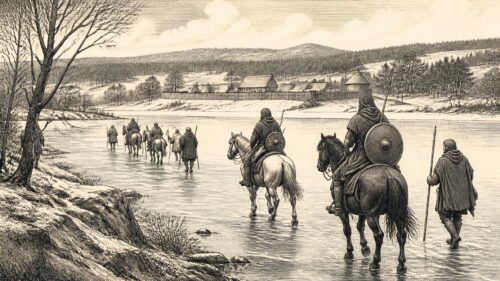
The year’s most vivid violent episode concerns Tolorg son of Alláed, described as chief of Féli or Fealla. The Four Masters state that he was slain by the foreigners of Loch Rí, while Finnacán son of Alláed escaped them. The wording identifies the raiders by their association with the lake rather than by a named leader, ethnic subdivision or permanent settlement. It is sound to say that a Scandinavian force was operating on or from Loch Rí; it is not sound to reconstruct its route, numbers, ships or exact base from this one notice.
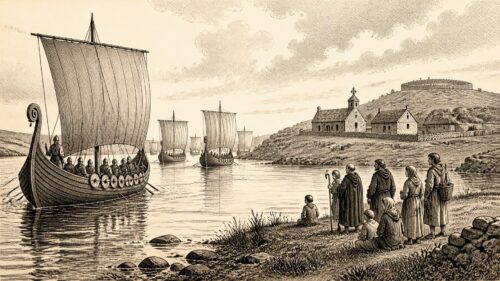
Loch Rí was strategically significant. It forms a broad reach of the Shannon, the principal north–south waterway through the island, between the midlands and Connacht. Control of boats on such a waterway offered rapid access to riverine monasteries, islands, cattle-rich territories and routes leading east towards Mide. Raiding parties could take portable valuables, food, captives and livestock, but their presence also forced neighbouring rulers to reckon with a mobile armed power. The attack that killed Tolorg belongs to the decisive shift of the early 840s, when Scandinavian activity in Ireland was increasingly connected with defended coastal and riverine bases rather than isolated landings alone.
That wider context must be used carefully. In the preceding year, annals record foreign naval encampments at Duiblinn and Linn Duachaill, near modern Annagassan in County Louth, and raids from them deep into Irish territories. Archaeology and scholarship support the importance of such longphuirt, defended ship-camps that could become centres of supply, repair, exchange and coercion. But there is no surviving 842 entry proving that the men at Loch Rí had sailed from either Dublin or Linn Duachaill. The important point is less a speculative chain of command than a changing geography: waterways enabled raiders to turn local violence into an island-wide problem.
Clonfert Burned
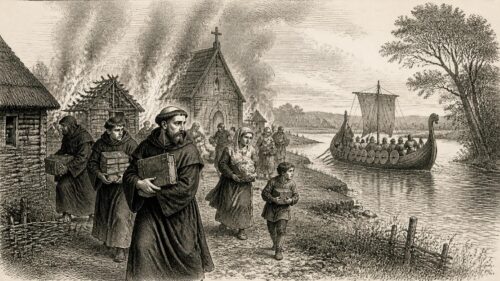
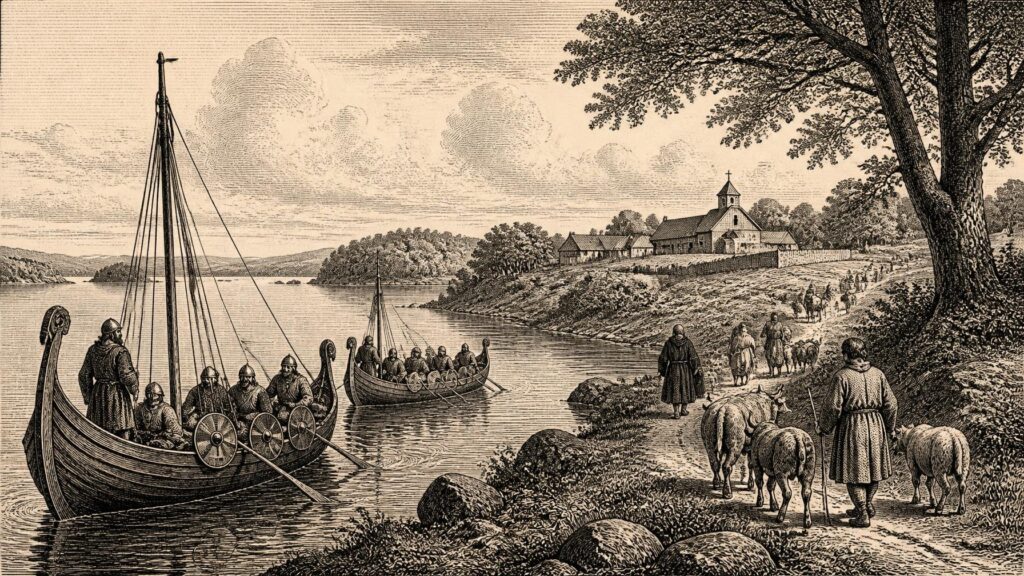
The Four Masters immediately link the foreigners who killed Tolorg with the burning of Cluain Ferta Brénainn, Clonfert. The Annals of Ulster independently preserve a burning of Clonfert by heathens from Loch Rí, although under the annal calibrated to AD 843. Taken together, the notices strongly associate the monastery’s destruction with raiders operating from the lake district, while leaving the precise timing uncertain between 842 and 843. For an article confined to 842, the responsible conclusion is that the Four Masters place the burning in this year, but the Ulster evidence prevents treating that dating as beyond dispute.
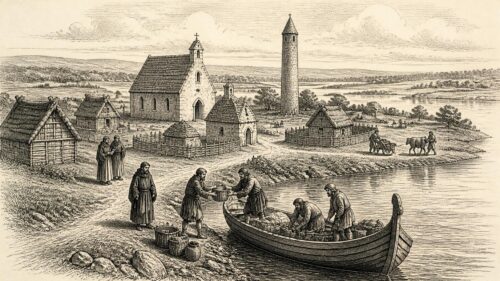
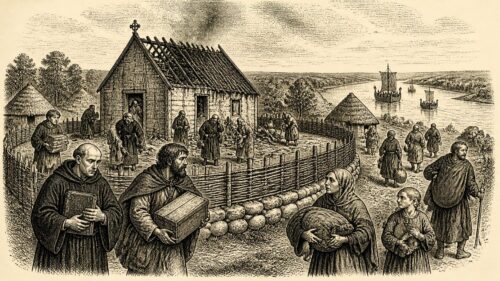
Clonfert was not merely a secluded religious house. Its foundation tradition centred on Brendan the Navigator, and its community stood within the political and economic networks of the Shannon corridor. Early medieval monasteries were places of worship, burial, learning, hospitality and craft, but also holders of land and livestock, recipients of gifts and employers of dependent labour. Their churches contained metalwork, books, furnishings and food stores attractive to raiders; their estates and tenants offered further targets. Burning a monastic centre could destroy buildings and provisions, kill or scatter residents, interrupt worship and learning, and damage the authority of patrons who had protected it.
Nonetheless, “burned” need not mean permanent extinction. Irish monasteries had endured attacks, fires and internal conflict before, and communities could rebuild through the resources of their lands and through aristocratic patronage. The record for 842 does not tell us which structures at Clonfert burned, how many people were harmed, or how quickly recovery followed. Its importance lies in what the notice shows: Scandinavian activity was not confined to the coast, and a renowned religious institution on the Shannon system could be reached and attacked.
Churches, Learning and Wider Horizons
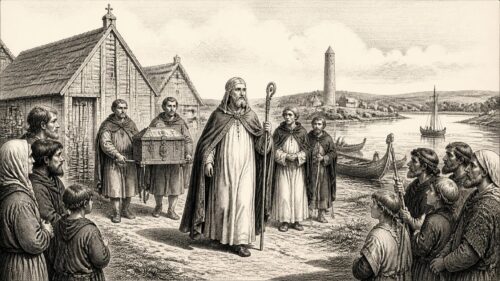
The religious notices of 842 are strikingly numerous. Dodiu, bishop of Birr, died; Cumsud son of Dereir and Maenach son of Sothchadach, both bishops and anchorites, died on the same night at Dísert Diarmata; Suibne son of Forannán, abbot of Imlech Fia, also died. The Four Masters add Rónán, abbot of Clonmacnoise, Bricéne, abbot of Lorrha, and Colggu, an anchorite. Such entries should not be mistaken for evidence of a single epidemic: the annals give no common cause. They do show the dense clerical landscape through which authority, education, prayer and commemoration were organised.
Donnacán son of Máel Tuile, described as both scribe and anchorite, died in Italy. His notice is a small but valuable indication of Irish Christian mobility. Pilgrimage, study and ecclesiastical travel linked Irish communities to Britain and the Continent. Calling him a scribe signals a learned role; calling him an anchorite signals ascetic religious standing. Even as violence struck the Shannon basin, Irish religious life remained connected to a wider Latin Christian world. That contrast is central to 842: insecurity on rivers and roads coexisted with durable institutions of learning, devotion and travel.
What 842 Reveals
For most people, whose names the annals do not preserve, life still revolved around households, cattle, crops, seasonal labour and obligations to lords and churches. The surviving entries cannot measure harvests, prices or population in 842. They do, however, show why security was an everyday concern. A ruler’s death could alter demands for food-rents or military service; a feud could endanger a district; raiders on Loch Rí could threaten the estates and communities tied to the Shannon. The year was not defined by one island-wide catastrophe, but by overlapping vulnerabilities.
Its enduring significance lies in the convergence of those pressures. Ireland in 842 remained a society of powerful local and provincial dynasties, not a centralised kingdom. Monasteries were indispensable religious and economic centres, yet exposed because of their wealth and riverine locations. Scandinavian raiding had become more sustained and geographically flexible, while Irish politics continued to generate its own violence and succession crises. Tolorg’s death beside Loch Rí, the disputed-date burning of Clonfert, and the passing of kings from Mide to Connacht capture a country in which waterways, dynasties and churches shaped both power and peril.
Primary Sources
- The Annals of Ulster: Year U843 (editorial equivalent AD 842)
- Annals of the Four Masters: Annals M837–M844
- The Annals of Ulster: Year U844 (editorial equivalent AD 843)
- The Annals of Ulster: Year U842 (editorial equivalent AD 841)
- Annals of Inisfallen
- Chronicon Scotorum
- The Annals of Tigernach
- Vikings in Irish Chronicles, 794–902: Introduction
- Emer Purcell, The Vikings in Ninth-Century Ireland: Sources and Settlements
- Emer Purcell, The Vikings in Ninth-Century Ireland: Sources and Settlements (full text)
- Donnchad Ó Corráin, Vikings in Scotland and Ireland
- Stephen Harrison, The Vikings in Ireland and Beyond: New Research and New Directions?
- Vikings in Early Medieval Ireland: Church-Raiding, Politics and Kingship
- Donnchad Midi, Dictionary of Irish Biography
- The Economy of Early Medieval Ireland
- Saint Brendan’s Cathedral, Clonfert: Conservation Plan
- Clonfert
- Clonmacnoise, County Offaly
- Dublin, Part I, to 1610: Irish Historic Towns Atlas, No. 11
- Vikings, Lough Ree
- Exploring the Irish Annals
- Early Medieval Ireland: Culture, Society and Politics