Forannán’s Patrick Relics846 CE
In 846, Ireland experienced dynastic change and Viking violence amid disputed annalistic dating. Niall Caille, northern Uí Néill king of Tara, drowned in the Callan near Armagh, enabling Máel Sechnaill of Clann Cholmáin to claim Tara, though opposition persisted. Scandinavian raiders defeated Connachtmen and plundered Baislec in Roscommon, demonstrating their growing ability to use waterways and strike inland. Forannán, abbot of Armagh, returned from Munster with Patrick’s relics after earlier abduction, reinforcing Armagh’s authority. Deaths of abbots and regional rulers reveal interconnected ecclesiastical and local political structures. The year showed Ireland divided yet resilient under intensified external pressure and uncertainty.
Dateline
In 846, Ireland’s political map was altered by an accidental death, while the continuing violence of the Viking age struck both religious communities and regional kingships. The year is unusually revealing because the annals record events at several levels: the drowning of Niall Caille, king of Tara; the accession of Máel Sechnaill of Clann Cholmáin; a defeat of Connachtmen by foreign raiders; the plundering of Baislec in Roscommon; and the reappearance of Forannán of Armagh with the relics of Patrick.
These reports require care with dating. Irish annals were compiled and recopied over centuries, and their year-numbering systems do not always align exactly. The Annals of Ulster place a cluster of notices under U846 but calculate that heading differently in their modern edition; the Annals of the Four Masters place several of the same events under 844. Chronicon Scotorum and the Annals of Inisfallen support the conventional placement of Niall Caille’s death in 846. What follows therefore distinguishes the events conventionally connected with 846 from the wider circumstances that explain their importance.
A King Drowned at the Callan
The clearest firmly dated event was the death of Niall son of Áed, known as Niall Caille, king of Tara. The Annals of Inisfallen record that he drowned in the Calann, identified there as a river beside Armagh; the Annals of Ulster preserve a short lament for him. His death was apparently accidental rather than the result of battle. Yet its political consequences were substantial. Niall belonged to Cenél nÉogain, the northern branch of the Uí Néill, and had held the pre-eminent kingship associated with Tara through a period of rivalry with Munster and increasing Scandinavian pressure.
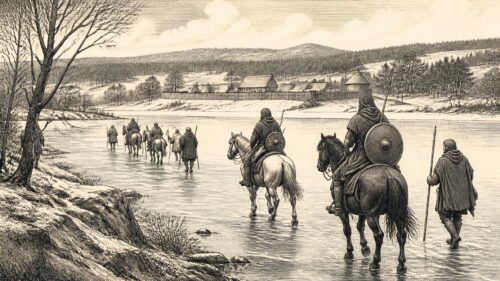
Tara was not a capital governing Ireland through officials or permanent institutions. Rather, its kingship expressed a claim to overlordship, exercised through kinship, hostage-taking, military expeditions, ecclesiastical alliances and the ability to command recognition from lesser rulers. Niall’s authority had been real but contested. In the previous decade he had confronted the formidable Munster ruler Feidlimid son of Crimthann and had also fought Viking forces in the north-west. His death at the Callan removed the northern Uí Néill king from this competition at a moment when inland waterways were becoming routes for raiding fleets.
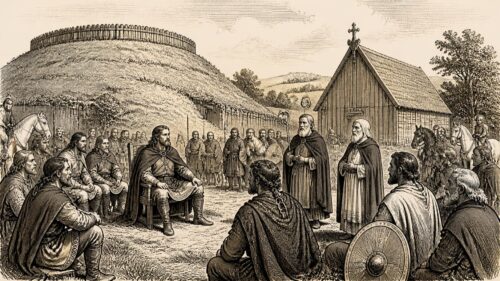
Chronicon Scotorum follows Niall’s death with the succinct statement that Máel Sechnaill ruled. Máel Sechnaill son of Máel Ruanaid, of Clann Cholmáin in Mide, had already secured his own position by violent dynastic action after his father’s death. In 846 he could advance a southern Uí Néill claim to the kingship of Tara. His accession did not erase the northern dynasty: Niall’s brother Máel Dúin succeeded locally in Ailech, while Niall’s son Áed Findliath would later become king of Tara. But the shift mattered. The centre of Uí Néill power now lay again in Mide, near the middle stretches of the Boyne and Shannon systems and close to the eastern Viking bases.
Foreigners in Connacht
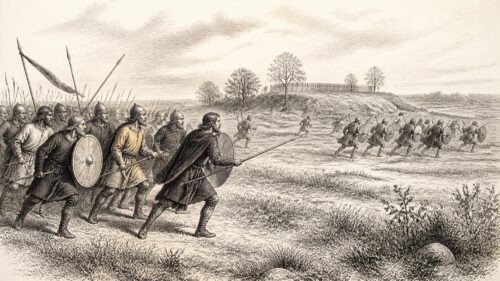
The annals also place a serious reverse for Connacht in this year. They say that the Gall, the “foreigners” of Irish record, won a battle against the Connachtmen. Rígán son of Fergus, Mugrón son of Diarmait and Áed son of Cathrannach were killed, along with many unnamed others. The sources do not name the battlefield, the Viking commander, the force’s point of departure or the immediate political cause. It would be unsafe to supply those missing details. The entry nevertheless establishes that a Scandinavian raiding force could defeat a regional army in the west, not simply plunder an undefended coastal church.
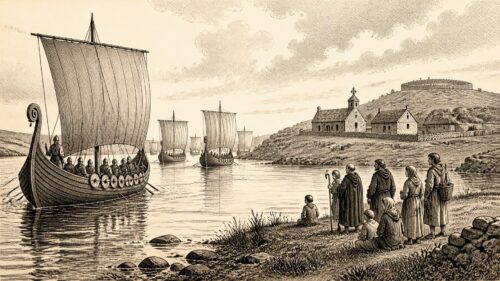
This was part of a broader, well-attested change in the 830s and 840s. Viking groups had begun to operate from defended waterside encampments, or longphuirt, and to exploit Ireland’s rivers and lakes. In 845, immediately before the events conventionally grouped with 846, sources describe a foreign encampment on Lough Ree and raids through Connacht and Mide. That background does not prove that the victors over Connacht in 846 came from Lough Ree, but it explains why an attack in the Connacht interior was possible. Waterways were roads for ships, supplies, captives and rapid withdrawal; they joined distant political crises.
Baislec was plundered by the heathens, according to the Annals of Ulster. The place is generally connected with Baslick, near Castlerea in County Roscommon; its name derives from Latin basilica, preserving the memory of a church. The brief notice gives no casualty figure, nor does it tell whether buildings were burned. “Plundered” should not be reduced to a picturesque raid. An ecclesiastical settlement held food renders, animals, metalwork, books, vestments and portable sacred objects, while its people included clerics, dependants, craftspeople and tenants. Taking its wealth could disrupt worship, learning, local protection and the redistribution of resources on which the surrounding population relied.
Forannán and Armagh’s Sacred Authority
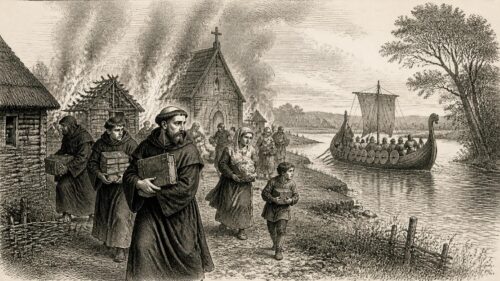
Forannán, abbot of Armagh, embodies the human and institutional dangers of the moment. In the preceding year, the Annals of Inisfallen say that he was carried off by heathens from Cluain Comarda in Munster and that Patrick’s shrine was broken and taken away. Chronicon Scotorum adds that he and his following, with their holy objects, were brought to ships at Limerick. Such an abduction was more than a personal calamity. Armagh’s abbot travelled with relics because the church of Patrick’s successor asserted authority far beyond its own settlement. Relics made that authority visible, carried sanctity into assemblies and protected claims to dues, patronage and precedence.
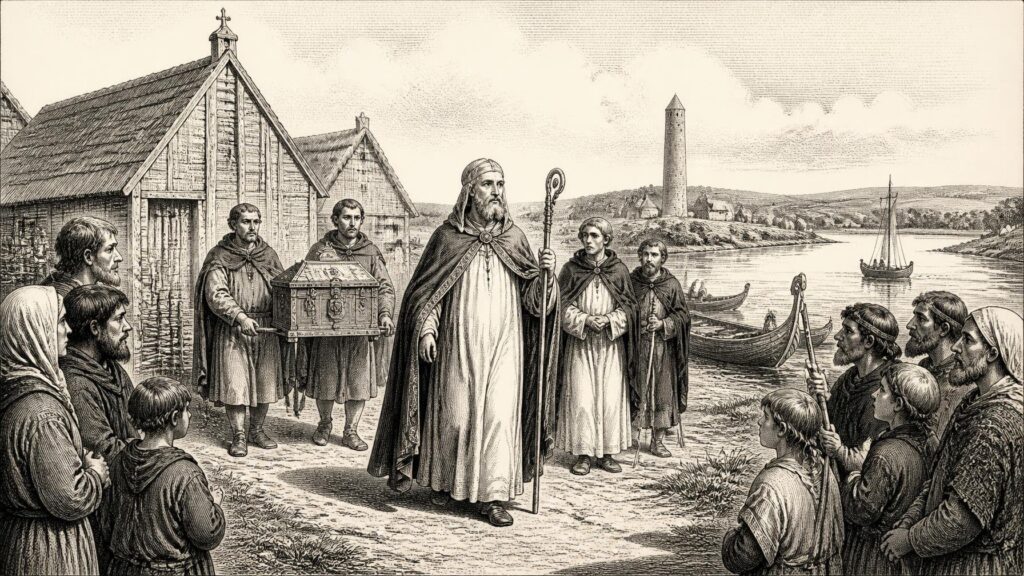
The Annals of Ulster then record Forannán coming from Munster “with the halidoms of Patrick”, a notice conventionally associated with 846. The wording confirms his return with sacred possessions, but it does not tell us how this was achieved. He may have been released, escaped, ransomed or recovered the objects through negotiation; any definite account would be invention. What is secure is that the Patrick relics were again travelling under Armagh’s custody. In a year when Niall died beside Armagh, that restoration had added resonance. The great northern church was preserving its spiritual and political standing amid a change of kingship and the threat of mobile raiders.
Religious life did not consist only of famous relics. The obituaries conventionally placed in 846 mark the loss of several ecclesiastical leaders: Muiredach son of Flann, abbot of Mainistir Buithe, now Monasterboice; Cairpre son of Colmán, abbot of Áth Truim, or Trim; and Conaing son of Ferdomnach, abbot of Domnach Pátraic. Ferdomnach himself is remembered as a scholar and excellent scribe of Armagh. These are compressed notices, but they reveal the density of the ecclesiastical landscape. Monasteries were places of worship, burial, landholding, hospitality, teaching and manuscript production, connected by travel and patronage as well as by religious practice.
The deaths of abbots and a named scribe also warn against imagining a society defined only by warfare. Books continued to be copied and learned men commemorated by name. Armagh, Trim, Monasterboice and Donaghpatrick were not isolated refuges from secular affairs; they were institutions within them. Their heads could be drawn from powerful families, their lands were economically valuable, and their prestige made them targets in disputes among Irish rulers as well as foreign raiders.
Local Losses and Contested Power
Several secular deaths underline how fragmented Ireland remained beneath the kingship of Tara. Cathal son of Ailill, king of Uí Maine, and Connmach the Great son of Coscrach, king of Uí Briúin, died in Connacht. Niall son of Cenn Fáelad, king of Uí Fhidgente, died in the south-west, while Máel Dúin son of Conall, king of Calatruim, was killed by the Leinstermen. None of these notices permits a full reconstruction of succession politics, but together they show that lordship was intensely local and vulnerable. A death in one small kingdom could alter control of cattle, client groups, church patronage and access to routes through its territory.
The Annals of Ulster additionally report that Tigernach inflicted a rout on Máel Sechnaill and Ruarc, with many killed. The identities and setting are insufficiently explained to turn this into a detailed campaign narrative. Its significance is simpler: Máel Sechnaill’s rise was not a smooth transfer of power after Niall Caille’s drowning. Even a ruler who could claim Tara faced opponents within the dense political world of Mide and Brega.
For ordinary people, the sources are mostly silent. They do not record the weather, harvest, prices or household routines of 846. Still, the year’s notices suggest the pressures borne by communities: the loss of rulers and clerics, the movement of armed men along rivers, attacks on religious estates, and the insecurity of travel with valuable goods. Ireland was neither conquered by Vikings nor united against them. It remained a country of competing kingdoms and powerful churches, now compelled to reckon with armed seaborne groups capable of reaching deep inland.
Thus 846 was a hinge rather than a single dramatic climax. Niall Caille’s drowning changed the balance of Uí Néill power; Máel Sechnaill began the career that would make him one of the century’s foremost kings; Connacht and Baislec felt the reach of Viking violence; and Forannán’s return with Patrick’s holy objects demonstrated both the vulnerability and resilience of Armagh. The annals’ terse lines preserve a year in which water connected danger, authority and recovery across Ireland.
Primary Sources
- The Annals of Ulster, Year U846
- Chronicon Scotorum, Annals CS845–CS847
- Annals of Inisfallen, Annals AI840–AI849
- Annals of the Four Masters, Annal M844
- Vikings in Irish Chronicles, 794–902: Data
- TEI Header for The Annals of Ulster
- CELT Project: Chronicon Scotorum
- CELT Project: Annals of Inisfallen
- CELT Project: Annals of the Four Masters
- Niall Caille
- Máel-Sechnaill
- Áed Findliath
- The Vikings in Ninth-Century Ireland: Sources and Settlements
- Vikings in Ireland and Scotland
- Vikings in Early Medieval Ireland
- Early Medieval Ireland: Archaeological Excavations, 1930–2009
- Early Medieval Dwellings and Settlements in Ireland, AD 400–1100, Volume 1: Text
- “basilica” Baislic / Baslick
- Monasterboice, County Louth
- High Crosses