Feidlimid’s Abandoned Crozier841 CE
In 841, Irish annals recorded Scandinavian forces remaining on Lough Neagh and establishing fortified naval camps at Linn Dúachaill and Duiblinn. These longphuirt enabled repeated raids into the midlands, Leinster and Uí Néill territories, threatening churches, communities and regional economies while supporting provisioning and ship maintenance. Irish politics remained equally violent: Feidlimid of Munster marched to Carman in Leinster, but Niall Caille defeated him at Mag Óchtair, where Feidlimid’s crozier was abandoned. Dynastic conflict included Diarmait’s killing by Máel Sechnaill and Áed’s treacherous murder. The year revealed an unconquered yet reoriented Ireland, facing persistent maritime power alongside rivalry among kings.
Dateline
The Irish records for 841 preserve a year of unusually revealing contrasts. On one hand, Scandinavian raiders had moved beyond seasonal attacks to maintain fortified naval bases at two strategically important eastern sites. On the other, Irish rulers were pursuing their own contests for supremacy with armies, ambushes and targeted killings. The year is therefore not simply a chapter in a story of ‘Vikings versus Irish’. It shows several competing centres of power, each exploiting rivers, roads, churches and royal assembly places to secure influence.
A Year Defined by Annals
The principal evidence is terse. The Annals of Ulster, compiled from earlier records and preserved in later manuscripts, groups several notices under 841: heathens remained on Lough Neagh; naval camps were established at Linn Dúachaill and Duiblinn; rival Irish leaders fought and killed one another; and Feidlimid of Munster marched into Leinster before Niall of the northern Uí Néill met him in the field. The entries do not provide dates within the year, casualty totals, speeches or a continuous narrative. Their value lies precisely in their compactness: they identify developments considered important enough to enter a learned historical record.
Modern chronology conventionally places these notices in 841 CE, although early Irish annals can show dating discrepancies caused by their systems of year-counting and later transmission. It is safest to treat the events as belonging to the annalistic year conventionally called 841, rather than claiming a precise season or day where none survives.
Heathens Still on Lough Neagh
The first notice is brief but significant: “The heathens were still on Loch nEchach”, modern Lough Neagh. The word “still” matters. Scandinavian fleets had reached the lough by 839, using the Lower Bann to gain access from the north coast into the heart of Ulster. In 840, raiders operating from Lough Neagh attacked Louth, taking bishops, priests and scholars captive and killing others; Armagh too suffered burning in the wider crisis. Thus the 841 entry confirms continuity rather than a fresh incursion.
It is reasonable, though still an inference rather than an explicit statement, that this force had overwintered in or around the lough during 840–41. Such a presence altered the strategic geography of northern Ireland. Lough Neagh was not merely a place at which ships paused: it was a large inland waterway connected to routes towards the coast, Armagh and the territories of the northern kingdoms. A fleet based there could choose when to strike, withdraw to water, and compel local rulers and ecclesiastical communities to live with a persistent threat rather than await the departure of summer raiders.
The annalist’s vocabulary, calling the newcomers gennti, “heathens”, expresses a Christian Irish perspective. It should not conceal the practical realities behind the label. These groups required food, shelter, repair materials, intelligence, captives and secure moorings. Their continued presence was an economic and political problem for neighbouring populations as much as a religious affront.
Two Naval Camps on the East Coast
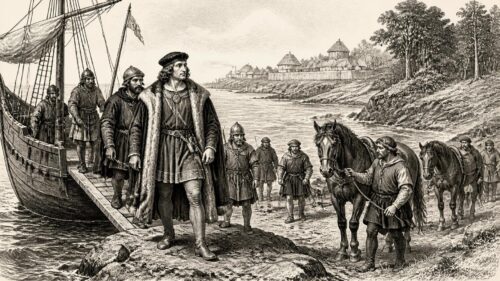
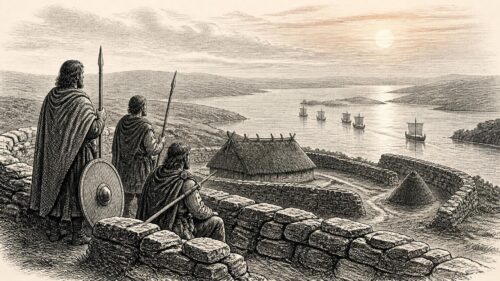
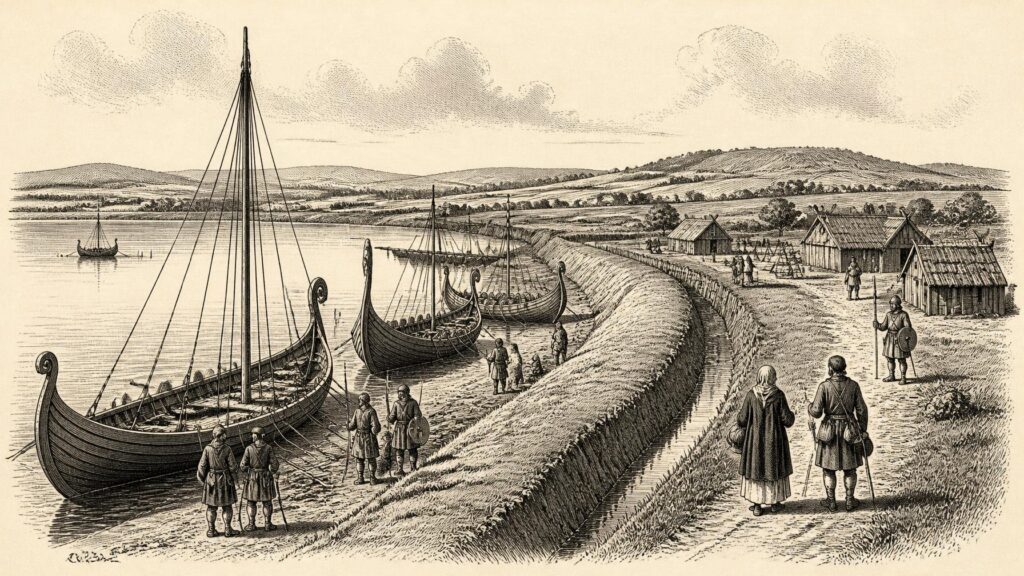
The defining development of 841 was the recording of two longphuirt, literally naval camps or ship-forts. One lay at Linn Dúachaill, generally identified with the Annagassan area on the County Louth coast near the River Glyde. The other was at Duiblinn, the dark pool beside the Liffey and Poddle, within the landscape from which Dublin later developed. The annals do not say that a city was founded in 841. They say that fortified maritime encampments existed there. That distinction is important: the settlement that would become medieval Dublin had a long and changing history, and its earliest Scandinavian phase should not be projected too confidently from its later urban prosperity.
Nevertheless, these camps marked a major departure from fleeting coastal raiding. A longphort offered a protected base for ships and crews, a place to store plunder, regroup after expeditions and maintain communications across the Irish Sea. Archaeological investigation at Annagassan has identified substantial early medieval defensive works in a location consistent with the annalistic Linn Dúachaill: a bank-and-ditch barrier cut across a peninsula between river and sea. The surviving evidence cannot reconstruct every building or identify every person present in 841, but it strongly supports the annals’ picture of a defensible, waterside base.
The geographical reach recorded for the two camps is striking. From Linn Dúachaill, the raiders plundered the peoples and churches of Tethba, a midland region broadly associated with parts of modern Westmeath and Longford. From Duiblinn, they plundered Leinster and the Uí Néill lands “as far as Sliab Bladma”, the Slieve Bloom mountains. These were not claims of formal Scandinavian rule over all territory between coast and mountains. They describe the range of raiding and exaction from bases that gave mobile war-bands repeated access to inland Ireland.
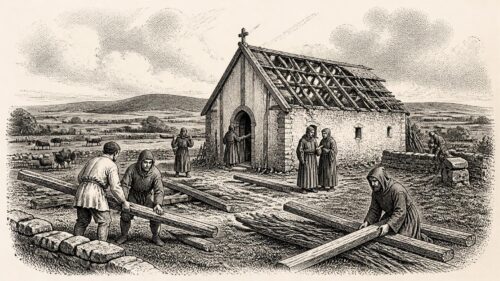
The annalist deliberately names both secular communities and churches. This does not mean that every settlement in these regions was attacked in 841, nor does it permit an exact map of destruction. It does show that monasteries and churches were not separate from the wider economy. Ecclesiastical centres possessed land, livestock, food renders, workshops, books, precious objects and networks of dependent people. They were also places of learning and hospitality. Their plundering harmed religious life, but it also disrupted local production, authority and the movement of goods.
More Than Raiding
Military purpose was central to the new camps, yet warfare was not their only possible function. Ships needed repair, and crews needed supplies that could be taken by force, purchased, exchanged or acquired through dealings with local intermediaries. Finds and landscape evidence at Linn Dúachaill have encouraged archaeologists to consider repair work and craft activity alongside raiding. That broader interpretation should be applied cautiously to 841 itself. There is no surviving account book from either camp, and no source proves the volume or character of trade in that calendar year. What can responsibly be said is that permanent or semi-permanent bases created conditions in which raiding, provisioning, ship maintenance and exchange could become entangled.
For ordinary people, the immediate consequence was uncertainty. Farmers and livestock keepers in accessible districts faced the prospect that armed men might arrive by river or from a coastal base; clerics and scholars were vulnerable not only to robbery but to capture. Communities could hide goods, move people, negotiate, seek protection from local rulers or retreat towards more secure places, but the evidence does not allow those responses to be assigned to particular unnamed settlements in 841. The annals’ broad wording is a warning against inventing a more detailed human story than the sources provide.
Feidlimid and Niall in Leinster
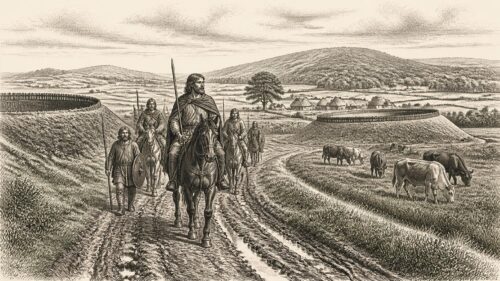
Irish kingship was no less active than Scandinavian expansion. Feidlimid mac Crimthainn, king of Munster and a leading ecclesiastical figure, led an army as far as Carman in Leinster. Carman, usually associated with the area near modern Kilcullen in County Kildare, was a celebrated royal assembly site. To appear there with an army was politically charged. It could signal a claim to direct influence in Leinster and, more broadly, a challenge to the pre-eminence claimed by the Uí Néill.
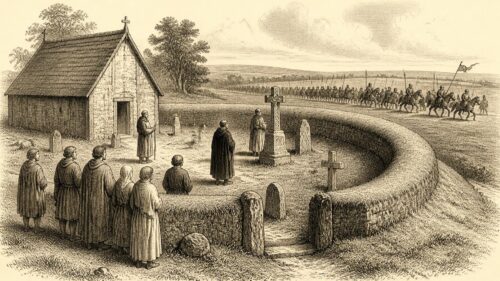
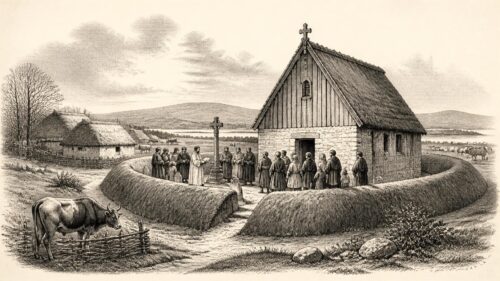
Niall Caille, ruler of Cenél nÉogain and the dominant northern Uí Néill king, marched against Feidlimid to Mag Óchtair. The annal entry itself gives no full battle narrative, but a contemporary-looking verse attached to it states that Feidlimid’s crozier was left among blackthorn bushes and taken by Niall through victory in battle. The verse provides the strongest basis for regarding the encounter as a defeat for Feidlimid. Its memorable image is also revealing. A crozier was an ecclesiastical staff, but in Feidlimid’s case it could carry political as well as religious meaning: he was a king whose authority was bound closely to church office and sacred prestige.
Later accounts treat Mag Óchtair as a decisive reverse for Munster’s northern ambitions. In 841, however, it is best understood as a successful counter-move by Niall rather than as the creation of a settled, uncontested high-kingship. Ireland remained a landscape of provincial dynasties, regional over-kings, church federations and local lordships. A battlefield victory could be powerful, but it had to be maintained through alliances, hostages, tribute, assemblies and further campaigning.
Violence Within Irish Dynasties
Two further notices underline that danger came from Irish political rivalries as well as from overseas raiders. Diarmait son of Conchobor subjected Máel Ruanaid son of Donnchad to what the translator cautiously renders as “compulsion”; the precise sense of the Irish phrase remains uncertain. On the same day, Diarmait was killed by Máel Sechnaill, while Máel Ruanaid survived. The sparse report does not identify the location or explain the quarrel. It does, however, place the future leading Mide dynasty in a moment of acute violence. Máel Sechnaill, probably Máel Ruanaid’s son, would later become one of Ireland’s most effective kings.
Elsewhere, Áed son of Dúnchad was deceitfully killed by associates of Conaing son of Flann, in Conaing’s presence. The annalist’s stress on deceit is moral as well as factual. Early medieval politics could involve formal assemblies and public military expeditions, but also betrayal within personal retinues. Such killings affected succession, landholding and the loyalties on which kings depended.
An Island Reoriented
By the end of 841, Ireland had not been conquered by Scandinavian armies, and no single Irish ruler controlled the island. Yet the year marks a durable change. The camps at Linn Dúachaill and Duiblinn connected Irish political life more directly to the maritime world of the Irish Sea and Scandinavia. Their occupants could raid deep inland, while Irish kings continued to contest the prestige of Leinster, Tara and the great assembly places. The abandoned crozier at Mag Óchtair and the new ship-forts on the coast are fitting emblems of the same year: established forms of Irish authority were still potent, but they now faced new, organised and persistent forces arriving by sea.
Primary Sources
- The Annals of Ulster: Year U841 (English translation)
- The Annals of Ulster: Year U841 (Irish text)
- The Annals of Ulster, AD 431–1201
- Chronicon Scotorum
- Annals of Inisfallen
- Annals of the Four Masters
- Vikings in Irish Chronicles, 794–902: Data
- Vikings in Ireland
- Fedelmid (Feidlimid)
- Niall Caille
- The Vikings in Ninth-Century Ireland: Sources and Settlements
- Early Medieval Archaeology Project: Early Medieval Dwellings, Settlements and Landscapes
- Dublin: Archaeological Background
- 2010:468 – LINNS, Louth
- Geophysical Survey Report No. 35
- The Winter Camp of the Viking Great Army, AD 872–3, Torksey, Lincolnshire
- The Viking Longphort of Linn Duachaill: A First Report
- Viking Sites
- Ireland’s Viking Fortress
- Viking Site Discovered in Co Louth