

British Ireland
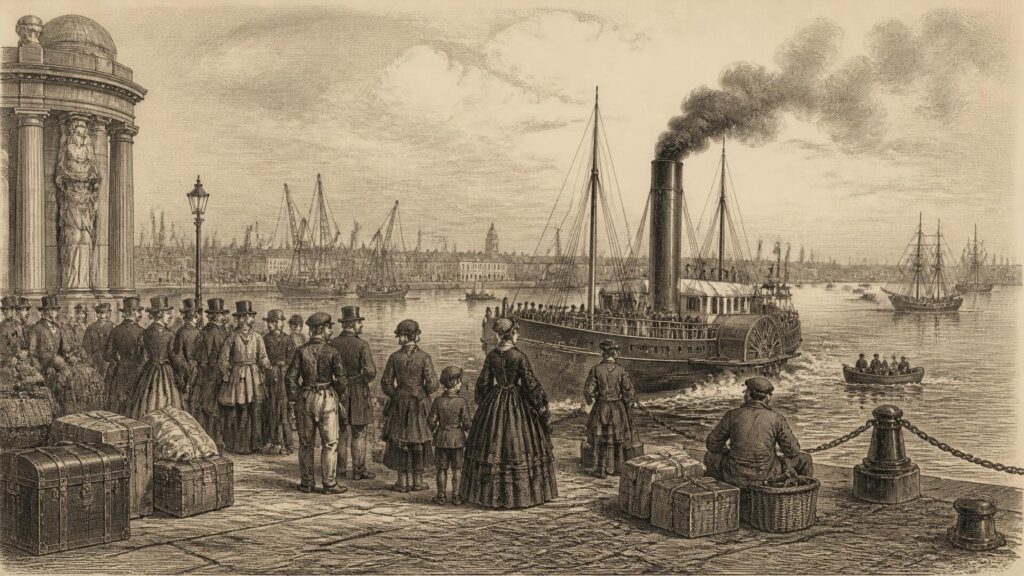
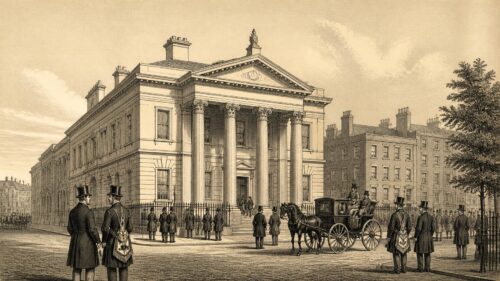
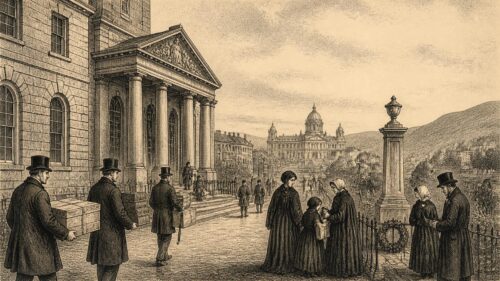
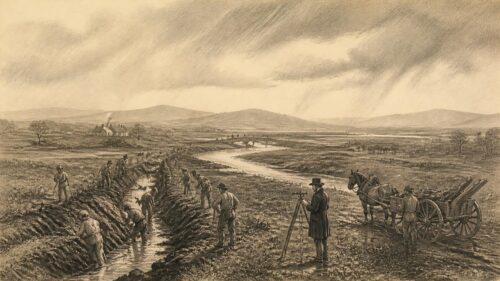
AI generated historical illustration, not a contemporary photograph.
At a Glance
“British” has never had one settled meaning in Ireland. It has described a state, a monarch, an imperial connection, a legal status, a cultural allegiance and, for many people, a deeply felt national identity. It has also been resisted as the language of conquest and government from outside Ireland. Any historical account must therefore avoid treating Britishness either as a simple colonial imposition or as an uncomplicated inheritance. Its meanings were made differently in different places, among Catholics and Protestants, in cities and rural districts, within the island and across the Irish diaspora.
Changing Meanings
The word “British” is often used carelessly as though it merely meant English. Historically, that is inaccurate. In antiquity, writers applied versions of the name Britannia to the neighbouring islands, though they did not possess modern ideas of nationality. In medieval and early modern political language, English rulers claimed authority in Ireland while their realm was usually understood as England and its lordship or kingdom of Ireland. “Britain” acquired a more distinct constitutional significance after the union of the crowns in 1603, when James VI of Scotland also became James I of England and Ireland, and especially after the parliamentary union of England and Scotland in 1707 created the Kingdom of Great Britain.
That development did not erase older identities. English, Scottish, Welsh and Irish attachments endured, while religious affiliation, locality, family, occupation and social rank could matter more immediately than any wider national label. For people in Ireland, “British” was never simply an umbrella term freely adopted by everybody living beside the Irish Sea. It was bound to unequal power, to the expansion of a state centred on London, and later to the growth of a worldwide empire. Yet it was also claimed sincerely by many Irish people, including people whose families had lived in Ireland for generations.
Historians consequently use Britishness with caution. It can refer to membership of the British state, to an emotional attachment to the Crown and Union, to participation in British political and imperial institutions, or to a cultural vocabulary involving Protestantism, military service, monarchy, parliament and imperial commerce. Those meanings sometimes overlapped but were not identical. A Dublin lawyer might be constitutionally British while favouring Irish parliamentary independence; an Ulster Presbyterian might resist Anglican privilege while feeling connected to Scotland and Britain; a Catholic parliamentarian might seek equal citizenship within the United Kingdom and later support Irish self-government.
Medieval Foundations
The institutional origins of the British connection in Ireland lay long before Britain existed as a united political name. The Anglo-Norman intervention of the late twelfth century brought powerful lords from England, Wales and the Welsh Marches into Ireland. Henry II asserted lordship over Ireland, and a lordship administered in the king’s name gradually developed. Its authority varied greatly. English law, lordship and settlement were strongest in some eastern and southern regions, while Gaelic Irish lordships retained extensive autonomy elsewhere.
It is misleading to project later British nationality backwards onto this period. The incomers were not “British” in the nineteenth-century constitutional sense, and medieval Ireland was not simply ruled from a cohesive British nation-state. What did emerge was a durable relationship between Ireland and the English Crown. English legal institutions, an Irish parliament, boroughs, ecclesiastical networks and aristocratic connections became part of Irish political life. The Dublin administration also depended on cooperation, compromise and conflict with Gaelic and Gaelicised lords.
By the later Middle Ages, English authority contracted markedly beyond the Pale. This did not mean that Ireland was detached from English politics. Rather, authority was fragmented. The political community represented in the Irish parliament included powerful landholders with connections across the Irish Sea, but it was not equivalent to the population of the island. Gaelic Irish communities remained largely outside that political structure, while many families of Norman origin became culturally and politically integrated into Gaelic society. The simple opposition of native Irish and foreign settlers obscures these layered realities.
Tudor Conquest
The Tudor period transformed the relationship. English monarchs sought to make their authority effective throughout Ireland, partly from fear that Ireland could provide a base for European rivals. Henry VIII’s assumption of the title King of Ireland in 1541 was a constitutional assertion as well as a symbolic change. Successive campaigns, plantations, military garrisons and administrative reforms extended Crown power, although at an immense human cost and through repeated war.
Religious change intensified the division. The Reformation created an established Church of Ireland linked to the English crown and, after 1707, to the British state. Most of the Irish population remained Catholic. The resulting political order increasingly associated loyalty to the Crown with Protestant power, especially after the wars of the seventeenth century. That association was neither inevitable nor complete, but it profoundly shaped the ways in which Britishness would be understood in Ireland.
The seventeenth century brought rebellion, conquest, confiscation and plantation on an enormous scale. The 1641 rising, the Wars of the Three Kingdoms, Cromwellian conquest and Williamite war were interconnected conflicts involving religion, sovereignty, land and survival. Protestant settlers came from England and Scotland in substantial numbers, most conspicuously in Ulster but not only there. Their descendants formed diverse communities: Anglican, Presbyterian and other dissenting groups; urban merchants, farmers, artisans and landlords. Later unionist identities drew upon these histories, though they did not all interpret them in the same way.
Protestant Power
After the Williamite settlement, political power in Ireland rested principally with the Protestant Ascendancy. The Irish parliament sat in Dublin, but its electorate was narrow, its politics were shaped by property and patronage, and its autonomy was constrained by the English and then British Parliament. Penal laws restricted Catholic civil and political life and also disadvantaged Protestant dissenters in significant respects. To call this order “British” is useful only if the term is understood as a system of state power rather than a shared national community.
At the same time, many Protestant political figures in Ireland developed a distinctive constitutional outlook. They could defend the rights of the Irish parliament against Westminster while identifying with the Crown and with the wider Protestant interest. Their debates show that attachment to Ireland and attachment to Britain were not necessarily mutually exclusive. The eighteenth-century Patriot movement demanded legislative independence for the Irish parliament, secured in 1782, without seeking separation from the monarchy.
That arrangement was unstable. The Irish parliament remained unrepresentative of most inhabitants and was embedded in a society structured by religious inequality. The American and French revolutions encouraged demands for wider reform. The Society of United Irishmen, founded in Belfast in 1791, initially sought parliamentary reform and Catholic emancipation. Its membership and ideas crossed some religious lines, though the movement’s radical politics generated intense alarm among the governing elite. The rebellion of 1798, brutally suppressed, became a decisive prelude to union.
Union Debates
The Acts of Union were not a natural or inevitable culmination of earlier history. They were contested political measures passed amid war, repression and anxiety after the 1798 rebellion. Supporters argued that an incorporating union with Great Britain would secure the kingdom, strengthen trade and place Ireland within a larger political framework. Opponents warned that it would abolish the Irish legislature and reduce Irish influence by transferring government to London.
The parliamentary process itself remains central to the historical memory of the Union. Government influence, patronage, compensation for disfranchised borough proprietors and the creation of peerages all featured in winning support. Such methods were characteristic of eighteenth-century parliamentary politics, but they also left a powerful legacy: for later nationalists, the Union appeared not as a freely negotiated settlement but as the destruction of legislative independence by a political elite acting under British pressure.
The Union came into force on 1 January 1801. It created the United Kingdom of Great Britain and Ireland and ended the separate Irish parliament at College Green. Ireland returned 100 members to the House of Commons at Westminster, alongside representative peers in the Lords. The Union joined states, not peoples into a uniform nation. It retained a distinct Irish legal system, and Ireland’s social, religious and economic conditions remained markedly different from those in Great Britain.
Its advocates expected Catholic emancipation to accompany or swiftly follow Union. King George III’s opposition prevented that immediate outcome, contributing to William Pitt’s resignation. The failure mattered profoundly. Many Catholics who might have regarded Union as a path towards equal citizenship instead saw the promised settlement deferred. Catholic emancipation did not arrive until 1829, after a mass political campaign associated above all with Daniel O’Connell.
Unionist Visions
Britishness under the Union was not merely an official doctrine imposed from Westminster. It was also a political conviction held by people in Ireland. Unionists believed that Ireland’s security, prosperity and liberties were best protected inside the United Kingdom. Some emphasised common monarchy, Protestantism and imperial achievement. Others valued the practical advantages they believed flowed from the Union: access to British markets, influence at Westminster, military security and membership of a powerful international state.
Those beliefs varied by class and religion. Landed Anglicans often regarded the Union as a safeguard for property and established privilege. Presbyterians in Ulster held more varied views: some had been prominent in radical politics during the 1790s, while many later found a durable place within unionism. Catholics could be loyal to the Crown and participate in British political life, even when they opposed the Union or sought Home Rule. The categories “British”, “Irish”, “Protestant”, “Catholic”, “unionist” and “nationalist” should therefore not be treated as permanent blocks.
Unionism also acquired a strong local geography. It was especially influential in the industrialising north-east, where Belfast expanded rapidly through linen manufacture, engineering, shipbuilding and commerce. Economic ties with Britain, patterns of migration from Scotland, and the demographic strength of Protestant communities all reinforced the Union’s appeal. Still, Ulster was not uniformly unionist, nor was unionism confined to Ulster. Nationalist and Catholic communities were substantial in the north-east, while southern and western Ireland contained Protestant unionists whose experiences were different from those of Belfast industrialists.
Imperial Horizons
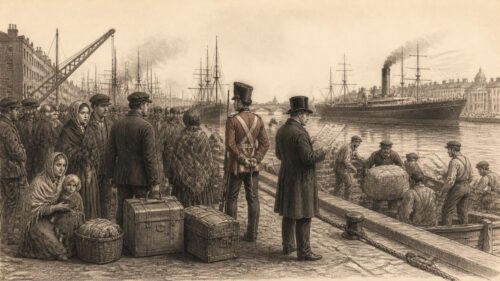
During the nineteenth century, Irish people participated in the British Empire in strikingly varied ways. Soldiers, civil servants, missionaries, merchants, labourers, settlers and emigrants from Ireland travelled through imperial networks. Irish regiments and individuals served in the British armed forces; Irish doctors, engineers and administrators worked overseas; Irish ports and manufacturers connected with imperial trade. Such participation does not mean that Ireland was simply an equal partner in empire. It does show that imperial history cannot be separated neatly into a British story on one side and an Irish story on the other.
The empire offered careers and routes of advancement to some, particularly among the professional and Protestant middle classes, but it also drew on a society marked by inequality and mass emigration. Irish people could be agents of imperial power and subjects of a state whose policies they contested. Nationalists sometimes condemned British imperialism while using imperial constitutional language to argue for Irish self-government. Unionists presented Ireland’s contribution to imperial service as evidence that Irish people, especially Protestants, belonged within a wider British world.
Popular culture carried these arguments. Royal jubilees, military commemorations, flags, parades, newspapers and schoolbooks could encourage identification with the United Kingdom and empire. Their impact was never uniform. A public celebration might attract genuine enthusiasm in one town and hostility or indifference in another. Historians should distinguish evidence of an organised ceremony from proof that every spectator shared its message. Attendance, silence and ritual do not disclose private belief with certainty.
Famine Politics
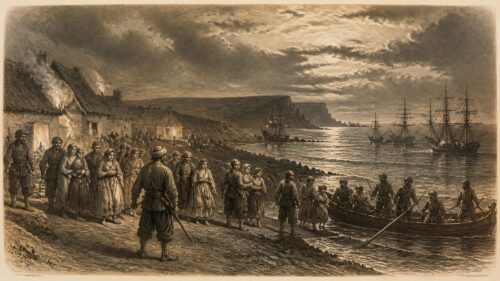
The Great Famine exposed the moral and political limits of the Union with terrible force. Potato blight first appeared in 1845, and repeated failures of the crop, combined with poverty, dependence on the potato and failures of relief, caused mass death and migration. The disaster unfolded under a British government responsible for Ireland, but responsibility was exercised through contested ideas about markets, property, poor relief and state intervention. The famine cannot be reduced to a single intention or slogan; nor can its scale be understood without recognising the governing structures of the United Kingdom.
Contemporary witnesses and later historians have argued fiercely over culpability. There is no sound basis for describing the famine as a simple natural catastrophe, because disease became mass death amid social arrangements and political decisions. Equally, historians distinguish between evidence for destructive policy, indifference, ideology and administrative failure, and evidence for a centrally planned policy of extermination. The documentary record strongly supports the conclusion that British government responses were inadequate and often shaped by assumptions that worsened suffering. It does not require invented claims to establish the enormity of that failure.
The famine altered Irish attitudes towards Britain and the Union, although it did not produce one universal response. It weakened confidence in the governing order, accelerated emigration and sharpened political memory. In later nationalist narratives, it became compelling evidence that Irish interests could not be entrusted to Westminster. For many unionists, however, the Union remained the constitutional framework within which reform, relief and economic recovery had to be pursued. These opposed readings became part of the emotional inheritance of later politics.
Constitutional Campaigns
Daniel O’Connell demonstrated that Irish Catholic politics could mobilise mass support while working through law, elections and public association. Having helped secure Catholic emancipation in 1829, he led the campaign for repeal of the Union. Repeal did not succeed, but it made the abolition of the Union a central question in nineteenth-century politics. O’Connell’s constitutional agitation also helped create political methods later employed by both nationalists and unionists: mass meetings, disciplined organisation, newspapers, electoral pressure and appeals to opinion beyond Ireland.
After the famine, the demand for an Irish parliament within the United Kingdom gained new force. Home Rule did not necessarily mean independence. Its advocates sought devolved self-government while retaining the Crown and an imperial connection. This constitutional ambiguity helps explain why Irish political identities could be more complex than a simple British-versus-Irish divide. Some Home Rulers saw themselves as Irish members of a multinational United Kingdom; others regarded Home Rule as an instalment on the road to complete independence.
Unionists rejected Home Rule for reasons that included constitutional principle, fears for religious liberty, concern about property and commerce, and attachment to the United Kingdom. The defeat of the first and second Home Rule bills in 1886 and 1893 preserved the Union, but it did not resolve the dispute. By the early twentieth century, electoral politics had made Home Rule appear increasingly likely, while unionist opposition, especially in Ulster, became more organised and more militant.
Ulster Identity
Ulster unionism was shaped by history, but it was not a fossil surviving unchanged from plantation times. It was modernised through mass politics, voluntary associations, industry, religious institutions and print culture. The Ulster Covenant of 1912, signed by hundreds of thousands in opposition to Home Rule, expressed a collective mobilisation on a remarkable scale. Its supporters framed their cause as the defence of British citizenship, civil and religious freedom, and their place in the United Kingdom.
These claims were sincere for many who made them, but they were contested by Irish nationalists and by northern Catholics, who saw the proposed exclusion of Ulster from Home Rule as a denial of their own political rights and Irish identity. The same territory thus held rival national narratives. Britishness in the north was not merely a constitutional preference. It could be expressed through family memory, cultural practice, remembrance of military service, loyalty to the monarchy, participation in Orange institutions and a feeling of kinship with Great Britain.
Interpretations of that identity require care. It is inaccurate to describe all unionists as descendants of settlers, just as it is inaccurate to suppose that all Protestants were unionists or all Catholics nationalists. Communities were internally divided by class, politics, gender, local circumstance and generation. Yet broad patterns mattered. The north-east’s industrial economy and Protestant demographic majority gave unionism resources and confidence not available to it across most of the island.
War Partition
The crisis over Home Rule unfolded alongside the First World War, the Easter Rising of 1916, the growth of Sinn Féin and the Irish War of Independence. Irish participation in the British armed forces during the war was large and diverse, but its later remembrance became politically fraught. Some families remembered service as patriotic sacrifice for Britain; others found that the revolutionary period changed the public meaning of that service. In recent decades, commemoration has made greater room for these complex histories without dissolving their political significance.
The Government of Ireland Act 1920 partitioned the island by creating separate legislatures for Northern Ireland and Southern Ireland. The southern parliament did not become a functioning political settlement, while Northern Ireland’s parliament opened in 1921. The Anglo-Irish Treaty of December 1921 established the Irish Free State as a self-governing dominion, while allowing Northern Ireland to remain outside it. Partition was therefore not simply a line drawn on a map. It established different constitutional orders and left major minorities on each side of the border.
The Treaty split the Irish revolutionary movement and contributed to civil war in the new Free State. In Northern Ireland, the new government operated amid violence, insecurity and profound communal division. Britishness acquired an official territorial form in the six counties, but national identity did not become uniform there. A substantial nationalist population regarded itself as Irish and rejected the legitimacy of partition. The decades that followed were shaped by the coexistence of a unionist-majority state and a large minority alienated from it.
Free State
After 1922, the relationship between Irishness and Britishness changed in the south but did not disappear. The Free State remained within the Commonwealth and retained constitutional links with the Crown. Its governments gradually widened autonomy, removed institutional ties and, through the 1930s and 1940s, redefined the state’s relationship with Britain. The Republic of Ireland Act took effect in 1949, ending the state’s remaining external association with the British Commonwealth.
These constitutional changes did not erase human connections. Families continued to move between Ireland and Great Britain for work, education and marriage. The Irish in Britain became one of the largest migrant communities there, while British-born people lived in Ireland. Trade, broadcasting, sport, churches and personal relationships crossed the Irish Sea. The histories of the two islands were intertwined even when the political language of independence insisted on difference.
Southern Protestant communities also faced changing circumstances. Some left after independence; many remained and contributed to the cultural, commercial and civic life of the new state. Their experiences cannot be represented by a single story of either exclusion or harmonious adjustment. Nor should “British” be assumed to describe every Protestant in independent Ireland. Some retained a British identification, some developed an emphatically Irish civic loyalty, and many lived with overlapping attachments that public political labels did not fully capture.
Northern Conflict
In Northern Ireland, the Unionist government governed from 1921 until 1972. Its supporters regarded the state as the democratic expression of a unionist majority and as a secure part of the United Kingdom. Nationalists contested its legitimacy and frequently alleged discrimination in housing, local government, employment and policing. These disputes were neither invented by later commentators nor reducible to ancient hatred. They concerned practical power as well as identity.
The civil rights movement of the late 1960s demanded reforms that its participants commonly described in the language of equal citizenship. The state’s response, loyalist counter-mobilisation, republican violence, British military intervention and political breakdown led into the period commonly called the Troubles. The conflict involved republican and loyalist paramilitaries, the British Army, police forces and political institutions. Its human costs were borne above all by people living in Northern Ireland, though violence also affected Great Britain and the Republic of Ireland.
Britishness was both part of the conflict and more than its cause. For many unionists and loyalists, British identity seemed threatened by constitutional uncertainty and violence. For many nationalists and republicans, British state authority was experienced as coercive and illegitimate. These were conflicting historical interpretations, not neutral descriptions. The language of identity could offer belonging and dignity, but it could also be used to harden boundaries, defend unequal arrangements or deny the legitimacy of neighbours.
Agreement Principles
The Belfast Agreement of 10 April 1998 altered the constitutional language through which these rival identities were addressed. It did not ask people in Northern Ireland to agree upon a single national story. Instead, it recognised the legitimacy of British and Irish identities and made consent central to any change in Northern Ireland’s constitutional status. Its promise was not that history had ended, but that constitutional disagreement should be pursued through democratic and peaceful means.
Crucially, the Agreement recognised the birthright of the people of Northern Ireland to identify and be accepted as Irish or British, or both, and to hold both British and Irish citizenship. This was a major departure from older political assumptions that identity had to follow one exclusive constitutional allegiance. It gave legal and political form to a reality long visible in family histories and daily life: identities can overlap, shift and be held with varying emphasis.
The Agreement also established institutions for power-sharing within Northern Ireland, cooperation across the island and structured relations between the Irish and British governments. These arrangements acknowledged that the constitutional question had several dimensions: internal governance, north-south relations and east-west relations. The formula was deliberately complex because the history was complex. Its durability depends not on erasing difference but on maintaining consent, rights, equality and reciprocal respect.
Memory Disputes
Arguments about Britishness remain arguments about memory. Commemorations of 1690, 1912, the Somme, 1916, partition and the Troubles can all become occasions for affirming a community’s version of the past. They can also provide opportunities for more generous historical understanding. A historian’s task is not to demand that people abandon inherited loyalties. It is to ask what sources can establish, whose voices were recorded, what language was used at the time and how later generations reshaped events into tradition.
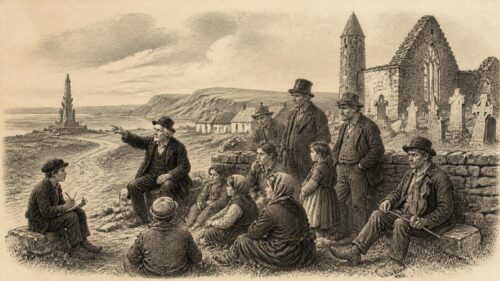
Folklore has a place in this history, but it should not be mistaken for archival proof. Family stories of settlement, military service or ancestral suffering can preserve experiences omitted from official records. They may also become simplified through repetition. Claims that an entire community descends from one settler group, or that a political identity has remained unchanged for centuries, are usually too blunt to withstand close investigation. Migration, intermarriage, conversion, social mobility and changing political circumstances complicate such assertions.
Similarly, visible symbols should be interpreted rather than mechanically decoded. A flag, parade, royal portrait or memorial may signify attachment, defiance, grief, cultural tradition or local belonging. It may mean different things to different viewers. The historical record can establish that a symbol was displayed, legislated for, criticised or defended. It cannot always reveal the inner feelings of every person present. Good history allows for that uncertainty.
Shared Histories
Irish history is not made clearer by excluding Britishness from it. The political institutions, wars, economies, migrations and cultural forms that linked Ireland with Britain were real and consequential. Nor is British history complete without Ireland. Irish people helped shape the United Kingdom, challenged it, served it, suffered under its policies, migrated through its cities and empire, and created political traditions that changed both islands.
The historical significance of Britishness in Ireland lies precisely in its plurality. It was the language of imperial authority and also of local attachment. It was claimed by powerful institutions and by ordinary people. It could exist alongside an Irish identity, compete with it or be rejected in favour of it. It could be a matter of constitutional allegiance, inherited culture, religious community, citizenship or emotional belonging. No single explanation covers every period or person.
The present constitutional settlement does not settle every argument about the past, nor should history be recruited to settle contemporary political questions by itself. What it can do is make simplifications harder. “British” in Ireland is neither a foreign word with no Irish history nor a neutral label detached from power. It is a historically formed identity and political relationship, inseparable from union and partition, but also from everyday mobility, shared institutions, disagreement and the continuing effort to live with more than one legitimate sense of belonging.
Royal Allegiance
One way to understand the unsettled character of Britishness in Ireland is to examine the monarchy. The Crown was more than an institution at the summit of government: it was expected to embody the Union, give emotional form to political allegiance and represent a state whose peoples had very different histories. After 1801 this expectation became especially difficult. The incorporation of Ireland into the United Kingdom brought a large Catholic population within a polity whose public constitutional language had long been strongly Protestant. The monarchy was supposed to stand above division, yet it inherited the divisions of the state it symbolised.
Those difficulties did not begin with the Union. In the 1690s, Irish Protestants lived in a kingdom where they exercised political power despite being a minority within a predominantly Catholic population. Their political vocabulary was revealingly unstable. They could call themselves the king’s Irish subjects or the people of Ireland, but often treated “the Irish” as a label for Catholics. Such usage shows that neither “Irish” nor “British” had a fixed, inclusive meaning. Identity was being shaped through religion, political privilege and allegiance to a monarch rather than through a modern national category shared equally by everyone on the island.
At the same time, Protestant writers and politicians could insist upon an Irish constitutional interest. William Molyneux’s 1698 argument against English parliamentary legislation binding Ireland expressed an assertion of Irish parliamentary sovereignty, even though the Irish parliament did not in practice possess full legislative independence. This was not a straightforward anticipation of later nationalism. The political elite seeking greater freedom from Westminster was Protestant and loyal to the Crown. Its complaint arose partly from the subordinate position of Ireland within the wider monarchy and from measures, including restrictions affecting Irish woollen exports, that damaged local interests.
Some Protestant advocates consequently looked towards union with England, and later Great Britain, as a possible answer to that inferior position. Their case did not rest only on trade or administrative convenience. It also drew upon claims of common Protestant religion and shared ethnicity with the sovereign’s subjects across the Irish Sea. The apparent contradiction is important: people could demand recognition of Ireland’s particular interests while presenting themselves as English, Protestant and loyal subjects. Britishness was therefore not simply a label received from London. It could be actively fashioned in Ireland, though it was fashioned within an unequal political order from which Catholics were largely excluded.
The Union of 1801 intensified rather than resolved this problem of representation. It removed the Irish parliament but made the monarchy the most visible common symbol of the new United Kingdom. In theory, the Crown could connect Ireland to a broader constitutional community without denying Irish distinctiveness. In practice, the settlement began with a serious failure. Catholic emancipation, widely expected by some supporters of Union, was not granted at the time. George III believed that concession was incompatible with his coronation oath. The monarch’s personal understanding of a Protestant constitution thus became bound up with the political exclusion of Catholics.
This mattered because the British constitutional tradition frequently presented monarchy as evidence of continuity, liberty and national stability. The settlement associated with 1688 was often understood through a Protestant frame, contrasting Britain’s supposedly secure constitution with Catholic Europe. Such assumptions encouraged cultural as well as theological prejudice. They made it harder for the monarchy to represent Irish Catholics as equal members of the United Kingdom, however much official rhetoric described the Crown as the common possession of all subjects. A symbol intended to unite could instead confirm the view that the Union privileged one religious tradition over another.
Claims of ancient connection did not remove that obstacle. Stories linking the coronation stone at Westminster to Tara, and the royal family to Irish and Scottish genealogies, offered an imaginative account of a monarchy with deep Irish roots. Yet the historical foundations for such claims were uncertain, and their political use was more significant than their factual strength. They allowed supporters of the Union, particularly in Ulster, to imagine the Crown not as wholly external but as connected to overlapping Irish, Scottish and British pasts. Such narratives demonstrate how historical memory can supply legitimacy even when it cannot provide uncomplicated proof.
The monarchy’s Irish meaning consequently depended on audience and circumstance. For unionists, loyalty to the Crown could express continuity, constitutional security and membership in a wider British people. For nationalists, the same institution could stand for the state that had abolished Ireland’s parliament, maintained unequal arrangements and resisted demands for self-government. Neither response was merely ceremonial. Each drew force from lived political experience. Nor did royal allegiance always dictate a person’s entire outlook: people could value a constitutional connection while seeking reform, or reject the Union while retaining complex cultural and familial ties with Britain.
The Belfast Agreement of 10 April 1998 supplied a different framework for these competing attachments. It did not make Britishness disappear, nor did it require acceptance of a single Irish national story. Instead, it placed consent at the centre of Northern Ireland’s constitutional position and affirmed parity of esteem. Most importantly for questions of belonging, it recognised the birthright of the people of Northern Ireland to identify and be accepted as British or Irish, or both, and to hold British and Irish citizenship. In this formulation, identity was no longer meant to be a test of exclusive loyalty imposed by the state.
The Agreement’s institutional design reinforced that principle. Its arrangements for devolved government in Northern Ireland, co-operation between North and South, and structured relations between Britain and Ireland acknowledged that political life could not be contained within one constitutional tradition alone. The result was not a settlement without disagreement. British and Irish identities continue to carry powerful memories, loyalties and fears. But the Agreement established that their legitimacy should not depend on the defeat or disappearance of the other. In that sense, it marked a significant shift from older models in which monarchy, religion and state power were expected to define a single public allegiance.
British Ireland is therefore best understood not as a completed national identity but as a history of contested membership. The Crown, parliament and Union gave Britishness institutional force; Protestant political culture gave it particular social meanings; and Irish resistance exposed its exclusions. Later constitutional arrangements did not settle the past, but they made room for plural affiliation as a political fact. That change does not dissolve conflict or memory. It does, however, offer a way to recognise that belonging in Ireland has often been layered, conditional and shared across boundaries that earlier generations tried to make absolute.
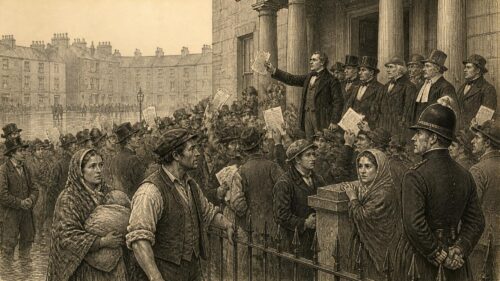
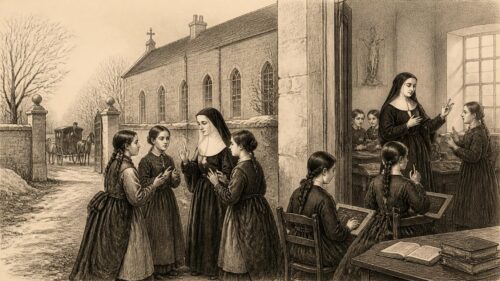
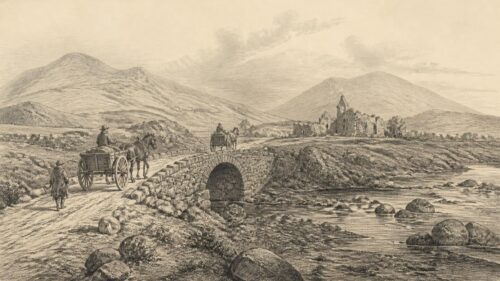
The article’s portrayal of Britishness as simultaneously constitutional status, cultural allegiance and contested memory is revealing in its treatment of Home Rule and Union. It suggests that identities did not divide neatly along religious or geographic lines: Catholics, Presbyterians, Protestants, nationalists and unionists could each combine Irish, British, imperial and local attachments in changing ways. This complexity challenges assumptions that partition emerged from communities with predetermined ambitions. It also raises questions about how rituals, economic links and political campaigns translated loyalties into choices. How far do you think interests, religious experience and principle explain Irish responses to Britishness before partition?