Ailbe’s Munster Law784 CE
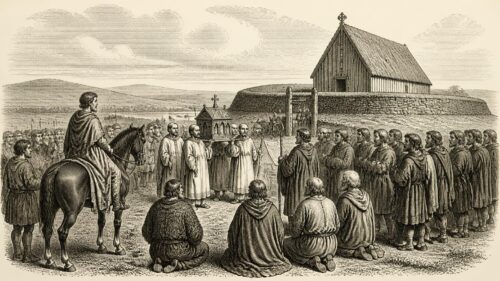
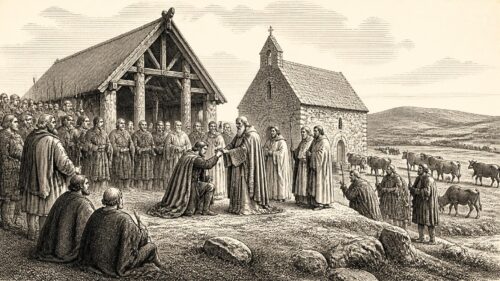
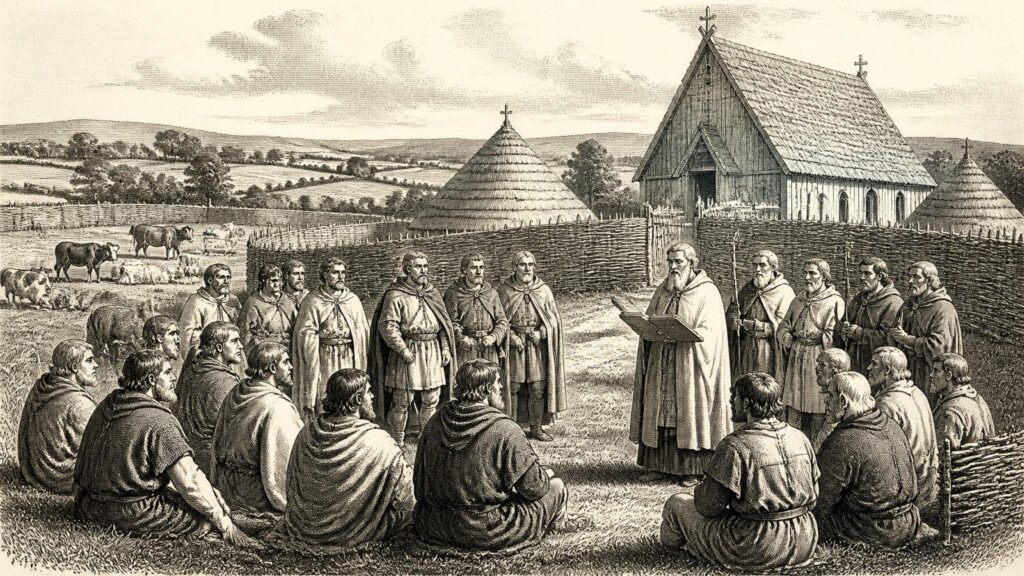
In 784, the Annals of Inisfallen record that the Law of Ailbe operated throughout Munster, indicating a provincial ecclesiastical settlement backed by saintly and likely secular authority. No surviving text identifies its rules, sponsors or proclamation, but such cána could protect churches, regulate obligations, secure revenues and reinforce peace. The measure reflected Emly’s importance and Munster’s contested kingship, without proving any specific ruler’s involvement. Notices of abbots’ deaths at Clonmacnoise and Terryglass reveal interconnected religious institutions. On 27 November, Irish-born Virgil of Salzburg died, demonstrating Irish ecclesiastical influence abroad. Together, these events illuminate sacred authority, political negotiation and rural obligations.
Dateline
A sparse but significant record
The clearest Irish notice securely assigned to 784 is brief: the Annals of Inisfallen record that “the Law of Ailbe” was in force in Mumu, Munster. Few annal entries look less revealing at first glance. Yet this small statement points to a major development in the political and religious ordering of southern Ireland: the public activation, or renewal, of a saint’s cáin—a law or protected settlement carrying ecclesiastical authority across a defined territory.
The wording must be treated carefully. The annal does not name the king, cleric or assembly responsible; it gives no place of proclamation; and no text of the Law of Ailbe survives from which its exact rules, penalties or beneficiaries can be recovered. It is therefore not responsible to imagine a detailed law code, a particular ceremony at Emly, or a single legislative day in 784. What can be said is both narrower and important: in that calendar year the authority attached to Ailbe, Munster’s leading saint, was recognised as operating throughout Munster.
This year also illustrates why chronology matters. The Annals of Ulster place several prominent events under their annal-number U784, but their own heading equates that annal with AD 783. Those events—including the battle of Carn Conaill in Connacht—should not simply be transferred into 784 CE. Likewise, the much later Annals of the Four Masters preserve valuable traditions but expressly flag chronological displacement in their entries for this period. For 784, the Inisfallen notice of Ailbe’s law, together with the securely dated death abroad of the Irish-born bishop Virgil of Salzburg, provides firmer ground.
A saint’s authority over Munster
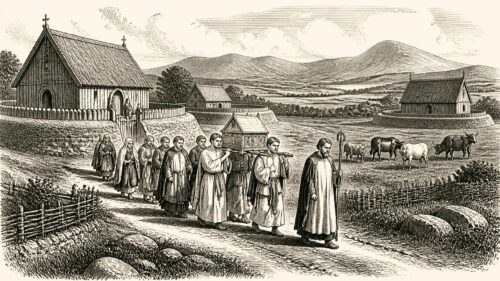
Ailbe was revered as patron of Imlech Ibair, modern Emly on the Tipperary–Limerick border. In later medieval memory Emly stood behind only Cashel among the great ecclesiastical centres of Munster, while Ailbe was remembered as the province’s premier saint. The traditions concerning his sixth-century life are not straightforward biography, but the importance of his cult in the eighth century is beyond doubt. To invoke Ailbe’s law was to call upon the prestige, sacred protection and institutional claims of the church associated with him.
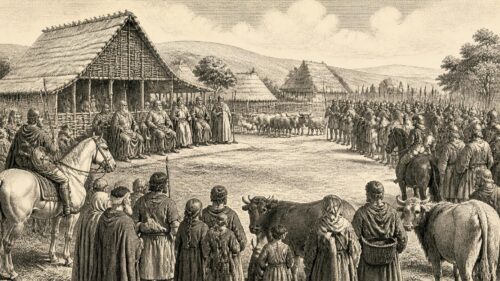
Irish cána were not necessarily statutes in the modern sense. They were enforceable settlements articulated through kings, clerics, communities and a saint’s authority. Annalistic evidence from the eighth and early ninth centuries shows laws attributed to saints being imposed, renewed or extended over kingdoms and provinces. Such measures could establish protected persons or places, regulate exactions, reinforce peace, and secure the revenues and immunities on which churches depended. Their enforcement was as much political as devotional: a ruler’s support gave a law reach, while a saint’s authority clothed obligations in moral and religious force.
The Law of Ailbe must not be assumed to have duplicated the better documented Law of the Innocents, associated with Adomnán and designed to protect non-combatants. Nor do we know whether it concentrated on sanctuary, tribute, clerical rights, compensation, or some combination of such concerns. But its provincial scale is explicit. “In force in Munster” signals something more ambitious than the internal discipline of one monastery. It implies an attempt to bind diverse peoples and local rulers within a recognised framework centred on a Munster saint and his church.
Emly, kingship and provincial politics
The measure belonged to a period when Munster’s overkingship was unsettled. The Eóganachta, the dominant royal kindred associated with Cashel and its wider hinterland, were not a single unified household. Their competing branches, together with powerful neighbouring peoples, made the extent of any ruler’s authority variable. Máel Dúin mac Áedo, associated with west Munster and the Eóganacht Locha Léin, was an important figure in these years; some sources style him king of Munster, while others use more limited titles. The evidence does not allow him to be named confidently as sponsor of the law of 784, but the law’s provincial language belongs naturally in this contested political setting.
Emly’s standing made it a useful partner for secular power. A ruler able to support Ailbe’s rights could present himself as guardian of Munster’s religious order; the church, in turn, gained a claim reaching beyond its own fields, tenants and dependants. This did not mean that church and kingship were identical. Their interests could overlap without being the same. A cáin could provide a negotiated structure through which royal protection, ecclesiastical privilege and obligations owed by communities were made mutually intelligible.
It is tempting to read the Law of Ailbe as a direct answer to Armagh’s growing promotion of Patrick, or as a prepared platform for the later Munster ruler Artrí mac Cathail. Those ideas have scholarly support as interpretations of the wider eighth-century competition between ecclesiastical centres and dynasties, but they remain interpretations, not facts stated by the annal for 784. The safest conclusion is that the law strengthened a distinctly Munster-centred sacred authority at a time when provincial leadership required alliances as well as force.
What the law meant on the ground
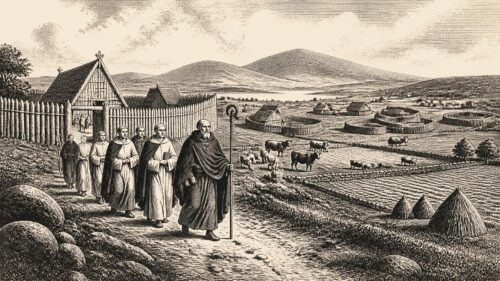
For most people, a provincial church law was unlikely to have been an abstract pronouncement. It touched ordinary life through the obligations and protections attached to land, livestock, food-renders, travel, hospitality and disputes. Munster’s population lived predominantly in dispersed rural settlements, cultivating cereals and keeping cattle, pigs and sheep. Monastic and ecclesiastical communities did not stand apart from that economy. They required grain, dairy produce, animals, labour, timber and skilled craftwork; they also offered worship, burial, literacy, hospitality and access to mechanisms of arbitration and commemoration.
Emly itself should be imagined not as a solitary modern-style parish church but as an early medieval ecclesiastical settlement: a place of worship and burial, but also of households, storehouses, workshops, guests, tenants and learned clergy. Its influence extended through relationships rather than neat territorial boundaries. A law proclaimed in Ailbe’s name could make those relationships more secure, converting local recognition of the saint into wider duties owed to his community. Yet the surviving record cannot tell us how consistently such duties were collected, how far they travelled into peripheral districts, or how readily they were accepted.
The same restraint applies to learning. A text known as the Rule of Ailbe survives and reflects Old Irish monastic culture, with concern for prayer, discipline, food and conduct. It cannot, however, be securely dated to 784, nor can its surviving form be used as the text of the Law of Ailbe. Its association nevertheless reminds us of the intellectual world in which a saint’s name could authorise both religious instruction and institutional claims. Churches such as Emly depended on literate specialists who could preserve genealogies, liturgy, legal formulae and the memories that made saintly patronage effective.
Deaths in the ecclesiastical network
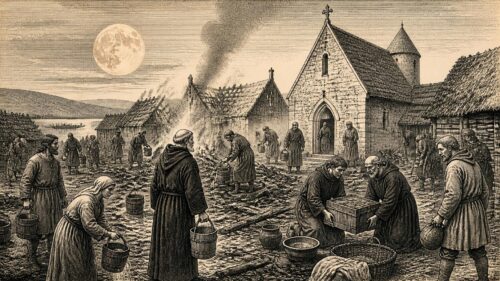
The same Inisfallen annal records the deaths of Rechtabra, abbot of Clonmacnoise, and Cumascach, abbot of Tír dá Glas, modern Terryglass. These notices are terse, but they locate 784 within a network that crossed provincial boundaries. Clonmacnoise, on the Shannon, and Tír dá Glas, on Lough Derg, were major religious communities on routes linking Munster, Connacht and the midlands. The loss of an abbot mattered because abbots were not merely spiritual figures: they directed households, estates, dependencies, books, churches and political relationships.
It would be wrong to claim that either death caused the Law of Ailbe or that 784 brought a general ecclesiastical crisis. The sources say no such thing. Their juxtaposition instead shows the density of Ireland’s religious landscape. A provincial law in Munster and successions at major midland churches belonged to the same world of interconnected institutions, in which saints, relics, land, learning and royal patronage supplied authority.
An Irish death in Salzburg
On 27 November 784, Virgil—also known as Virgilius—died at Salzburg. He was Irish-born and had spent about four decades on the Continent, becoming abbot of St Peter’s and bishop of Salzburg. His identification with Fergil of Aghaboe, whom later Irish annals call “the Geometer”, is probable but not beyond dispute; his Irish origin, however, is strongly attested. His death offers a sharply dated reminder that Ireland’s intellectual and ecclesiastical world was not enclosed by the Irish Sea.
Virgil’s career connected Irish learning with Bavaria, Frankish politics and Christian missions among the Carantanians. He was remembered as a learned churchman and was involved in debates over baptism and cosmology. His career should not be made into evidence that every Irish church in 784 possessed continental books or ideas. It does show, however, that people formed in Irish ecclesiastical culture could operate at the highest levels of European church life. In the same year that Ailbe’s law expressed the reach of a Munster saint within Ireland, Virgil’s death marked the long reach of an Irish cleric beyond it.
Authority Made Visible
Thus 784 was not a year dominated in the surviving Irish evidence by a famous battle or royal succession. Its central development was quieter but consequential: the Law of Ailbe was active across Munster. The annal’s economy conceals a world in which political authority needed sacred endorsement, churches needed enforceable rights, and communities encountered law through obligations embedded in everyday rural life. The record does not permit a reconstructed statute book or a dramatic scene of proclamation. It does permit something more valuable: a view of how an eighth-century Irish province could be organised through the authority of its saint.
Primary Sources
- Annals of Inisfallen, Annal AI784
- Annals of Inisfallen
- The Annals of Ulster, Year U784
- CELT Project: The Annals of Ulster
- Annals of the Four Masters, Part 61
- CELT Project: Annals of the Four Masters
- The Annals of Tigernach
- CELT Project: Annals of Tigernach
- Early Christian Ireland: An Introduction to the Sources
- An Ecclesiastical Institution in Medieval Munster: A Study of Emly to c. 1100
- Saints as Instruments of Politics: Vita sancti Albei in the Context of Dynastic Changes in Eighth-Century Munster
- Irish Hagiography and Its Dating: A Study of the O'Donohue Group of Irish Saints' Lives
- Ailbe
- Artrí
- Virgil (Virgilius, Fergil)
- Virgilius [St Virgilius]: Bishop of Salzburg
- On Bishop Virgil’s Litigations in Bavaria
- A Lacuna in Irish Historiography: the Irish Peregrini from Eoin MacNeill to The Cambridge History of Ireland and Beyond
- 27 November: Saint Virgil of Salzburg
- Regnal Succession in Early Medieval Ireland
- The Practice of Irish Kingship in the Central Middle Ages
- Exploring the Irish Annals