Bran’s Curragh Captivity782 CE
In 782, Ruaidrí son of Fáelán defeated his cousin Bran son of Muiredach at the Curragh near Kildare, killing allies including Mugrón of Uí Fhailgi and capturing Bran. The Leinster struggle involved rival Uí Dúnlainge branches and allied regional interests, amid wider pressure from Donnchad Midi of Tara, Bran’s father-in-law. In Connacht, King Artgal son of Cathal adopted the pilgrim’s staff, declaring a journey to Iona for the following year. Annals also record numerous ecclesiastical deaths, illustrating monastic administration and influence. Careful chronology is essential, since Four Masters entries are misdated; 782 reveals clearly intertwined dynastic, religious and maritime connections.

Dateline
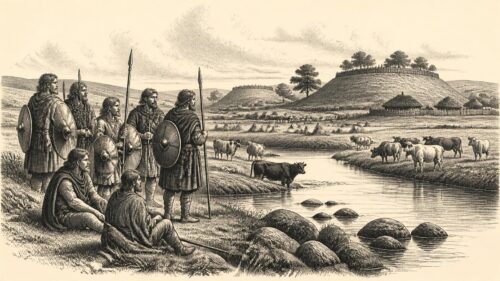
The clearest Irish event of 782 was a battle on the Curragh, the open limestone plain beside Kildare. On 27 August, according to the Annals of Ulster, Ruaidrí son of Fáelán defeated Bran son of Muiredach at Cuirrech, ‘in the vicinity of Cell Dara’. Two named opponents of Ruaidrí were killed: Mugrón son of Flann, king of Uí Fhailgi, and Dub dá Crích son of Laidcnén. Bran himself was captured. The entry is unusually precise for this period, preserving not only the place and participants but the Roman-calendar date and day of the week. It supplies a rare fixed point in a year otherwise recorded principally through deaths of ecclesiastics and one king’s decision to undertake pilgrimage.
A Battle Beside Kildare
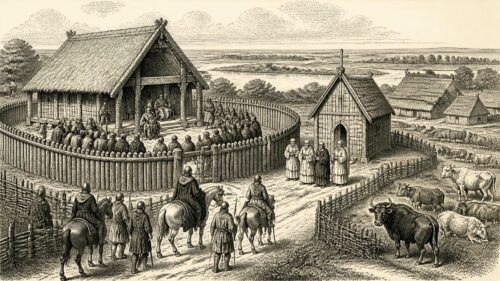
The battle was a contest within Leinster, not a clash between a unified Leinster and an external invader. Ruaidrí and Bran were first cousins from rival branches of the Uí Dúnlainge, the dynasty that supplied Leinster’s overkings. Ruaidrí was then the established leading king; Bran was an ambitious challenger whose family was centred around Máistiu, now Mullaghmast in southern County Kildare. Their rivalry must be understood against the pressure exerted by Donnchad Midi, king of Tara, whose Clann Cholmáin kindred dominated the midlands and sought influence in Leinster.
That political background does not make the outcome automatic. The annal names a substantial coalition against Ruaidrí. Mugrón was king of Uí Fhailgi, a powerful people of the west-Leinster and Offaly borderlands; Dub dá Crích belonged to the Leinster political world as well. Modern historical work identifies Bran’s support as including Uí Fhailgi and Uí Chennselaig interests. The engagement therefore drew together neighbouring rulers with their own claims, clients and local calculations. It was probably fought by relatively compact royal warbands and their followers, rather than by national armies in any modern sense, but its consequences could be severe for the families and districts involved.
The Curragh was a meaningful setting. Its broad, dry grassland was well suited to assembly, travel and fighting, while Kildare lay close enough to give the campaign a major ecclesiastical and political landmark. Yet the annal does not say that the monastery was attacked, that its clergy took sides, or that its lands were the immediate object of the dispute. Those would be tempting but unsupported additions. What can safely be said is that control and status in this part of Leinster were inseparable from proximity to important royal territories and to Kildare’s wealthy, prestigious church.
Ruaidrí won, and Bran was ‘led away captive’. Captivity was a political instrument: it removed a rival from the field, displayed victory, and created scope for negotiation, submission or ransom. The record does not state where Bran was held, how long he remained captive, or what settlement followed. Nor does it say that Ruaidrí thereby ended Leinster’s dynastic conflict. Indeed, later events show that the rivalry endured. For 782 itself, however, the result is plain: Ruaidrí retained the initiative, Bran’s alliance suffered fatal losses, and one of the principal challengers to Leinster’s kingship was in his victor’s hands.
Leinster and the King of Tara
The Curragh struggle unfolded in a Leinster already unsettled by intervention from the north. In 780 Donnchad Midi had campaigned against Ruaidrí and devastated the territories of Ruaidrí’s adherents. That earlier intervention provides essential context, but should not be mistaken for a campaign dated to 782. The surviving notice for this year records a fight between Leinster rivals, not an army of Tara on the field. Still, the wider relationship mattered. Bran was married to Eithne, Donnchad’s daughter, a connection that made the quarrel more than a merely local family affair and linked Leinster’s succession to midland power.
Early Irish kingship was layered. A ruler could be king of a people, a regional overking, a client or ally of a stronger king, and a competitor with close relatives at the same time. Allegiance was expressed through military service, hostages, marriages, tribute, protection and church patronage. The language of the annals can make this world appear as a parade of individual names and deaths. The battle of 782 instead reveals its practical workings: a disputed royal succession mobilised allied groups, cost the life of a neighbouring king, and was decided near one of Ireland’s foremost ecclesiastical centres.
Artgal’s Pilgrim Staff
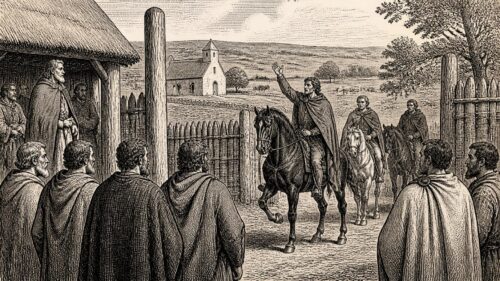
Far to the west, the annal records a different exercise of kingship. Artgal son of Cathal, king of Connacht, ‘took the pilgrim’s staff’, and was to make a pilgrimage in the following year to Í, the island now known as Iona. The act belongs firmly to 782; the actual journey is explicitly placed by the annalist in the year after it. This distinction matters. The entry documents Artgal’s adoption of the staff and declared pilgrimage, not his arrival on Iona during 782.
Iona lay off the western coast of what is now Scotland, but it was deeply connected to Ireland through the Columban community, seaways and learned networks. A Connacht king’s intended journey there shows that political authority and devotional travel could overlap. Pilgrimage was not necessarily a retreat from public life. It could proclaim penitence, seek spiritual protection, cultivate relationships with a celebrated church, or mark a change in a ruler’s position. The annal does not explain Artgal’s motive, so none should be imposed. Its importance lies in the public character of the act: the king’s religious commitment was significant enough to be entered among the year’s major events.
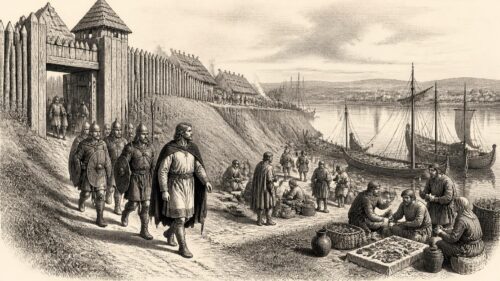
The notice also points to the practical world behind devotion. Travel from Connacht to Iona required access to coastal routes, vessels, crews, provisions and hospitable religious communities. Such movement was arduous and exposed to weather, but it was not extraordinary. Monasteries, kings and lay households participated in networks extending across the Irish Sea. In 782, therefore, the political map of Ireland should not be imagined as bounded by the island’s shoreline. The ecclesiastical connections of western rulers extended into a Gaelic maritime zone that included Iona.
A Year of Ecclesiastical Loss
The annal for 782 opens with a long sequence of deaths, many attached to monasteries across Ireland and the Irish Sea world. Cormac son of Bresal, abbot of Ardbraccan and other monastic communities, died. So did Muiredach son of Uargal, steward of Í; Scannal grandson of Tadc, abbot of Aghaboe, after forty-three years in office; Banbán of Clane; Aedán of Roscommon; Ultán, steward of Bangor; and Ferdomnach of Tuaim dá Gualann, among others. These notices do not prove a general mortality crisis: medieval annals often cluster obits because they preserve information valued by particular ecclesiastical networks. They do, however, show the geographical breadth and administrative density of the church.
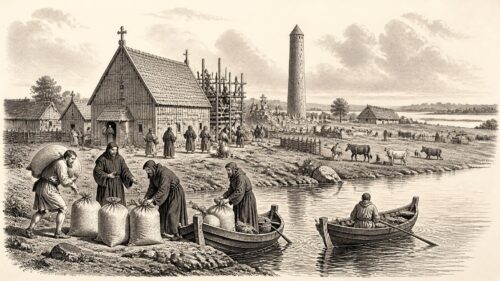
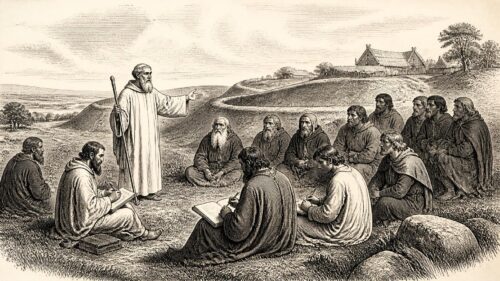
The titles are revealing. An abbot was not simply the head of a secluded body of monks. At major Irish foundations, abbots stood at the centre of communities containing clergy, dependants, tenants, craftsmen and visitors, with interests in land, livestock, hospitality and learning. A steward, or oeconomus, managed material affairs. The deaths of stewards at Iona and Bangor therefore mattered alongside those of abbots: religious institutions depended upon organised household management as well as prayer and scholarship.
Scannal’s forty-three-year tenure at Aghaboe hints at continuity beneath the year’s change. Long office-holding could make an abbot a durable political figure, while an obit created an occasion for succession and potential competition. Yet the annal does not name Scannal’s successor or describe any dispute. Likewise, the list records the deaths of churchmen but not the responses of their communities: the funeral rites, selection of new leaders, redistribution of responsibilities and prayers for the dead remain beyond the evidence.
Kildare’s Institutional Weight
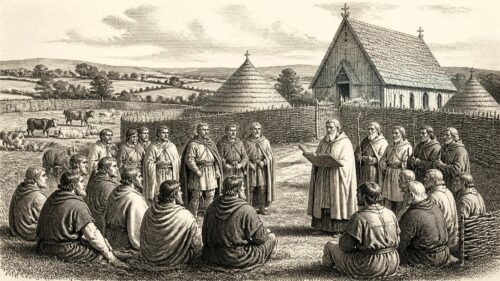
Kildare’s prominence appears in both the battlefield notice and the wider ecclesiastical record preserved in later annalistic traditions. It was among the great religious centres of eighth-century Ireland, a community associated with Brigit, royal patrons and extensive local influence. Such centres were not towns in the later medieval sense, but they drew people, goods, labour and authority into enclosed settlements of churches, dwellings, workshops, fields and grazing land. Their clerics were literate custodians of books, genealogies, law and memory; their households were also economic institutions rooted in the countryside.
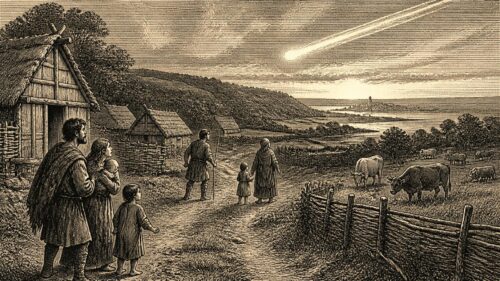
For most people, life in 782 was lived not in royal confrontations but in dispersed farming settlements. Cattle had central economic and social value, while arable cultivation, dairying, seasonal labour, fishing, craft production and obligations to lords or churches structured everyday routines. Archaeology and early Irish legal material illuminate this broader setting, but they do not permit a diary of one particular household in this year. The battle on the Curragh and Artgal’s planned pilgrimage touched this rural society through demands for food, transport, labour and military followings, even where the sources do not record those burdens directly.
Dating the Evidence Carefully
782 illustrates why the Irish annals must be read with attention to their compilation and chronology. The Annals of Ulster preserve the Curragh battle, Artgal’s taking of the staff and the ecclesiastical obits under this year. The seventeenth-century Annals of the Four Masters transmit related material, but their chronological headings for this stretch of the eighth century are offset: entries placed under 777 are identified in the modern edition as ‘recte 782’, while material placed under their 782 belongs five years later. Their apparent 782 notices must therefore not be treated as events of 782 CE.
Read carefully, the evidence gives the year a distinct character. At the Curragh, Ruaidrí’s victory and Bran’s capture exposed the contested foundations of Leinster rule. In Connacht, Artgal’s taking of the pilgrim staff connected kingship with Iona and the sea. Across the country, the deaths of abbots and stewards marked turnover in institutions that were religious communities, centres of learning and major landed households. The annals do not offer a complete portrait of Ireland in 782. They do preserve enough to show a society in which dynastic conflict, monastic administration and long-distance religious connections were tightly entwined.
Primary Sources
- The Annals of Ulster: Year U782
- Annals of the Four Masters: Annals M777–M786
- Bran Ardchenn
- Donnchad Midi
- Fínshnechtae Cetharderc
- Fáelán
- Exploring the Irish Annals
- Monasteries
- Early Christian Monasteries
- Patrician and Early Christian Architecture
- Early Irish Monasticism
- Early Monastic Churches
- Saints and Halls
- High Crosses
- Brigit: The Goddess and The Saint
- Christian Ireland 5th–8th Centuries
- Early Medieval Dwellings and Settlements in Ireland, AD 400–1100: Vol. 1 Text
- The Economy of Early Medieval Ireland
- Early Medieval Ireland: Archaeological Excavations 1930–2009
- Historical Truth or Literary Embellishment? Uncovering the Voices of Historical Queens in Medieval Irish Sources