Tuathal of Uí Muiredaig958 CE
Dateline
In 958, Ireland’s annalists recorded no single battle that reordered the island, no spectacular raid on a famous monastery, and no weather disaster on the scale sometimes preserved in their terse notices. Yet the year mattered. It marked the death of Tuathal son of Augaire, overking of Leinster, at a moment when authority in the province was being contested between rival Irish dynasties and negotiated under the shadow of Viking Dublin. It also brought a cluster of deaths among abbots, bishops and church administrators. Taken together, these entries reveal an Ireland in which political succession, ecclesiastical office and regional power were closely entwined.
A Firmly Dated Death
The death of Tuathal son of Augaire is securely assigned to 958 by the Annals of Ulster, Chronicon Scotorum and the Annals of Inisfallen. The Ulster annalist calls him rí Laigen, king of Leinster. This did not mean that he governed a unified state in the modern sense. Leinster contained numerous lesser kingdoms and powerful kindreds, while its leading dynasties competed for provincial precedence. Still, the title indicates that Tuathal had attained the highest available rank within the province, and his death opened a consequential vacancy.
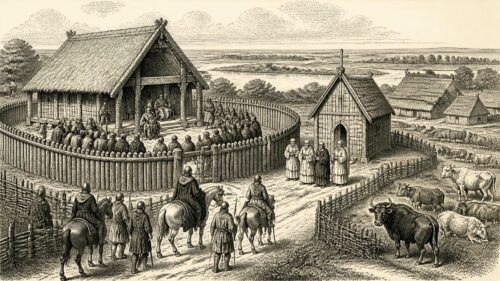
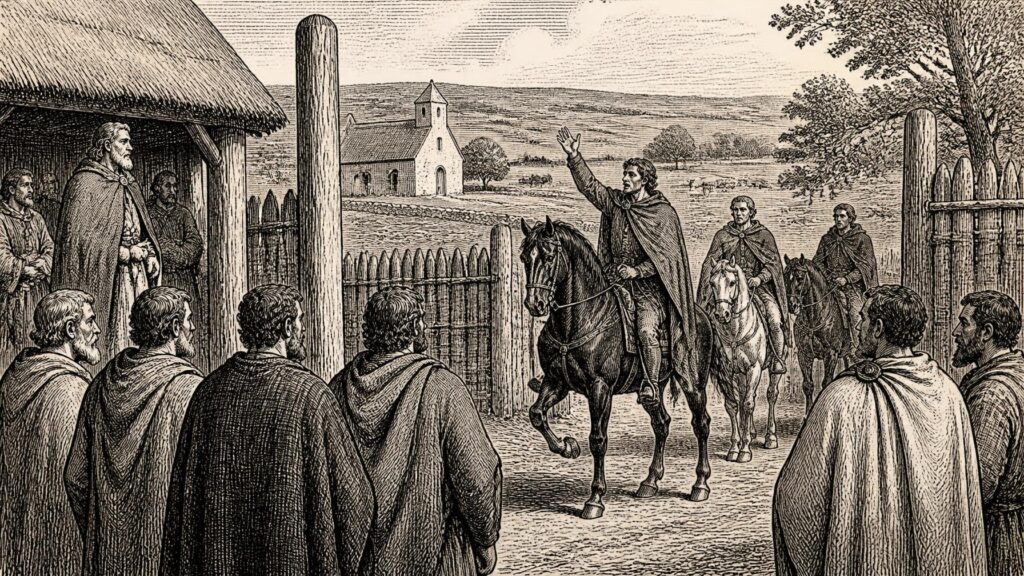
Tuathal belonged to Uí Muiredaig, a branch of the Uí Dúnlainge, the dynasty that dominated Leinster’s overkingship for generations. Its principal territories lay in the northern and central parts of the province, especially in the region later associated with County Kildare. Uí Dúnlainge politics did not rest on automatic inheritance by the eldest son. Different branches of the wider dynasty could compete, and a capable adult kinsman might displace a son or brother. The passing of an overking was therefore a moment of danger as well as ceremony: it invited bargaining, alliance-making and, if agreement failed, violence.
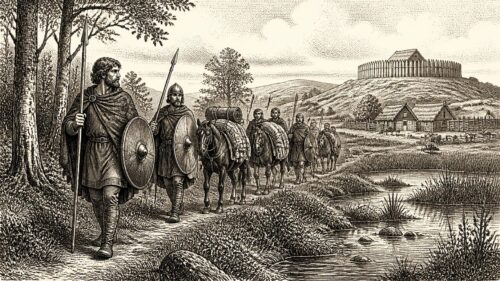
Tuathal’s career helps explain why his death was important. During the 930s and 950s he had helped make Uí Muiredaig a serious force in Leinster. His interests collided with Uí Chennselaig in the south-east, with rival Uí Dúnlainge kindreds, and with the political reach of Dublin. Earlier campaigns associated with him included attacks on Osraige and Uí Chennselaig. By 957, the year immediately before his death, he had defeated the king of Uí Chennselaig in Leinster. That was not a permanent settlement, but it shows that the provincial kingship depended on practical military power, not merely pedigree.
Leinster Between Dublin and Its Rivals
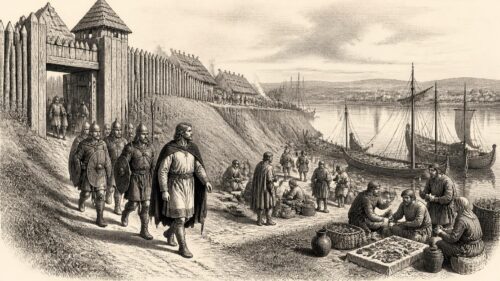
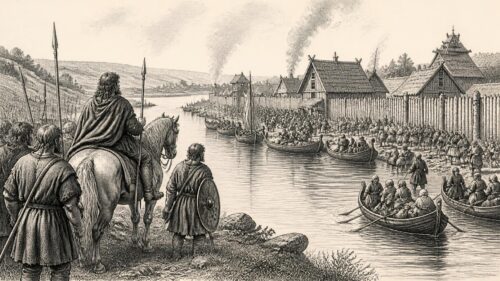
The strategic problem facing a Leinster ruler in 958 was sharpened by the proximity of Dublin. The Hiberno-Scandinavian town was neither simply a foreign camp nor an isolated coastal enclave. It was a maritime trading centre, a royal base and a military power linked to the Irish Sea world. Its rulers could make alliances with Irish kings, support one Leinster faction against another, and draw supplies, tribute and captives from the surrounding countryside. Dublin’s political influence was particularly strong in northern Leinster, where its commercial and military networks met inland routes.
Amlaíb Cuarán had returned to Dublin in 952 and was an established force by 958. Two years earlier, in 956, his forces and Leinster allies had killed Congalach Cnogba, the king of Tara, at Tech Giugrann near Dublin. That killing had removed a ruler who had sought authority over Leinster and had intervened conspicuously in its affairs. It also left Domnall Ua Néill of Cenél nÉogain in a stronger position to claim the wider Uí Néill supremacy. Thus Tuathal’s death occurred amid a reordering of power that extended far beyond Leinster: Dublin remained formidable, but no single ruler controlled the island.
It is tempting to attach every recorded movement of kings in these years to Tuathal’s death. The evidence does not allow that. A later annalistic compilation, the Annals of the Four Masters, places an expedition by Domnall Ua Néill into Dál Araide and the taking of hostages in 958. The earlier Annals of Ulster, however, places the corresponding notice under its entry for 960. This chronological disagreement makes it unsafe to present the expedition as a firmly dated event of the calendar year 958. What can responsibly be said is that Domnall’s new regime was beginning to press its authority across the north and midlands in this period, while Leinster faced its own succession.
Tuathal’s immediate successor was Cellach son of Fáelán of Uí Dúnchada, another Uí Dúnlainge branch. His accession demonstrates that Tuathal’s sons did not simply inherit the overkingship in 958. Nevertheless, Tuathal’s descendants remained prominent. His son Dúnlaing would later become king of Leinster, while another line descending from the family took the name Uí Thuathail, remembered in the modern surname O’Toole. The succession of 958 was therefore a setback for Tuathal’s immediate household, not the end of its political importance.
Bangor and the Vulnerability of Churches
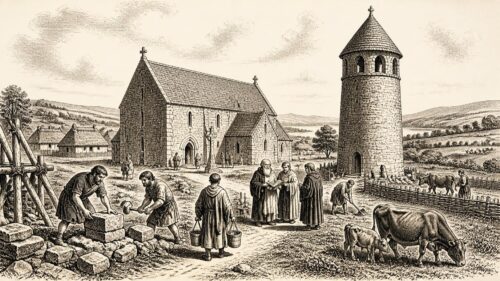
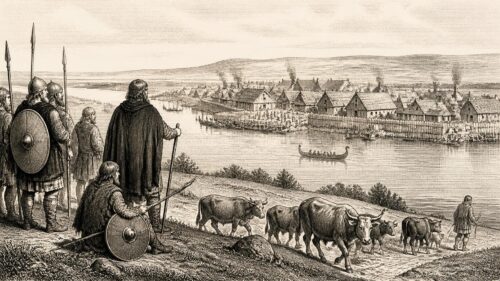
The year’s sharpest note of violence concerns Tanaide son of Odar, the comarba, or successor, of Comgall at Bangor. The Annals of Ulster and Chronicon Scotorum agree that he was killed by the Gall, the foreigners: in this context, Scandinavian or Hiberno-Scandinavian warriors. Bangor, on the south shore of Belfast Lough, was an old and prestigious monastic foundation associated with St Comgall. Its head was not merely a secluded religious superior. He stood within a network of landholding, learning, clientship and political protection.
The annal does not say where or how Tanaide was killed, nor whether Bangor itself was attacked. Those silences matter. It would be wrong to turn one brief notice into an imagined sack of the monastery. But the killing is still revealing. Churchmen of high rank travelled, administered estates, received guests and dealt with secular rulers; they could be caught in the violence generated by maritime raiding and regional rivalry. The distinction often made between “church” and “world” is too stark for tenth-century Ireland. Ecclesiastical communities possessed wealth and depended upon patrons, while kings sought their prestige, prayers and administrative skills.
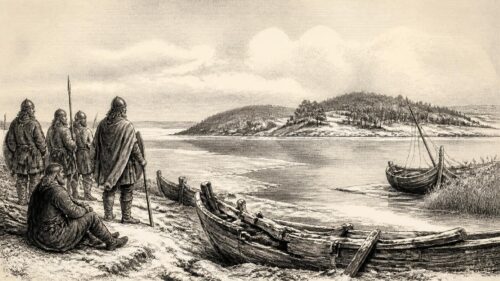
Bangor’s location also made it exposed to movement through the northern Irish Sea. Belfast Lough connected the monastery to coastal routes reaching the Ulaid, Dál Araide, Man, western Scotland and the wider Scandinavian world. Such waterways could carry merchants, pilgrims and learned travellers, but they also allowed armed bands to strike quickly. Tanaide’s death is a small but concrete reminder that sea power shaped life beyond the better-known port of Dublin.
A Year of Ecclesiastical Change
Several other deaths recorded in 958 show how extensively churches were embedded in regional society. The Annals of Ulster note Flann son of Mochloingse, successor of Tigernach and Máel Doid; Lugaid son of Colgu, superior of Slane, who died “in penitence”; and Fínnechta son of Lachtna, superior of Ferns. The phrase “in penitence” signals an ideal Christian ending rather than providing biographical detail. It suggests the continuing importance of confession, ascetic preparation and reconciliation at death among elite clerics.
Slane and Ferns were particularly meaningful places in the ecclesiastical geography of eastern Ireland. Slane, in the Boyne valley, held associations with Patrick and stood near the contested political landscapes of Brega and Meath. Ferns was a major centre in south-east Leinster, closely connected with the territory of Uí Chennselaig. The death of its superior in the same year as Tuathal’s is not proof of a coordinated crisis, but it meant that political and ecclesiastical leadership were changing simultaneously in a province where monasteries could be allies, landholders and centres of memory.
The Munster-based Annals of Inisfallen add further notices: Domnall son of Aengus, king of Uí Echach, died; Cinaed Ua Con Minn, bishop of Lismore and Inis Cathaig, died; and Áed son of Cellach, abbot of Clonfert, died. These entries illuminate different Irish regions. Lismore in the south-east of Munster, Inis Cathaig at Scattery Island in the Shannon estuary, and Clonfert on the Shannon’s eastern side all belonged to religious landscapes sustained by agriculture, waterways, hospitality and patronage. Their leaders’ deaths did not necessarily interrupt daily worship or farming, but each required a succession within communities whose resources and connections mattered to neighbouring rulers.
Learning, Poets and What the Annals Preserve
The Annals of the Four Masters, compiled many centuries later from earlier materials, also credits 958 with the deaths of Faifne, chief poet of Leinster, and Fínshnechta Ua Cuill, poet of Munster. These notices are valuable evidence for the prestige of professional learning, though the later compilation must be treated cautiously when assigning events to an exact year. Poets in elite society were not entertainers alone. They preserved genealogies, composed praise and satire, advised patrons, and helped articulate the claims of dynasties. Their commemoration alongside kings and abbots shows that learned status could be politically significant.
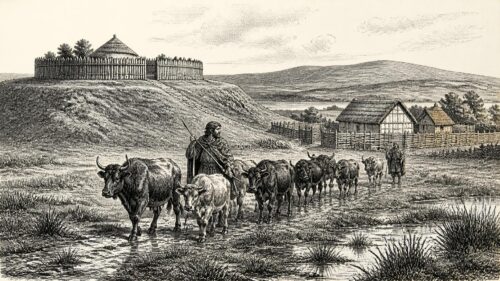
For most people, however, 958 would have been experienced through the recurring demands of pastoral and arable work, rents and food renders, obligations to local lords, and participation in church festivals and markets. The annals rarely record such routines because their purpose was to remember deaths, raids, successions and extraordinary events. Yet the offices named in their entries depended on ordinary production: cattle, grain, dairy goods, labour, boats and the work of tenants on church and royal lands. The political changes of 958 mattered because they affected who could demand those resources and offer protection in return.
An Uneventful Year That Was Not Quiet
There is no responsible basis for claiming that 958 was a year of general peace. Tanaide’s killing alone disproves that. Equally, there is no evidence for an island-wide war. The surviving record instead captures a series of local but important transitions: an overking of Leinster died; a leading Bangor churchman was killed by Scandinavians; senior figures at Slane, Ferns, Lismore, Inis Cathaig and Clonfert passed from the scene; and the political order created by the deaths of Congalach in 956 and Tuathal in 958 was still unsettled.
Tuathal’s death is the year’s central event because it exposed the fragility of Leinster’s balance of power. His achievement had been to strengthen Uí Muiredaig amid rival dynasties and the influence of Dublin. His replacement by a rival branch underlines the limits of any one ruler’s control. In 958, Ireland was not moving through a simple contest between Irish and Viking worlds. It was a connected, competitive landscape in which Irish kings, Dublin rulers, ecclesiastical communities and learned families all pursued security, status and influence. The surviving notices are brief, but they preserve a year when that landscape changed hands in several crucial places.
Primary Sources
- The Annals of Ulster, U958 (Irish text)
- The Annals of Ulster, U955–U962 entries
- Chronicon Scotorum, Annal CS958 (Irish text)
- Chronicon Scotorum, English translation
- Chronicon Scotorum, CELT document details
- Annals of Inisfallen, Annal AI958
- Annals of Inisfallen, CELT edition details
- Annals of the Four Masters, Annal M958
- Annals of the Four Masters, Volume 2
- Tuathal, Dictionary of Irish Biography
- Dúnlaing, Dictionary of Irish Biography
- Ua Néill, Domnall, Dictionary of Irish Biography
- Amlaíb (Óláfr) Cuarán, Dictionary of Irish Biography
- Congalach Cnogba, Dictionary of Irish Biography
- Cellachán Caisil, Dictionary of Irish Biography
- Muirchertach na Cochall Craicinn, Dictionary of Irish Biography
- Donnchad Donn, Dictionary of Irish Biography
- Fragmentary Annals of Ireland, CELT document details
- Fragmentary Annals of Ireland, manuscript history
- CELT List of Published Texts
- Irish Texts at CELT