Rechtabra and Eógan876 CE
In 876, the Annals of Inisfallen record the deaths of Rechtabra son of Bran, king of Leinster, and Eógan, abbot of Clonmacnoise. Rechtabra’s death potentially unsettled Leinster’s contested kingship, where succession depended upon kinship, alliances and support rather than primogeniture. Eógan’s death affected a major church whose religious, economic and political influence extended across Ireland. Rural production, estate obligations and riverine communications nevertheless continued. Uncertain Annals of Ulster notices, conventionally placed in 877 but internally dated 876, describe Rhodri of Gwynedd’s flight to Ireland and Scandinavian conflict at Strangford Lough. Records portray institutional transition within a changing Irish Sea world.
Dateline
A Sparse but Significant Record
The surviving evidence for 876 CE in Ireland is unusually brief. That is not evidence that the year was peaceful, uneventful or unimportant; rather, it is a reminder that early medieval annals preserve selected notices, chiefly deaths, accessions, violence, ecclesiastical changes and occurrences judged memorable by their compilers. For this year, the Annals of Inisfallen record two firmly placed Irish deaths: Rechtabra son of Bran, described as king of Leinster, and Eógan, abbot of Clonmacnoise. Each notice occupies only a line, but together they illuminate two central pillars of ninth-century Irish life: regional kingship and the great monastic churches.
The same period also demonstrates why dates require care. The Annals of Ulster preserve a cluster of notices under their year-number 877, while their internal chronological heading identifies the year as AD 876. Modern historians often cite these events under 877, owing to known discrepancies in annalistic year-reckoning. They include the flight to Ireland of Rhodri son of Merfyn, king of the Britons, and a clash at Loch Cuan, Strangford Lough, between rival Scandinavian groups. These are closely connected to the 876–77 annalistic horizon, but cannot safely be presented as securely dated to the calendar year 876 alone. The death notices in the Inisfallen sequence provide the clearest fixed basis for this year’s Irish account.
A King of Leinster Dies
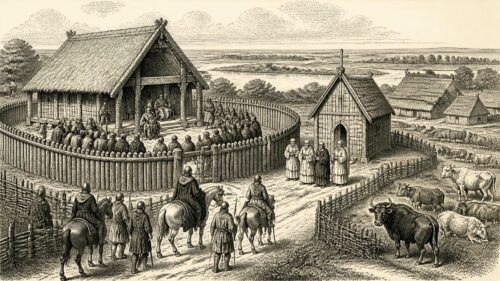
The death of Rechtabra son of Bran is the principal political notice. The annalist calls him rí Laigen, king of Leinster. That title mattered. Leinster was not a compact state with a single administrative centre, but a large and contested eastern province composed of numerous lesser lordships, ecclesiastical estates and kin-groups. A ruler acknowledged as king of Leinster stood above a hierarchy of local kings, yet his authority depended on alliances, tribute, military followings and the willingness of subordinate rulers to accept his precedence.
Nothing in the surviving entry tells us how Rechtabra died, how long he had ruled, where he was buried, or who immediately succeeded him. It would be irresponsible to supply any of those details. Even the relationship between notices in adjacent years must be handled cautiously. The Annals of Inisfallen state that Muiredach son of Bran, also styled king of Leinster, raided the Uí Néill as far as Sliab Fuait in 875. In 876 they report Rechtabra son of Bran’s death. The shared patronymic may indicate a family connection, perhaps brothers, but the annals do not explain the political relationship between the two men. In a landscape where kingship could be shared, disputed or transferred rapidly among close relatives, the title is more secure than any reconstructed family narrative.
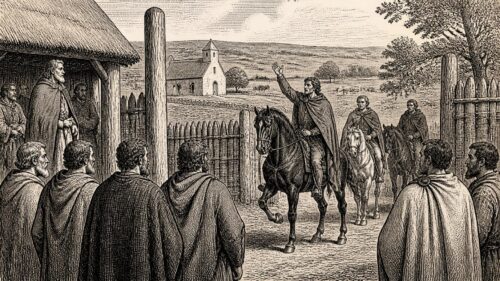
Nevertheless, Rechtabra’s death marks a real moment of uncertainty in the eastern province. A king’s passing could unsettle the balances that held a regional polity together. It created an opening for rivals, for neighbouring dynasties, and for ambitious local rulers who might renegotiate their obligations. Royal succession was not governed by simple primogeniture. Eligible men of a ruling kindred could compete, and a successor needed both pedigree and practical support. The immediate human consequences reached well beyond elite households: military clients, church dependants, food-rent collectors, tenants and allied communities all had reason to watch a succession closely.
Leinster’s position made its politics especially consequential. Its plains and river valleys contained valuable agricultural land; its eastern coast faced the Irish Sea; and its rulers stood between the southern Uí Néill heartlands and Munster, while also dealing with Scandinavian power centred on Dublin. By 876, Vikings were not merely occasional raiders on the horizon. Scandinavian groups had established durable bases and participated in Irish and British political networks. Yet no source records a Viking attack on Leinster specifically in this calendar year. The responsible conclusion is narrower: Rechtabra died at a time when Leinster’s succession and security had to be managed within a changing Irish Sea world.
Clonmacnoise Loses an Abbot
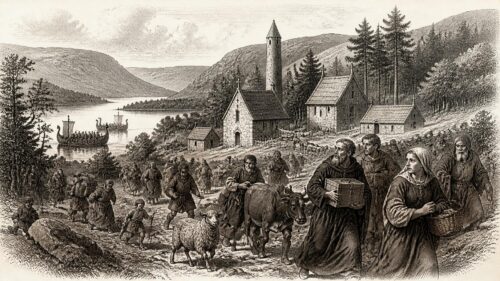
The year’s second securely dated notice is the repose of Eógan, abbot of Cluain Moccu Nóis, Clonmacnoise. The word “repose” is conventional Christian annalistic language for death, but it also locates Eógan within a community whose religious authority was inseparable from its social and economic importance. Clonmacnoise stood on the River Shannon, near a major crossing and at the meeting zone of Connacht and Mide. Its position gave it access to waterborne traffic and overland routes, making it one of the best-connected ecclesiastical settlements in Ireland.
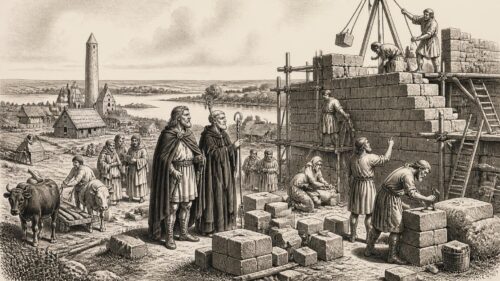
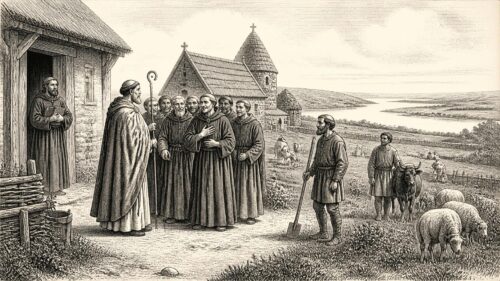
An abbot in ninth-century Ireland was much more than the resident head of worship. Major churches held land, received food-renders and gifts, maintained households of clerics and workers, and were deeply entangled with royal families. Their churches, shrines, books, graveyards, workshops and guest facilities made them centres of devotion, learning, craftsmanship and exchange. The evidence does not permit a detailed biography of Eógan or a description of his particular achievements. It does, however, show the institutional scale behind the bare title “abbot”. His death concerned a community which had influence far beyond its enclosure.
Clonmacnoise had endured earlier ninth-century violence and political pressure, as had many great Irish churches. Such centres could be targeted because they concentrated portable wealth, livestock, food stores, captives and prestige objects, but they also retained value as places where rulers sought legitimacy, burial and commemoration. The loss of an abbot therefore raised practical questions: who would direct the community, control its resources, represent its interests before kings, and preserve relationships with its patrons? Annals often record such changes because they were public matters, not merely private bereavements.
The Annals of Ulster, in its chronologically troublesome 876/77 section, names Eógan alongside Máel Túile grandson of Cúanu as two abbots of Clonmacnoise who “fell asleep in peace”. The agreement that Eógan died is valuable corroboration, even though the phrasing and chronological framework differ. It also suggests that abbacy at a major church cannot automatically be imagined as a single, uncomplicated office. Irish ecclesiastical institutions could have coexisting senior figures, affiliated churches, hereditary interests and overlapping ranks. Rather than forcing modern administrative neatness onto the evidence, the notices reveal a complex church polity whose leading personnel were important enough to enter more than one annalistic tradition.
Work, Land and Everyday Continuity
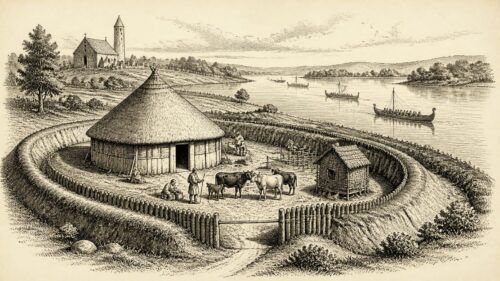
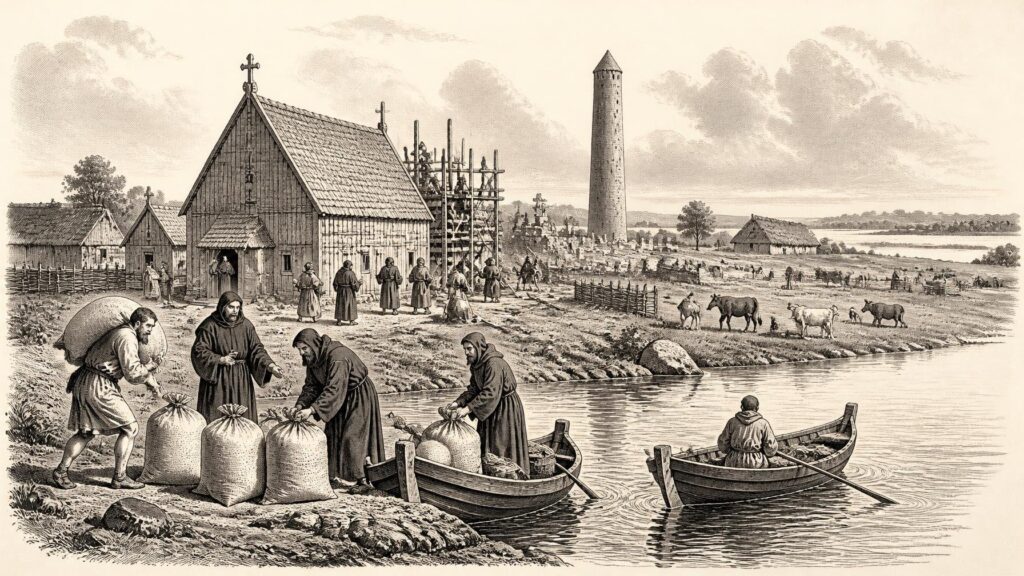
Neither annal describes ordinary life in 876, but archaeology and early Irish documentary evidence provide a cautious setting. Most people lived in a predominantly rural Ireland of dispersed farmsteads, enclosed settlements, fields, pasture and routes linking territories. Cattle remained a principal measure of wealth and a source of dairy produce, while arable cultivation was increasingly significant. Grain required labour for sowing, harvesting, drying, milling and storage; livestock required herding, dairying, fencing and seasonal movement. These routines did not stop because a king or abbot died, although political instability could alter demands for food-renders, military service and hospitality.
Churches such as Clonmacnoise participated in this agricultural world rather than standing apart from it. Their communities relied on estates and dependants, and their riverside locations enabled movement of people and goods. The Shannon was a corridor through the island, not an empty boundary. Boats, messengers, pilgrims, ecclesiastics, craftsmen and armed parties could all use its waters. That geography helps explain why Clonmacnoise was repeatedly relevant to wider politics, while also remaining a place of prayer, burial, teaching and local work.
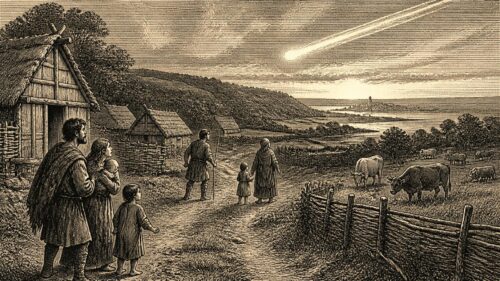
There is no securely dated evidence for a famine, epidemic, exceptional weather event or island-wide economic crisis in 876. The absence matters. It means the year should not be made dramatic simply because the ninth century is associated with Viking raids and political conflict. For many households, the agricultural calendar, local obligations and kinship ties continued as normal, even while elite transitions in Leinster and at Clonmacnoise could reshape the networks on which communities depended.
An Irish Sea Horizon
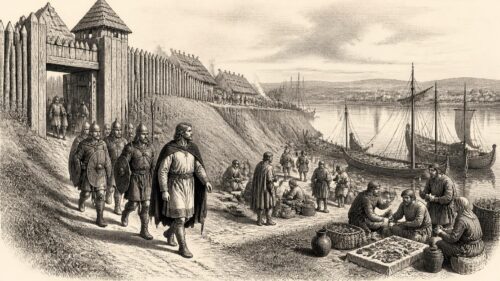
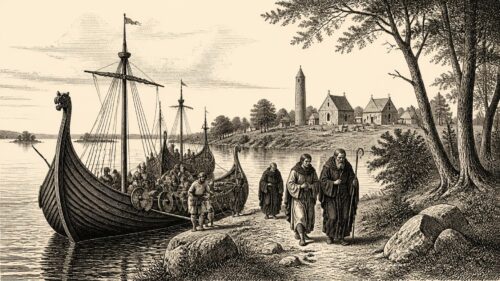
The uncertain 876/77 notices in the Annals of Ulster nevertheless reveal the wider horizon against which Irish affairs unfolded. Rhodri of Gwynedd, called “king of the Britons” by the Irish annalist, is said to have come to Ireland fleeing the “dark foreigners”. This was not a migration of an anonymous population but a politically charged refuge involving a major British ruler. It shows that the sea between Ireland and Wales was a route of contact, escape and diplomacy as well as danger.
The same annalistic cluster reports fighting at Loch Cuan between “fair” and “dark” heathens, in which Albann, leader of the latter, fell. These colour labels are annalistic categories, not reliable modern ethnic descriptions, and they should not be turned into simple national identities. What can safely be said is that Scandinavian groups operating around Ireland were divided and capable of fighting one another. Irish kings and churches therefore faced not one uniform Viking force, but shifting groups with competing leaders and interests.
For 876 itself, the safest historical picture is consequently one of transition rather than spectacle. Leinster lost a king; Clonmacnoise lost an abbot; and the Irish Sea region was being reshaped by mobile rulers and rival Scandinavian forces. The annals leave much unsaid, but their silences are instructive. They direct attention away from invented battles and towards the institutions that made early medieval Ireland durable: provincial kingship, great churches, rural production, riverine communication and the constantly renegotiated bonds between them.
Primary Sources
- Annals of Inisfallen, AI870–AI891
- Annals of Inisfallen
- The Annals of Ulster, U877
- The Annals of Ulster, U878
- Chronicon Scotorum
- Annals of the Four Masters, M875–M876
- Vikings in Irish Chronicles, 794–902: Data
- Exploring the Irish Annals
- The Construction of the Irish Annals, 429–466
- The Irish Annals
- Clonmacnoise, County Offaly
- The Viking Age in Ireland
- The Vikings in Ninth-Century Ireland: Sources and Settlements
- Agriculture, Settlement and Society in Early Medieval Ireland
- The Economy of Early Medieval Ireland
- Early Medieval Ireland, AD 400–1100: The Evidence from Archaeological Excavations
- Early Medieval Ireland: Archaeological Excavations, 1930–2009
- Early Medieval Archaeology Project
- Ireland in the Middle Ages
- Áed Findliath
- Rhodri Mawr (‘the Great’)
- Vikings in Ireland and Scotland
- The Annals of Inisfallen to Go on Public Display in University College Cork