Carn Fiachach and Bread765 CE
Recorded conventionally under 765, though Ulster’s chronology suggests 764, the year combined dynastic conflict, food insecurity and ecclesiastical change. At Carn Fiachach near Uisnech, Donnchad son of Domnall Midi defeated his brother Murchad, who was killed; Murchad’s ally Ailgel of Tethbae fled, strengthening Donnchad’s position in Mide. Annals also noted a shortage of bread, probably reflecting grain supplies, without proving a nationwide famine. Deaths included abbots and churchmen at Birr, Clonard, Clonbroney and Ard Braccan, kings in southern and eastern kingdoms, and retired Tara king Flaithbertach at Armagh. Together, these notices reveal Ireland’s fragmented politics, powerful churches and precarious subsistence.
Dateline
The evidence conventionally associated with 765 is unusually rich in its combination of dynastic violence, hunger and ecclesiastical deaths. It also requires a caution about dates. The Annals of Tigernach group these notices under 765, and modern reference works commonly date both the death of Flaithbertach son of Loingsech and the battle of Carn Fiachach to 765. In the surviving Annals of Ulster, however, the corresponding annal-number is U765 but its internal heading gives AD 764. Such one-year divergences are a familiar problem in early Irish annalistic chronology. The events belong securely to this narrow mid-760s sequence; for the purposes of this year, they are treated as 765 while the uncertainty is kept in view.
A Battle for Midland Rule
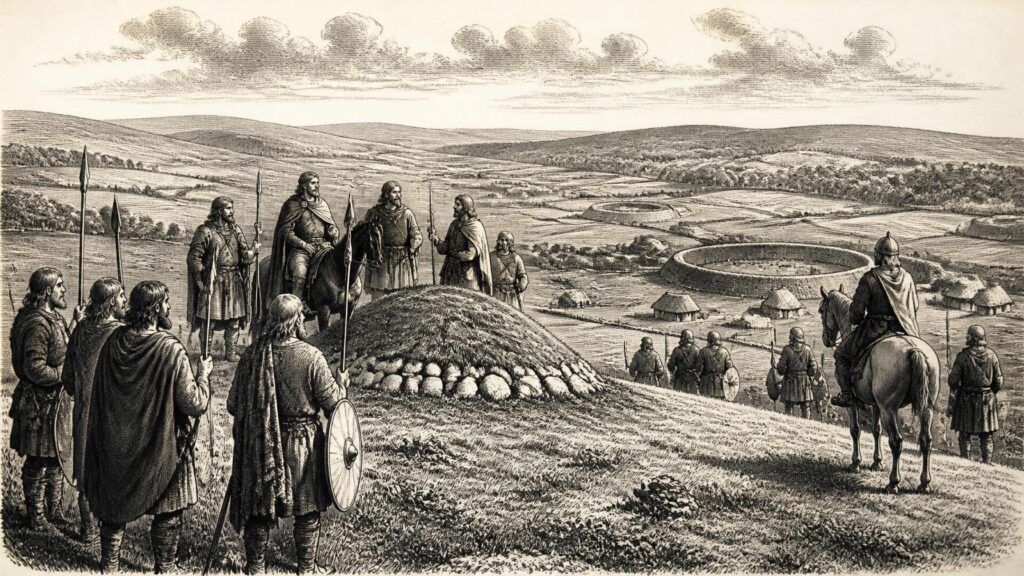
The most consequential recorded event was the battle of Carn Fiachach, fought between Donnchad and Murchad, sons of Domnall Midi. Domnall had been a leading king of Clann Cholmáin, the dominant southern branch of the Uí Néill, and had died only a few years earlier. His death left the kingship of Mide—and with it access to the political heartland around Uisnech and Tara—open to competition within his own family.
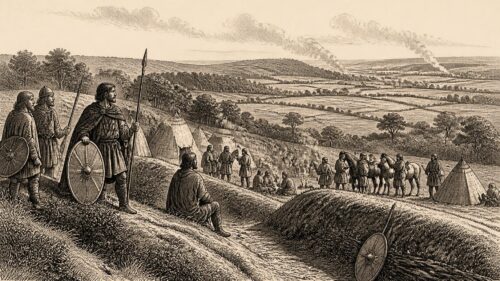
The annals are terse but unusually informative about alliances. Fallomon son of Cú Chongalt fought with Donnchad; Ailgel, king of Tethbae, supported Murchad. Murchad was killed, and Ailgel was put to flight. This was not simply a private quarrel between brothers. The intervention of the king of Tethbae, a territory west and north-west of the central plain, shows that the succession in Mide mattered to neighbouring rulers. Fallomon’s support was equally significant: he was himself a powerful figure in Mide. The battle was therefore a contest over the practical business of lordship—commanding followers, drawing in allied kings, and controlling the routes and client territories of the midlands.
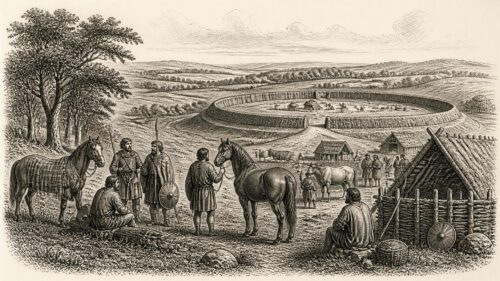
Carn Fiachach is generally identified with a place near present-day Rathconrath in County Westmeath, on the southern side of the wider Uisnech landscape. The identification is not absolute, but it is persuasive enough to make the setting meaningful. This was country close to the symbolic and political centre of southern Uí Néill power. A victory there did not automatically confer the kingship of Tara, nor did Ireland possess a single state with a settled law of succession. Yet it strengthened Donnchad’s claim to lead Clann Cholmáin and to exercise authority in Mide. Later developments make clear how important that advantage was: Donnchad Midi became one of the most formidable Irish kings of the later eighth century.
The battle also reveals the human cost hidden within formulaic annal entries. Murchad’s death removed one claimant by force. Ailgel’s flight meant the defeat of a regional king and the dispersal of his following. Men whose names never reached the chronicle would have carried weapons, guarded roads and cattle, supplied food, and borne the risks of a campaign. The annals do not describe the fighting, the season or the numbers involved. It would be wrong to invent them. But their wording leaves no doubt that political succession could be decided by armed confrontation in a landscape of local strongholds, church lands and cultivated fields.
A Shortage of Bread
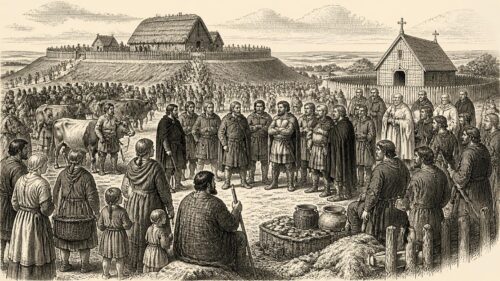
Beside the battle, the Annals of Tigernach record defectio panis: a shortage or failure of bread. The compact Latin phrase does not permit a precise diagnosis. It does not tell us whether the difficulty was island-wide, how long it lasted, whether it followed a poor harvest, or how many people died. It should not automatically be expanded into a full national famine. Nevertheless, it is among the year’s most important notices because grain food was central to security, status and everyday survival.
Archaeobotanical research shows that oats and hulled barley were the dominant cereals at many early medieval Irish sites; wheat was present but usually less prominent. Grain could become porridge, gruel, ale and several kinds of bread. Its availability was socially uneven. Legal and literary evidence associates superior wheat bread with high rank, while oats were linked more closely with commoners, and monasteries were substantial consumers as well as producers of cereal foods. Thus a recorded shortage of bread concerned far more than a single meal. It threatened household stores, hospitality, rents rendered in food, obligations to lords, and the capacity of religious communities to feed their members and visitors.
The notice belongs in a troubling environmental sequence, though causation cannot be proved. Entries immediately preceding it in the annalistic tradition report extraordinary snow, drought and sickness or bloody flux. Modern archaeological and environmental syntheses likewise identify the later eighth century as a period in which harsh winters and difficult growing conditions could make agricultural communities vulnerable. A shortage recorded in 765 may have reflected the accumulated effects of weather and depleted reserves; it may also have been regional. The sources do not allow a firmer conclusion.
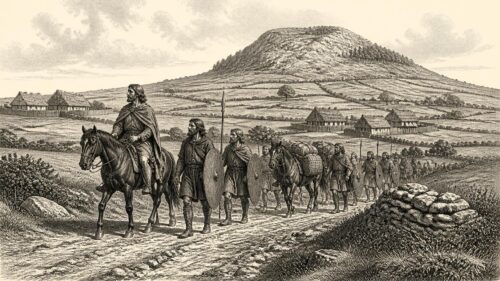
What can responsibly be said is that food insecurity formed the background against which political action took place. A king’s ability to gather a force depended on provisions; a monastery’s standing rested partly on its resources and hospitality; ordinary households relied on a narrow margin between one harvest and the next. The battle at Carn Fiachach and the shortage of bread should not be forced into a direct causal relationship, but together they convey a year in which the demands of power met the fragility of subsistence.
Abbeys, Churches and Local Authority
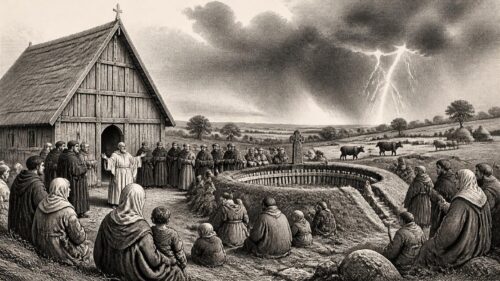
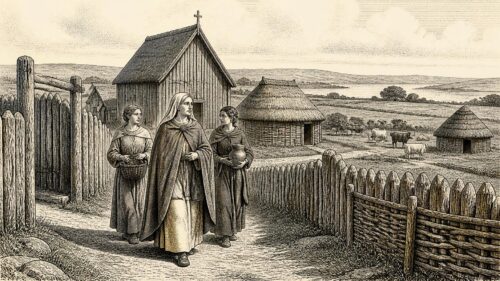
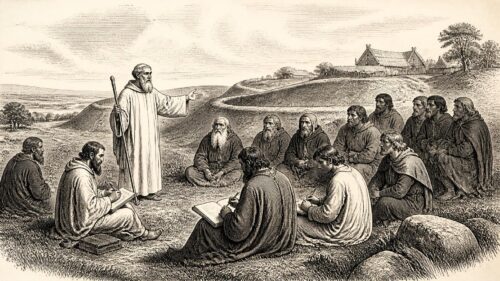
The year’s obituary notices display the density of Ireland’s ecclesiastical landscape. Folachtach, abbot of Birr, died; Loarn, abbot of Clonard, “rested”; Cellbile of Clonbroney died; and Tóla of Ard Braccan was commemorated. The language of repose or rest is Christian and deliberately honourable, but these were not merely private devotional figures. Major churches were centres of worship, learning, burial, landholding and political connection. Their superiors managed communities, estates and relationships with secular patrons.
Birr, in what is now County Offaly, already had a long-established monastic tradition. Clonard, in modern County Meath, was an important ecclesiastical centre within the contested midland world. Ard Braccan stood in Brega, east of Mide, while Clonbroney lay in the broader Tethbae region. Read together, these notices trace a connected zone running through the centre and east of the island—the same broad political world in which Donnchad, Murchad, Fallomon and Ailgel sought advantage.
It is tempting to describe churches as neutral refuges from warfare. The evidence does not support such a simple contrast. Religious institutions possessed wealth, dependants and prestige; kings sought their support, and disputes over their leadership could have political consequences. Yet the repeated recording of abbots and holy men also shows what the annalists regarded as worthy of public memory. A ruler’s death, a battle, a food shortage and an abbot’s passing belonged in the same annual record. For contemporaries, the welfare of a church community was part of the welfare of the kingdom.
Other deaths widen the view beyond the midlands. Dúngalach, king of Uí Liatháin in the south, and Uargalach, king of Conaille, were also recorded. Their notices are brief, and neither should be made into evidence for a national political settlement. They do, however, underline the patchwork nature of Irish rule. Ireland was made up of many kingdoms and peoples, linked by kinship, rivalry, ecclesiastical networks and occasional military alliances rather than ruled through a single administrative centre.
Flaithbertach at Armagh
The death of Flaithbertach son of Loingsech gave the year a wider historical resonance. The annals call him king of Tara and say that he died in religious life; later tradition places his death at Armagh. Flaithbertach had abdicated roughly three decades earlier after losing ground to his Cenél nEógain rivals. By 765 he was no longer an active claimant. His death nevertheless marked the passing of the last Cenél Conaill ruler to have held the paramount Uí Néill kingship for generations.
His religious retirement should not be treated as a modern-style withdrawal from public significance. Entry into clerical life offered elite men a recognised status and connected them to institutions that were deeply embedded in political society. Armagh, associated with Patrick and increasingly prominent in Irish ecclesiastical affairs, was an especially meaningful place for such a death. Flaithbertach’s end there joined dynastic memory to the authority of one of Ireland’s foremost churches.
A Year of Narrow Margins
765 cannot be reconstructed as a continuous narrative. We do not know the weather on the day Carn Fiachach was fought, the scale of the bread shortage, or the experiences of most families. The annals preserve the concerns of literate churchmen and political elites, not a census of the population. Their silences matter.
Even so, the surviving notices make a coherent impression. A southern Uí Néill succession was settled violently in the midlands. Grain supplies were sufficiently troubled to merit a rare, stark entry. Leading churchmen died at institutions spread across the centre of Ireland, while the death of a retired king at Armagh closed a chapter in northern Uí Néill history. In a society of small kingdoms and powerful churches, security depended on precarious balances: between brothers and allies, harvest and reserve, local rulers and religious communities. That is the Ireland visible through the record of 765.
Primary Sources
- The Annals of Ulster, U765
- The Annals of Ulster, U766
- The Annals of Ulster
- CELT Project: The Annals of Ulster
- The Annals of Tigernach, T765
- Annals of Tigernach, T765, Irish and Latin text
- The Annals of Tigernach
- CELT Project: The Annals of Tigernach
- Annals of the Four Masters, Part 59
- Annals of the Four Masters
- Flaithbertach
- Donnchad Midi
- Flaithbertach mac Loingsig: (d. 765), high-king of Ireland
- The Chronology and Sources of the Early Irish Annals
- St Patrick and the Landscape of Early Christian Ireland
- Early Medieval Farming and Food Production: A Review of the Archaeobotanical Evidence from Archaeological Excavations in Ireland
- The Archaeology of Livestock and Cereal Production in Early Medieval Ireland, AD 400–1100
- Stories of Ireland’s Past: An Introduction to the Archaeology of County Offaly
- County Offaly Urban Archaeology Survey: Birr
- Exploring the Irish Annals
- Annals of Inisfallen
- Annals of Inisfallen to Go on Public Display in University College Cork
- Agriculture, Settlement and Society in Early Medieval Ireland
- Making Hay While the Sun Shines? Socio-economic Change, Cereal Production and Climatic Deterioration in Early Medieval Ireland