Sruthair and Folloman766 CE
In annalistic year 766, Ireland’s fragmentary records reveal political rivalry and ecclesiastical links. Folloman, king of Mide, was treacherously killed after supporting Donnchad Midi, while fighting between Mide and Brega claimed Máel Uma and Donngal. In Connacht, Dub Innrecht’s Uí Briúin defeated the Conmaicne at Sruthair, killing many, including Áed Dub. In Munster, Uí Fhidgeinte and Araid Cliach defeated Máel Dúin at Énboth Breg. Crimthann, abbot of Clonfert, died, and Suibne, abbot of Iona, visited Ireland. These notices depict competing dynasties, powerful churches, and Irish Sea connections, while leaving ordinary life largely unrecorded and offer no evidence of Viking raids.
Dateline
766 CE is a year of unusually sharp but fragmentary evidence. The surviving Irish annals place killings, battles, an abbatial death and a journey across the sea within it, but they do not offer a continuous narrative. Their chronological systems also demand care: the Annals of Ulster preserve the events beneath the heading U766 while printing “AD 765” in their calendrical rubric, whereas the Annals of Inisfallen assigns related material to AI766. For a year-by-year account, 766 is therefore best treated as the annalistic year conventionally attached to these notices, rather than as a modern diary with securely known days and months. Even so, the entries illuminate a politically divided island in which local kingship, military followings and major churches were deeply entangled.
A King of Mide Killed
The most striking midland notice is the “treacherous killing” of Folloman son of Cú Chongalt, called king of Mide. The wording matters. Annalists regularly recorded deaths in conflict, but to describe a killing as treacherous marked it as a violation of expected conduct, whether by deceit, assassination or the betrayal of a protection. No place, perpetrator or immediate motive is supplied. That silence limits certainty, but the killing is readily connected to the violent recent struggle within Clann Cholmáin, the dominant Southern Uí Néill dynasty of Mide.
In the preceding annalistic year, Donnchad Midi, son of the former king of Tara Domnall Midi, had defeated and killed his brother Murchad at Carn Fiachach. Folloman had fought on Donnchad’s side. Modern biographical scholarship consequently judges it likely that Folloman, initially an ally, was later eliminated by or on behalf of Donnchad as the latter consolidated power in Mide. That is a historical inference, not an explicit statement of the 766 entry. What is firm is that a recognised king of Mide was removed violently only a short time after assisting Donnchad’s rise. The episode shows how uncertain authority could be even in the island’s political centre: kingship rested on kinship, armed support, client relationships and control of tribute, but none guaranteed safety.
A second battle, this time between Mide and Brega, belongs to the same year’s record. Máel Uma son of Tuathal and Donngal son of Doiret were killed. Again, the annals do not name a victor or identify the larger political purpose. Yet the setting is revealing. Brega, east of Mide and associated with branches of the Southern Uí Néill, was not an external frontier but a neighbouring field of dynastic competition. Fighting between Mide and Brega suggests that Donnchad’s emerging predominance was contested within the wider Uí Néill world. Ireland was not governed as a single territorial kingdom. The title “king of Tara” expressed a claim to exceptional pre-eminence, but the practical politics of 766 were conducted through rival provincial, regional and local rulers.
Sruthair in Connacht
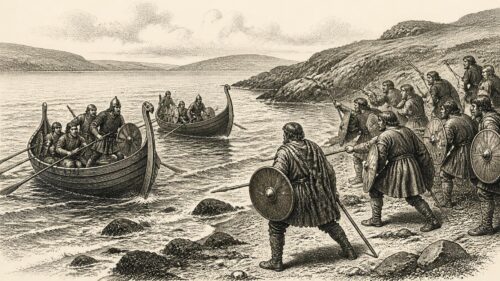
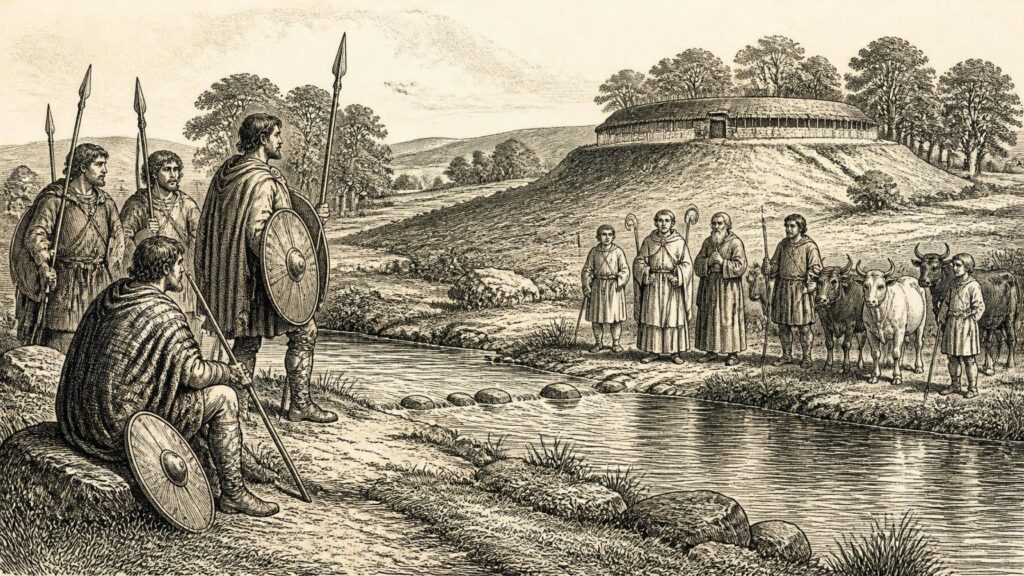
In Connacht, the battle of Sruthair was the year’s clearest recorded military success. The Annals of Ulster say that the Uí Briúin fought the Conmaicne; “very many” of the Conmaicne fell, among them Áed Dub son of Taichlech. Dub Innrecht son of Cathal was victor. The formula is concise, but its scale is emphatic: the annalist wished readers to understand that the Conmaicne had suffered heavily. Sruthair is often identified with the area of Shrule on the modern Mayo–Galway border, although the precise landscape of the encounter and the composition of the forces cannot be recovered from the entry alone.
The battle was more than an isolated clash. The Uí Briúin were a major Connacht dynasty, while the name Conmaicne covered several peoples of the province’s western and northern zones. Their defeat opened space for Dub Innrecht’s authority, though the annal does not explicitly style him king in this notice. Later entries do identify him as king of Connacht, and he died in 768. It is reasonable, therefore, to see Sruthair as a significant stage in the Uí Briúin’s contest for provincial supremacy; it would be unsafe to describe it as the final conquest of Connacht. The political map remained a mosaic of competing kindreds, and victories had to be maintained through alliances, hostages, tribute and further campaigning.
The names in the record also correct any impression that early medieval warfare was merely a struggle between a few famous “high kings”. Military action reached communities whose names survive mainly in local genealogies and annals. A battle could remove a leading figure such as Áed Dub, kill an uncounted body of fighting men, disrupt cultivation and stock-keeping, and alter the bargaining power of families far beyond the battlefield. The sources do not permit a reconstruction of weapons, tactics or civilian losses at Sruthair. They do, however, support the narrower conclusion that this was a substantial defeat for the Conmaicne and a notable success for Dub Innrecht’s Uí Briúin.
Munster’s Recorded Reversal
The Annals of Inisfallen, a chronicle with especially valuable Munster material, adds another conflict under 766. It reports that the Uí Fhidgeinte and the Araid Cliach inflicted a defeat on Máel Dúin son of Áed at Énboth Breg. The entry is terse and does not call Máel Dúin king, identify the battlefield beyond its name, or explain why forces associated with north-west Munster were fighting him. Later tradition and modern scholarship connect Máel Dúin with rulership in Munster or western Munster, but his exact standing at this point should not be overstated.
What can responsibly be said is that powerful groups within the Munster sphere could combine against a prominent rival and defeat him. The Uí Fhidgeinte held territory in the wider Limerick region; the Araid Cliach were another regional people. Their appearance together is a reminder that provincial kingship depended upon the consent, coercion or calculated co-operation of subordinate dynasties. Munster, like Mide and Connacht, was a political landscape of shifting coalitions rather than a unitary state. This notice also demonstrates why no single annal can carry the whole history of a year. The Connacht battle receives detailed notice in the northern and midland annalistic tradition; the Munster reverse survives most plainly in Inisfallen.
Clonfert and the Sea Road
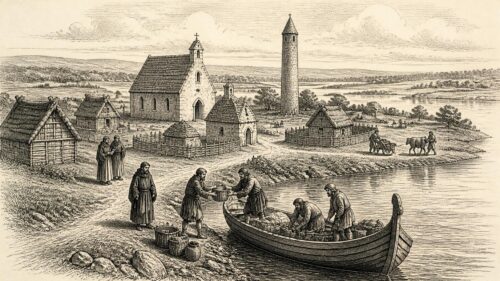
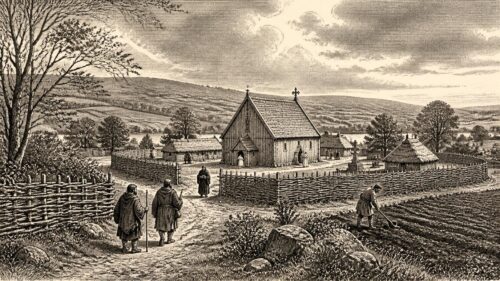
Church affairs are present in two firm notices. Crimthann, abbot of Cluain Ferta—Clonfert, the foundation associated with St Brendan—“fell asleep”, the customary ecclesiastical language for death. The Annals of Inisfallen call him coarb, successor or hereditary office-holder of Brendan. Such terminology did not mean that an eighth-century abbot was simply a monk succeeding another monk. A major church could be a landed institution, a centre of learning and liturgy, a focus for craft production, and a lordship with tenants and clients. Its head occupied a position of religious authority and considerable social consequence. Crimthann’s death therefore marked an institutional succession as well as a personal loss, although the sources do not name his successor or report any dispute.
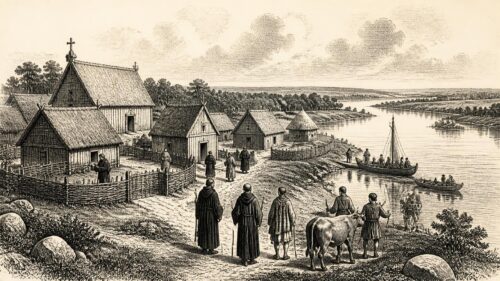
The Annals of Ulster also record that Suibne, abbot of Í, came to Ireland. Í is Iona, the Columban island monastery off the west coast of Scotland. The bare notice does not reveal Suibne’s itinerary, destination, purpose or length of stay. It should not be transformed into a claim of a synod, a political embassy or a relic-tour. Nevertheless, the journey itself is historically meaningful. Iona and Irish Columban churches belonged to a network of communities linked by saints’ cults, personnel, learning and sea travel. The crossing was demanding but routine enough for an abbot’s arrival to be recorded without explanation. It reveals an Irish Sea world in which ecclesiastical connections crossed what modern maps treat as a national boundary.
What the Year Does Not Tell Us
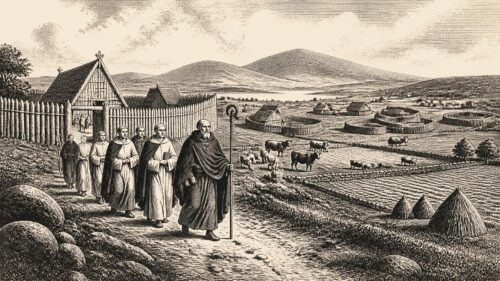
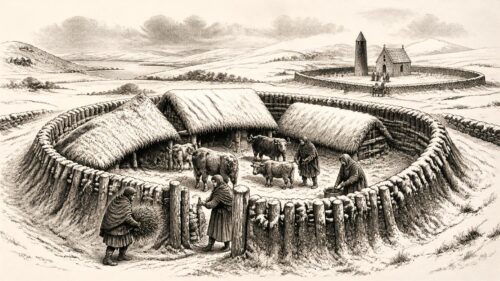
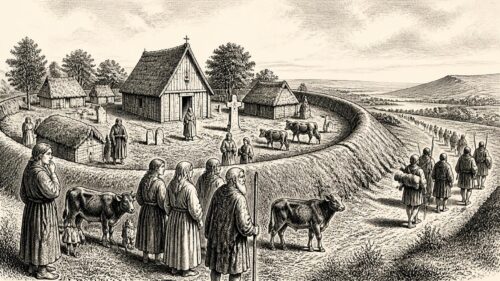
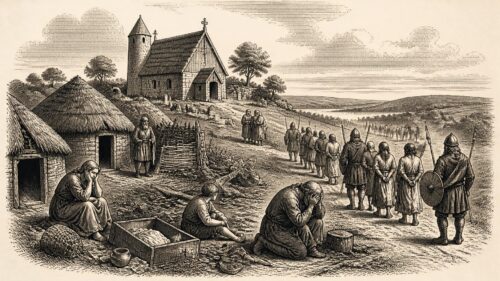
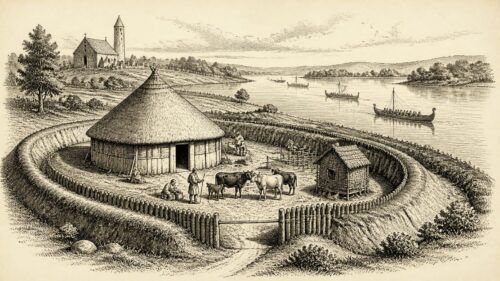
For ordinary people, 766 offers fewer direct observations. The annals name rulers, clerics and battle casualties, not the farmers, herders, craftspeople, dependants and enslaved people whose labour sustained both kings and churches. Archaeology supplies the broader setting: much of the population lived in dispersed rural settlements, including ringforts enclosing houses, livestock and storage. Cattle were central to wealth and tribute, while grain cultivation, dairying and woodland resources underpinned daily survival. Raiding and local war made movable wealth—especially animals—vulnerable, and could expose farmsteads to danger even where no battle was fought nearby.
Yet broader context must not be mistaken for a report on this particular year. The annals record a shortage of bread in the preceding year, but they do not explicitly report famine, epidemic, exceptional weather or harvest failure for 766. Nor do they mention Scandinavian raiders: the first securely recorded Viking attack on Ireland lies later, in 795. The Ireland of 766 was already connected by sea to Iona, Britain and continental Christian culture, but its immediate concerns were indigenous rivalries, ecclesiastical succession and the control of regional power.
The year’s scattered notices thus form a coherent, if incomplete, picture. Folloman’s treacherous death and the fighting with Brega expose the precarious consolidation of power in Mide. Sruthair records a hard Uí Briúin victory in Connacht. Énboth Breg shows conflict inside the Munster political world. At Clonfert and Iona, meanwhile, succession and travel demonstrate the reach of major churches. In 766, violence and religious institutions were not separate stories: both were embedded in the networks of kin, land, prestige and movement through which early medieval Ireland was governed.
Primary Sources
- The Annals of Ulster
- Part 336 of The Annals of Ulster
- The Annals of Tigernach
- CELT Project: Annals of Tigernach
- Annals of Inisfallen
- Part 32 of Annals of Inisfallen
- Part 59 of The Annals of the Four Masters
- Donnchad Midi
- Domnall Midi
- Cellach
- Áed Oirdnide
- Exploring the Irish Annals
- The Annals Attributed to Tigernach
- On Reconstructing Medieval Irish Chronicles
- Ireland To 1170 (with Andrew Woods)
- The Church and the World in Early Christian Ireland
- Monastic Identity in Early Medieval Ireland
- Land Use and Economy AD 500–1100
- Ringforts / Ráthanna
- Souterrains / Pasáistí Faoin Talamh
- Ordinary People in Early Christian Ireland
- The Earthen Rath or Lios
- Ways of Death: Cremation and Belief in First-Millennium AD Ireland