The Battle of Argaman764 CE
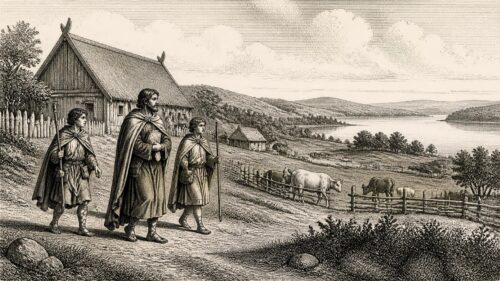
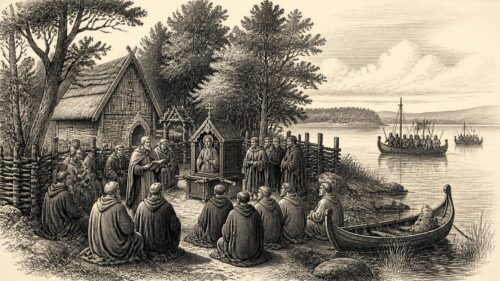
Irish annals conventionally date 764, despite chronological uncertainty, as a year of disruption. Exceptional snow, famine, drought and an intestinal sickness afflicted Ireland, though their precise effects remain unknown. The battle of Argaman saw Clonmacnoise defeat Durrow, with Durrow leaders Diarmait Dub and Diglach among 200 dead, while Bresal of Clonmacnoise was killed. The conflict reflected monasteries’ roles as wealthy, politically connected communities, not solely religious houses. Other notices record battles, deaths of abbots and kings, and Connacht’s king Ailill. Later sources add regional conflicts. A poem celebrating Niall Frossach’s miraculous showers contrasted ideal kingship and abundance with widespread privation.
Dateline
The Irish annals assign an unusually crowded and grievous sequence of events to 764: a winter of exceptional snow, famine, drought, sickness, political deaths and a battle between two of the island’s greatest ecclesiastical communities. The principal contemporary-derived record, the Annals of Ulster, preserves these notices under its entry U764, although its inherited chronological apparatus also gives an Anno Domini date one year earlier. This is a familiar problem in early Irish annalistic chronology. The events discussed here are conventionally treated as belonging to 764 CE, but neither the annals nor modern readers can safely attach a day or month to most of them.
A Year of Climatic Shock
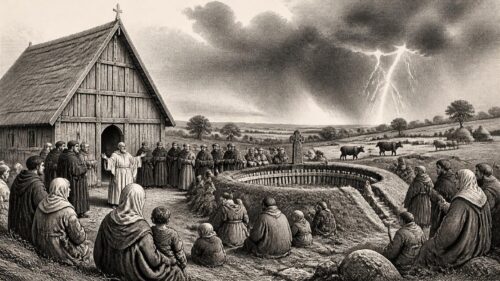
The year opened, or was remembered as opening, with “a great snowfall” that lasted almost three months. For an overwhelmingly agricultural society, that was not merely striking weather. A long snow cover could shut down grazing, delay the spring growing season, impede travel and strain the remaining stores of grain and preserved food. The annalist then records “great scarcity, and famine”. These entries do not allow a modern reconstruction of harvest totals, mortality or the precise districts worst affected. They do, however, establish that contemporaries regarded the shortage as grave and widespread enough to deserve permanent record.
The pattern became stranger still. The same entry reports an “abnormally great drought”. Heavy winter snow followed by drought may seem contradictory, but both could devastate production in one agricultural year: a prolonged winter delayed cultivation, while dry conditions later damaged pasture and cereal crops. Ireland’s food economy depended on livestock as well as crops, and ordinary households had limited reserves with which to absorb successive shocks. Grain was eaten, brewed and used in payments; cattle supplied milk, meat, hides, status and movable wealth. A failure in either sphere had social and political consequences, even if the sources do not spell out each household’s experience.
The Annals of Ulster adds a “bloody flux throughout Ireland”, conventionally understood as a severe intestinal illness, perhaps dysentery rather than a literal flow of blood. Diagnosis from a brief medieval phrase is impossible. Yet the ordering of snow, famine, drought and sickness is revealing. The annalist saw them as a connected catalogue of public calamity. Hunger and physical exhaustion could make a population more vulnerable to disease, but it would be unsafe to claim that drought caused the flux, or to calculate the number of deaths. What can be said securely is that 764 was remembered as a year in which environmental stress and illness were experienced on an island-wide scale.
Clonmacnoise and Durrow at War
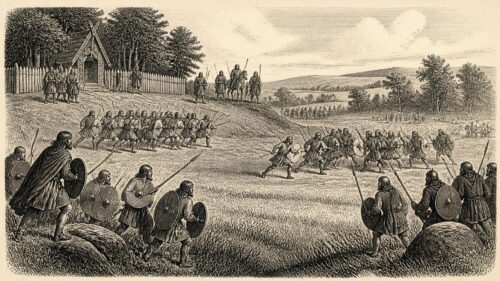
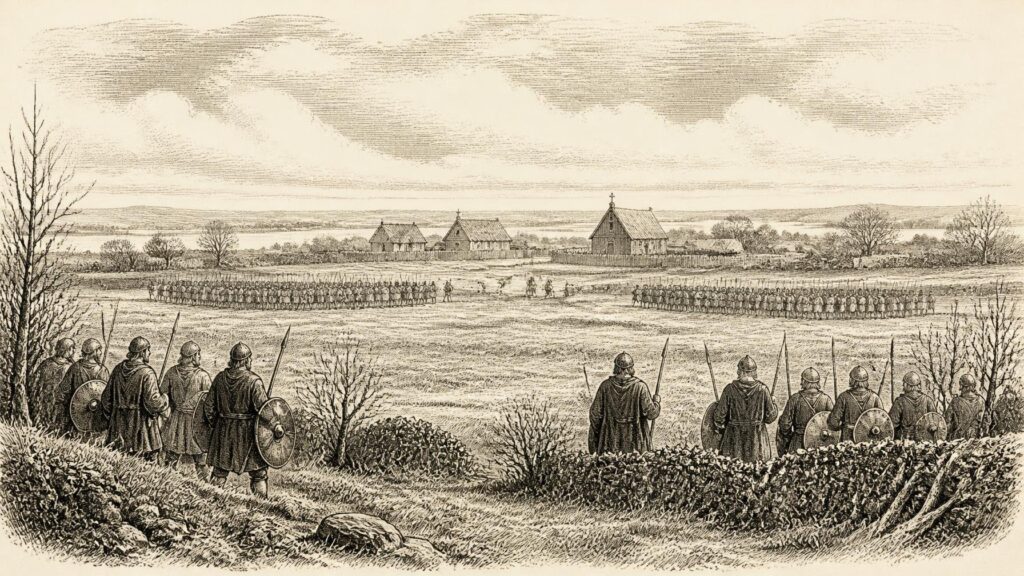
Against that hard background came the year’s most arresting event: the battle of Argaman. The annals say that the familia of Clonmacnoise fought the familia of Durrow, known in Irish as Dermaig, and that Clonmacnoise won. Diarmait Dub, son of Domnall, and Diglach, son of Dub Liss, fell with 200 men of Durrow’s community. Bresal, son of Murchad, emerged as victor on Clonmacnoise’s side.
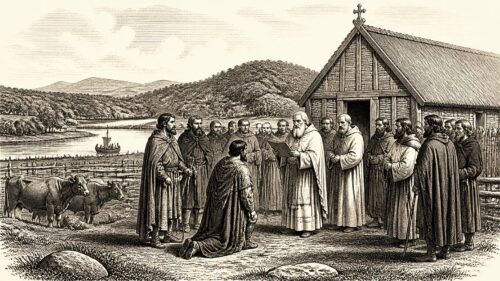
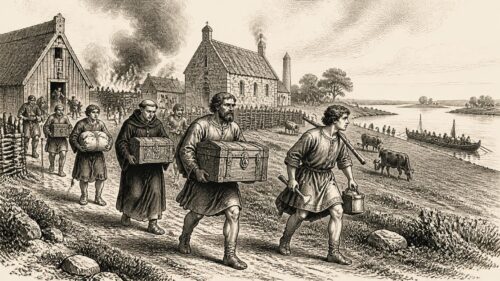
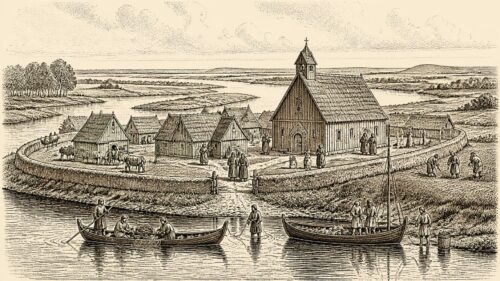
This was not a story of two small groups of cloistered monks abandoning their books for a spontaneous brawl. In early medieval Ireland, a major monastery was a religious institution, landed estate, political client and settlement. Its familia could include clergy, tenants, craftsmen, dependants and fighting men, rather than only professed monks. Clonmacnoise stood beside the Shannon at a vital crossing of river and overland routes; Durrow lay near the Slí Mór across the central midlands. Both were wealthy, well-connected communities with estates, patrons and claims upon labour and produce. The exceptionally precise casualty total gives a sense of the scale, though it cannot tell us how many combatants Clonmacnoise fielded or whether every man recorded as belonging to Durrow lived at the monastery itself.
The immediate cause of the battle is not recorded. Later historical analysis has plausibly placed it within the volatile politics of Mide after the death of Domnall Midi, the powerful Clann Cholmáin king whose death is entered in the preceding year. Durrow had important Columban associations and enjoyed Clann Cholmáin patronage, while Clonmacnoise had its own powerful networks. Diarmait Dub and Bresal may themselves have belonged to competing branches of the ruling kindred. That interpretation helps explain why ecclesiastical communities could become armed parties, but it remains an inference from names, affiliations and context, not an explanation supplied by the annalist.
Nor should the battle be treated as evidence that Christianity had failed to restrain violence. Churches possessed sanctuary and moral authority, but they also held land, tribute rights, livestock, learning, relics and political influence. Their communities needed protection and could participate in the conflicts of their secular patrons. Argaman shows how closely religious and dynastic power were intertwined in eighth-century Ireland. It also exposes the human cost of rivalry at institutions commonly remembered principally for manuscripts, prayer and scholarship.
Deaths, Leadership and Retaliation
Losses touched the religious leadership of several regions. Rónán, abbot of Clonmacnoise, died in the same annalistic year as the victory won by his community. Cormac, son of Ailill, abbot of Monasterboice, also died. The annals additionally note the death of Dub Deilge, called sapiens, “the learned”, a terse but significant recognition of scholarly standing, and that of Fiachra, son of Fothad, abbot of Baislec. Such notices remind us that monasteries were centres of teaching, writing, legal memory and ecclesiastical government as well as worship. The records do not state whether any of these deaths resulted from famine or disease, so no such connection should be assumed.
Bresal’s triumph was brief. The Annals of Ulster separately records his killing later in its 764 sequence. It does not name his killer or explicitly call the death revenge for Argaman. Linking the two would be tempting, particularly after a battle in which Durrow suffered so heavily, but the evidence does not justify certainty. The juxtaposition instead conveys a broader truth about political life: victory could be precarious, and a leading war-band commander could quickly become a target.
Another battle is reported at Dún Bile, where Donnchad defeated the Fir Tulach. The annals give neither a fuller account of the combat nor an unambiguous modern location for every party. Donnchad is generally understood in this political setting as Donnchad Midi, the son and successor of Domnall Midi in Mide, but the brief notice does not identify him by patronymic. It is therefore safest to see Dún Bile as evidence of continuing armed competition in and around the midlands rather than to supply a detailed campaign narrative that the sources cannot sustain.
Connacht and the Wider Island
In Connacht, Ailill, grandson of Dúnchad, king of Connacht, died. His death mattered beyond his own dynasty: provincial kings controlled tribute, military followings and access to important churches, while their success depended on shifting alliances among branches of the Connachta. The annals record the death but offer no description of illness, succession negotiations or funeral rites. The same restraint is needed with Scannlán of Femen, son of Áedgal, whose death is entered without a title, and with Murchad son of Indrechtach, whose notice is equally spare.
A later compilation, the seventeenth-century Annals of the Four Masters, also places a conflict among the Osraige at Tuaimsnamha and a battle at Ferns among the Uí Cheinnselaig in this year, alongside deaths at Reachrainn and Glendalough. These reports are valuable evidence for traditions of regional conflict and ecclesiastical succession, but they are not preserved in the same form in the principal U764 entry. They should therefore be treated as later annalistic testimony, rather than folded uncritically into a single, fully certain chronology.
Niall of the Showers
The year closes in the Annals of Ulster with an extraordinary northern story. At Crích Muiredaig in Inis Eógain, three showers supposedly fell: one of pure silver, one of wheat and one of honey. A short Irish poem immediately interprets the marvel as heaven’s favour for Niall Frossach, the northern Uí Néill ruler who had begun to rule in the preceding year. It explains his epithet, “Niall of the Showers”, and praises his ability to exact hostages from every province.
This is not meteorological evidence that silver and honey fell from the sky. It is royal praise embedded in annalistic form, converting precious metals and foodstuffs into signs of abundance, generosity and legitimate kingship. Its position after the grim notices of famine and flux is especially striking. Whether composed at the time or preserved from an earlier political tradition, the poem shows that Irish historical writing could move between plain record, religious interpretation and praise poetry. In 764, the annals remembered real privation and killing, but also imagined the ideal ruler as one whose rule brought wealth and sustenance from heaven.
That contrast makes the year unusually vivid. Ireland in 764 was neither a unified kingdom nor a secluded island of peaceful monasteries. It was a landscape of regional kingships and armed households, linked by churches whose authority rested on people, land, learning and patronage. Its inhabitants faced an exceptional sequence of snow, hunger, drought and disease. At Argaman, two great religious communities met in battle; elsewhere, kings died, commanders were killed and rulers’ claims were expressed through poetry as well as force. The surviving evidence is brief and often uncertain, but it leaves no doubt that this was a year of deep disruption.
Primary Sources
- The Annals of Ulster, Year U764
- The Annals of Ulster
- The Annals of Tigernach
- Annals of the Four Masters, Part 59
- Irish Texts at CELT
- CELT FAQ
- The Annals of Tigernach: Index
- The Church and the Dynasties of Ireland in the Eighth Century
- Ireland, 700–900
- Durrow Abbey, Co. Offaly: Conservation Plan
- Early Irish Monasticism
- Clonmacnoise Visitor Guide
- Agriculture, Settlement and Society in Early Medieval Ireland
- Settlement Origins in the Prehistoric and Early Medieval Periods
- The Irish Annals and Climate, Fifth–Seventeenth Centuries CE
- Medieval Irish Chronicles Reveal Persistent Volcanic Forcing of Severe Winter Cold Events, 431–1649 CE
- Raiding and Warring in Monastic Ireland
- Understanding Whether Environmental Conditions Can Provoke Violence
- The Cross-Slabs of Clonmacnoise: Reassessing One of the Largest Collections of Early Medieval Carved Stone Monuments in Northwest Europe
- The Present and the Past in Medieval Irish Chronicles