

Northern Kindred
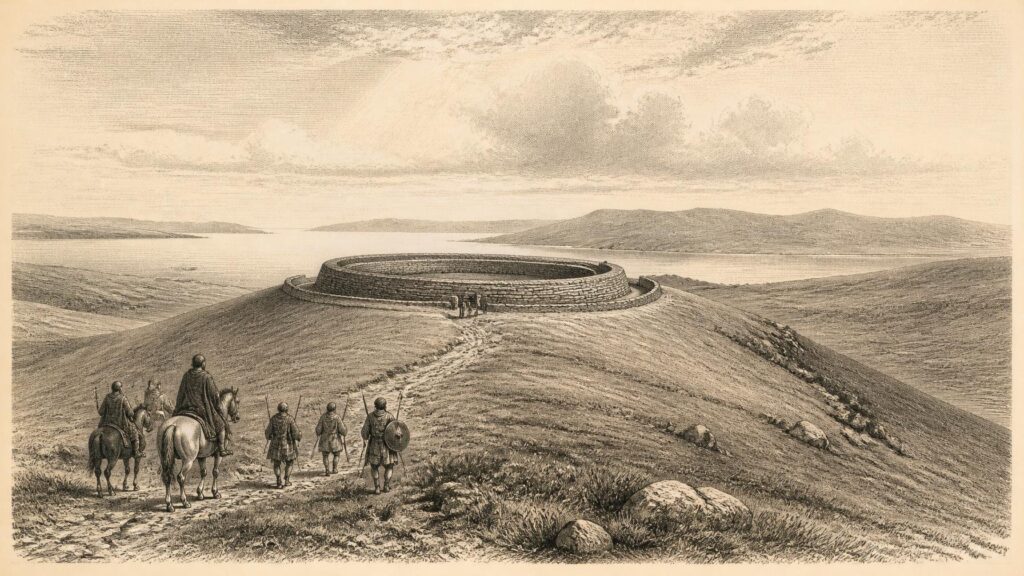
AI generated historical illustration, not a contemporary photograph.
At a Glance
Cenél nEógain—the “kindred of Eógan”—was among the most consequential political communities of medieval Ireland. Its rulers emerged from the northern Uí Néill, held Ailech, contested authority in Ulster and beyond, and at intervals supplied kings of Tara. From an early heartland around Inishowen and the great stone enclosure at Grianán Aileach, its power later became closely associated with Tír Eógain, the territory which gave County Tyrone its Irish name. Yet its long history cannot be told simply as the story of an ancient family advancing steadily towards greatness. It is also a history of rival kindreds, changing territorial claims, church alliances, Viking age warfare, carefully cultivated genealogies and the limits of the surviving evidence.
Dynastic Meaning
The Irish word cenél means kindred, offspring or descent-group. Cenél nEógain therefore means the kindred of Eógan. Medieval genealogists represented Eógan as a son of Niall Noígiallach, Niall of the Nine Hostages, and made him the eponymous ancestor of one of the two principal branches of the Northern Uí Néill. The other was Cenél Conaill, the kindred of Conall. Such formulae were not mere family trees in the modern sense. They expressed political order: descent supplied a language through which rights to land, kingship, tribute, alliance and precedence could be claimed.
It is tempting to treat the name as evidence for a straightforward biological lineage reaching back to a single fifth-century founder. That would go beyond what the sources can establish. Early Irish genealogies preserve invaluable information about political relationships, but they were also composed, copied and adapted in environments where ancestry could legitimise present power. The name Eógan may preserve a genuine remembered ancestor; equally, the detailed pedigrees descending from him must be read as medieval arguments about rank as well as records of descent. The safest conclusion is that a powerful northern ruling coalition came to be known as Cenél nEógain and that its claim to shared ancestry became central to its political identity.
The distinction matters because early medieval Irish society was organised through overlapping loyalties. A king was not the head of a unitary nation-state, nor was a dynasty a modern clan with unchanging borders. Kings ruled particular peoples and territories, negotiated with subordinate rulers, sought hostages and tribute, and relied on ecclesiastical communities for literacy, ceremony and support. Cenél nEógain was at once a kin-group, a succession of ruling lines, a field army, a political label and, eventually, a source of surnames and lordly identities. Its extent changed as fortunes changed.
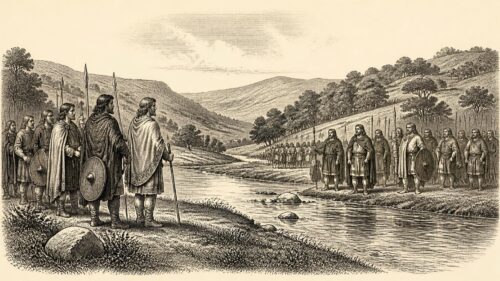
The Northern Uí Néill itself was no fixed bloc. Cenél nEógain and Cenél Conaill could cooperate when faced by external opponents, but they were persistent competitors for dominance in the north. Their southern Uí Néill counterparts in Mide and Brega were both cousins in genealogy and rivals in the contest for Tara. Beyond the Uí Néill stood the rulers of Ulaid, Airgialla, Connacht, Leinster and Munster, each with their own claims and networks. A history of Cenél nEógain is therefore a history of connections across Ireland rather than a narrow regional chronicle.
Uneasy Origins
The conventional origin story places Eógan and his brother Conall among the sons of Niall. Medieval Irish historical writing often located the beginnings of such peoples around the transition from late Roman Britain to early Christian Ireland. Exact dates, however, are insecure. Annalistic chronology for the fifth and sixth centuries was assembled retrospectively, and later compilers worked with traditions already shaped by dynastic interests. It is prudent not to convert a genealogical scheme into a precise foundation date.
There is another difficulty. The surviving narratives of Niall, Eógan and their descendants are inseparable from the later political success of the Uí Néill. A dynasty which acquired extraordinary influence had strong reason to project that influence backwards. The learned record itself reflects the power of royal and ecclesiastical patrons. In particular, scholars have long considered whether the apparent antiquity and cohesion of Uí Néill tradition was reinforced by the literary and political culture that grew around Armagh and northern kingship. This does not make every early tradition false. It does mean that origin stories should be treated as traditions with political work to do.
Folklore and learned legend attach Eógan to the northern landscape. Inishowen, Inis Eógain, is conventionally understood as Eógan’s island or peninsula, while Ailech became the emblematic royal place of his descendants. Such associations are historically important even where their earliest form cannot be verified. Place-names, tales and inauguration traditions helped communities remember authority in the landscape. They should not be mistaken for archaeological proof that one individual founded a kingdom there at a recoverable moment in time.
What can be said with greater confidence is that, by the early medieval period, Cenél nEógain was recognised in Irish political writing as a major northern people. Its relationship to Cenél Conaill supplied an enduring framework for the politics of the north-west. The former was associated especially with Inishowen and Ailech; the latter with much of what later became Tír Chonaill or Donegal. Those broad associations shifted, overlapped and were challenged, but they remained powerful geographical languages through which later historians and chroniclers described the region.
Ailech Heartland
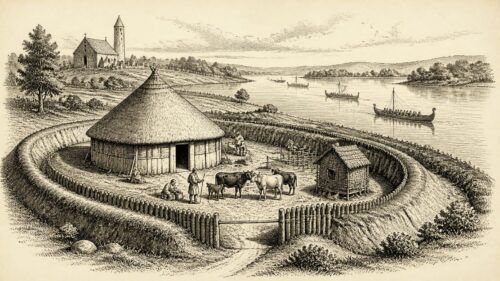
Ailech lay at the centre of Cenél nEógain’s early political imagination. The name can refer both to a territory and to the celebrated royal site now known as Grianán Aileach, on a commanding hill in County Donegal. The surviving stone enclosure, dramatically placed above Lough Swilly and Lough Foyle, is a reconstruction of a much older fortification. Its present appearance should not be read uncritically as a complete early medieval royal residence; nevertheless, the site’s commanding position and long cultural memory make clear why Ailech became a potent symbol of northern kingship.
Royal sites in early Ireland were not capitals in the later urban sense. They were ceremonial and strategic nodes within a wider landscape of estates, churches, client peoples, routeways and assemblies. Ailech’s significance derived not only from defensive elevation but from what it represented: access to the northern peninsula, visibility across surrounding territories and a claim to inherited authority. To be king of Ailech was to possess a recognised rank within the competitive order of Irish kingship.
The early territorial core of Cenél nEógain is commonly placed in Inishowen. From there, its influence expanded and contracted through warfare, settlement, marriage and lordship over neighbouring peoples. The later association with Tír Eógain, “Eógan’s land”, reflects a major movement of political gravity eastward into what became Tyrone. It would be misleading to imagine a clean transfer from Donegal to Tyrone. Medieval territorial names frequently had broad, elastic and changing applications. Rather, the dynasty’s sphere developed across the north-west and central Ulster, with different branches and dependent groups active in different places.
Landscape also reveals a caution. A famous stone fort can give the impression of an enduring, centralised kingdom, but Cenél nEógain’s authority was negotiated. A ruler required armed followers, subordinate kings, church allies and a capacity to extract resources. When those supports failed, even a prestigious royal site could not guarantee power. Conversely, a dynasty could project influence well beyond its immediate heartland without directly administering every place it raided or from which it received hostages.
Kingship Networks
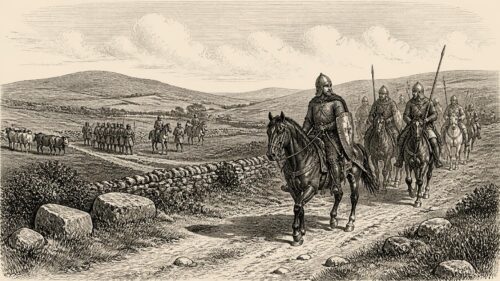
The rise of Cenél nEógain is most visible in the annals from the seventh and eighth centuries, although the terse entries rarely provide a complete explanation for events. Its kings competed with Cenél Conaill for northern predominance and with the Southern Uí Néill for wider authority. Fergal son of Máel-dúin, killed in 722, was one of the line’s important rulers. His defeat and death at the battle of Allen demonstrated the hazards of ambitious overkingship: a northern ruler could lead a great hosting into Leinster, but distance, coalition politics and local resistance could turn such expeditions into catastrophe.
Fergal’s sons, Áed Allán and Niall Frossach, illustrate both the resilience and the limits of dynastic power. Áed Allán became king of Tara after defeating a rival Uí Néill ruler in 743. He was killed in 743 or shortly afterwards according to the complex chronologies used by different traditions; the important point is not an artificially exact sequence but the pattern of recurrent contest. Kingship of Tara, often called the high-kingship in later writing, was not an uncontested sovereignty over all Ireland. It was a prestigious and real claim to pre-eminence, continually challenged by other powerful rulers.
Niall Frossach followed as a leading Cenél nEógain ruler and was later remembered as king of Tara. His epithet, “the Showery”, attracted stories in which showers of wheat, silver, honey or blood accompanied his birth. Those stories are folklore and retrospective literary interpretation, not contemporary reportage. They suggest how later tradition imagined a prosperous or providential reign. The documentary evidence is more restrained: Niall belonged to a generation in which Cenél nEógain had become a principal force among the northern Uí Néill and could compete with the dominant Clann Cholmáin of Mide.
Kinship did not prevent violence. Internal succession was frequently disputed, and a ruler’s nearest political opponent could be a cousin. Kingship passed within a restricted royal kindred rather than automatically from father to eldest son. This system could offer a wider pool of experienced adult candidates, but it also created chronic potential for rivalry. Annalistic notices of killings, blindings, expulsions and raids are not signs that the system had collapsed; they are part of the harsh political vocabulary through which succession was decided.
Ecclesiastical Alliances
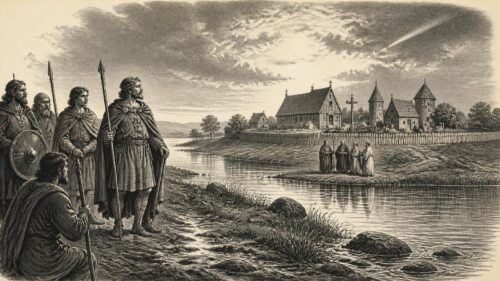
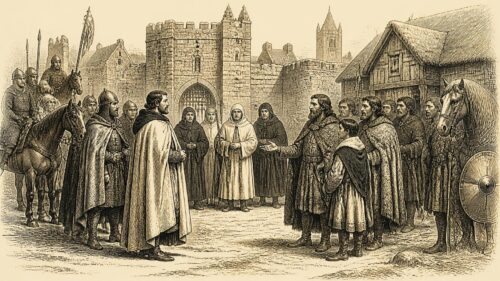
No account of Cenél nEógain can separate dynastic power from the church. Armagh, associated with St Patrick, developed into one of Ireland’s foremost ecclesiastical centres. Its authority was spiritual, cultural and material. It held land, maintained learned traditions, received protections and dues, and sent clerics on circuits through regions in which secular kings exercised influence. An alliance with Armagh could enhance a ruler’s legitimacy; protection from a powerful king could likewise serve Armagh’s interests.
The relationship was not simply one of king commanding church or church blessing king. It was reciprocal, negotiated and sometimes tense. Hagiography, law and genealogy could articulate an ideal order in which the community of Patrick and a northern dynasty reinforced one another. Modern scholarship on Patrician hagiography has demonstrated that such texts must be read in their political contexts. When saints curse enemies, grant privileges or recognise kings, their stories may preserve memories of conflict, but they may also argue for the interests of the ecclesiastical community that transmitted them.
The career of Áed Ua Néill, king of Ailech from 993 until his death in 1004, offers an unusually clear example. The Irish Dictionary of Biography notes that he was formally ordained to the kingship at a circuit of Tír Eógain by the abbot of Armagh, in the presence of Patrick’s community. Whatever the exact ritual entailed, the episode shows that royal authority could be ceremonially expressed through an ecclesiastical gathering. It is a useful corrective to the idea that early Irish kingship was wholly secular or merely military.
Churches were not passive observers of dynastic struggles. They held estates, possessed skilled writers and maintained contacts beyond local kingdoms. Monasteries and churches could be raided, defended, granted immunity or used as places for negotiation. Their annalists preserved the deaths of kings and clerics alike, but the survival of a record does not make it neutral. The annals remain indispensable evidence; they must also be read as texts produced within particular learned communities.
Viking Pressures
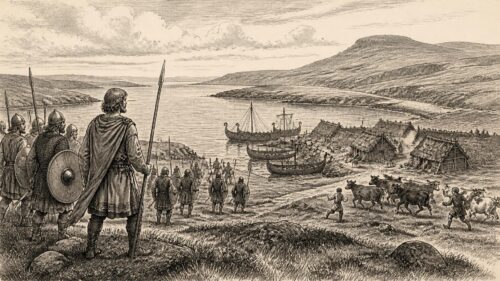
The arrival of Viking raiders and settlers from the late eighth century altered the military and commercial environment in which Cenél nEógain operated. It did not replace older Irish politics with a simple Irish-versus-Scandinavian struggle. Viking leaders made alliances with Irish rulers; Irish kings fought one another with Scandinavian support; and Scandinavian towns became durable participants in the economy and warfare of Ireland and the Irish Sea world.
Cenél nEógain rulers faced these pressures in a north connected by sea to western Scotland, the Hebrides, Man, northern England and Dublin. Raiding fleets could threaten coastal churches and estates, but maritime contact also offered opportunities. The annals describe campaigns whose participants and objectives cannot be reduced to ethnic categories. A king’s interest was often immediate: the capture of hostages, cattle, territory or prestige, rather than a permanent ideological hostility to every foreign group.
Niall Caille, who died in 846, is one of the better documented ninth-century Cenél nEógain kings of Tara. His career belongs to a period when rivalry between Uí Néill branches continued alongside conflicts involving Scandinavian forces. The Dictionary of Irish Biography emphasises the tension between northern Uí Néill aspirations and the ambitions of Munster rulers. The wider lesson is that Viking activity intensified an existing competitive system. It did not abolish the contest between Ailech, Mide, Munster, Leinster, Connacht and the many regional kingdoms.
The evidence also warns against romantic certainty. Later narratives can transform a complicated political world into heroic resistance, while modern readers may expect every encounter to fit a national story. The sources instead reveal shifting coalitions. Cenél nEógain’s importance rested on its ability to survive that instability, to raise forces repeatedly and to retain a place in the highest level of Irish political competition.
Tara Ambitions
By the tenth century, Cenél nEógain could again make serious claims to Tara. Muirchertach na Cochall Craicinn, who died in 943, was celebrated in later tradition and poetry for extensive campaigning. The sobriquet “of the Leather Cloaks” contributes to a vivid martial image, but literary fame should not obscure the practical basis of his authority: alliances, royal succession, military movement and the capacity to impose demands beyond his northern base.
His son Domnall Ua Néill, who died in 980, was among the dynasty’s most important rulers. Contemporary annalistic usage is significant here. The Dictionary of Irish Biography observes that Domnall was one of a small number of Uí Néill rulers styled king of Ireland in the original hand of the Annals of Ulster, and that his obituary offers an early contemporary use of the title high-king of Ireland. This does not demonstrate that he controlled every kingdom directly. It does demonstrate that his pre-eminence was recognised in unusually forceful terms by a major learned source.
Domnall’s position was nevertheless precarious. Cenél Conaill had revived under Ruaidrí Ua Canannáin; the Southern Uí Néill remained formidable; Dublin’s Scandinavian rulers mattered; and new regional powers could enter the contest. The history of Tara is thus not a succession list of universally accepted monarchs. It is a history of claims, acknowledgements, military expeditions and occasional moments when one ruler’s authority appeared broader than that of his peers.
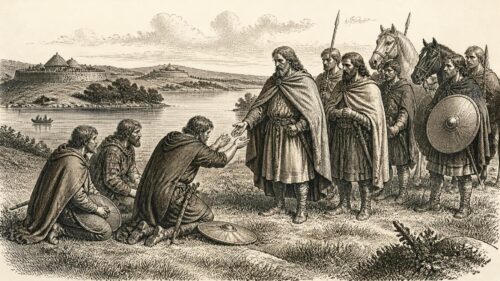
Áed Ua Néill inherited this difficult context. In 1002, Máel Sechnaill of Clann Cholmáin reportedly offered to resign the kingship of Tara in Áed’s favour in an effort to preserve Uí Néill primacy against Brian Bóruma of Munster. Áed declined, and Brian’s rise altered the political balance. The episode, whether viewed as a formal offer or a highly charged annalistic statement, conveys a crucial truth: Uí Néill supremacy was no longer secure. Cenél nEógain remained powerful, but it could not dictate the outcome of Irish politics alone.
Territorial Change
The eleventh and twelfth centuries brought further transformation. Cenél nEógain did not disappear after Brian’s ascendancy, but its leadership and territorial emphasis changed. Inishowen and Ailech retained symbolic weight, while Tír Eógain became increasingly important as a political centre. The dynasty’s old structure also gave way to more recognisable hereditary surnames. Mac Lochlainn and Ó Néill became leading names within the wider Cenél nEógain inheritance.
The Mac Lochlainn line produced Domnall Mac Lochlainn, a ruler who died in 1121 and who made a formidable bid for countrywide pre-eminence. His authority was exercised through expeditions, submissions and alliances, not through a bureaucratic state. Yet he was plainly more than a local lord. The annals record his dealings across Ulster, the midlands and beyond, while later historians have recognised his place among the most powerful Irish rulers of his generation. His career demonstrates that the older contest for wide lordship survived long after the political world of the ninth century had changed.
Conflict with the Ulaid and other Ulster powers remained central. The Annals of Ulster record battles between Cenél nEógain and Ulaid, including the battle of Craeb Tulcha in 1004. Such entries are terse, often naming notable dead and immediate outcomes rather than causes. Their value lies in their proximity to learned recording traditions and their accumulation over time; their limitation is that they cannot by themselves provide a complete narrative. Historians reconstruct the larger picture by comparing annals, genealogies, hagiography, place evidence and later chronicles.
Territorial expansion was never a smooth march. A raid could obtain hostages without producing permanent occupation. A submission might last only as long as a ruler’s army remained nearby. Nor should modern county boundaries be projected backwards. Medieval Tír Eógain extended through a political landscape unlike that of modern Tyrone, and its frontiers varied according to the strength of its rulers and neighbours.
Later Lordship
By the later medieval period, the Ó Néills had become the most enduring representatives of the Cenél nEógain tradition. The surname itself recalled descent from Niall, but its political authority rested upon far more recent achievements: control of followers, landholding, marriage alliances, church patronage and military capacity. The medieval lordship of Tír Eógain was not a fossil preserved from the fifth century. It was a living, adaptive polity whose leaders used ancient ancestry to support contemporary power.
The arrival of Anglo-Norman forces in Ireland after 1169 changed the island’s political map, but it did not immediately extinguish northern Gaelic lordship. Ulster became an arena of interaction among Gaelic rulers, Anglo-Norman magnates, church institutions, mercenaries and Scottish maritime interests. Cenél nEógain’s successors navigated this world with varying success. Their identity was both local and wide-ranging: local in the lordship of Tír Eógain, wide-ranging in their claims to the prestige of the Northern Uí Néill and the kings of Ailech.
Internal division continued. The Annals of Ulster record, for example, a settlement in 1367 between Niall Ó Néill and his brother Domnall, by which the land was divided and Niall received hostages and kingship from Domnall. The notice is revealing. It shows that even within the ruling house, territory and authority were subject to negotiation and partition. Dynastic solidarity existed, but so did sibling rivalry and factional competition.
In the sixteenth century, the political inheritance of Cenél nEógain became entangled with Tudor expansion. Conn Ó Néill and his son Hugh, later Earl of Tyrone, operated in a changing constitutional order shaped by English royal policy, Gaelic lordship and the military realities of the archipelago. The Nine Years’ War and the Flight of the Earls in 1607 are often treated as an ending. They were certainly a profound rupture in Gaelic political power, but they should not be used to simplify the preceding thousand years into an inevitable national drama. The early medieval kindred, the Mac Lochlainn kings and the earls of Tyrone belonged to connected yet very different political worlds.
Historical Evidence
Much of what is known about Cenél nEógain comes from sources written long after the earliest events they describe or preserved in manuscripts copied centuries later. The Annals of Ulster are foundational because they provide a chronological framework and frequently record deaths, battles, raids and successions. They are not a modern chronicle: their entries vary in length, chronology can be difficult, and editorial perspectives must be considered. Still, without them, the political history of northern Ireland would be immeasurably poorer.
Genealogies are equally important and equally problematic. They identify branches, explain claims and preserve names otherwise lost. Yet they are documents of power. A pedigree can elevate a line by connecting it to a prestigious ancestor, minimise rivals or make a changing alliance appear ancient and natural. Scholars therefore use genealogical material critically, testing it against annalistic notices, linguistic evidence, local geography and the chronology of known individuals.
Hagiography presents a related challenge. Saints’ lives tell stories of miracles, curses, conversions and royal encounters. Their purpose was devotional and institutional as well as historical. A tale that associates Patrick’s community with a Cenél nEógain ruler may preserve evidence of a real alliance, but its literary form means it cannot be treated as a verbatim report. The most productive approach asks what the story sought to establish: rights over churches, a hierarchy of rulers, obligations of protection or the moral authority of a saint’s community.
Archaeology offers a necessary counterweight, though it too has limits. Royal sites, ecclesiastical landscapes, ringforts, routeways and artefacts can illuminate settlement and status, but they seldom identify a named king without supporting textual evidence. Grianán Aileach tells us that the landscape of Ailech mattered profoundly; it does not independently prove every later story told about Eógan or his descendants. The strongest history emerges when material evidence and written sources are allowed to question one another.
Enduring Memory
Cenél nEógain remains important because it reveals how medieval Irish power worked. Its rulers did not govern a nation in the modern sense, nor were they merely tribal chieftains outside wider politics. They belonged to a sophisticated and literate political culture in which kinship, territory, law, religion and warfare were mutually reinforcing. They dealt with rival Irish dynasties, Scandinavian leaders, church communities and, later, Anglo-Norman and English power.
The dynasty’s memory is especially visible in names. Inishowen retains Eógan in its Irish name; Tír Eógain survives in Tyrone; Ó Néill remains one of the most resonant surnames in Irish history. These survivals can encourage a misleading sense of continuity. Names endure more easily than institutions. The Cenél nEógain of the early annals, the kings of Ailech, the Mac Lochlainn rulers and the early modern earls were linked by inherited tradition, but each adapted that tradition to new circumstances.
There is no need to diminish the dynasty’s significance in order to acknowledge uncertainty. The documented record establishes that Cenél nEógain was a principal northern Irish power for centuries, repeatedly capable of contesting Tara and reshaping Ulster. Interpretation is required to connect the often-fragmentary evidence, and responsible interpretation must remain alert to propaganda, retrospective genealogy and literary convention. Folklore, meanwhile, has its own value: it shows how later generations imagined prosperity, royal legitimacy and ancestral possession of the northern landscape.
That combination of evidence and memory explains the durability of Cenél nEógain. It was not simply a family descended from a heroic founder, nor simply an invention of medieval writers. It was a changing political community which used descent to organise power and used history to defend its place in Ireland. Its story, read critically, is one of the clearest routes into the ambitions and constraints of medieval Irish kingship.



The article usefully highlights how Cenél nEógain’s identity combined kinship, territorial ambition, ecclesiastical relationships and carefully maintained genealogy, rather than representing a fixed dynasty with stable borders. Its treatment of Tara is particularly revealing: recognition as king of Ireland could signal genuine pre-eminence without implying direct control of every kingdom. This suggests that medieval political authority operated through negotiation, ceremony and networks as much as conquest. How might comparing Cenél nEógain’s claims to Tara with its alliances around Armagh and its shifting relations with Viking powers help us understand the difference between symbolic supremacy and practical rule in medieval Ireland?