Loch Cerr’s Reckoning912 CE
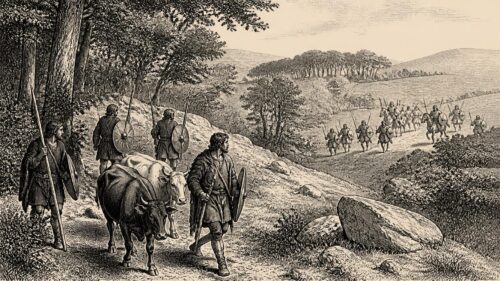
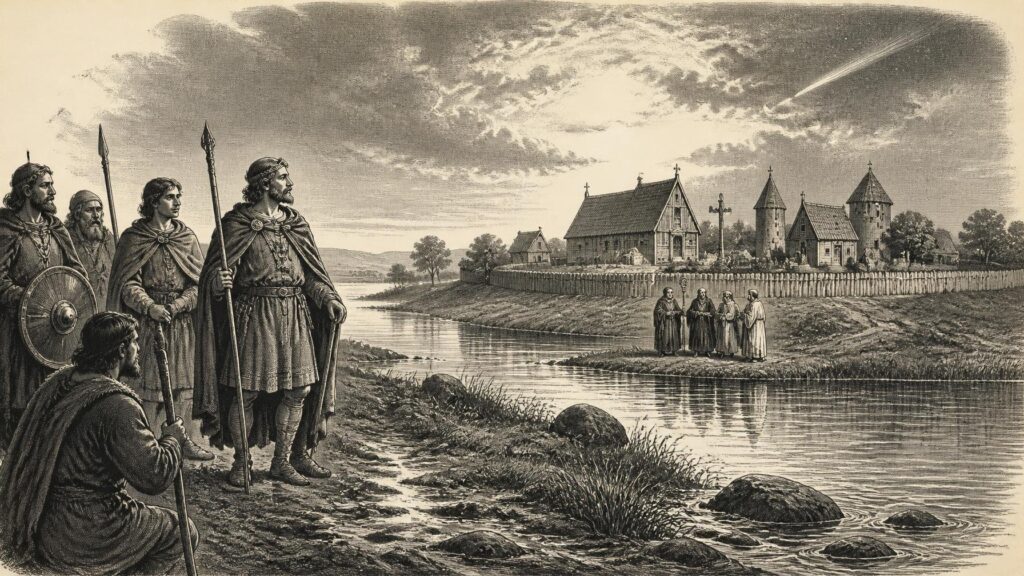
In 912, Irish annals centre on Cernachán son of Duiligén, who removed a captive from Armagh’s sanctuary and who was then killed at Loch Cerr. Niall son of Áed, king of Ailech, drowned Cernachán there, asserting Patrick’s church protection and northern Uí Néill authority. The episode reveals sanctuary, kinship and violence within fragmented kingship. Nearby notices record Niall’s campaigning, conflict between Brega and Leinster, clerical deaths and an accidental fire at Armagh. Annals also describe wet, dark weather and an appearance of Halley’s Comet. Maritime entries show Ulaid fleets, Welsh captives, ransom networks and Scandinavian activity across the Irish Sea.
Dateline
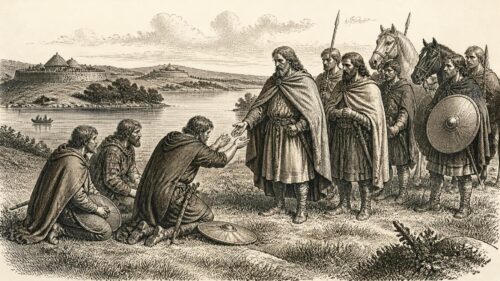
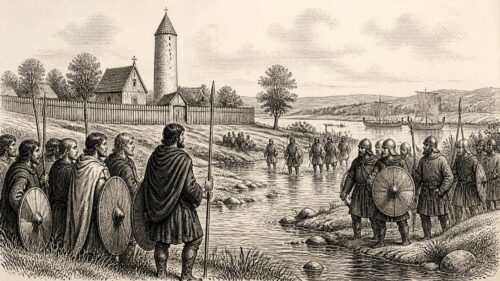
For Ireland, 912 is a year best approached through a small but unusually revealing group of annal entries. They do not offer a single national narrative, and their year-numbering is not perfectly uniform between chronicles. Yet Chronicon Scotorum and the later annalistic tradition preserve a firmly associated episode at Armagh: Cernachán son of Duiligén violated the sanctuary of Patrick’s church by removing a captive, who was then killed at Loch Cerr. Niall son of Áed, king of Ailech, subsequently had Cernachán drowned in the same lake. The incident brings law, kingship, church privilege and violence into sharp focus.
A Violation of Patrick’s Protection
The language of the record is important. Cernachán’s offence was not simply a killing. It was a profanation of Ard Macha: a prisoner had been taken from the church’s protection. In early medieval Ireland, sanctuary was both a religious claim and a practical social institution. A church could offer protection to people at risk, while clerics and lay leaders negotiated settlements, sureties and compensation. To seize someone from such a place challenged not only the victim’s safety but the honour, resources and authority of the ecclesiastical community.
Armagh was the foremost church of Patrick and one of the most powerful ecclesiastical settlements in Ireland. Its authority rested on sacred tradition, learning, landholding, client communities and close dealings with kings. The annal’s description of the offence as a violation of Patrick frames the episode as an affront to the saint’s own protected domain. This was not an abstract jurisdiction backed by a central government. It depended on people with the capacity to enforce it. Niall’s retaliation therefore mattered as much politically as morally.
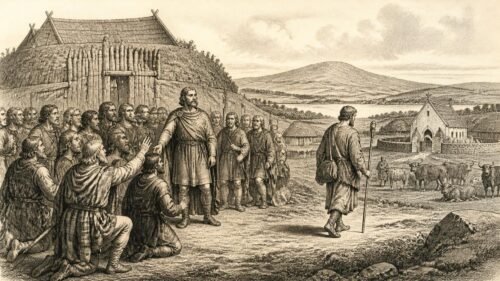
Cernachán was an heir of the Airthir, an important people of the wider Airgialla region around Armagh. Niall belonged to Cenél nÉogain, the northern branch of the Uí Néill, and had become king of Ailech after his brother Domnall entered religious retirement in 911. His drowning of Cernachán was presented as punishment for the profanation. It also demonstrated that the new king could act in the politically sensitive country surrounding Armagh, where the interests of the church, the Airgialla and the northern Uí Néill overlapped but did not always coincide.
It would be misleading to call this a criminal trial in a modern sense. The annals do not describe an investigation, a court or a universally applied royal law. Nor do they explain who ordered the captive’s death or what earlier dispute lay behind it. Nevertheless, the sequence shows that sanctuary had consequences. The killing at Loch Cerr was answered by another drowning in the same place, a deliberate symmetry which the annalist understood as retribution and the restoration of violated protection.
Niall’s Northern Position
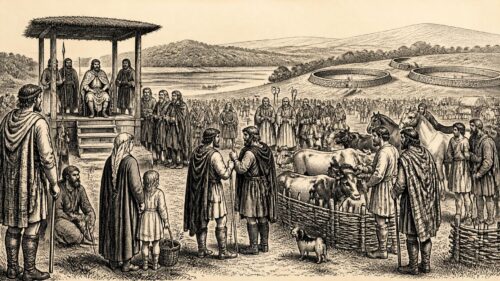
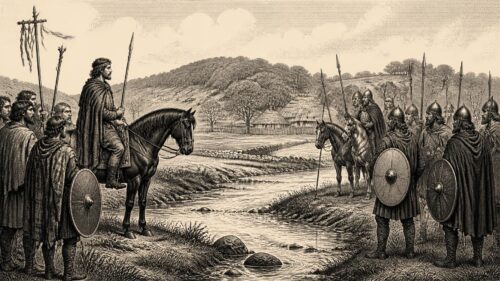
Niall was not yet king of Tara or overking of Ireland. That position remained with Flann Sinna of Clann Cholmáin in the Midlands. Ireland was governed through competing provincial and regional kingships, not a unitary monarchy. The northern Uí Néill controlled substantial power, but kingship was continually tested through raids, alliances, hostage-taking, church patronage and public displays of military strength. The Armagh episode belongs to this environment: a local outrage could become an opportunity for a neighbouring ruler to assert standing.
The wider record around 912 suggests that Niall was becoming a more conspicuous force. Annalistic entries placed in the adjacent chronological sequence credit him with a campaign against northern Connacht, where the Uí Amalgada and the men of Umall suffered defeat, losses and captures. The precise calendar placement of that expedition varies with the annals’ dating systems, so it should not be assigned an exact month in 912. Its broader significance is clearer: Niall’s ambitions reached westward beyond Ailech and Armagh, while his authority was being built through armed followings and successful campaigning.
Conflict elsewhere likewise shows how fragmented political life remained. A battle between forces of Brega and Leinster is recorded in the same annalistic horizon, with prisoners as well as dead left behind. Such notices are terse, but they reveal that warfare was not solely about killing. Captives could be ransomed, exchanged, enslaved or used to compel settlements; cattle and portable wealth were equally central to the economy of power. A king’s household needed food, gifts and followers, and campaigns were one means of acquiring and redistributing them.
Churches as Settlements
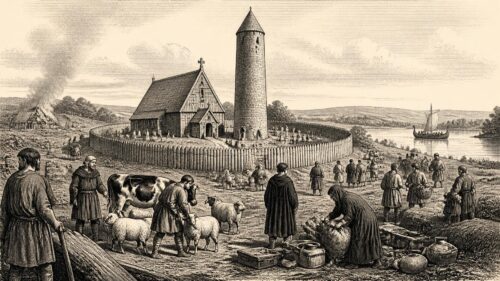
The annals also mark the deaths of leading churchmen associated with Cork and Lismore. Their chronological arrangement differs between surviving compilations, and it is safest to treat them as part of the 912 annalistic dossier rather than insist on a day or even a universally agreed year. Their prominence is itself instructive. An abbot or superior was not merely the head of a secluded religious house. Major Irish churches were settlements with churches, residences, food stores, workshops, cultivated land, livestock and dependent families. Their leaders administered property, welcomed travellers, maintained learning and dealt with powerful lay patrons.
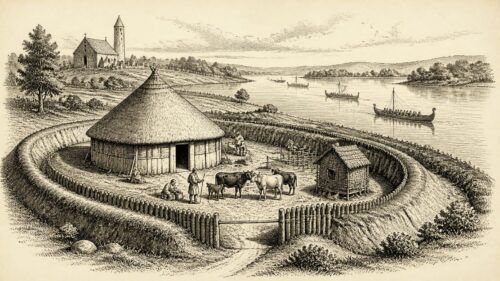
The vulnerability of such places is starkly illustrated by the burning of many houses within the close of Armagh, reportedly through carelessness. The word “houses” should not be imagined as a row of later stone dwellings. Early medieval ecclesiastical communities were largely built in timber and other combustible materials, within enclosures that could contain clergy, students, artisans, tenants and visitors. A destructive accidental fire could damage accommodation, stores and working spaces as well as places of worship. The annal does not say that the church itself burned, nor does it record deaths or famine afterwards; those further consequences must not be presumed.
Learning nevertheless remained embedded in these communities. Irish monasteries and churches preserved Latin literacy, copied texts, trained clerics and maintained historical memory, while also participating in the agricultural world around them. The notice of an attack on sanctuary is therefore not a marginal religious detail. It concerns an institution at the centre of social organisation. To defend Armagh’s protection was to defend a place whose spiritual prestige and material networks extended far beyond its immediate enclosure.
Rain, Darkness and a Comet
The Annals of Ulster characterise the year as dark and rainy and add that a comet appeared. Medieval annals commonly recorded striking weather and celestial phenomena, but the entry should be read carefully. It is evidence that observers considered the conditions memorable; it is not, by itself, proof of a nationwide climatic disaster, failed harvest or famine. Rain may have affected journeys, pasture, river crossings and the rhythm of agricultural work, but the sources for 912 do not quantify such effects.
The comet is more securely placed in a wider astronomical setting. Calculations identify a return of Halley’s Comet in the summer of 912, making it a plausible explanation for the annal’s brief observation. Plausible is not identical to certain: the Irish annalist did not name the object, describe its position or give an observing date. For people in Ireland, however, a bright unfamiliar object in a troubled-looking sky could be significant enough to preserve beside political deaths and fires. The juxtaposition reflects an early medieval habit of recording human affairs and natural signs within one providential history.
An Irish Sea Beyond Ireland
Ireland’s concerns were never confined to the island. An entry assigned to this chronological neighbourhood records that a newly raised fleet of the Ulaid was defeated by “heathens” on the coast of England, with the death of Cumuscach, a son of the king of Leth Cathail. Even allowing for uncertainty in the annals’ exact year alignment, the notice is valuable evidence for maritime connections. Ulster rulers could put ships and crews into the Irish Sea, and their political world extended to western Britain and the English coast.
Another account tells of Máel Brigte son of Tornán travelling to Munster with clergy to raise wealth for the ransom of Welsh captives. The fuller version presents the prisoners as survivors of ships sunk or wrecked while escaping Scandinavian raiders. Again, the absolute dating is not secure enough to turn the story into a precisely dated event of 912, but it illuminates the conditions surrounding the year. Clerical networks crossed provincial boundaries; Welsh people appeared in Irish records as distressed travellers and captives; and ransom was an organised, collective response to the human cost of seaborne violence.
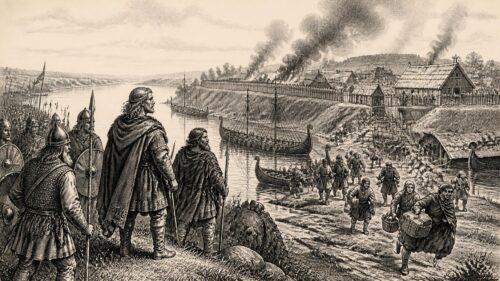
This was a moment between major Viking settlements rather than an age without Scandinavian activity. Dublin’s Viking rulers had been expelled in 902, but Scandinavian groups remained active around the Irish Sea, in Britain and the Isles. Their return to establish new strongholds in Ireland came soon afterwards, most dramatically from 914. In 912, Irish rulers such as Niall were still chiefly occupied with their own rivalries, church relationships and regional campaigns, yet the sea ensured that events in Ulster, Wales, England and the western seaways remained connected.
A Year of Enforced Meaning
The most securely dated Irish episode of 912 was not a great set-piece battle or a royal succession. It was the violation of sanctuary at Armagh and the retribution exacted at Loch Cerr. Its importance lies precisely in its scale. It shows how the authority of Patrick’s church was contested and defended; how a rising northern king could present himself as its protector; and how violence, kinship and sacred privilege shaped political life. Around it, the annals preserve a wet, dark year, a comet, accidental fire, clerical deaths and evidence of an Irish Sea world in which captives and fleets travelled far beyond Ireland’s shores.
Primary Sources
- The Annals of Ulster
- The Annals of Ulster: Year U912
- The Annals of Ulster: Year U913
- Chronicon Scotorum
- Fragmentary Annals of Ireland: Annals 445–450
- Annals of the Four Masters
- Annals of the Four Masters: Annals M903–M912
- Annals of the Four Masters, Irish Text: Annal M912
- Annals of Inisfallen: Annals AI910–AI919
- Niall Glúndub
- The Chronicle of Ireland: Then and Now
- The Vikings in Ninth-Century Ireland: Sources and Settlements
- The Vikings in Ulaid
- Vikings in Ireland and Scotland
- Early Christian Monasteries
- Churches and Ecclesiastical Enclosures
- Early Irish Monasticism
- The ESA Mission to Comet Halley
- The Fragment of Al-Kindī’s Lost Treatise on Observations of Halley’s Comet in A.D. 837
- The Motion of Halley’s Comet from 837 to 1910
- Early Long-Period Comets: Their Discovery and Flux
- CELT: List of Published Texts