Niall’s Meath Settlement915 CE
In 915, Ireland experienced interconnected political, religious and military pressures rather than a decisive battle. Óengus, Flann Sinna’s designated heir, died, weakening the ageing king of Tara, while Domnall of Ailech died in penitence, confirming his half-brother Niall Glúndub’s northern prominence. Flann’s sons Donnchad and Conchobor rebelled in Mide, but Niall’s army secured their submission and a truce with Brega, enhancing his influence. Scandinavian forces based at Waterford Harbour plundered Munster churches and settlements. Deaths of leading clerics and the treacherous wounding of a local king reveal institutional and regional instability. The year foreshadowed later succession conflicts and Viking warfare.
Dateline
The year 915 was not marked by a single battle that settled Ireland’s affairs. Instead, it exposed how precarious authority could be: an elderly king of Tara faced revolt from his own sons; a northern ruler intervened to restore a family peace; two important dynastic figures died within weeks; and Scandinavian forces based around Waterford Harbour continued to menace the south. The Irish annals offer unusually sharp glimpses of these developments, but their chronology must be handled with care. The Annals of Ulster places its material under a heading reading ‘AD 914 alias 915’, while Chronicon Scotorum gives the same cluster under 915. This article follows the calendar-year placement generally used for these events, while avoiding the temptation to import famous episodes that belong to 916 or 917.
A Death at Temair’s Edge
On 7 February, Óengus, son of Flann Sinna and heir designate of Temair (Tara), died. The notice is unusually exact, even supplying the day of the week. Temair was more than a hill in Meath: in political language, its kingship represented the paramount authority claimed by leading Uí Néill dynasties. To be named heir designate there was therefore a major distinction, though it did not guarantee a peaceful or automatic succession.
The annals preserve two perspectives on Óengus’s end. The Annals of Ulster simply records his death, then attaches a short verse praising Cern son of Bern for killing him in an armed assault said to avenge Áed Allán. Chronicon Scotorum instead says that Óengus died after being mortally wounded at the battle of Grellach. Neither brief notice supplies the full setting, and it would be unsafe to reconstruct one. What can responsibly be said is that the death removed a recognised successor from the household of Flann Sinna at a particularly difficult moment in the king’s long reign.
Flann was still king of Tara in 915. He did not die until 25 May 916, and Niall Glúndub did not become king of Tara, nor renew the fair of Tailtiu, until after that death. Some later annalistic arrangements place those later actions under 915; they should not be treated as events of this calendar year. In 915, Flann remained alive, elderly and politically vulnerable, while the question of his succession was becoming more dangerous.
Domnall’s Penitent End
On 21 March, at the spring equinox, Domnall son of Áed, king of Ailech, died ‘in penitence’. Domnall was Niall Glúndub’s half-brother and belonged to Cenél nÉogain, the powerful northern branch of the Uí Néill. The phrase used by the annalist matters. It presents his death through a religious lens and accords with evidence that Domnall had already taken the pilgrim’s staff and withdrawn from active kingship some years earlier. Niall had succeeded to the rule of Ailech in 911, so Domnall’s death was not a sudden transfer of power; rather, it closed the life of a former ruler whose renunciation had shaped the northern dynasty’s recent arrangements.
The pairing of Óengus’s February death and Domnall’s March death reveals two different pressures within elite politics. Óengus’s end reduced Flann’s pool of acceptable heirs in the south. Domnall’s death, by contrast, left Niall more clearly the senior political figure of his immediate northern kindred. Neither event made Niall high king of Ireland in 915. Yet the year gave him an opportunity to act beyond Ailech in a way that displayed both military reach and diplomatic usefulness.
Rebellion in Mide
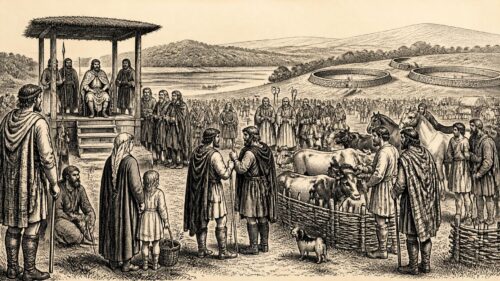
Flann Sinna’s sons Donnchad and Conchobor rebelled against their father and harried Mide as far as Loch Rí. The detail is revealing. Mide was the heartland of Flann’s Clann Cholmáin dynasty, and Loch Rí, on the Shannon, lay at an important western approach to it. This was not merely an argument inside a royal household. A royal rebellion meant the mobilisation of followers, the taking of livestock and provisions, and the disruption of communities whose obligations and security depended on the king’s peace.
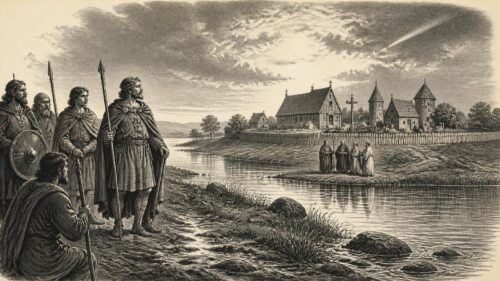
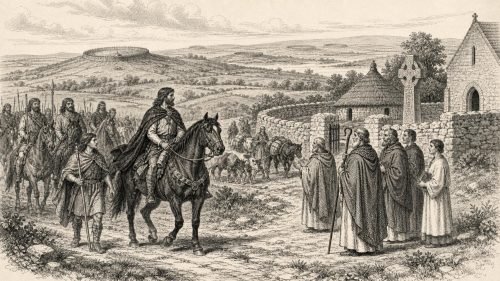
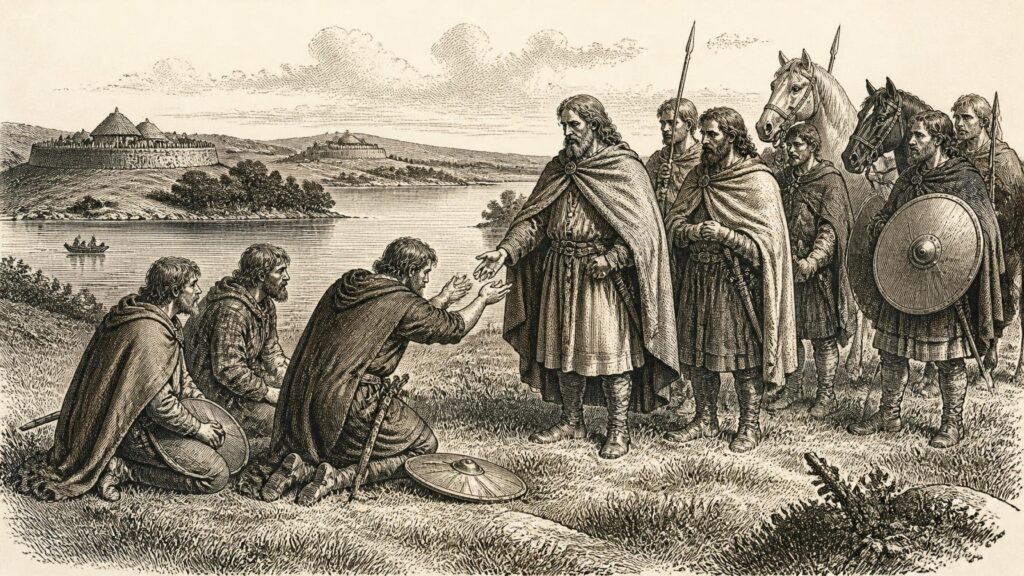
Niall came south with a northern army. The annalist does not describe a pitched battle. Instead, Niall compelled Donnchad and Conchobor to give a pledge that they would obey their father, and he made a truce between Mide and Brega. Such a pledge was not a modern written contract. It was a public political obligation, backed by honour, kinship and the real possibility of renewed force. Its importance lay in binding the rebel sons again to Flann while also calming the wider frontier between Mide and Brega.
The settlement shows that Ireland’s many kingdoms were connected by more than warfare. Niall’s intervention depended on his ability to bring an army into Meath, but its outcome was a negotiated restoration of order. Kinship helped explain his role: he was married to Flann’s daughter Gormlaith. Even so, this should not be reduced to a domestic favour. By rescuing the authority of the king of Tara, Niall made himself indispensable to the southern Uí Néill establishment. The support he gave in 915 would plainly strengthen his position when the succession to Tara opened the following year.
The Harbour of Loch Dá Chae
While political tension was contained in the midlands, the south faced a more immediate external threat. The Annals of Ulster reports ‘a great and frequent increase’ in the number of heathens arriving at Loch Dá Chae, generally identified with Waterford Harbour. The annalist adds that the laity and clergy of Mumu, or Munster, were plundered. Chronicon Scotorum gives a starker local list: Cork, Lismore and Aghaboe were plundered by the heathens.
These entries should not be made to say more than they do. They do not establish that every named ecclesiastical centre was struck in one coordinated expedition, nor do they provide casualty totals. They do, however, document a broad worsening of danger from a harbour that offered access to the south-east and to river routes inland. A Scandinavian fleet had established itself in the Waterford region in 914; by 915 the annals perceived not a passing raid but a growing and repeatedly arriving force.
The word ‘heathens’ is the Christian annalists’ term, not a neutral ethnic description. The newcomers included Scandinavian military and political groups, especially people linked to the wider dynasty later called Uí Ímair. Their presence was part of a sea-connected world spanning Ireland, the Irish Sea and northern Britain. Yet the experience registered in Irish churches and settlements was immediate: loss of goods, fear of attack and the breach of places regarded as protected by saints and ecclesiastical privilege.
Cork and Lismore were not isolated shrines. They were religious communities with land, food renders, craftsmen, clerics and lay dependants; Aghaboe likewise belonged to the network of important Irish church settlements. Their vulnerability helps explain why annalists recorded such attacks as public calamities. Monasteries were centres of worship and learning, but they were also repositories of movable wealth and nodes in regional exchange. Raiding them damaged both sacred standing and local economic life.
Churches, Offices and Memory
Ecclesiastical deaths recorded in 915 remind us that the church’s institutional map overlapped with the political map. Máel Ciaráin son of Eochucán died in his fiftieth year. He was superior of Cluain Eois, modern Clones, and bishop of Armagh; Chronicon Scotorum also associates him with Muccnamh and calls him the fosterling of Féthgna. His combination of offices linked a major northern monastery with Armagh, the foremost Patrician church. Such titles were not simply spiritual honours: they indicate authority over communities, property, personnel and inherited relationships.
Two men called Scannlán also died. One was associated with Tallaght, the monastery founded by Máel Ruain and long connected with the Céli Dé tradition of disciplined religious observance; the other was superior of In Chongbáil in Glenn Suilige. The Annals of Ulster calls the Tallaght Scannlán a superior, while Chronicon Scotorum calls him a bishop. The difference is a useful warning against imposing rigid modern job descriptions on early medieval church offices. Churches could be centres of pastoral authority, learning, estate management and political connection at once.
Elsewhere, Ruarc son of Máel Brigte, king of Múscraige Tíre, was mortally wounded through ‘treachery and cunning’ by the Uí Dúngalaig. The phrase is formulaic but forceful: the annalist marked not a formal battle but a lethal act of political violence. It is a reminder that the great names of Tara, Ailech and Waterford did not exhaust Irish history. Local kingships mattered, and their rivalries could be resolved abruptly through ambush, betrayal or targeted killing.
A Year of Contained Crisis
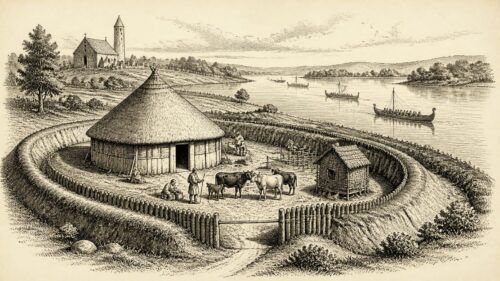
For ordinary people, the surviving record is frustratingly selective. It names kings, clerics, raids and settlements; it does not describe a farmer’s household, a boatman’s cargo or a craftworker’s routine in 915. Archaeology and wider early medieval evidence show an overwhelmingly rural Ireland sustained by cattle, arable production and church-centred estates, while Scandinavian bases were helping create the island’s first towns. But these are the conditions surrounding 915, not separately dated events within it.
What the year itself securely shows is a society under pressure but not without mechanisms of repair. In Mide, armed rebellion ended in submitted pledges and a truce. In the north, the death of Domnall confirmed Niall’s standing at Ailech. In the south, the growing Scandinavian presence at Loch Dá Chae exposed the limits of such internal settlements: no agreement between Irish dynasties could by itself remove a seaborne threat. The crises of 915 therefore formed a threshold. They did not yet produce Niall’s kingship of Tara or the major conflicts of 917, but they made both the opportunity and the danger unmistakable.
Primary Sources
- The Annals of Ulster, Year U915
- Chronicon Scotorum
- Annals of the Four Masters, Volume 2
- Annals of Inisfallen, Annals AI910–AI919
- Fragmentary Annals of Ireland, Annals FA451–FA459
- Niall Glúndub
- Flann Sinna
- Ragnall
- The Viking Age in Ireland
- Early Medieval
- Agriculture, Settlement and Society in Early Medieval Ireland
- The Chronological Apparatus of the Annals of Ulster AD 82–1019
- Chronological Synchronisation of the Irish Annals
- The Chronology and Sources of the Early Irish Annals
- The Irish Annals
- Ireland in the Middle Ages
- Prehistoric and Early Christian History of Tallaght
- Introduction to County Waterford: City Urban Archaeology Survey
- Waterford Heritage Strategy 2025–2030
- Vikings in Ireland