Jordan’s Corann Raid1273 CE
In 1273, Irish authority remained fragmented among royal officials, settler magnates and Gaelic dynasties. Jordan d’Exeter’s raid in Corann provoked a failed Connacht pursuit, killing several members of ruling and learned families. Elsewhere, Conchobar Buidhe Ó Ruairc of Brefne and Eochaid Mac Mathghamhna of Oriel were killed, while expulsions altered power in western Connacht. Maurice FitzGerald’s expedition into Thomond obtained O’Brien hostages and submission, though not lasting conquest. Geoffrey de Geneville arrived as justiciar, strengthening royal administration without eliminating regional independence. Richard de Carew died, and a Barry charter granted Cahirduggan church to Ballybeg Priory, illustrating ecclesiastical patronage amid warfare.
Dateline
In 1273, Ireland’s political map was not a clean division between an English lordship and an Irish resistance. Authority was layered, negotiated and repeatedly contested. The king of England claimed the lordship of Ireland, his justiciar governed from Dublin, great settler families commanded castles and estates, and Gaelic kings exercised power through kinship, tribute, military followings and control of routes, herds and client peoples. The year’s records show this unstable order especially clearly: a raid in north Connacht ended in a bloody reverse; rulers died in Brefne and Oriel; a Fitzgerald army compelled an O’Brien submission in Thomond; and Geoffrey de Geneville arrived as justiciar to represent royal authority.
Corann and the Cost of Pursuit
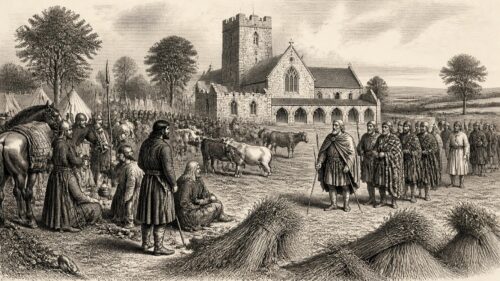
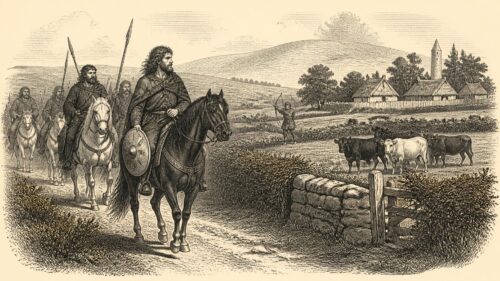
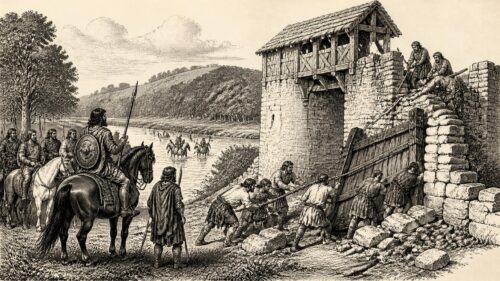
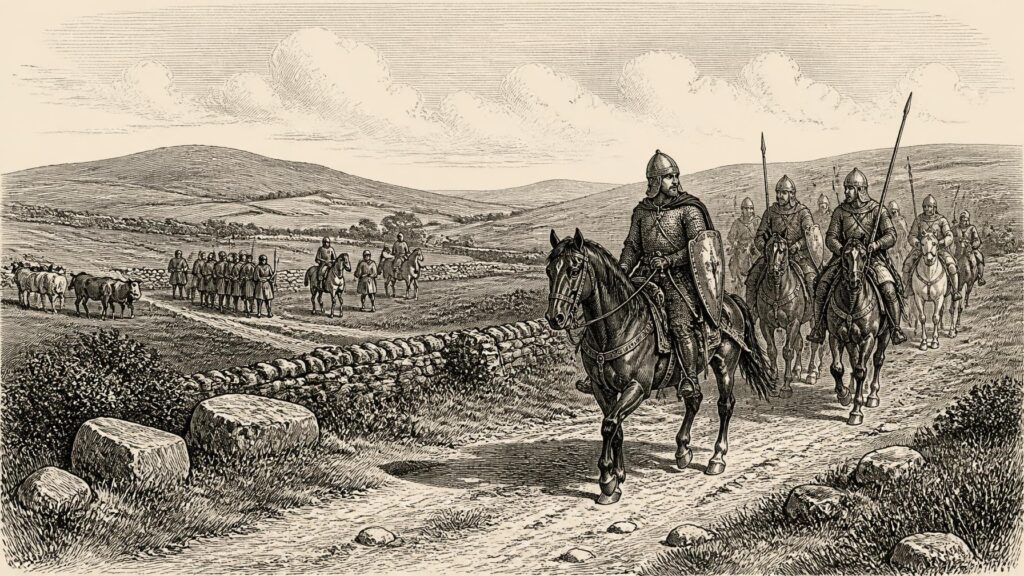
The most revealing episode took place in Corann, a district centred broadly on south County Sligo and adjoining north Connacht. Jordan d’Exeter, a leading member of a settler family established in Connacht, made a raid there. Raiding was not incidental violence. It was a political instrument: livestock could be seized, dependants punished, claims to protection tested, and a rival lord’s ability to mobilise men exposed. The annalist’s brief notice assumes that readers understood this harsh logic.
A small party of Connacht princes caught up with Jordan’s force. But, according to the Annals of Connacht, they were led into an ‘unwise move’ by the counsel of an unnamed, disreputable figure. The pursuit became a disaster. Domnall, son of Donnchad and grandson of Magnus Ó Conchobair; Magnus son of Art; Oirechtach Mac Aedacáin; Áed Ó Birn; and many others were killed. The Annals of the Four Masters, drawing on related annalistic traditions, preserves the same essential account.
The detail matters because it reveals the scale on which power operated. The dead were not anonymous foot soldiers alone but men of ruling and learned families, people whose loss weakened particular kindreds and their alliances. Yet the sources neither name a battlefield nor supply a precise day, and they do not permit a confident reconstruction of tactics. It would be wrong to turn a terse notice into a set-piece battle. What can responsibly be said is that Jordan’s incursion was followed by a failed interception, and that the losses fell heavily upon Connacht’s political elite.
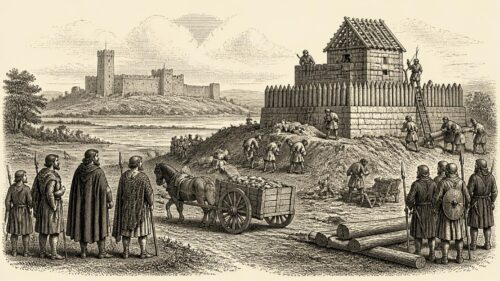
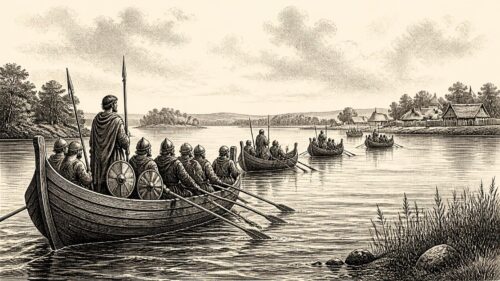
The episode also belongs to a larger, recent struggle in Connacht. Áed mac Fedlimid Ó Conchobair, king of Connacht since 1265, had fought both Gaelic rivals and the settlers whom the Irish annals commonly called Galla, or ‘foreigners’. In 1269 the royal administration had constructed a castle at Roscommon while Áed was ill; by 1272 he had demolished it, burned Athlone and damaged its bridge, and launched a fleet on Lough Ree. Such actions show why a raid into Corann could carry consequences far beyond the immediate plunder. In 1273 neither lordship nor kingship in Connacht rested securely on a fixed frontier.
Deaths and Successions Beyond Connacht
Conflict also reshaped leadership elsewhere. Conchobar Buidhe Ó Ruairc, king of Brefne, was killed by sons of Conchobar son of Tigernán Ó Conchobair. He in turn killed Tigernán, described as the best of his attackers, before he fell. The compressed wording points to a feud among powerful neighbouring dynasties rather than a simple contest between two neatly bounded states. Brefne, spanning much of the region later associated with counties Leitrim and Cavan, remained a strategically important Gaelic kingdom between Connacht, Meath and Ulster. The death of its king made its internal balance still more precarious.
Further north, Eochaid Mac Mathghamhna, king of Oriel or Airgíalla, was killed along with many companions by Ó hAnluain and Cenél nEógain. The record is especially significant for the history of the Mac Mathghamhna, later MacMahon, dynasty in the Monaghan region. Eochaid’s son Brian succeeded him, but the killing underlines that his kingship was contested by both local rivals, including the Ó hAnluain of south Armagh, and the far more powerful northern interests of Cenél nEógain.
These deaths should not be treated as evidence of a general collapse, nor as isolated personal tragedies. Medieval Irish kingship was dynastic and competitive: a ruler needed the backing of close kin, subordinate lords, churchmen and military followers. Killing a king could alter access to tribute, land, hostages and alliances immediately. The same year’s notices of banishment make the point. Domnall of Erris was driven from Umhaill and Erris, while Ruaidrí Ó Flaithbertaig was expelled from west Connacht, both by the Galla. Exile was therefore a practical method of remaking regional power without necessarily holding every settlement permanently.
Hostages in Thomond
In the west of Munster, Mac Muiris Mac Gerailt — Maurice fitz Maurice FitzGerald — led what the Annals of Connacht calls a great expedition into Thomond. It secured hostages and ‘submission’ from Ó Briain. This was not simply an English conquest of a Gaelic kingdom. Maurice was a leading Anglo-Norman magnate with his own regional interests, while the O’Briens were divided by rivalry within their dynasty. Brian Ruad Ó Briain, who had succeeded in the late 1260s, faced growing pressure from his nephew Toirrdelbach.
Hostages were central to this kind of politics. They were usually people of rank, surrendered as guarantees that terms would be observed. Their delivery publicised superiority, imposed a cost on defiance and created leverage for further negotiation. But it did not necessarily establish permanent obedience. The wording of the annal means that the 1273 expedition compelled an O’Brien submission at that moment; it does not justify claiming that Thomond had been fully subdued. Later warfare in the region confirms how limited and contingent such settlements could be.
The campaign also illustrates the overlap of Gaelic and settler political methods. Armies marched, cattle and supplies were vulnerable, fortifications mattered, and hostage-taking remained a recognised means of enforcing agreements. The distinction was not between a supposedly orderly feudal world and an allegedly lawless Irish one. Rather, competing lordships used related coercive tools within different legal and cultural frameworks.
A New Royal Governor
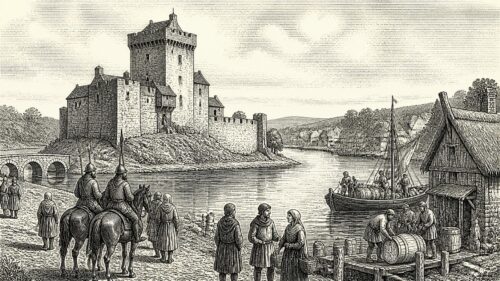
During the year Geoffrey de Geneville arrived in Ireland as justiciar from the king of England. His arrival is firmly associated with 1273, and he was in Ireland by September. Geneville was no stranger to the island: through his wife, Matilda de Lacy, he held the liberty of Trim in Meath, one of the great lordships of the English settlement. He had also served earlier in Irish government and had military and diplomatic experience in the king’s wider dominions.
The justiciar was the king’s chief representative in Ireland, responsible for royal administration, justice, finance and military response. Yet the office did not command effortless obedience. The lordship was a patchwork of royal lands, ecclesiastical jurisdictions, powerful liberties and territories where Gaelic rulers retained or recovered authority. Geneville’s appointment brought a more experienced royal agent into that difficult environment, but it did not erase the independence of magnates such as the de Burghs, FitzGeralds and de Exeters, nor did it end the power of Irish dynasties.
His first months should therefore be seen as a change in the machinery of government rather than an instant turning point. The troubles visible in 1273 — competition in Connacht, resistance on regional frontiers, dynastic conflict in Thomond and upheaval in the north — were precisely the problems that his government had to confront. His later attempts to rebuild royal positions in Connacht demonstrate that this was an active frontier, not a remote zone beyond administration.
Church, Charter and Everyday Continuity
Not every development of 1273 was military. The Annals of Inisfallen records the death in Cork of Richard de Carew, described as a great baron and seneschal of Desmond. His death marked a change within the local governing class of south Munster, where offices, estates and affinities helped connect lordship to towns, manors and religious institutions.
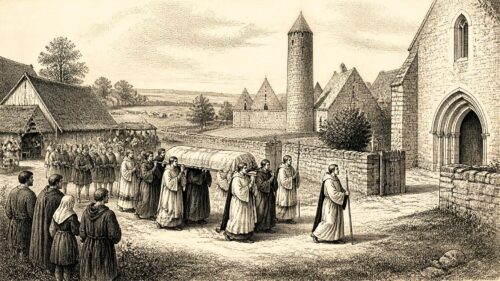
A charter dated 28 September records William fitz Richard de Barry granting the church of Cahirduggan to the Augustinian priory of Ballybeg. Such a gift was small beside an army’s progress, but it shows another durable form of power: the transfer of rights in churches and land to a religious house. Monastic and canonical communities prayed for patrons, administered property, received rents and offerings, and formed part of the social infrastructure through which elite authority was remembered and reproduced.
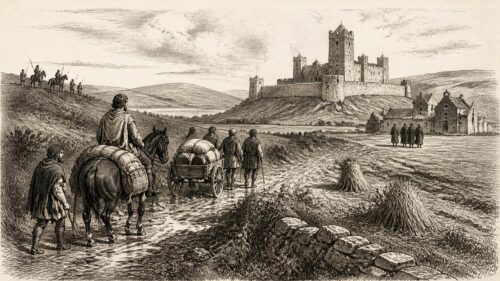
For most people, the year was experienced less through named kings than through its local effects: the movement of armed men, the threat of cattle-raiding, obligations of food and transport, the safety of roads and fords, and the claims made by secular lords and churches alike. The chronicles overwhelmingly preserve the deeds of rulers, yet their repeated concern with raids, hostages, banishment and lordship makes clear that warfare bore directly on the agricultural and pastoral communities who supplied its labour and suffered its losses.
Thus 1273 was not a year of one decisive Irish event. It was a year in which several contested regions exposed the realities of late thirteenth-century Ireland: royal government could appoint a new justiciar, but authority still depended on personal alliances; a successful expedition could win hostages, but not settle Thomond; and a raid in Corann could end with the deaths of men whose families shaped Connacht’s future. The island’s politics remained local in operation, but interconnected in consequence.
Primary Sources
- Annála Connacht
- Annála Connacht: Irish Text
- Part 33 of Annála Connacht
- Annals of the Four Masters, Part 11
- Annals of the Four Masters: Irish Text
- The Annals of Ulster, Part 75
- Annála Uladh: Annals of Ulster Otherwise Annala Senait
- Annals of Inisfallen, Part 79
- Annals of Inisfallen: Irish Text
- Annales Hiberniae
- Annales Hiberniae: Irish Text
- Geneville (Joinville), Geoffrey de
- MacMahon (Mac Mathghamna), Brian
- O'Brien (Ó Briain), Brian Ruad
- Vaucouleurs, Ludlow and Trim: the Role of Ireland in the Career of Geoffrey de Geneville (c. 1226–1314)
- English Rule in Ireland, c.1272–c.1315
- The Archaeology and History of Medieval Dublin: Volume Two
- The O’Hanlons, the O’Neills and the Anglo-Normans in Thirteenth-Century Armagh
- Norman Times and After
- ‘Geographical Loyalty’? Counties, Palatinates, Boroughs and Ridings
- Sefraid Ó Fearghail and Anghaile, 1271–1318
- Ballybeg Priory St Thomas: An Augustinian House in Ireland