

Limerick Exodus
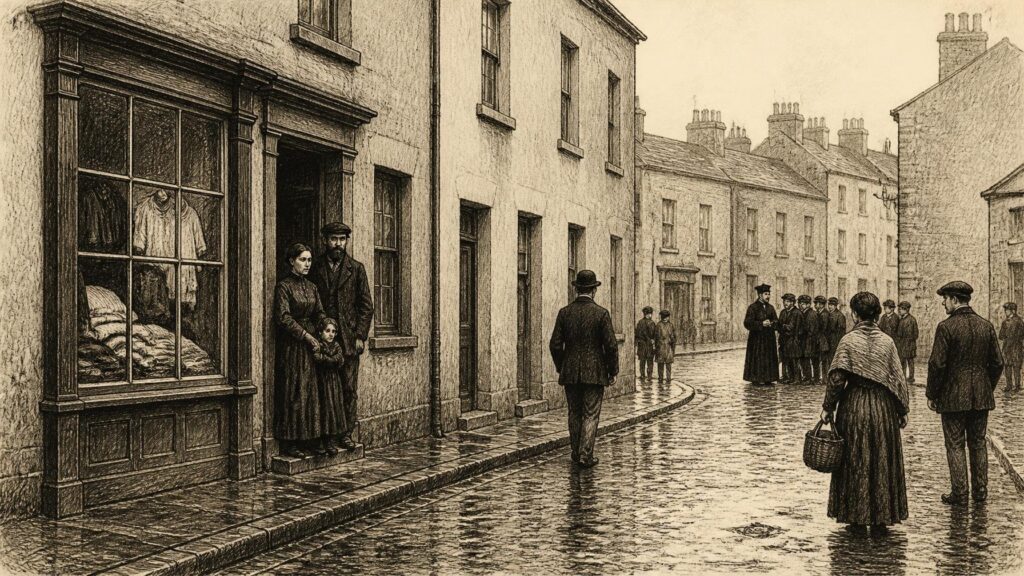
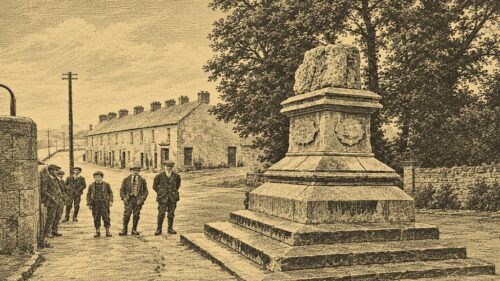
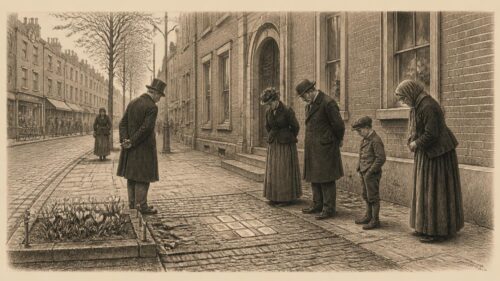
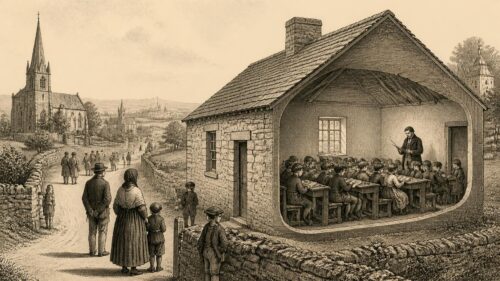
AI generated historical illustration, not a contemporary photograph.
At a Glance
The history of the Jews in Limerick is not simply the story of a boycott in 1904. It is the history of a small migrant community which made homes, built institutions, traded, worshipped and raised children in an Irish provincial city, before organised hostility damaged livelihoods and helped to disperse many families. The episode has endured because it exposes a grave failure of neighbourliness, but it should not erase the community’s life before the crisis, the resistance offered during it, or the complexity of the city in which it occurred.
New Arrivals
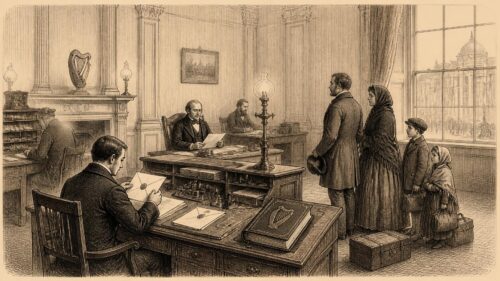
Jewish settlement in Limerick developed during the later nineteenth century, when migration from eastern Europe brought Jewish families from the Russian Empire and its western borderlands to Britain and Ireland. Many of those who came to Ireland had roots in Lithuania, then under Russian rule. They were part of a much wider movement caused by poverty, legal discrimination, military pressures and recurrent antisemitic violence. Ireland was not the principal destination: London, Liverpool, Leeds, Manchester, Glasgow, New York and other large cities offered larger established communities and more varied employment. Yet Irish ports and towns became stopping places and, in some instances, permanent homes.
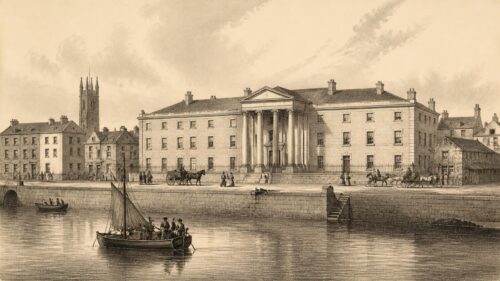
Limerick’s Jewish residents were therefore neither ancient outsiders nor an undifferentiated body of strangers. They were recent arrivals in a city already marked by commercial rivalry, religious division, migration and economic insecurity. Most lived near Collooney Street, now Wolfe Tone Street, and Lord Edward Street. Their neighbourhood was close to the commercial centre, allowing families to combine domestic life with small-scale retail and itinerant trade. The 1901 census recorded 168 Jews in Limerick, though figures in contemporary accounts vary according to whether they counted the urban district, temporary residents, individual households or families connected with the community.
The variation matters. Later retellings often reduce Limerick Jewry to a neat number of families, usually somewhere between thirty and forty, or to a population of roughly 150. Such estimates convey the community’s small scale but can suggest a fixed and isolated group when its membership was fluid. Hawkers travelled; relatives joined or left households; some people lived nearby rather than in the central streets; and some families were connected to businesses without appearing in a single simple tally. The available evidence nevertheless leaves no doubt that the community was large enough to create its own religious, charitable and social arrangements.
A synagogue was established in Collooney Street in 1889. There was also a bikur cholim, a traditional visiting and relief society concerned with the sick and needy. By the turn of the century, the community had organised a Jewish Board of Guardians. In 1902 it acquired land at Castletroy for a burial ground and prayer house. These were not ornamental signs of prosperity. They were practical institutions through which a dispersed migrant population could sustain worship, burial customs, mutual aid and dignity in a place where few public structures were designed around Jewish life.
The Limerick congregation was never entirely separate from the wider Irish Jewish world. It had connections with Dublin, Cork, Belfast, London and the representative organisations of British and Irish Jewry. It also belonged to the everyday social world of Limerick: customers entered its shops, traders dealt with local suppliers, children went to local schools, and Jewish families encountered Catholic, Protestant and nonconformist neighbours. This proximity was the condition of both coexistence and conflict. It created ordinary routines of exchange, but it also made a small visible minority vulnerable when commercial grievance was turned into religious accusation.
Street Commerce
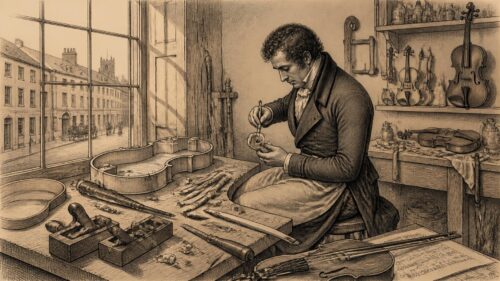
The economic life of the community lies at the centre of the 1904 crisis, but it requires careful explanation. Many Jewish residents were traders: pedlars, drapers, grocers, dealers in clothing, pictures and household goods, and travelling salesmen. Such occupations were common among migrants who had little capital, limited access to established professions and few local connections. They were also highly visible. A trader’s work was conducted in streets, markets, rented shops and customers’ homes; success could easily be resented by longer established competitors or misrepresented by debtors.
Particular hostility attached to the practice of selling goods through weekly instalments. For households with irregular or very low incomes, the opportunity to obtain clothing or domestic necessities and pay gradually could be useful. For sellers, credit carried obvious risks. Debts could go unpaid, collection was time-consuming, and profits were not necessarily large. Yet instalment trading was readily recast by opponents as evidence of exploitation. The accusation relied on a familiar antisemitic stereotype: that Jews were peculiarly associated with usury, dishonesty and the manipulation of poor people.
It would be a mistake to respond to that prejudice by pretending that no customer ever disliked a creditor, no shopkeeper ever complained about competition, or no trader ever acted harshly. Commercial disagreement existed in every town. The central historical question is different: why did ordinary conflicts become a campaign against people as Jews? The answer cannot be reduced to the conduct of particular merchants. The campaign generalised from individual debts to an entire population, treating Jewish religious and ethnic identity as proof of collective guilt.
Limerick in the early twentieth century contained many people living close to hardship. Employment was insecure and the city’s economy was not flourishing. Its military presence could affect family incomes, while emigration was a constant fact of life. Such conditions did not cause antisemitism in any automatic sense. Poverty does not explain bigotry away, nor does it make violence inevitable. But economic insecurity supplied an audience for claims that identified a visible minority as the source of hardship. The merchants were portrayed not as neighbours making a living under similar constraints, but as alien intruders whose gain supposedly depended upon native loss.
That rhetoric could draw strength from broader European currents. The decades before 1914 saw mass Jewish migration, political agitation over immigration, and the circulation of hostile myths across national borders. The Kishinev pogrom of 1903 had horrified many observers, including the Irish nationalist Michael Davitt, who travelled in Russia and wrote against antisemitic persecution. At the same time, anti-Jewish language was available in Catholic polemic, nationalist journalism, British anti-immigration politics and European conspiracy theories. Limerick was a local place, but local prejudice did not develop in intellectual isolation.
Contemporary Jewish testimony stressed that many relations had previously been amicable. That should not be romanticised into an image of perfect harmony. It does, however, challenge the idea that a permanent and unanimous hostility had always governed the city. The events of 1904 were made, not fated. Sermons, newspaper controversy, organised social pressure and failures of civic courage changed the atmosphere in which Jewish residents had been living.
January Sermons
The immediate catalyst came in January 1904, when Father John Creagh, a Redemptorist priest and spiritual director associated with the Arch Confraternity of the Holy Family, delivered antisemitic addresses at the Redemptorist church. The confraternity had thousands of members and gave the priest a large male audience. Its scale is important: Creagh did not make private remarks in an obscure setting. He spoke from a position of moral authority before an organised body capable of carrying a message into workplaces, streets and households.
Creagh’s allegations combined religious hostility with commercial accusation. He represented Jews as exploitative traders, attacked their faith and invoked old calumnies that had long been used to endanger Jewish communities elsewhere. Contemporary reports record accusations of ritual murder, blasphemy and financial predation. These were not responsible criticisms of named businesses supported by evidence. They were collective slanders. Their function was to turn a dispute about trade into a moral emergency, in which Christians were invited to see dealings with Jewish neighbours as a betrayal of their own community.
The chronology is reasonably clear, even if every detail of the sermons survives through mediated reports rather than a complete authorised transcript. Creagh spoke on 11 January and followed with another intervention soon afterwards. The first sermon was followed by attacks and disorder; the second urged listeners to avoid commercial dealings with Jews. The distinction between verbal incitement and subsequent action should not be blurred. A priest did not personally perform every assault or refuse every purchase. But the sermons supplied a religious licence for conduct which, without such sanction, might have been more difficult to organise or defend.
Creagh later asserted that he deprecated violence. That qualification cannot absolve him of responsibility for the climate he helped create. When a speaker depicts a minority as a predatory collective, tells an organised audience to withdraw custom from it, and does so amid street intimidation, the practical meaning is clear. A boycott does not remain merely a matter of individual consumer preference when participants use threats, public shaming and violence to enforce it. The line between persuasion and coercion was crossed repeatedly in Limerick.
The role of religion must be described precisely. The crisis was not an inevitable expression of Catholic belief, nor can it fairly be assigned to every Catholic in Limerick. Creagh was a Redemptorist and therefore belonged to a religious order with its own structures, not simply to the diocesan clergy of Limerick. The Catholic bishop, Edward O’Dwyer, condemned mob action and communicated his opposition to diocesan priests. Other Catholic figures, including Michael Davitt, publicly rejected the antisemitic agitation. Nonetheless, Creagh’s clerical office and the mobilisation of a Catholic confraternity gave the campaign a powerful religious vocabulary and organisational setting.
For Jewish residents, the sermons created an abrupt crisis of safety and belonging. Rabbi Elias Bere Levin, community leaders including Saul Goldberg, and others sought help, reported assaults and appealed for intervention. Their actions demonstrate that the community was not passive. It used letters, deputations, legal processes, contacts beyond Limerick and public argument. Those efforts are essential to the record because later narratives sometimes present Jewish families only as victims departing in silence. They protested, negotiated, gathered evidence and insisted on their rights as residents.
Boycott Begins
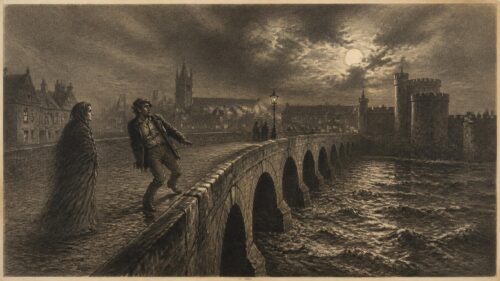
In the days after the sermons, intimidation moved from pulpit to street. Jewish people were abused and assaulted, windows were broken, stones and mud were thrown, and business was disrupted. Police made arrests and some cases reached the courts. The existence of prosecutions is significant, since it confirms that violence was not merely an invention of hostile reporters. Yet the limited number of people brought before the law should not be mistaken for a measure of the campaign’s total reach. Crowds could be large, witnesses reluctant, and daily pressure difficult to prosecute.
The more enduring weapon was economic exclusion. Customers were urged not to buy from Jewish traders. Those who did continue to trade could be exposed to social pressure. Debtors sometimes withheld instalments or repudiated obligations, leaving traders unable to recover money owed without risking further hostility. The boycott therefore attacked not only current sales but credit arrangements, stock purchases, household income and confidence in remaining in business. For a family enterprise with little reserve capital, even a short interruption could be ruinous.
Descriptions of the boycott’s duration vary. Some accounts describe a campaign lasting until 1906; others emphasise the particularly destructive months of 1904, after which the community had already contracted drastically. These are not necessarily incompatible claims. The acute outbreak, including much of the recorded violence, was concentrated in the early period. Its commercial and demographic consequences continued longer. Historical writing should distinguish the first sustained phase of intimidation from the wider period in which Jewish residents continued to live with its effects.
There is similarly no single uncontested count of incidents. Scholarly research has identified as many as fifty anti-Jewish incidents between February and July 1904, encompassing intimidation and violence. Such a figure should be treated as a record of known cases, not as an exact total of everything that occurred. Lesser threats may have gone unreported; newspapers had political loyalties; police reporting could minimise disorder; and later memory could compress separate episodes into a single narrative. What is secure is that the attacks were numerous enough to make ordinary trade and movement hazardous.
The behaviour of the local press formed part of the conflict. The Limerick Leader gave space to arguments hostile to Jewish traders, while newspapers beyond the city also circulated the controversy. The press could reinforce the idea that Jewish commerce was a public menace, or could give opponents a platform from which to dispute it. In this sense the boycott was not merely a spontaneous crowd reaction. It was sustained by words in sermons, editorials, meetings, letters and conversations that defined one group of residents as a legitimate target.
Boycott had a particularly sharp resonance in Ireland, where the word itself had entered international usage after the ostracism of Captain Charles Boycott in County Mayo in 1880. Yet the comparison should not obscure the moral difference between campaigns. The earlier term was associated with agrarian resistance to an estate agent. In Limerick, a method of collective withdrawal and social coercion was deployed against a small religious minority. The historical irony is painful: a tactic associated with resistance to power was used against people with little power and few means of protection.
Public Responses
Limerick did not speak with one voice. The public response included encouragement, silence, equivocation and resistance. It is tempting to divide the city cleanly between persecutors and defenders, but the evidence points to a less comfortable picture. A campaign need not command universal approval to succeed. It can prevail when its active supporters are organised, when bystanders fear the cost of dissent, and when public bodies respond more vigorously to criticism of the city’s reputation than to injury done to vulnerable residents.
Michael Davitt was among the most conspicuous Irish critics. His opposition carried particular force because he was a Catholic nationalist with a long record of identifying Irish political experience with resistance to oppression. He condemned the importation of antisemitism into Ireland and compared its language with the cruelty exposed in Russia. Davitt’s intervention demonstrates that nationalist and Catholic identities did not prescribe one response. They could be deployed against antisemitism as well as alongside it.
John Redmond also voiced condemnation, although the level and timing of public intervention has been debated by historians. The wider point is firm: national political figures did not uniformly endorse the agitation. Protestant clergy, especially the Church of Ireland bishop Thomas Bunbury, also criticised the treatment of Jewish residents. Bunbury’s intervention provoked an angry reaction from Limerick Corporation, which rejected his judgement of the city. That civic response is revealing. It shows how concern for collective reputation could become a means of avoiding the central question of what Jewish families were experiencing.
Bishop O’Dwyer’s disapproval of violence mattered, but his jurisdiction did not extend in a simple way to the Redemptorist order. This institutional fact helps explain why an episcopal intervention could fail to halt the campaign. It should not be used as an excuse. The campaign had acquired enough popular energy, and Creagh enough support among his adherents, that condemnation from above was insufficient. The difference between theological authority and effective local control was painfully exposed.
Jewish organisations in Dublin and London sought information, sent representatives and provided relief. Their involvement illustrates the importance of transnational Jewish networks. Limerick’s residents had been local traders, but when they were threatened they could appeal to a wider communal world. Assistance was practical as well as symbolic. Families required money, help in relocating, advice about businesses and public advocacy. Relief records and correspondence also show the difficult choices faced by outside bodies: whether to encourage people to remain, assist them to rebuild elsewhere, or try to negotiate an end to the boycott.
Some non-Jewish residents continued to deal with Jewish shops or expressed sympathy, and the Protestant commercial community is often remembered as comparatively supportive. Such examples deserve notice, but they should not be inflated into proof that the boycott was harmless or broadly rejected. The decisive fact is that Jewish businesses lost sufficient custom, and families felt sufficient danger, for departure to become rational. The moral test of a city is not whether every inhabitant joined a campaign of prejudice; it is whether those at risk could live and work safely under the protection of their neighbours and institutions.
Contested Language
The event is commonly called the Limerick Boycott and is also frequently called the Limerick pogrom. Both terms communicate something important, but neither should end historical inquiry. “Boycott” accurately identifies the organised economic weapon at the centre of the campaign. It can, however, sound bloodless if it conceals assault, intimidation and the forcing of families from their homes and livelihoods. “Pogrom” conveys anti-Jewish collective violence and recalls the Russian context from which many Limerick Jews had fled or from which their families came.
At the same time, historians have urged caution about applying “pogrom” without qualification. The word is associated in many minds with mass killing, widespread destruction and state complicity on a scale not demonstrated in Limerick. There were no recorded fatalities in the 1904 outbreak. The community was damaged and diminished, but it was not physically exterminated. The local police did make arrests, and the state was not simply absent. These differences do not make the campaign trivial; they require accurate description.
The most responsible formulation is to say that Limerick experienced an antisemitic boycott accompanied by violence and intimidation, and that many Jewish writers and later commentators have understood it as a pogrom. This acknowledges both the victims’ historical memory and the limits of direct comparison. It also avoids a sterile argument over terminology in which the word chosen becomes more important than the material consequences: fear, disrupted trade, broken security and migration.
The language of exception is also contested. Limerick has often been presented either as the sole serious eruption of antisemitism in modern Irish history or as proof that Irish society was fundamentally antisemitic. Neither conclusion fully satisfies the evidence. The episode was distinctive in its duration, organisation and impact upon a provincial Jewish community. But antisemitic ideas circulated elsewhere in Ireland, as did broader forms of sectarian and xenophobic politics. Conversely, the fact that Limerick was distinctive does not permit it to be dismissed as a freak incident without roots in Irish, British and European culture.
Interpretation should resist national self-congratulation. Appeals to Ireland’s history of suffering were used by Davitt and others to demand sympathy for persecuted Jews. That was a powerful moral argument, yet it did not prevent the boycott. A people’s memory of oppression does not automatically produce solidarity with others. Historical experience may furnish empathy, but it can also be narrowed into claims that only one group’s suffering is authentic. Limerick remains troubling precisely because it demonstrates the gap between a national ideal and local conduct.
Community Departure
The boycott altered the demographic future of Jewish Limerick. Families left for Cork, Dublin, Britain, North America and other destinations. Some departures had already occurred through ordinary migration, and not every person who left can be assigned to the boycott alone. However, the evidence overwhelmingly supports the conclusion that the campaign was a major cause of the community’s rapid contraction. Businesses could not endure without customers, and families could not be expected to remain where children and adults faced repeated hostility.
Cork received several refugees. Among the best-known was the Goldberg family. Louis Goldberg’s subsequent move to Cork became part of a wider family history whose later generations included the writer David Marcus and the filmmaker Louis Marcus. Gerald Goldberg, who had fled Limerick as a child, went on to become Lord Mayor of Cork in 1977. Such later achievements have sometimes been told as a redemptive ending. They are better understood as evidence of individual resilience and of Cork’s capacity to become a home, not as compensation for what Limerick lost.
The loss was cultural as well as numerical. A community cannot be measured only by population tables. With departing families went traders, languages, foodways, prayer, kinship networks and everyday knowledge of how Jewish life was lived in a Munster city. The burial ground at Castletroy became a particularly potent remnant: a material record of people who had expected to belong. Cemeteries are often the last visible trace left when a small diaspora community disperses, but they should not be allowed to replace the fuller history of homes, shops, worship and argument.
It is inaccurate to say that all Jewish life instantly vanished from Limerick. A reduced presence remained, and there were later individual Jewish residents and connections. Yet the institutional community that had emerged in the late nineteenth century did not recover its former strength. The decisive transformation had already occurred by the time the boycott waned. A city that might have sustained a growing Jewish population instead became chiefly remembered for driving many of its Jewish families away.
The episode also had consequences beyond Limerick. It was reported in Britain and internationally, where it unsettled the image of Ireland as a land uniquely sympathetic to the oppressed. Jewish observers compared it with Russian persecution, while Irish critics sought to distinguish local violence from the massacres abroad. The comparisons were politically charged, but they ensured that the fate of a small community in a provincial city became part of a wider conversation about migration, religious prejudice and national character.
Historical Memory
Memory of Limerick has moved through several stages. For many years the story survived most vividly within Jewish family and communal memory, in local recollection and in specialist historical writing. Later documentaries, newspaper articles, museum projects and scholarly studies brought it to wider audiences. The publication of detailed research based on police, court, press, church and communal materials has made it harder to deny either the reality of the boycott or the need for nuance about its scale and terminology.
Folklore has a place in this history, but it must be labelled as folklore. Stories of particular acts of kindness, threats, rescues or individual villains may preserve emotional truth while remaining difficult to verify in surviving records. The same applies to claims that one group uniformly defended Jewish neighbours or that all Limerick residents supported Creagh. Such assertions can be meaningful as community memory, but they are not substitutes for documentary evidence. The historian’s task is not to strip memory of feeling; it is to distinguish remembered tradition from what can be securely demonstrated.
Documented evidence establishes the broad outline beyond serious doubt. A Jewish community flourished in Limerick before 1904. Father Creagh delivered antisemitic sermons. Violence and intimidation followed. A commercial boycott damaged Jewish livelihoods. Religious and political figures criticised the campaign, while others defended or minimised it. Many Jewish families left, and the community was permanently weakened. Within that outline, questions remain about exact numbers, the changing intensity of the campaign, the degree of support among different social groups and the best language in which to compare it with European pogroms.
Those uncertainties are not a weakness in the history. They are a reason to read it carefully. The temptation to make Limerick either an innocent city defamed by an exaggerated story or an uncomplicated emblem of permanent Irish hatred does justice to no one. The surviving record shows a more difficult reality: a small group of Jewish residents became the target of a campaign that drew force from religious authority, economic anxiety and inherited prejudice; many others failed to stop it; and some people, inside and outside Ireland, resisted it.
Limerick’s Jewish history should therefore be remembered neither as a decorative tale of tolerance nor as an excuse for crude national judgement. It is a warning about how rapidly neighbours can be transformed into scapegoats when a minority is blamed for social distress. It is also a record of endurance: of families who created institutions in an unfamiliar city, of leaders who protested when those institutions were attacked, and of descendants who carried their Limerick inheritance into other Irish and international lives. The proper response to that inheritance is not comfort, but honesty.
Most striking is the article’s insistence that Limerick’s 1904 crisis cannot be understood solely as a sudden outbreak of prejudice: economic insecurity, credit trading, clerical influence, press rhetoric and uneven civic resistance combined to turn ordinary commercial tensions into collective persecution. Its distinction between the acute violence of 1904 and the longer boycott’s consequences also complicates simple accounts of an immediate exodus. Equally important is the warning against portraying either Catholicism or Irish identity as uniformly antisemitic. How should historians weigh local economic grievances against imported antisemitic ideas and organised religious authority when explaining why coexistence deteriorated dramatically in Limerick?