

Precarious Shelter
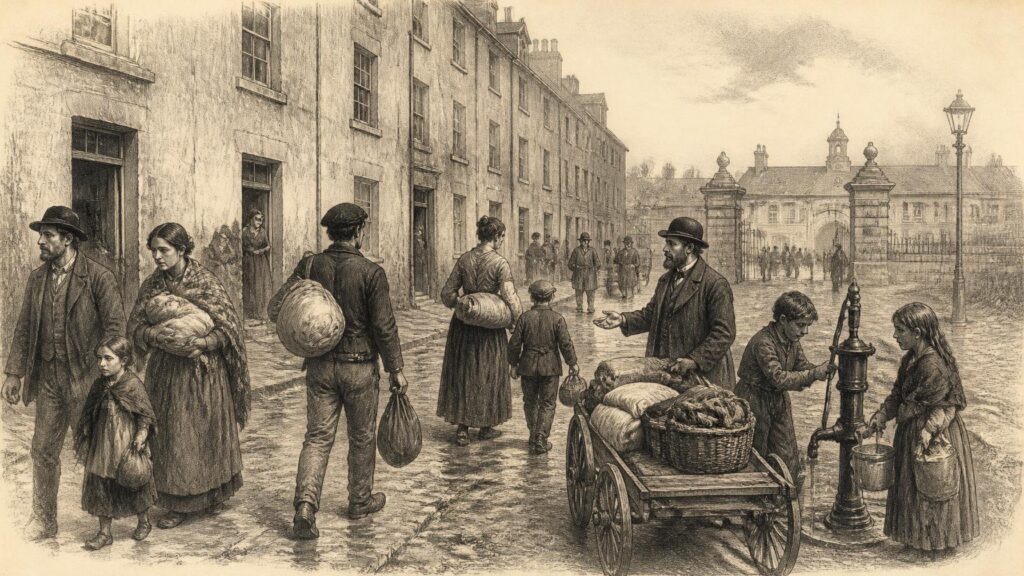
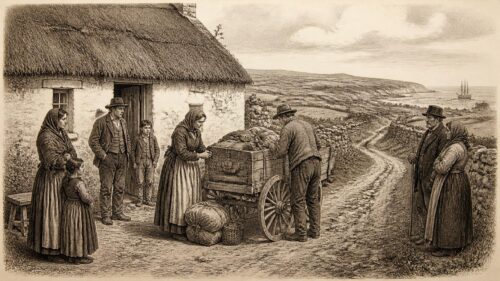
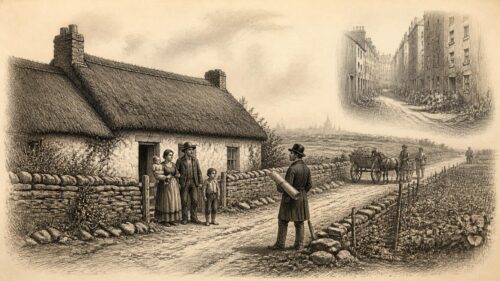
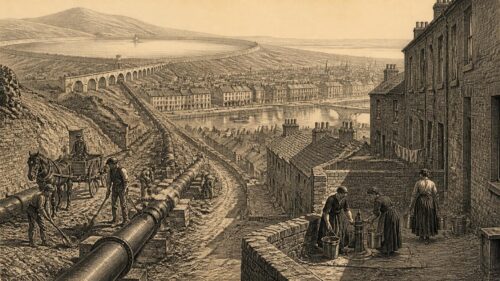
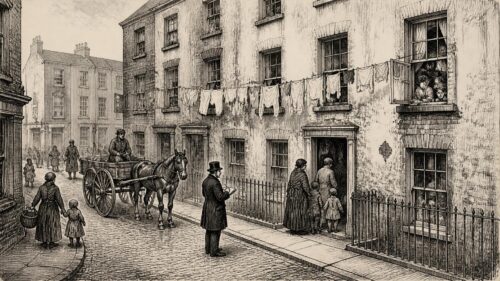
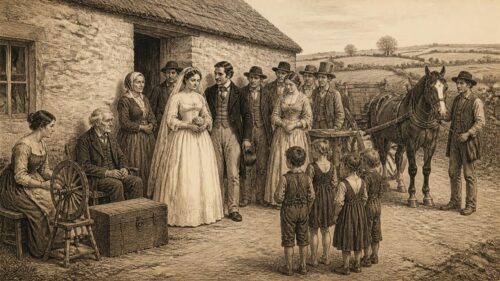
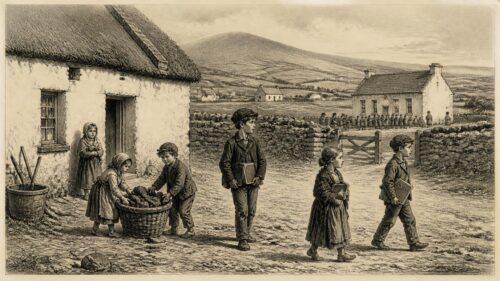
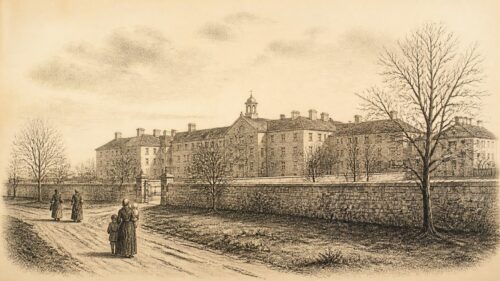
AI generated historical illustration, not a contemporary photograph.
At a Glance
Homelessness in Irish history cannot be reduced to the visible figure on a street corner. It has included the family crowded into one rented room, the labourer sleeping in a lodging house, the widow entering a workhouse, the child separated from parents by institutional rules, the tenant displaced by collapse or demolition, and the household whose dwelling was so unhealthy or insecure that it offered little real shelter. Housing history is therefore a history of property and building, but also of poverty, public health, family life, migration, charity, state power and human dignity.
Changing Meanings
The modern word “homelessness” can obscure as much as it reveals when applied to the past. It now commonly suggests rough sleeping, emergency accommodation or the absence of a settled home. Earlier Irish records used other terms: destitution, vagrancy, mendicity, pauperism, overcrowding, unfit housing, lodging, wandering and indoor relief. Each described a condition that overlapped with homelessness without precisely matching present administrative categories.
For much of the eighteenth and nineteenth centuries, secure housing was neither universal nor expected as a public entitlement. Rural families might occupy cabins on land controlled by landlords or farmers; urban households might rent a room, a cellar or a bed. Seasonal work, eviction, illness, old age, bereavement and the collapse of a household economy could turn precarious accommodation into outright destitution with startling speed. A person might have a roof one week and require charitable relief the next. The documentary trail is consequently uneven: records often preserve the view of officials, landlords, clergy, philanthropists and reformers rather than that of those in need.
That imbalance matters. A workhouse admission register may establish that a person sought institutional shelter, but it rarely tells us fully what home, kinship or community had been lost. Newspaper reports can dramatise a building collapse while missing the long years of rent collection, overcrowding and neglect that preceded it. Local authority records illuminate official action, though not always the compromises households made to survive. Historical evidence is strongest when such sources are read together rather than treated as a complete account of private lives.
There is also no single Irish story. Housing conditions differed sharply between city and countryside, between industrial Belfast and largely commercial Dublin, between expanding towns and sparsely populated districts, and between the jurisdictions created after partition. Nonetheless, common themes recur: a deep dependence on rental housing among poorer people, the unequal power of owners and tenants, periodic reliance on institutions, and a gradual but incomplete movement towards public responsibility for housing conditions.
Early Relief
Before the Poor Law, poverty relief in Ireland depended on an unsettled mixture of family support, parish arrangements, charitable institutions, religious bodies, private benevolence and occasional official intervention. Dublin’s Houses of Industry, hospitals and charitable societies were part of that landscape. They could provide food, medical care or a temporary place of refuge, but were neither designed nor resourced to guarantee homes for all who lacked them.
Urban begging was particularly conspicuous to contemporary observers, who often treated it as both a social problem and a moral offence. An 1827 memorial connected with Dublin’s Mendicity Association described large numbers of beggars on the streets and pressed for workhouses or houses of industry. Such records demonstrate that visible homelessness and extreme poverty were already matters of public debate before the formal Irish Poor Law. They do not, however, prove that all people who begged lacked homes. Some may have had unstable lodgings or family connections; others were pushed into begging by low wages, illness or unemployment.
The language of reform commonly divided the poor into categories regarded as deserving or undeserving. This distinction shaped the forms of help available. Children, older people, sick people and widows could be presented as objects of compassion, while able-bodied men without work were frequently described in more suspicious terms. Such judgements were not merely rhetorical. They influenced access to relief and contributed to the belief that assistance should deter dependence rather than provide comfort.
Housing insecurity was especially acute because it was intertwined with subsistence. A cabin was often tied to employment, land access or a local relationship with a proprietor. Losing work could mean losing both income and habitation. In towns, rent arrears might lead to displacement into cheaper rooms, lodgings, institutions or the homes of relatives. The informal strategies used to avoid destitution were extensive but poorly recorded: doubling up with kin, subletting beds, taking lodgers, moving repeatedly, or splitting families between households.
Poor Law
The Irish Poor Relief Act of 1838 established a more formal system. Modelled on the English Poor Law, it divided Ireland into 130 poor law unions, each centred on a workhouse administered by a board of guardians. The National Archives describes the system as an attempt to provide institutional relief for destitution. In practical terms, it made the workhouse the central official answer to the problem of those unable to maintain themselves outside it.
The workhouse was shelter, but of a punitive and conditional kind. Admission ordinarily meant surrendering domestic autonomy. Men, women and children were separated into different wards; daily life was regulated; work was required where possible; diets, discipline and movement were controlled. For a family facing hunger, eviction or abandonment, entry could avert immediate disaster. Yet the price was often the temporary dissolution of family life. It is therefore misleading to imagine workhouses as simply early homeless shelters. They were institutions intended to make relief available while making dependence unattractive.
The system had been devised on a limited scale. It was initially intended to support approximately one per cent of the population, but the Great Famine overwhelmed such calculations. By March 1851, according to the National Archives, nearly four per cent of the population had been forced into workhouses. This statistic conveys institutional pressure, but only partly captures the larger catastrophe. Many more people sought food, medical assistance, migration routes, outdoor relief, charitable help or accommodation with relations. Many died before relief could be secured.
During the Famine, loss of a home was often inseparable from loss of food and livelihood. The destruction of the potato crop, debt, rent demands, eviction, disease and the failure of local economies worked together. Historical scholarship has rightly resisted simple explanations: not every eviction resulted from one cause, and not every destitute person entered a workhouse. Still, the convergence of hunger and housing insecurity was unmistakable. The workhouse became a last refuge for people whose household economy had broken down.
Workhouse records are among the most important surviving sources for this history. Admission and discharge books, minute books and correspondence can identify individuals and families, reveal fluctuating numbers, record disease and mortality, and expose the practical decisions of guardians. They also show that the poor law system expanded beyond relief into areas including health, sanitation and housing. That administrative reach would have a long afterlife in local government.
Famine Displacement
The Famine has often been represented through stark images of starving tenants, abandoned cabins and emigrant ships. Those images carry historical truth, but they can become shorthand that flattens local variation. The surviving evidence shows diverse experiences: some people entered workhouses; some emigrated; some moved within Ireland; some depended on extended families; some endured severe deprivation while remaining in their homes. Others were displaced after eviction or the collapse of a tenancy.
Eviction occupies a powerful place in Irish popular memory. It is associated with roofless cottages, landlord power and coercive removal. There is ample documentary evidence that evictions occurred, including during the Famine years, and that their effects could be devastating. Yet historians must distinguish individual documented cases from generalised folklore. A ruined cottage is not automatically evidence of a Famine eviction; many structures were abandoned for later reasons, altered, demolished or left vacant after migration. The emotion carried by local memory deserves respect, but it cannot replace dates, ownership records, estate papers or contemporary testimony.
The social consequences of displacement extended beyond the immediate loss of a dwelling. A household broken up by the workhouse system could be separated by age and gender. Emigration might relieve local pressure while permanently dispersing families. Children could be placed in institutions; older people might become dependent on relatives who had little space or income themselves. In this sense, homelessness was not always a period spent without any roof. It could mean the loss of a household as a functioning unit.
The post-Famine countryside was transformed by depopulation, consolidation of holdings and migration. That change did not end rural housing hardship. Agricultural labourers, smallholders and those without secure access to land continued to face poor-quality dwellings and limited alternatives. But the scale of abandonment after the Famine altered later perceptions of housing: empty cabins and declining village populations became part of the material landscape through which the catastrophe was remembered.
Urban Rooms
In Dublin, one of the most enduring housing problems arose from the conversion of large eighteenth-century houses into multi-occupied tenements. As wealthier residents moved towards newer suburbs during the nineteenth century, many former townhouses in the inner city were divided into rooms and let to poor households. The result was not one uniform slum. Conditions varied between streets, houses and landlords. Nevertheless, overcrowding, structural decay, deficient sanitation and shared facilities became widespread and well documented.
The 1911 census material assembled by the National Archives conveys the density of life inside these buildings. It records households that included labourers, charwomen, domestic servants, porters, tradespeople, pensioners and children. Such evidence corrects the tendency to view tenement residents merely as an anonymous mass. These were working people, families, older residents and children whose lives were made precarious by low incomes and a degraded rental market.
In 1913, the collapse of numbers 66 and 67 Church Street killed seven people, including children. The disaster prompted a public inquiry into the housing of Dublin’s working classes. Dublin City Library and Archive records that the investigation found 87,305 people living in inner-city tenements, with the great majority in single rooms. The inquiry documented shared taps and water closets, insanitary conditions, crowded courts and decaying structures. Its authority lay not only in statistics but in evidence from officials, landlords, clergy and voluntary workers.
The Church Street deaths did not create the housing crisis; they made it harder to ignore. A collapse provides a dramatic moment, whereas overcrowding often proceeds quietly behind doors. The inquiry made visible the relationship between defective buildings, public health and class inequality. It also revealed a political problem: councillors and other figures involved in urban government could have connections to tenement property. Housing reform was thus entangled with conflicts of interest as well as limited resources.
Public discussion sometimes described Dublin’s tenements in sensational terms, and such language should be handled carefully. It can obscure residents’ resourcefulness, neighbourly support and attachment to place. Yet avoiding sensationalism must not minimise harm. A family living in one room, sharing a tap and closet with numerous others, and exposed to damp, infection or collapse, experienced a profound form of housing deprivation even where it was not classified as homelessness.
Health Burdens
Housing conditions were inseparable from health. Overcrowding made it harder to isolate infectious illness; defective drainage and inadequate water supplies compounded risks; insufficient light and ventilation affected daily life; damp rooms and cellars weakened already vulnerable residents. In poor urban districts, illness could itself generate homelessness. A worker unable to earn wages could fall into rent arrears, while a carer’s responsibilities narrowed the possibilities of employment and movement.
The link between bad housing and mortality was recognised by nineteenth- and early twentieth-century medical officers and public-health reformers. Their reports were shaped by the assumptions of their day, sometimes blaming residents for conditions rooted in poverty and landlordism. Even so, they provide important evidence about infrastructure, building condition and the prevalence of overcrowding. They help explain why housing reform increasingly became a municipal and public-health concern rather than being left wholly to private charity.
Children bore a particular burden. A crowded room could be bedroom, kitchen, workplace and sickroom at once. School attendance, sleep, nutrition and recovery from illness were all affected by domestic space. The 1913 inquiry photographs and testimony are useful evidence, though they must be read critically. Reform photography was intended to persuade and could select the most shocking scenes. Its value lies in combination with census data, inspection reports and witness evidence rather than as neutral visual proof by itself.
In Belfast, industrial growth produced a different urban pattern from Dublin’s, but it did not eliminate poverty or housing insecurity. The National Archives’ account of Belfast social conditions notes the persistence of slum areas and identifies a corporation hostel for homeless men, alongside the Belfast Union Workhouse as a final resort. This is an important reminder that homelessness was not restricted to the capital and that municipal accommodation could coexist with institutional relief well into the twentieth century.
Municipal Response
Late nineteenth- and early twentieth-century reforms slowly broadened public responsibility. The Local Government Act of 1898 transferred some functions connected with housing and sanitation to rural district councils, while poor law institutions continued to provide relief. The process was piecemeal. New powers did not automatically create enough money, land, skilled staff or political agreement to replace unhealthy dwellings at the required scale.
Municipal housing was an important innovation because it treated decent dwellings as an object of collective provision. Dublin Corporation and other local authorities developed schemes, while philanthropic and employer-linked housing also played a part in particular places. Yet the pace of building was often slower than the pace of need. Clearance could also create a difficult paradox: demolishing a dangerous house was necessary, but families required somewhere affordable to go. Unless replacement housing was ready, reform could intensify displacement.
After independence, housing became a central responsibility of the Irish Free State and later governments, though inherited problems were formidable. Slum clearance, local authority construction, grants and loans formed elements of policy. The political language of nation-building frequently celebrated new cottages and estates as evidence of progress. That interpretation has merit, but it should not be mistaken for a complete solution. Large numbers remained in overcrowded or substandard homes for decades.
Archival and local authority evidence demonstrates the persistence of the crisis. A University College Dublin research resource notes that unsuitable or hazardous urban family accommodation increased between 1913 and 1938 despite slum-clearance efforts. It also records that Dublin still contained 6,300 tenements housing 112,000 people in 1950. The precise figures belong to the reports from which they were drawn, but their broader significance is clear: improved policy did not quickly undo a century of neglect.
New Estates
From the mid twentieth century, local authority building reshaped Irish cities and towns. In Dublin, families were moved from older inner-city tenements to houses and flats in expanding suburbs. The change could mean indoor sanitation, more rooms, gardens, improved light and a degree of privacy previously unavailable. For many households, a corporation house was a real and welcome improvement rather than an abstract policy outcome.
Relocation also brought losses. Established networks of kin, work, shops, schools and neighbours could be disrupted. A house on a new estate might be better built but distant from employment or services. Women, older people and people with disabilities could experience that distance particularly sharply. Historical interpretation should therefore avoid portraying suburban rehousing either as a simple triumph or as unbroken social damage. Its consequences varied by estate, household income, transport, amenities and the strength of local community life.
Dublin City Council’s history of social housing in Inchicore places this movement in a wider pattern. It describes a concerted effort from the mid-1940s to transfer families to suburban homes, while also noting the role of tenant-purchase provisions in Housing Acts. The growth of home ownership transformed the tenure structure of the state, but it also meant that public housing stocks could diminish when sold without equivalent replacement. That longer-term consequence was not necessarily apparent to families gaining security through ownership at the time.
Housing quality remained uneven. The 1960s brought further pressure from urban population, household formation and persistent inner-city need. Official assessments under the Housing Act 1966 identified major requirements to replace unfit dwellings and relieve overcrowding. The state and local authorities sought faster, larger-scale building methods, including system-built and high-rise developments. These choices were products of urgency as well as planning ideology.
High Rise
Ballymun became the most prominent symbol of this era. Developed in the 1960s as a large high-rise scheme north of Dublin, it was intended to provide homes rapidly for people leaving poor inner-city accommodation. The urgency behind the project should be understood in the context of the continuing tenement crisis and the limited speed of conventional building. High-rise construction appeared to offer a modern, efficient answer.
The popular memory of Ballymun has often been compressed into a story of failure. There were serious problems: inadequate amenities, isolation, maintenance difficulties, social stigma and the consequences of concentrating disadvantage. But this retrospective narrative can erase residents’ agency, ordinary domestic lives and the positive value that some attached to new homes with facilities unavailable in tenements. It also risks blaming architecture alone for failures connected to policy, management, employment, transport and uneven public investment.
Dublin City Council links the Ballymun scheme to the urgency created by fatal tenement collapses in 1963 and notes that high-rise construction was adopted because it could be delivered quickly. RTÉ’s 1966 report on housing conditions recorded both the continuing inner-city crisis and the hopes invested in the new scheme. These sources make clear that high-rise housing was not conceived as an experiment detached from need; it was an attempt, however imperfect, to respond to an inherited shortage.
Later regeneration fundamentally changed Ballymun’s physical form. That later chapter belongs to the history of urban renewal as much as to the history of public housing. Its most useful lesson is not that one housing type is inherently doomed. Rather, durable homes require sustained maintenance, accessible services, transport, social infrastructure and residents’ meaningful place in decision-making.
Homeless Voices
By the late twentieth century, homelessness was increasingly recognised as a distinct policy issue rather than simply a residual category within poverty or housing need. Voluntary organisations, including the Simon communities, drew public attention to people sleeping rough, using hostels, moving through institutions or living in insecure temporary arrangements. Their advocacy challenged the idea that economic growth or high rates of owner occupation made homelessness a marginal concern.
The legal and administrative definition of homelessness mattered greatly. Definitions determine who appears in official counts, who can seek local authority assistance and what forms of housing need become visible. They can also exclude people who are technically accommodated but living in unsafe, overcrowded or temporary circumstances. Historical figures must thus be read with care. A low official number may show fewer recorded cases, but it can also reflect narrow definitions, incomplete returns or the invisibility of concealed homelessness.
Oireachtas debates from the 1980s and early 1990s record disputes about the scale of homelessness, the cost of hostels, social welfare access and declining construction. Parliamentary speeches are not neutral statistical reports; speakers argue cases and select evidence. Yet they document a significant political shift. Homelessness was being discussed as a public failure involving local authorities, central government, voluntary bodies and the housing market, not as individual misfortune alone.
The historical continuity is striking. Workhouses had offered institutional refuge at the cost of autonomy. Hostels and emergency accommodation could prevent immediate exposure while rarely providing the settled home people needed. The problem was not solved merely by moving a person indoors for a night. Secure housing required affordability, safety, permanence, privacy and the ability to maintain family and community ties.
Lasting Lessons
The long history of homelessness and housing in Ireland offers no simple cycle in which every generation repeats the last. Laws changed, local authorities built homes, public health standards improved, and many families achieved security unimaginable to earlier generations. The record includes real progress: new municipal estates, better sanitation, public investment, stronger recognition of housing need and a larger expectation that state institutions have obligations beyond emergency relief.
Yet the history also warns against narrow definitions and short-term solutions. A person can be housed but insecure; sheltered but separated from family; allocated a dwelling but isolated from work and services; removed from a slum but placed under new forms of disadvantage. Counting beds or units is necessary, but it cannot by itself measure whether a home supports dignity and stability.
Documented evidence is strongest where official inquiries, census material, workhouse records and local authority files converge. Interpretation enters when historians connect those records to wider structures of class, gender, migration and political power. Folklore and local memory add another dimension, preserving the emotional meanings of eviction, tenement life and estate formation, although they must not be confused with independently verified fact. All three forms of knowledge can contribute to understanding when their differences are acknowledged.
Ireland’s housing history is therefore not only a catalogue of hardship. It is also a record of people making homes in adverse circumstances, campaigning for better conditions, sustaining neighbours, demanding public action and resisting the assumption that poverty makes poor shelter acceptable. The persistent question, from the workhouse age to the present, is whether housing is treated as a commodity granted by circumstance or as a foundation of social belonging. The historical evidence suggests that whenever secure homes have been postponed, the costs have been carried most heavily by those with the least power to bear them.
The article’s broad definition of homelessness is especially revealing: families in overcrowded tenements, workhouse inmates and people displaced by clearance could possess shelter while lacking security, privacy or family unity. This complicates comparisons between nineteenth-century destitution and modern homelessness policy, which may privilege rough sleeping or emergency accommodation. It also suggests that apparently progressive interventions, from workhouses to slum demolition and municipal rebuilding, could relieve one hardship while creating another through separation or displacement. How should historians and policymakers compare these forms of housing insecurity across different Irish places and periods, while recognising both changing official definitions and households’ experiences?