

Household Pressures
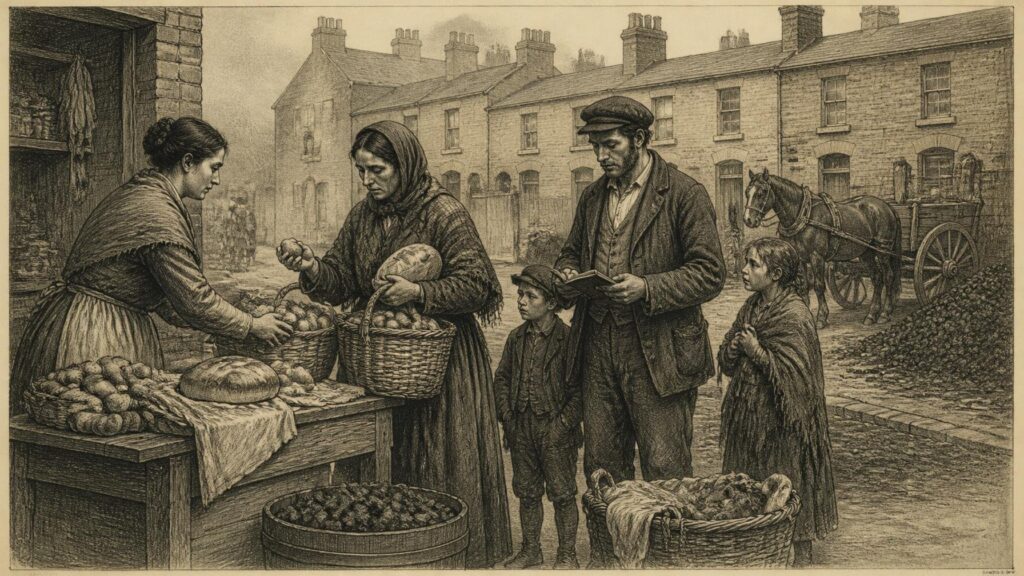
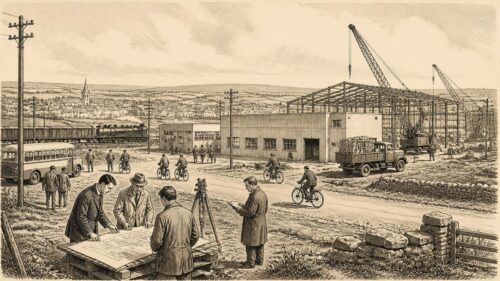
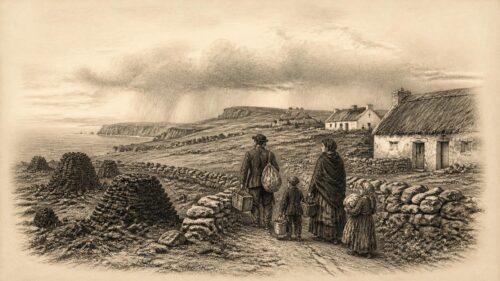
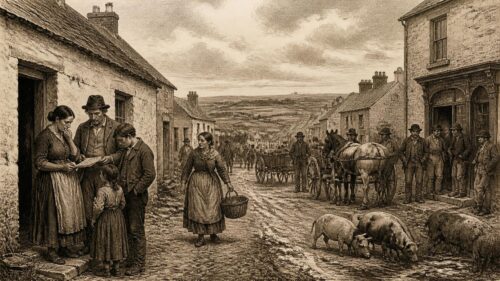
AI generated historical illustration, not a contemporary photograph.
At a Glance
Cost of living is not merely a contemporary complaint or a monthly percentage. In Ireland it is a long historical question: what ordinary households must surrender from their income for food, shelter, warmth, clothing, movement and the modest securities of family life. The language has altered, as have the goods, services and expectations contained within it, but the underlying contest between earnings, prices and necessity is one of the most durable threads in the social history of the State.
Present Pressure
By September 2026, the Central Statistics Office recorded an annual rise of 4.1 per cent in the Consumer Price Index. That was the highest annual CPI rate since January 2024. The headline figure matters, but it does not describe a single, shared experience. The largest annual increases lay in housing, water, electricity, gas and other fuels, education services, and transport. Those headings reach into the least optional parts of daily life. A household may postpone a purchase of furniture or reduce leisure spending; it cannot simply elect not to heat a dwelling in winter, travel to work, pay rent, or meet costs attached to a child’s education.
The same release makes the limits of general averages plain. Some familiar food items became cheaper over the preceding year, including butter, cheddar, milk and brown sliced pan, while diesel and petrol rose sharply. This was not a return to the simple household arithmetic of an earlier Ireland, when bread, bacon, butter, tea, coal and rent made up a recognisable common budget. A modern household meets a far wider set of charges: electricity, mobile communications, insurance, childcare, digital services, mortgage interest, transport fares, school costs and rents in a strained private market. What is called the cost of living therefore includes both price change and the social structure of indispensable expenditure.
There is an important distinction to preserve. Inflation is the rate at which prices change; the cost of living is the resources required to sustain a given standard of life. The two are related but not identical. A lower rate of inflation does not mean that prices have returned to their earlier level. Nor does an average price index tell us whether a pensioner living alone, a renter with children, a household paying a mortgage, or a worker on a low hourly wage can meet the particular costs before them. Ireland’s official statistics are indispensable evidence, but they are starting points for historical interpretation rather than complete accounts of hardship.
The phrase “cost of living crisis” acquired exceptional force after the steep inflationary episode that followed the Russian invasion of Ukraine in 2022. Yet the September 2026 figures show why it should not be understood solely as the residue of one external shock. Prices continued to rise, and the categories rising fastest were connected to domestic housing conditions as well as international energy and transport markets. The history of living standards is always partly international in a small trading economy. It is also decisively local: shaped by the availability of homes, the organisation of public services, the distribution of wages, and the design of taxation and social protection.
Early Measures
Ireland’s formal official history of measuring consumer prices begins amid the founding crisis of the State. The first official retail price index was compiled for March 1922, with July 1914 set as 100. Its making was itself revealing. The new administration inherited a society disrupted by world war, revolution, political division and economic uncertainty. Measuring the cost of household life was not an abstract technical exercise. It concerned wage demands, industrial relations, relief, public legitimacy and the ability of families to secure basic necessities.
The 1922 household-budget inquiry was necessarily limited. Forms were sent through national schools to wage-earning households, but only 308 usable returns from 112 towns were obtained. Such a sample cannot be read as a complete portrait of all Irish people, particularly rural households, farming families, the unemployed and those living in institutions. It is, nonetheless, a remarkable surviving administrative record. It permits historians to see what the infant State and its officials thought a working household’s budget contained, and what articles they regarded as sufficiently universal to be counted.
The resulting basket was intensely material. Food and non-alcoholic drink accounted for just over 57 per cent of the 1922 expenditure weight. Clothing and footwear represented 17.5 per cent; fuel and light 7 per cent; and rent 5.4 per cent. Taken together, food, clothing, rent and fuel absorbed almost 87 per cent of average expenditure in the index. Beef, bread, butter, bacon, milk, tea, sugar, potatoes, coal, turf, firewood, gas, paraffin and candles all appeared in the schedule. The entries show not an idyllic self-sufficient countryside but a wage-earners’ economy in which purchased staples, clothing, heat and light dominated calculations of security.
The first reports also demonstrate the instability of the period. In mid-October 1922, the official cost-of-living index stood at 188.8 against the July 1914 base of 100, an increase of 88.8 per cent. Seasonal increases in butter, milk and eggs outweighed falls in meat and potatoes. The report’s language is dry, but behind its tables lay the practical question of what a weekly wage could buy. The very use of weighted averages was an attempt to translate many fluctuating prices into a figure useful to administrators, employers and organised labour.
That original index should not be mistaken for a timeless measure of need. It was based on a particular population, with constrained incomes and a narrow range of goods. The index treated the expenditure pattern of working-class families in 1922 as its foundation. In effect, it documented a society where survival and respectability demanded a large share of income for food and clothing, while many costs familiar to a twenty-first-century household did not exist, were not yet mass expenses, or were outside the inquiry’s frame.
Household Evidence
Household budgets are among the most valuable forms of social evidence, but they require cautious reading. They are records of expenditure, not direct records of contentment, hunger, debt, care work or informal assistance. A budget does not easily capture a daughter’s unpaid labour, credit obtained from a local shop, food grown in a garden, remittances from relatives abroad, or the embarrassment associated with going without. It tells us what entered the ledger, not always what was sacrificed to keep it balanced.
Nevertheless, the 1922 budget material is historically significant precisely because it places ordinary consumption at the centre of public measurement. It counted a household’s food over the preceding seven days and asked about expenditure on fuel, light, household requisites and sundry items, as well as annual spending on clothing and dressmaking. The list carries traces of an older economy of repair and making. Materials for clothes and the cost of making them were distinct matters. Clothing was a recurrent and substantial expense rather than a category frequently treated as discretionary.
There was no single Irish household even then. Urban wage earners, agricultural labourers, small farmers, servants, tradespeople and the unemployed faced different rhythms of income and different access to food, fuel and accommodation. The official inquiry was especially useful for a retail-price index, but it does not eliminate those differences. For that reason, a responsible historical account should resist turning the national average into a representative family with a uniform experience. The same reservation applies to 2026.
Historical memory can simplify the past into a story of thrift: turf cut locally, vegetables from the garden, garments mended until they could no longer be mended, and neighbours helping one another through a difficult winter. Such practices were real in many communities, and oral testimony often preserves their importance. But folklore and family memory are not evidence that life was cheap or that insecurity was slight. Self-provisioning commonly existed alongside low cash incomes, cramped dwellings, seasonal employment and restricted choice. Mutual aid mattered because formal incomes and public provision could be inadequate.
The lesson is not that earlier Irish people were uniquely resilient, nor that present hardship is unprecedented. It is that material resilience often came at a cost that official prices cannot fully reveal. Repair, borrowing, sharing rooms, walking long distances, taking in lodgers, postponing medical attention, and reducing food variety are all ways in which households have historically adapted. They should be understood as evidence of pressure as well as resourcefulness.
Changing Basket
A century separates the first Irish cost-of-living inquiry from the modern consumer-price system, and the altered basket of goods is one of the clearest records of social change. The Central Statistics Office’s comparison of 1922 and 2022 shows food falling from 57.1 per cent of the index weight to 11.4 per cent, and clothing from 17.5 per cent to 4.7 per cent. This does not mean food or clothing ceased to matter. It means that, across the average pattern of spending, a greater share of household resources came to be devoted to services and to forms of consumption unavailable or uncommon in 1922.
In the modern basket, transport carried a weight of almost 14 per cent; restaurants and hotels over 15 per cent; communications, health, education, recreation, culture, insurance and financial services all had explicit places. Mortgage interest was counted alongside rents and dwelling maintenance. The very presence of these items marks changes in standards of living, consumer expectation and the economy itself. Motor travel, wider education, formal insurance, healthcare spending, mobile communication and leisure are not mere additions to an old grocery list. They signify the expansion of social participation and the multiplication of household obligations.
This transformation complicates nostalgic comparisons. A household in 1922 spent far more of its recorded budget on food, but it did not face the same expectation of car ownership, broadband, third-level participation, private insurance, formal childcare or regular long-distance travel. A household in 2026 may have greater command over a wider range of goods, yet still experience acute insecurity if fixed charges consume income before food is bought. Living standards cannot be reduced to the price of a loaf, however emotionally potent that measure remains.
The CPI itself has changed as Irish consumption has changed. Its weights are updated, and the contemporary methodology rests on a much larger stream of information than was available in the early Free State. The CSO now gathers tens of thousands of price quotations monthly and uses expenditure information to reflect the average importance of categories. That is a considerable administrative achievement. It also means that continuity in the name of the index should not be confused with continuity in the contents of life.
In 2026, comparison requires another caution. A basket designed to describe the average household will necessarily fit some households badly. Renters do not have mortgage-interest bills; homeowners without loans do not face either monthly cost in the same way; households without cars experience petrol increases differently from those dependent on long commutes; and families with young children face pressures not shared by pensioner households. The average is valuable because it establishes a common national measure. It is insufficient because necessity is distributed unequally.
Housing Burden
Housing is where the difference between inflation and affordability is especially sharp. In the 1922 index, rent represented 5.4 per cent of expenditure. The figure does not tell us that housing was easy to obtain, nor does it include the full social reality of overcrowding, poor building conditions or unequal tenure. It does show that the weight assigned to rent in the working-class urban budgets used for the index was modest compared with food and clothing. The statistical picture of 2022 placed rents paid by tenants at 7.64 per cent, while mortgage interest and dwelling maintenance appeared separately. Such classifications are not directly comparable, but they signal a much more complex relationship between households and homes.
By September 2026, the CSO attributed a substantial part of the annual increase in housing, water, electricity, gas and other fuels to higher prices for home-heating oil, electricity, rents and mortgage-interest repayments. The division rose by 9.5 per cent over the year. This was the largest of the major CPI divisions. For households already at the edge of affordability, increases in rent and mortgage costs are qualitatively different from modest changes in more optional expenditure. They can determine whether a family moves, shares accommodation, gives up privacy, returns to a parental home, or falls behind on bills.
Housing pressure also has a historical dimension because homes are not simply consumer products. They are places of care, family formation, illness, study and retirement. Irish public debate has often treated the house as a store of security and independence, an aspiration strengthened by the long expansion of owner-occupation. Yet the historical ideal of secure domestic life has not been shared equally. Tenure, location, inheritance, household size and access to credit have long divided experiences of security.
It would be misleading to claim that every modern housing difficulty has an exact parallel in 1922. The legal framework, building standards, welfare state, mortgage market and scale of urban employment are different. The more defensible interpretation is that housing has repeatedly converted broad economic change into intimate household strain. When shelter becomes expensive, it affects nutrition, heating, transport, family decisions and the capacity to save. That is why an account of Irish living standards that leaves housing at the margin is incomplete.
Energy Exposure
Heat and light form another line of continuity. The 1922 cost-of-living basket contained coal, turf, firewood, candles, paraffin and gas. Electricity for lighting had only a minute weight; electricity for cooking was absent. These details locate the early State in a mixed fuel world. Households depended on solid fuel and older forms of illumination, while access to newer systems was limited and uneven. The fuel entry was not simply an economic category. It marked the practical labour of keeping rooms warm, preparing food and maintaining a household through winter.
Modern energy dependence is technologically different but no less fundamental. Electricity powers light, cooking, refrigeration, communication and increasingly the operation of domestic systems that earlier households did not possess. Heating oil, gas and electricity are connected to global markets, national taxation, infrastructure and the energy performance of individual homes. This is why price rises in the housing-and-fuels division have such a pronounced distributive effect. A well-insulated home with stable income can absorb a price movement more readily than a poorly insulated dwelling occupied by a low-income household.
Government action in 2026 acknowledged this exposure. Temporary energy and fuel measures, alongside changes to fuel supports and reductions in certain fuel taxes, were responses to renewed pressure. Such measures may ease an immediate bill, but historically they belong to a broader pattern: the State stepping in when household budgets cannot readily accommodate a sudden shock. The question is not whether temporary relief is useful. It is whether it addresses the structural conditions that make households vulnerable to the next rise.
The historical record warns against presenting fuel poverty as a new discovery. The names of fuels have changed, and the physical comforts associated with a warm home have improved greatly, but winter has always tested unequal access to resources. Earlier people may have used turf, coal or firewood; contemporary households receive bills for electricity, gas, oil and other services. In both cases, the issue is the same: the ability to convert income into heat without abandoning other essentials.
Income Protection
The other side of the cost-of-living equation is income. Wages, pensions, benefits, tax credits and public services decide whether a price increase becomes a manageable inconvenience or a crisis. In 2026 the national minimum wage rose to €14.15 an hour for adult workers. Budget measures also included increases in weekly social-welfare payments, higher fuel allowance, changes to child-related supports, and the continuation of certain tax measures. These are not merely budgetary details. They are the contemporary instruments through which the State attempts to mediate the relationship between market prices and household need.
Yet support must be judged in relation to the costs it is meant to meet. The ESRI’s analysis of Budget 2026 estimated that average household income would be 1.3 per cent lower than under a tax-and-welfare system indexed to price growth, and 1.9 per cent lower than under one indexed to expected wage growth. Its analysis found that welfare-rate increases helped lower-income families, but that this gain was offset overall by the withdrawal of temporary cost-of-living supports. The finding is an important corrective to simple claims that a rise in a weekly payment automatically restores living standards.
There is a historical pattern here. Emergency or once-off supports are often politically and administratively attractive during moments of exceptional inflation. They are visible, rapid and capable of reaching many households. But temporary payments also create a difficult transition when they end. A household may have used them for electricity arrears, school costs, rent shortfalls or accumulated borrowing; the cessation of the payment can then feel like a cut even if the underlying welfare rate has risen.
Permanent supports, by contrast, become part of the ongoing architecture of income. They may be more predictable, but they must be adequate, accessible and responsive to the household circumstances they are intended to protect. The history of Irish social policy is not a straight advance from neglect to security. It is a continuing negotiation between universal provision, means testing, contributory entitlement, family responsibility, voluntary assistance and market income.
For historians, the essential point is that prices never operate alone. The same food or fuel increase has different meaning depending on pay, working hours, debt, savings, household composition and eligibility for support. A national inflation figure can indicate the direction of pressure. It cannot decide who is able to endure it.
Unequal Effects
The uneven character of pressure is strongly supported by recent evidence. The ESRI’s sixth annual report on poverty, income inequality and living standards found that average equivalised disposable household income rose by 4 per cent between 2023 and 2024, recovering above its 2021 level after the surge in prices. But gains were not evenly shared. Income grew by more than 7 per cent for the highest tenth of households, compared with 3 per cent for the bottom half. The report also found that poverty after housing costs rose from 14.6 per cent to 15.6 per cent between 2023 and 2024.
These findings should prevent two opposite errors. The first is to deny improvement because hardship remains. Average incomes did recover. The second is to treat average recovery as proof that hardship has been resolved. After-housing-cost poverty rose, and the concentration of pressure among households with children was marked. For families whose youngest child was aged five or under, the report recorded a sharp worsening in poverty rates since 2018. A history of living standards must hold these truths together: aggregate prosperity can coexist with deep insecurity.
Low-income households are not simply smaller versions of middle-income households. Their spending is more tightly committed to essentials, leaving less scope to substitute cheaper goods, reduce consumption without harm, or use savings to cover a temporary shock. Research on low-income households’ responses to the recent cost-of-living crisis documented changes in ordinary spending, borrowing and saving. The significance of that work lies in its attention to behaviour under constraint. People do not merely receive inflation; they respond by cutting back, delaying, borrowing, drawing down reserves, seeking assistance or attempting to navigate complicated schemes.
Those strategies are historically familiar. What has changed is the context in which they occur. Today a household may be negotiating direct debits, online applications, energy tariffs, rent transfers and credit obligations rather than an account at a local shop. The administrative form of hardship is more digital, but the moral and emotional consequences remain recognisable: anxiety, shame, exhaustion and the difficult choice between competing necessities.
Historical Comparisons
Comparison over a century can illuminate, but only if it avoids false equivalence. Ireland in 1922 was poorer, less urbanised, less technologically equipped and less protected by public welfare than Ireland in 2026. Food took an overwhelming share of the official household budget. Consumer choice was limited, ownership of cars was rare, and many elements of modern life did not appear in the statistical frame. It would be perverse to portray that world as economically easier because some individual goods were cheaper in nominal terms.
Equally, modern abundance does not abolish the historical question of affordability. The expansion of consumption has created commitments that are now socially ordinary: reliable communication, transport, heating, schooling, insurance and adequate housing. These are not luxuries in the simple sense when employment, education, care and social participation depend upon them. The reduction in food’s share of a typical budget is a sign of long-run development, but it also means that financial strain may now arise from a larger collection of bills that cannot readily be avoided.
The strongest documented continuity is institutional. Since 1922, Irish governments and statistical authorities have sought to turn the cost of household life into evidence. The index has been rebased and its weights revised repeatedly because purchasing patterns change. The old title, “Cost of Living Index”, was eventually replaced by “Consumer Price Index” partly to avoid the misleading impression that it measured every aspect of the cost of living rather than changes in consumer prices. That terminological shift is valuable. It reminds us that statistics are tools with defined boundaries, not final verdicts on how people live.
Interpretation begins where the boundaries become visible. The present article’s reading is that 2026 belongs to a longer Irish history in which households bear shocks unevenly, while the State tries to measure, relieve and regulate their consequences. The composition of pressure has changed from food and clothing towards housing, energy, transport and services. The political question, however, is durable: how much protection should a society provide when earnings and essential prices diverge?
Public Memory
Public memory often reaches for a simple moral: previous generations had less money but managed better. There is some truth in the observation that households practised repair, reuse and mutual support with intensity. But it can become an unfair standard when used to dismiss modern distress. Earlier generations also endured lower consumption, narrower opportunities, inadequate housing, difficult physical labour and forms of dependency that should not be romanticised.
Folklore is most useful when treated as testimony to values and habits rather than as a substitute for evidence. Stories of saving bacon fat, stretching a pot of stew, cutting turf, making clothes last, or taking in a boarder explain how households understood thrift and survival. They cannot establish national price levels, poverty rates or living standards on their own. Documentary sources, statistical series and careful research are necessary for those claims. At the same time, the stories remind historians that national aggregates are lived in kitchens, bedrooms, shops, workplaces and cold rooms.
The moral economy of the household has also altered. A century ago, a household budget may have been organised around cash wages, food shops, rent and solid fuel. In 2026 it may be organised around wages arriving electronically and leaving almost immediately through standing orders, rent, loans, utilities, insurance and transport costs. The sensation of money vanishing before the week’s food is purchased is not entirely new, but its mechanisms and visibility are different.
For Emerald Archives, the appropriate historical conclusion is neither sentimental nor despairing. Ireland has experienced profound improvement in material resources, life expectancy, public infrastructure and the scope of social protection. Yet the history of the cost of living shows that progress is not self-executing. Gains are distributed through institutions, and they can be weakened where housing, energy or family costs rise faster than the resources available to meet them.
Measured Limits
The CPI is a vital public record. It allows price movements to be observed consistently across time, supports economic analysis, and makes claims about inflation testable. But it should never be asked to answer questions it was not designed to answer. It does not measure wealth, debt, quality of housing, access to public services, unpaid care, homelessness, the adequacy of a diet, or the distress attached to arrears. It measures average price movement in a weighted basket.
Nor do poverty measures exhaust the subject. Income poverty and material deprivation identify important forms of disadvantage, while after-housing-cost measures bring the burden of shelter more clearly into view. Still, every measure involves definitions and thresholds. A household just above a line may be struggling; another below it may have family support or savings unavailable to others. This is not a reason to reject measurement. It is a reason to combine it with historical context and humility.
The best-supported account of Ireland’s cost of living in 2026 is therefore layered. Documented evidence shows renewed price growth, especially in housing, energy and transport; a modern basket far removed from the subsistence-heavy budget of 1922; and inequalities in income and hardship which aggregate recovery has not erased. Interpretation suggests that housing and energy have become the pivotal sites where international shocks, domestic policy and household vulnerability meet. Folklore and memory add texture, but they should not be allowed to overrule the record.
Future Questions
The historical importance of the 2026 moment will not be decided by one inflation release. It will depend on whether the rise in essential costs proves temporary, whether incomes and supports keep pace, whether housing supply and affordability improve, and whether public policy reduces the exposure of low-income households to future shocks. The answers will emerge over years, not months.
What can be said already is that the old question remains. In 1922, officials counted tea, bread, butter, coal, turf and rent to estimate what wage-earning households required. In 2026, the national measure follows rents, mortgage interest, heating oil, electricity, transport, insurance and education alongside food. The articles have changed; the need to make household life affordable has not.
Ireland’s cost-of-living history is thus not a tale of unbroken crisis, nor a simple ascent from want to comfort. It is the history of changing necessities, imperfect measurements and recurrent public arguments about what citizens owe one another when the ordinary costs of life outrun the ordinary means of meeting them. That is why the subject belongs not only to contemporary economics, but to the historical record of the Irish State and its people.
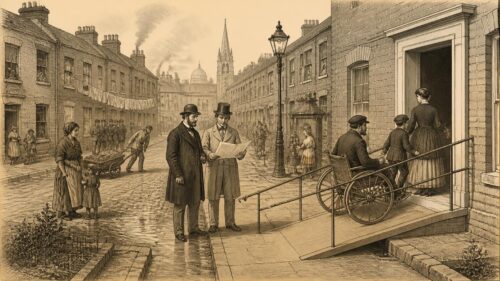
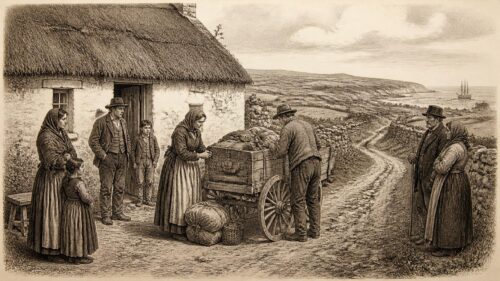
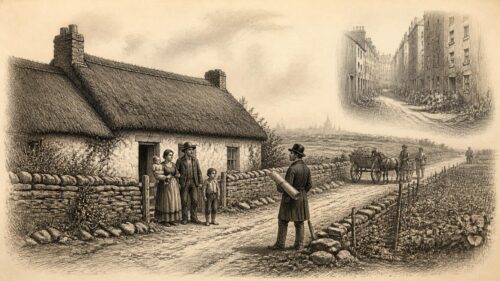
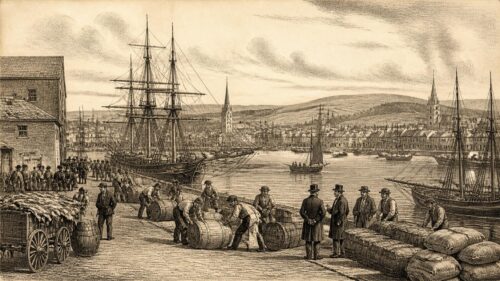
The article’s comparison between 1922 and 2026 usefully shows that household pressure cannot be understood through inflation alone. Food once dominated the official basket, whereas today housing, energy, transport and services shape whether people can maintain ordinary participation in society. Yet both periods reveal how average indices can obscure unequal exposure: a renter, mortgaged owner, rural commuter and pensioner confront different unavoidable costs. The historical continuity lies less in identical prices than in the struggle to turn income into security, warmth and independence. How might Ireland’s public measures better reflect these contrasting household realities while still providing a national picture?