

Dwelling Language
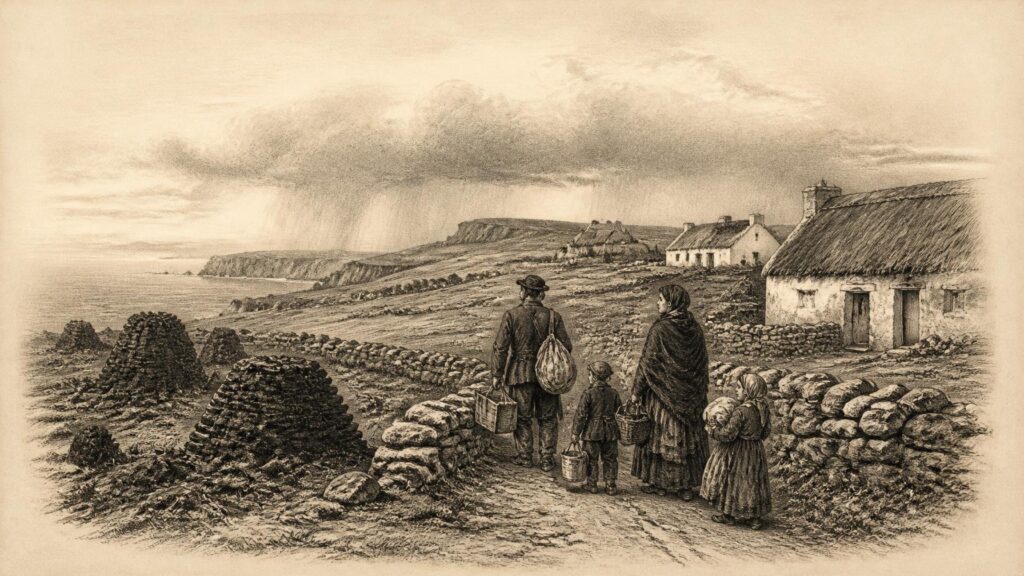
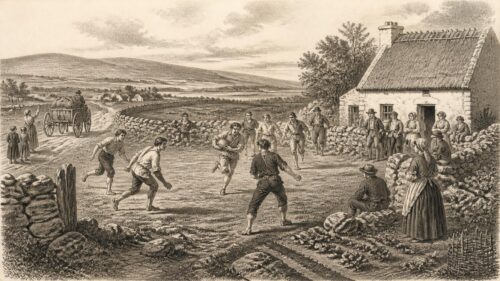
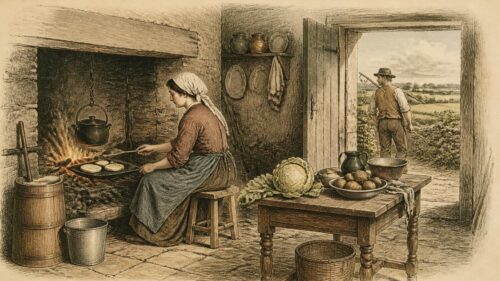
AI generated historical illustration, not a contemporary photograph.
At a Glance
In the Gaeltacht, a house is never merely a house. It may be a home, a holding, an inheritance, a refuge from emigration, or a holiday property; but it is also a setting in which Irish is either spoken from one generation to the next or ceases to be a communal language. The present housing crisis therefore belongs to a much longer Irish history, in which land, livelihood, population movement and language have repeatedly been bound together.
Living Territory
The word Gaeltacht is often translated simply as an Irish-speaking district. That definition is useful but incomplete. It describes officially designated areas in seven counties—Cork, Donegal, Galway, Kerry, Mayo, Meath and Waterford—yet it also conveys an older social fact: places where Irish was, or remained, the ordinary language of family, neighbourhood, work, worship and local exchange. The official boundaries have changed, and the strength of Irish has varied greatly within them. Still, the idea of the Gaeltacht has endured because it refers to a territory in which language has been understood not as an individual accomplishment but as a shared condition of life.
Housing enters that history at every point. A language can be taught in schools and honoured in statutes, but it is sustained as a community language through repeated everyday use. Children hear it at breakfast, neighbours use it at gates and shops, clubs conduct business through it, and families choose it at home. Those habits depend upon people remaining in a place. When young Irish-speaking adults cannot rent, buy, inherit or build locally, the loss is not merely numerical. It may remove future parents, workers, volunteers and neighbours from the social networks through which a minority language is reproduced.
This does not mean that every resident of a Gaeltacht district must have the same linguistic background, nor that newcomers are inherently hostile to Irish. Such claims would be both historically crude and socially unhelpful. The Gaeltacht has always contained degrees of bilingualism, migration, return and cultural exchange. The more precise historical point is that a minority language requires sufficient density of habitual speakers to remain normal in public and domestic life. When that density falls below an uncertain threshold, English tends to become the safest common language, even among people who know Irish.
The current phrase “Gaeltacht housing crisis” emerged from campaigns, committee hearings and public debate in the early twenty-first century, particularly during Ireland’s wider shortage of affordable homes. It refers to several overlapping problems: high prices, scarce rental accommodation, holiday and short-term letting pressures, derelict or vacant dwellings, restrictive rural planning rules, weak infrastructure, limited social housing and the absence of serviced sites. These are not identical in every district. The pressures of Connemara differ from those of the Donegal coast, the Kerry peninsula, the Waterford Gaeltacht or Ráth Chairn in Meath. Yet the shared concern is that ordinary Irish-speaking households may be unable to establish themselves in the very places where Irish remains most deeply rooted.
Colonial Pressures
The modern housing question cannot be separated from the nineteenth-century collapse of the Irish-speaking population. Irish had once been the dominant language across most of the island, but political conquest, legal exclusion, changing land relations, English-medium administration and schooling, and the growing economic power of English all encouraged language shift over several centuries. By the nineteenth century, Irish remained strongest in poorer western and southern districts, many of them coastal, mountainous or otherwise marginal to centres of political and commercial power.
It would be misleading to describe this history as a simple tale of one language being forcibly replaced on a single day or by one law. Language change occurred through many pressures, including the practical value of English in markets, emigration and official life. Nevertheless, the unequal distribution of power was fundamental. English expanded in institutions that controlled opportunity, while Irish became increasingly associated, often unfairly and cruelly, with poverty and rural backwardness. The social geography of the later Gaeltacht was therefore shaped by dispossession and unequal development long before the Irish state adopted the word as an administrative category.
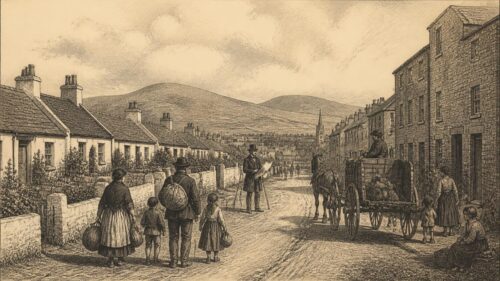
The Great Famine intensified those processes with extraordinary force. The Irish-speaking poor were heavily represented in districts dependent upon precarious smallholdings and the potato. Death, eviction, migration and overseas emigration emptied many communities. The famine did not create the decline of Irish, but it devastated populations among whom the language was strongest. Subsequent emigration mattered as much as immediate mortality. In many localities, the people most likely to leave were younger adults seeking wages and security elsewhere; that pattern weakened the continuity of households and altered the relationship between home, land and language.
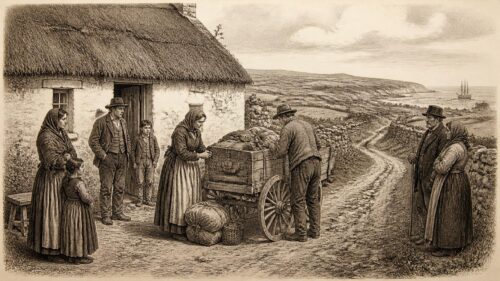
Housing in this period should not be imagined through the modern vocabulary of mortgages, apartments and planning permission. It concerned cabins, small farms, tenancy, subdivision, congestion, access to common resources and the ability of families to remain near kin. Yet the underlying question was recognisably related to today’s crisis: could people make a secure life in their own community? Where subsistence failed and land was scarce, the answer was too often no. The later state would inherit the consequences in the form of depopulation, fragmented holdings, poor infrastructure and a language community confined disproportionately to economically disadvantaged districts.
Folklore and local memory frequently preserve stories of families leaving a home, of houses abandoned after a death or a departure, and of whole townlands becoming quieter. Such memories are historically valuable as evidence of experience and feeling, but they cannot by themselves establish regional totals or a single explanation for language decline. The documentary record—census material, land records, state reports and parish evidence—shows broad population loss. Folklore helps explain what that loss meant within communities: not only fewer inhabitants, but broken continuities of speech, work and belonging.
State Beginnings
When the Irish Free State was established, the condition of Irish became a central national concern. Revivalist politics had given language a symbolic place in the new state, but officials quickly faced a difficult reality. The places where Irish remained strongest were often those facing poverty, emigration and limited employment. A policy directed solely at schools could not answer the economic circumstances pushing speakers away. In 1925 the Free State established the Gaeltacht Commission to investigate the extent and needs of Irish-speaking districts. Its work was one of the earliest acknowledgements that the language question was also a question of social and economic survival.
The 1926 census provides a stark backdrop. Later analysis by the Central Statistics Office has shown that the traditional Irish-speaking areas suffered a marked loss of speakers between 1911 and 1926, even while the number reporting some Irish outside those areas rose. That contrast mattered. It suggested that national enthusiasm for Irish, encouraged by school and public policy, was not the same thing as protecting Irish as a vernacular language in the communities where it had survived. The distinction remains essential: the ability to speak Irish and the use of Irish as the ordinary language of a locality are related, but not interchangeable measures.
The young state tried a range of interventions. Land improvement, fisheries, rural industries, education, grants and administrative schemes were all discussed or pursued under the broad heading of Gaeltacht development. Housing appeared within this framework because living conditions were plainly part of rural welfare. Oireachtas records from the 1930s show state attention to Gaeltacht housing grants and to co-operation between public bodies in housing matters. Those records do not demonstrate a complete or successful housing system; rather, they reveal that policy-makers already understood housing to be one component of an effort to stabilise Irish-speaking districts.
There was also a more troubling strand of policy: the migration of some families from congested Gaeltacht districts to land elsewhere, including County Meath. Ráth Chairn became the best-known result. Such schemes were intended to relieve congestion and provide better farming prospects. They also demonstrate the contradiction at the heart of much policy. The state sought to preserve Irish-speaking life, yet it sometimes did so by moving speakers away from their ancestral districts. For some families, relocation offered opportunity; for others, it involved risk, disruption and a difficult adjustment. It cannot be reduced either to triumph or failure.
The historical lesson is not that every movement of people is harmful. Migration has long formed part of Irish life and has sometimes created new Irish-speaking networks. Rather, the lesson is that language policy becomes fragile when the only route to material security requires people to leave the places where Irish is socially strongest. The persistent tension between protecting communities in place and responding to economic need has never disappeared.
Rural Remedies
Mid-century state policy approached the Gaeltacht through development as well as language. The Gaeltacht boundaries were revised in the 1950s, reducing the territory formally included. A dedicated department for Gaeltacht affairs was established, followed by Gaeltarra Éireann, intended to encourage industry and employment. These measures reflected a recognition that cultural protection without livelihoods could not halt emigration. They were also products of their time: centrally directed, administrative and often shaped by a belief that industrial employment could remedy rural decline.
Parliamentary debate from 1956 is revealing. It records the Land Commission’s work in congested and Gaeltacht districts as involving land improvement, additional land where possible, roads, employment and better housing accommodation. The language of the debate is paternalistic by modern standards, but it confirms that the question was never simply whether Irish should be taught. It was whether communities marked by insecure or insufficient land could be made viable. Housing was treated alongside roads and holdings because all were elements of settlement.
There were real gains in public housing, electrification, roads, education and income opportunities across rural Ireland. Yet there were limitations. Industrial projects did not always generate durable employment; remoteness remained costly; state investment could be uneven; and outward migration continued. Some development initiatives treated the Gaeltacht chiefly as an economically lagging periphery rather than as a language community requiring tailored measures. The distinction matters because a policy capable of increasing population may not necessarily increase the use of Irish. New homes, jobs or visitors can strengthen a locality, but their linguistic effect depends on who can access them and how local institutions operate.
By the 1960s and 1970s, Gaeltacht activism challenged purely top-down approaches. Community co-operatives, civil-rights campaigning and language movements pressed for greater local authority and accountability. This political history culminated in the creation of Údarás na Gaeltachta in 1980. The agency was given responsibilities for economic, social and cultural development, reflecting a broader understanding that the language could not be insulated from employment, planning, education or community life.
The creation of Údarás did not solve the housing question, but it changed its setting. The future of the Gaeltacht increasingly came to be discussed in terms of locally grounded development rather than rescue from outside. That tradition lies behind contemporary calls for the agency to play a greater part in acquiring land, preparing sites, renovating vacant houses or co-ordinating provision for Irish-speaking households. These proposals are political choices, not settled historical facts; but they have deep roots in the belief that a language community needs some practical influence over the conditions of its own continuation.
Planning Conflicts
Modern planning has brought a new set of contradictions. Rural housing controls seek, among other things, to prevent dispersed development, protect landscapes, avoid unsustainable infrastructure costs and ensure that housing is linked to genuine local need. Those objectives have force, particularly in ecologically sensitive coastal and upland districts. Yet Gaeltacht campaigners have argued that standard definitions of local need can fail to recognise linguistic need: an Irish speaker may have family, work, cultural and community connections to a district but face obstacles in securing permission to build or in accessing housing there.
The difficulty is not imaginary on either side. Unrestricted one-off building can strain water systems, roads and landscapes, while a permissive approach can raise land values and encourage speculative development. Conversely, a framework that treats every applicant only through residence length, property ownership or conventional family ties may neglect the special public interest in maintaining Irish as a living community language. The policy challenge is therefore not simply to abolish controls. It is to design them carefully enough to support permanent, locally integrated, Irish-speaking settlement without turning language into a crude instrument of exclusion.
Housing (Gaeltacht) legislation has recognised, in limited form, that dwellings in these areas can have linguistic implications. The existence of such provisions is historically important because it acknowledges that housing policy may affect the use of Irish. But legislation alone does not provide land, finance, construction workers, wastewater capacity or affordable rental homes. Nor can it solve the differences between regions. A family seeking a first home in a village with no wastewater capacity faces a different problem from a tenant competing with short-term visitors in a coastal tourism market, even if both describe their situation as a housing crisis.
Public argument has sometimes reduced this complexity to a dispute between “locals” and “outsiders”. That framing has emotional power but limited explanatory value. The historical record shows that Gaeltacht communities have long been mobile, connected and hospitable, with return migrants and incomers contributing in various ways. The sharper issue is tenure and permanence. A dwelling used occasionally, or converted into a highly profitable short-term let, does not perform the same social role as a secure year-round home for a household participating in local schools, clubs, care networks and Irish-language life.
The pressure of tourism must therefore be discussed precisely. Tourism can provide employment, markets and renewed interest in local heritage. It can also increase demand for second homes and visitor accommodation, especially in attractive coastal districts with limited housing stock. The effect differs by locality and requires local data. It should not be assumed that every vacant house is a holiday house or that every visitor property displaces a family. Still, where scarce homes are removed from long-term use, the consequences for settlement can be serious, particularly in a small language community whose social networks are already thin.
Census Warnings
Census evidence gives the debate its necessary scale. Census 2022 recorded more than 106,000 residents in Gaeltacht areas, an increase from 2016. On one reading, this is encouraging: the official Gaeltacht population has not simply emptied out. Yet the same returns show a more complicated linguistic picture. Just over 65,000 residents aged three and over said they could speak Irish, but the proportion able to do so had declined. About 20,261 people reported speaking Irish daily in the Gaeltacht, a fall from 2016.
These figures should be handled with care. Census answers are self-reported; they cannot capture every nuance of household language, confidence, social setting or local variety. A person may speak Irish daily with grandparents but use English at work; another may possess excellent Irish but rarely have an opportunity to use it. Nor does a census table explain why a number changed. Housing, schooling, employment, age structure, migration and changing patterns of self-description can all matter. It would be unsound to claim that housing shortages alone caused the recorded decline in daily use.
Nevertheless, the figures make the housing question more than rhetorical. They show that population growth inside the official Gaeltacht does not automatically preserve Irish as an everyday community language. This is the central historical distinction. If additional residents cannot or do not use Irish regularly, the demographic survival of a district may coexist with linguistic weakening. Equally, if young fluent speakers leave because suitable homes are unavailable, the effects may be greater than their number suggests, because they are part of the generation most likely to form new households and raise children.
The long trend is equally sobering. In 2006, official statistics recorded a far higher number of daily Irish speakers in Gaeltacht areas than in 2022. Changes in census questions and categories must always be considered when comparing eras, but the overall direction in daily community use has caused sustained concern among scholars, activists and public bodies. This is why the present crisis has been described as both a housing crisis and a linguistic crisis. The expression is an interpretation, not a census category; its force lies in connecting measurable housing difficulty with the known vulnerability of habitual Irish use.
There is no single linguistic threshold at which a community instantly ceases to be Gaeltacht. Social language shift is gradual, uneven and reversible in some circumstances. Yet history shows that once a minority language ceases to be normal among younger households, recovery becomes more difficult. Schools can create new speakers, but schools cannot fully substitute for a local environment in which the language is used naturally across generations. Housing policy therefore becomes part of language planning not because bricks speak Irish, but because households do.
Community Demands
Recent campaigns have pressed the state to acknowledge that relationship openly. Community groups and Irish-language organisations have called for a co-ordinated Gaeltacht housing strategy, for serviced sites, for use of vacant and derelict homes, for affordable rental provision and for stronger involvement by Údarás na Gaeltachta. In parliamentary evidence during 2026, representatives of the campaign group BÁNÚ argued for a dedicated housing function within the agency and for the use of its land bank to provide clusters of serviced sites in Irish-speaking areas. Such evidence is advocacy, not neutral measurement, but it identifies concrete policy mechanisms rather than merely expressing distress.
The idea of clustered development deserves particular historical attention. Much twentieth-century rural policy favoured dispersed individual houses, often because family land and rural identity made that form attractive. But dispersed building does not always produce a dense social environment. In some circumstances, well-designed small developments near villages, schools, shops and community facilities may make it easier for households to live through Irish daily. Such a model would also reduce dependence on exceptional individual planning permissions. Whether it is appropriate in a particular place depends on local infrastructure, landscape, consent and need; it should not be imposed as a universal formula.
Vacancy is another frequently proposed avenue. A vacant dwelling can appear, from a distance, to be an obvious answer to homelessness or shortage. In practice, it may need extensive repair, have unclear ownership, lack services, be tied to probate, or be unsuitable for a modern household. Island and coastal construction costs can be especially high. Government support for renovation and for island communities may help, but grants alone cannot guarantee that a restored dwelling will become an affordable permanent home for a local household. The decisive questions are ownership, affordability, tenure and local capacity.
Social and cost-rental housing also matter. The Gaeltacht is sometimes imagined as a landscape solely of owner-occupied family homes. That image excludes young workers, single people, separated families, older residents wishing to downsize and households unable to secure a mortgage. A living community needs a range of homes. If the only viable route to residence is inheriting land, buying at a high price or constructing an individual house, many Irish speakers—including those returning after education or work elsewhere—will be excluded.
Government statements published in 2025 recognised the importance of adequate housing and community services to keeping Irish speakers living and working in Gaeltacht areas, and indicated an intention to develop a national planning statement. That acknowledgement is significant. It does not, by itself, establish whether proposed measures will be funded, delivered quickly or prove effective. Historical caution is warranted: Irish policy has often identified the connection between language and economic life before producing a response adequate to the scale of the challenge. The worth of any new initiative will lie in implementation, local participation and lasting affordability.
Historical Balance
The Gaeltacht housing crisis should neither be romanticised nor treated as a niche variation of a national property problem. It is part of Ireland’s general housing emergency, but it has additional cultural consequences. A shortage affecting Irish-speaking districts is not automatically different in every respect from one affecting other rural or urban communities. People everywhere need stable homes. What makes the Gaeltacht case distinctive is that displacement may weaken one of Europe’s oldest living vernacular language communities in the places where it retains its strongest intergenerational base.
Historical evidence supports several firm conclusions. Irish-speaking districts have long faced economic marginality, emigration and demographic change. The independent Irish state repeatedly recognised that language survival was linked to material conditions, including housing. Official statistics demonstrate that the Gaeltacht’s population and its number of habitual Irish speakers do not move in simple parallel. Recent public bodies and government statements have explicitly connected housing availability to the future of Irish-speaking communities.
Other claims require more restraint. It cannot be proven from present evidence that a single policy, such as short-term letting regulation or relaxed planning permission, would restore Irish as a majority daily language across every Gaeltacht area. Nor can all demographic change be attributed to newcomers, tourism or state neglect. Language shift has many causes, and communities retain agency amid pressure. The strongest case for action is not a promise of instant linguistic revival. It is the more modest and urgent proposition that Irish-speaking people should have a realistic chance to live, work and form households in Irish-speaking communities.
That proposition would have been recognisable to many earlier generations. The material forms have changed—from cabins and congested holdings to mortgages, rentals, dereliction and serviced sites—but the underlying question has endured: whether a community may remain on its own ground without surrendering the means of its continuity. The answer will not be found in sentiment alone. It requires houses that are permanent, affordable and connected to schools, employment, transport, care and local decision-making. For the Gaeltacht, that practical work is also cultural work. A dwelling becomes part of the language’s future when it allows Irish to be lived rather than merely remembered.
The article’s striking implication is that population growth within the Gaeltacht may coexist with declining daily Irish use. This complicates any assumption that more residents automatically strengthen the language: tenure, permanence, household composition and participation in local institutions may matter as much as numbers. It also suggests that housing policy must balance environmental planning, affordability and linguistic continuity without treating newcomers as opponents. Given the article’s caution that census data cannot establish causes on their own, what additional local evidence or comparisons would clarify whether secure, year-round housing for Irish-speaking households can sustain everyday Irish use durably across Gaeltacht communities?