Áth Senaig’s Broken Leinster738 CE
In 738, Áed Allán, king of Tara, defeated Leinster at Áth Senaig, probably near modern Kilcullen, killing Áed mac Colggen, Bran Bec and numerous provincial leaders. Annals date the battle to 19 August, although claims of near-total destruction and 9,000 deaths are rhetorical. The defeat intensified Leinster’s succession crisis, weakened Uí Chennselaig, and preceded long Uí Dúnlainge dominance, without conquering the province. Munster’s Cathal mac Finguine also exacted hostages and treasure from Leinster, though chronology is uncertain. Tólae, bishop of Clonard, died, while Cernach of Brega was murdered, illustrating ecclesiastical influence and continuing dynastic instability across Ireland during the year.
Dateline
In 738 CE, the most consequential Irish event securely attached to the year was the battle of Áth Senaig, a catastrophic Leinster defeat at the hands of Áed Allán, king of Tara. Fought on Tuesday, 19 August according to the calendar detail preserved in the annals, it killed leading rulers from across Leinster, including Áed mac Colggen and Bran Bec mac Murchada. The battle was not a clash between national armies in a united state. It was a struggle among provincial and dynastic powers in an Ireland of many kingships, alliances and church-centred communities. Yet its scale, and the political vacuum it created in Leinster, made 738 a turning point.
A Year Recorded with Care
The principal accounts occur in the Annals of Ulster and the Annals of Tigernach, texts compiled later from earlier records. They agree on the year, the opposing sides, the named leaders and the exceptional severity of the fighting. The Annals of Ulster gives the unusual precision of the fourteenth day before the Kalends of September and identifies the day of the week, allowing the date to be rendered as 19 August. Such precision is valuable, but it does not make every flourish in the narrative literal fact. Its claim that almost the whole Leinster army was destroyed, leaving only a few messengers, is victorious rhetoric as well as commemoration. A verse in Tigernach speaks of 9,000 dead; that figure should not be treated as a modern headcount. What can responsibly be said is that Leinster suffered a grave and memorable concentration of aristocratic losses.
Leinster Before the Battle
Leinster entered the year with a succession problem and competing centres of authority. Fáelán mac Murchada of the Uí Dúnlainge, described in the annals as king of Leinster, died unexpectedly while still comparatively young. His death removed a ruler whose standing rested in the northern part of the province. At the same time, Áed mac Colggen of the Uí Chennselaig, a dynasty based farther south-east, had emerged as the effective provincial overking. Later king-lists do not always reflect this awkward political reality, preferring a cleaner dynastic sequence, but the battle notice calls Áed mac Colggen king of Leinster. Bran Bec, Fáelán’s brother, also appears among the slain as a Leinster king. The wording reveals not a tidy transfer of office but a province in which more than one royal claimant could possess real authority.
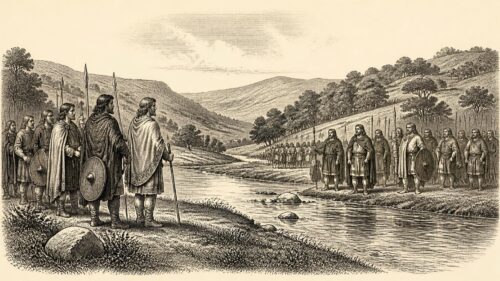
This mattered because Leinster lay between powerful neighbours. Áed Allán belonged to Cenél nEógain, the northern Uí Néill dynasty, and had secured the kingship of Tara after defeating rivals in the north. Tara was a pre-eminent kingship, but its holder’s authority depended upon military reach, political bargaining and the willingness of lesser rulers to acknowledge it. Áed’s earlier victories against Ulaid had extended his influence towards the eastern seaboard. A successful intervention against Leinster could similarly project northern Uí Néill power across the midlands and towards the south.
The Battle of Groans
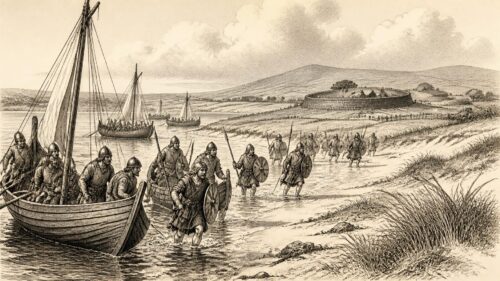
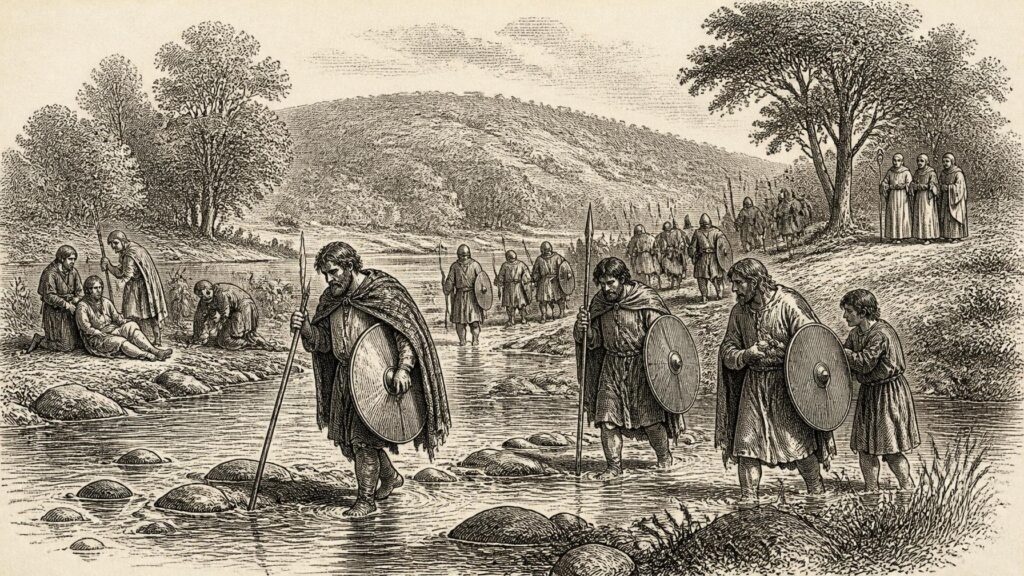
The annals call the encounter cath Átha Senaig, the battle of Áth Senaig, and also explain a name as the “battle of groans”. Its exact site is not certain. It is often identified, cautiously, with Ballyshannon near Kilcullen in modern County Kildare, but the identification should remain provisional. Whatever its precise location, the fighting brought the Uí Néill and the Laigin—the people and rulers of Leinster—into a direct contest at a strategically significant crossing or ford.
The annalistic account makes the personal stakes plain. Áed Allán was wounded but survived. His opponent Áed mac Colggen was killed and beheaded with a sword. Bran Bec also died, alongside Fergus mac Máenaig and Dub dá Crích, identified as two lords of Fothairt, Fiangalach of Uí Máel Aithgen, Conall ua Aithechda, four sons of Flann ua Congail, Éladach ua Máel Uidir, and many unnamed others. This is a roll-call of rulers, noble kindreds and military leaders rather than an impersonal report of casualties. It shows how battle could remove the men through whom local lordships commanded followers, controlled land and cattle, negotiated marriages, guaranteed agreements and represented their communities at assemblies.
The result was a clear victory for Áed Allán, but it should not be exaggerated into the conquest of Leinster. The province survived, and its kingship continued. Nor did the victory create a permanently unified Irish monarchy. It did, however, break the position of Áed mac Colggen and inflict a blow from which the Uí Chennselaig did not immediately recover. In the longer pattern of Leinster politics, Uí Dúnlainge dynasties became dominant for centuries thereafter. That later outcome cannot be reduced to one battle, but Áth Senaig removed both the leading Uí Chennselaig ruler and a number of rival Leinster magnates at a decisive moment.
Cathal’s Southern Pressure
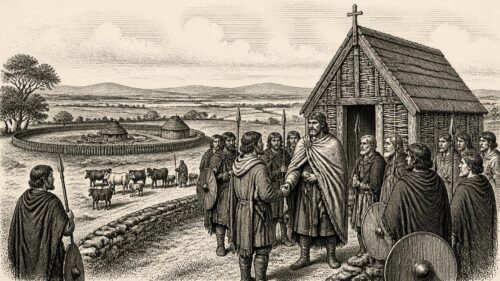
Leinster’s predicament was sharpened by the actions of Cathal mac Finguine, king of Munster. An annal for 738 records that Cathal led a hosting into Leinster, took hostages and acquired great treasure. Hostages were not merely prisoners: in early medieval politics they were living securities for submission, agreement and future conduct. Treasure could include valuable movable wealth, especially livestock, precious metal and high-status goods. A hosting therefore asserted supremacy while also drawing material resources from a weaker neighbour.
There is an important difficulty. One version of the entry says Cathal took hostages from Fáelán, although Fáelán’s death is also recorded in 738; another names Bran Bec, who had fallen at Áth Senaig. Modern historians accordingly treat the sequence as uncertain. Cathal’s expedition may have preceded the battle, followed it, or have been transmitted with a confused personal name. The responsible conclusion is not to impose a confident order of events. It is enough to see that Leinster faced pressure from both north and south in the same recorded year, while Cathal and Áed Allán competed for influence on an island-wide stage.
The previous year gives this tension a useful context. In 737, Cathal and Áed Allán met at Tír dá Glás, modern Terryglass, and the annals then state that Patrick’s law held Ireland. Scholars have suggested that the meeting involved a political accommodation and recognition of Armagh’s ecclesiastical claims, but the sources do not describe its terms. By 738, whatever understanding had existed did not prevent each ruler from seeking advantage in Leinster.
Clonard’s Bishop
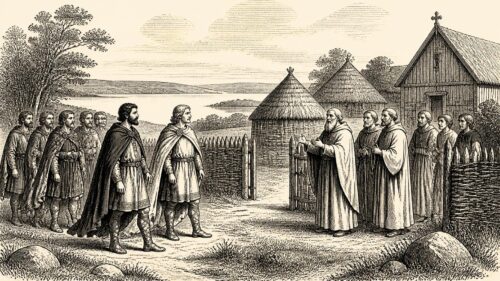
Military upheaval was not the only business recorded in 738. Tólae, bishop of Clonard, died and was praised as a worthy soldier of Christ. His obituary is brief, but the office matters. Clonard, in the Boyne valley region, was among Ireland’s important ecclesiastical communities: a place of worship, learning, landholding and social connection rather than simply a secluded retreat. Tólae had been bishop there since 718 and had earlier associations with religious settlements in what are now counties Clare and Westmeath. Later martyrologies commemorate him on 30 March, though that day should be understood as a liturgical tradition rather than an independently contemporary date of death.
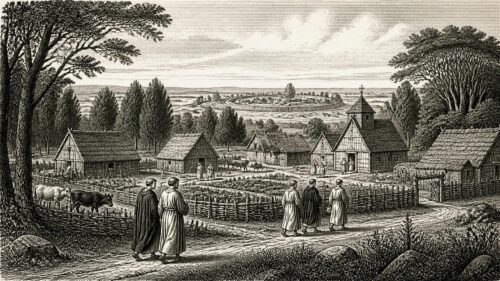
His passing reminds us that church institutions formed part of the political landscape through which kings travelled, negotiated and sought legitimacy. Bishops, abbots, scribes and hereditary ecclesiastical families could link distant regions. They also preserved the Latin literacy and record-making on which knowledge of 738 now depends. The sources do not permit a detailed picture of ordinary households in that particular year. They do show, however, a rural society in which cattle and other movable wealth underpinned status, in which hostages made political obligations tangible, and in which churches were major local institutions alongside royal kindreds.
Violence in Brega
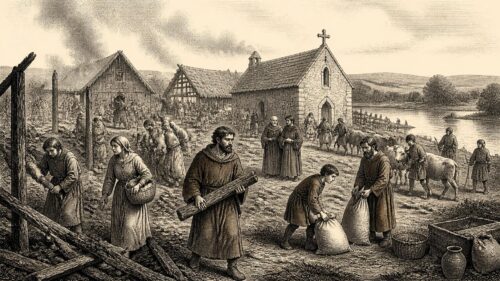
Another death exposes instability nearer the heart of Uí Néill territory. Cernach, son of the former king of Tara Fogartach, was killed treacherously by his own followers. The annalist’s lament is strikingly emotional, saying that women and calves bewailed him. This should not be read as a literal report of a public ceremony; it is conventional but meaningful language of loss, connecting a nobleman’s death with households and cattle, the foundations of social reproduction and wealth. Cernach’s killing also shows that Áed Allán’s triumph over Leinster did not eliminate danger within the wider Uí Néill world. Kingship rested on kinship and armed support, but both could fracture violently.
After Áth Senaig
For Ireland, 738 CE is therefore best understood through a cluster of firmly recorded deaths, warfare and coercive diplomacy. The battle of Áth Senaig transformed the immediate balance within Leinster and enhanced Áed Allán’s reputation as king of Tara. Cathal mac Finguine’s expedition demonstrated that Munster, too, expected payment and submission from its eastern neighbour. The deaths of Tólae of Clonard and Cernach of Brega place religious leadership and internal dynastic violence beside the headline battle. Together, these entries reveal an island connected by roads, fords, assemblies, church networks and mobile wealth, but divided among rival kingships. In that fractured landscape, the August slaughter at Áth Senaig was the year’s defining shock.
Primary Sources
- The Annals of Ulster, Year U738
- The Annals of Tigernach, Annal T738
- Annals of Inisfallen
- Annals of Inisfallen: Bibliography and Annal Index
- Annals of the Four Masters, Volume 1 English Translation
- Annals of the Four Masters: CELT Editorial Record
- The Annals of Ulster: CELT Editorial Record
- The Annals of Tigernach: CELT Manuscript and Editorial Record
- Áed Allán
- Áed Menn
- Fáelán
- Cathal
- Tólae
- Fogartach
- Cathal mac Finguine and Áed Allán at Tír dá Glás, AD 737
- Battle of Ballyshannon, 738 A.D.
- The Development of the Munster Overkingship
- Early Christian Monasteries
- Christian Ireland 5th–8th Centuries
- Patrician and Early Christian Architecture
- Exploring the Irish Annals
- Annals of Tigernach / National Library of Ireland Catalogue
- Annals of Tigernach / National Library of Wales Archives and Manuscripts
- List of Published Texts at CELT