Tír Dá Glas Meeting737 CE
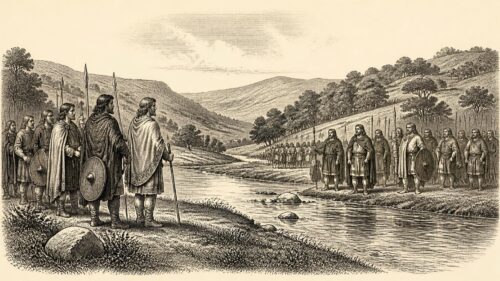
In 737, Áed Allán, northern Uí Néill overking, met Cathal mac Finguine of Munster at the monastery of Tír dá Glas, probably to limit conflict, although terms remain unknown. Annals then declared Patrick’s law effective in Ireland, projecting ecclesiastical legitimacy and wider order rather than recording a uniform national code. The year nevertheless saw dynastic violence in Brega, where Conaing defeated Cernach and Cathal son of Áed died, alongside deaths of regional rulers and abbots. Failbe of Applecross drowned with twenty-two sailors, illustrating Gaelic maritime links. These records reveal negotiation, church influence, instability, and aspirations to unity amid fragmented kingship.
Dateline
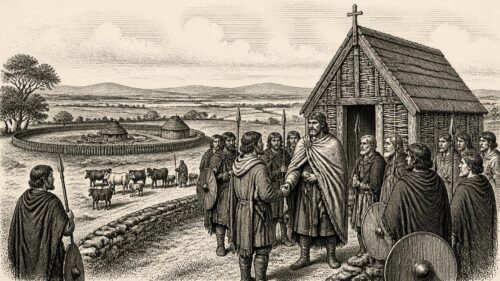
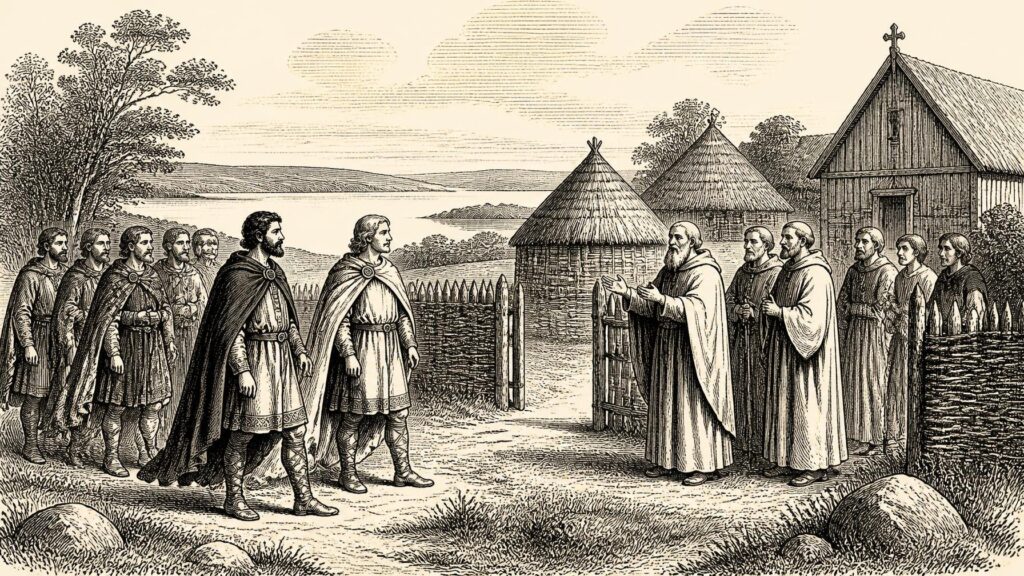
In 737 CE, two of the most powerful rulers in Ireland met at Tír dá Glas, the monastery now associated with Terryglass on the north-eastern shore of Lough Derg. The annals record the encounter in exceptionally few words: a dál, or meeting, between Áed Allán and Cathal son of Finguine. Yet the entry is followed immediately by another statement of unusual breadth: “the law of Patrick was in force in Ireland”. Read together, these notices suggest a moment when royal diplomacy, monastic authority and the language of law were brought into deliberate alignment. The terms of any settlement are unrecorded, and the annalistic dating of this period requires care: the principal chronicles place the notices under their year 737, while some related annal traditions use differing chronological reckonings. The events are conventionally discussed as belonging to 737 CE.
Two Overkings at a Monastery
Áed Allán, of the northern Cenél nÉogain branch of the Uí Néill, was king of Tara in the political sense: he was the most formidable claimant to overlordship among the northern and midland dynasties. His authority had been forged through warfare. In the preceding years he had overcome rivals among Cenél Conaill and defeated the Ulaid at Fochart. Cathal mac Finguine, king of Munster, was no lesser figure. A member of the Éoganacht Glendamnach dynasty, he had ruled Munster for decades and had made claims extending well beyond its southern heartlands. Neither man was a king of a unitary Irish state. Their power depended instead on kin-groups, client kings, tribute, hostages, ecclesiastical alliances and the ability to assemble armed followings.
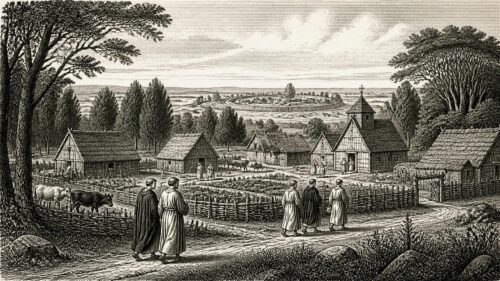
Tír dá Glas was a meaningful place for their meeting. Its name, “land of two streams”, preserved a landscape identity, while its monastery stood close to routes linking Munster, the Shannon corridor and the midlands. Founded in the sixth century and enclosed by a substantial monastic precinct, it was an established religious community rather than an empty neutral field. A monastery could offer sacred protection, facilities for visitors and an institutional setting in which clerics might mediate between rulers. It was also situated in territory where the political worlds of Munster and the midlands met. Choosing it made practical sense, but it also made a statement: the discussion was being conducted under ecclesiastical auspices.
The annals do not call the encounter a peace treaty, do not name an abbot as broker, and do not preserve speeches, pledges or hostages. It would therefore be unsafe to describe a detailed agreement as fact. Modern historians have nevertheless reasonably explored the possibility that Áed and Cathal reached a non-aggression understanding. Both had immediate reasons to limit conflict with the other. Áed faced the strategic problem of Leinster, whose rulers had killed his father, Fergal, at Allen in 722. Cathal wished to preserve his standing in Munster and in the southern half of Ireland without inviting a destructive northern intervention. A settlement could have left Áed freer to act against Leinster while allowing Cathal room to assert authority in the south.
Patrick’s Law
The following annal, Lex Patrici tenuit Hiberniam, is among the most arresting statements in eighth-century Irish historical writing. Its literal sense is that Patrick’s law “held” or was effective in Ireland. It should not be treated as evidence that a single written national law code was suddenly enacted across the island. Early Irish law remained a body of customary learning administered locally by legal experts, kin-groups, rulers and churches. Nor does the terse notice explain which offences, obligations or protections were covered.
What can be said is that “the law of Patrick” gave ecclesiastical authority a language capable of reaching beyond one monastery or one petty kingdom. Patrick was not simply remembered as an early missionary. His name was a powerful claim to island-wide Christian legitimacy, closely associated in later tradition with Armagh and with the reconciliation of inherited legal practice and church teaching. In this setting, the law may have concerned the protection of church people and property, the enforcement of dues, peace obligations, or the acknowledgement of Patrician authority. The wording is deliberately comprehensive, but its practical operation cannot be reconstructed clause by clause.
The sequence of entries matters. A meeting between the northern king and the Munster king is followed by the assertion that Patrick’s law prevailed in Ireland. That is not proof that one caused the other, but it makes a connection plausible. Cathal’s participation may have enabled the reach of a Patrician ecclesiastical settlement into Munster; Áed, whose power was closely entangled with northern church politics, had reasons to value such a declaration. The claim was also aspirational. To announce an all-Ireland law was itself an exercise in political and religious imagination, projecting unity across a landscape still divided among competing dynasties.
Violence in Brega
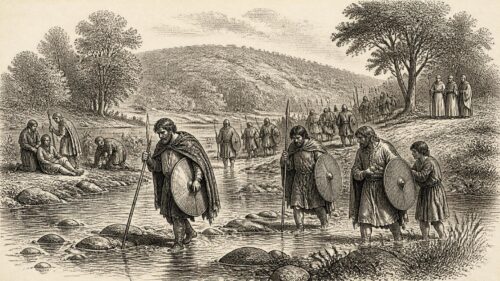
Diplomacy at Tír dá Glas did not make 737 a peaceful year. The annals also report a clash among the descendants of Áed Sláine, a dominant southern Uí Néill lineage centred on Brega, the rich and contested plain north of the River Liffey. Conaing son of Amalgaid defeated Cernach, while Cathal son of Áed was killed. The encounter occurred near Lia Ailbe, on its eastern side. Lia Ailbe was a major monument of Mag Breg, and the precise locational reference indicates that the fighting was remembered as occurring within a politically charged central landscape.
The entry is brief, but its implications are clear enough. The Uí Néill were not a single disciplined bloc behind Áed Allán. Their southern branches had their own rival lineages, claims to local kingship and histories of bloodshed. Brega mattered because its rulers commanded fertile lands, routes towards Tara and the Boyne valley, and access to the wider politics of the midlands. The death of Cathal and Conaing’s victory changed the balance within one branch of Áed Sláine’s descendants, but the sources do not tell us whether Áed Allán intervened, endorsed either side or merely benefited from division among potential rivals.
Other short notices reinforce the year’s atmosphere of local insecurity. Muirgius son of Fergus Forcraid and Bresal son of Conchobor of Ard were slain, though no causes are supplied. Aengus son of Ailill, king of Ard Ciannachta, died. Fiangalach son of Murchad, king of Uí Máil in Leinster, also died. Such entries are not a complete register of mortality. They record people considered significant enough for annalists to name: rulers, heirs and men embedded in aristocratic networks. Their accumulation shows how fragile authority could be. A local king’s death could create a succession struggle, alter alliances or invite pressure from a more powerful neighbour.
Church Communities and the Sea
Ecclesiastical life is present throughout the record, not merely in the great declaration of Patrick’s law. Rónán, abbot of Cenn Garad, died; Conmael grandson of Lóchéne, abbot of Clonmacnoise, “rested”; and Graiphnech, abbot of Imlech Fia, died. The formulae are restrained, but they mark the passing of leaders of religious communities that were also landholders, centres of learning, employers of dependants and participants in aristocratic patronage. Clonmacnoise, on the Shannon, was especially well placed to connect central Ireland with western and southern routes. Its abbot’s death mattered within a church network as well as within a local community.
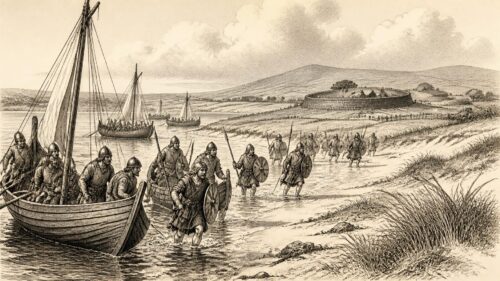
The most vivid religious notice concerns Failbe son of Guaire, described as successor of Máel Rubai of Apor Crosán, usually identified with Applecross in western Scotland. Failbe was drowned in the open sea with twenty-two sailors. His death demonstrates the maritime dimension of the Gaelic ecclesiastical world. Sea crossings linked Irish, Scottish and island communities; clerics, goods, messages, books and political news could travel by boat, while the same routes exposed crews to sudden and fatal danger. The annal does not say where Failbe’s vessel had sailed from or intended to go, so a particular voyage cannot be invented. But the loss of a church superior and a sizeable crew was plainly important enough to be entered in Irish chronicles.
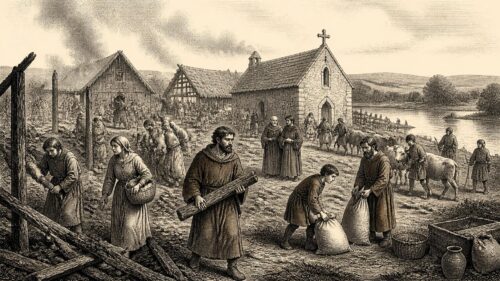
For ordinary people, the surviving evidence is frustratingly indirect. The annals do not describe harvests, markets, household work or the movement of cattle in 737. They do, however, reveal a society in which monasteries and royal households concentrated resources, warriors could be mobilised for dynastic feuds, and travel by water connected distant communities. Monastic sites such as Tír dá Glas and Clonmacnoise depended on farming tenants, craftsmen, hospitality, transport and scribal labour, even when those people remain unnamed. The political actions of kings rested on similarly local foundations: food renders, client obligations and the service of armed companions.
A Year of Claims
The importance of 737 lies less in a single battle than in the conjunction of its records. At Lia Ailbe, an internal struggle exposed the volatility of Brega. Across Ireland, named kings and churchmen died, while a maritime disaster touched the wider Gaelic religious sphere. At Tír dá Glas, meanwhile, Áed Allán and Cathal mac Finguine met in a monastery positioned between political regions. The assertion that Patrick’s law then held Ireland presented ecclesiastical order as something larger than any one dynasty.
That claim should not be mistaken for evidence of a settled, centralised realm. The following years brought major warfare, including Áed’s devastating victory over Leinster in 738, while Cathal continued to pursue Munster’s interests. Still, in 737 the annals preserve a rare glimpse of rulers using negotiation and sacred authority alongside force. Tír dá Glas was not simply a backdrop to their meeting. Its monastic setting allowed a local religious institution to become a stage on which the possibility of an Irish-wide order could be expressed.
Primary Sources
- The Annals of Ulster, Year U737
- The Annals of Tigernach, Annal T737
- Annals of Tigernach
- Annals of the Four Masters, Part 56
- Annals of the Four Masters: Editorial and Bibliographical Information
- Annals of Inisfallen
- Fragmentary Annals of Ireland, Part 12
- Chronicon Scotorum, Part 56
- Áed Allán
- Cathal
- Cathal mac Finnguini and Áed Allán at Tír dá Glás, AD 737
- The Rieddl at Terrygelass (737 A.D.)
- Terryglass Castle
- The Urban Archaeological Survey: County Tipperary North and South
- The Céli Dé and Ecclesiastical Government in Ireland
- The Mission of Palladius
- Kingship and Law in Medieval Ireland
- Muirchú's Life of Patrick
- Exploring the Irish Annals
- Irish Texts at CELT