Fogartach at Cenn Deilgden724 CE
In 724, Fogartach mac Néill was killed by Cináed mac Írgalaig at Cenn Deilgden, probably in the Brega–Mide region, strengthening Cináed’s claim to paramount kingship among the southern Uí Néill. The battle reflected competitive dynastic politics rather than rule over a unified Ireland, and its military details remain unknown. Elsewhere, Fáelchú, abbot of Iona, died and Cilléne Fota succeeded, possibly reuniting contested offices. Nechtan’s withdrawal and Drust’s accession marked a Pictish change of ruler. Cuinnles of Clonmacnoise and Cáech Scúili, scribe of Derry, also died. These records illuminate interconnected political, ecclesiastical and literary authority, while leaving everyday conditions largely undocumented.
Dateline
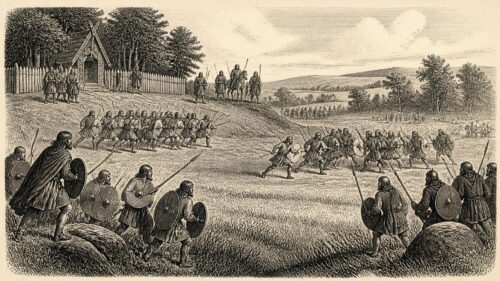
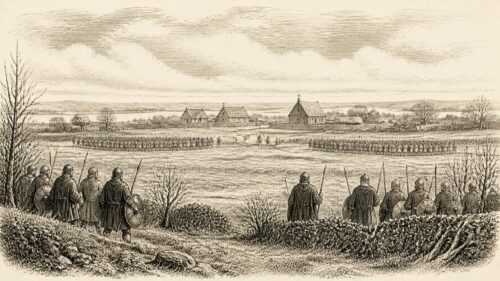
In 724 CE, a battle at Cenn Deilgden brought the career of Fogartach mac Néill to a violent end and made Cináed mac Írgalaig the immediate victor in the contest for supremacy among the southern Uí Néill. The Annals of Tigernach date the engagement to 9 October, recording that Fogartach, grandson of Cernach, fell and that Cináed was victorious. It is the year’s clearest political event, but it should not be misunderstood as the transfer of a modern national crown. Ireland consisted of many kingdoms, lordships and ecclesiastical territories. The title ‘king of Ireland’, used by annalists and later historians, described a claim to paramount influence rather than a centrally administered state. At Cenn Deilgden, power changed hands through the defeat of one rival lineage by another.
A Battle in Brega
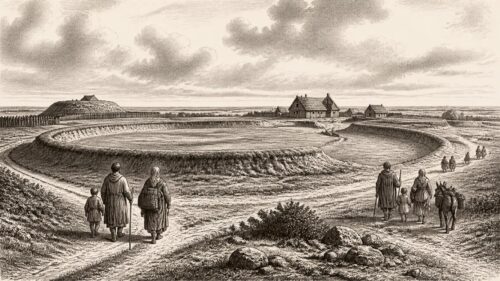
Cenn Deilgden is generally placed, though not with complete certainty, in the Brega–Mide region; it has often been identified with or near Kildalkey in modern County Meath. That probable setting matters. Brega lay in the rich central-eastern lowlands around the Boyne, close to Tara and the great assembly-site of Tailtiu. Control there conferred more than prestige: it offered access to productive agricultural land, major routes and influential client communities. The combatants were both members of the wider Uí Néill political world, but from competing branches. Fogartach belonged to Síl nÁedo Sláine, the powerful southern Uí Néill dynasty associated with Brega; Cináed was of Uí Chonaing, another Brega kindred. The battle was therefore an intra-dynastic struggle, not a clash between neatly bounded provinces.
The annalistic wording is concise, but its implications are substantial. Fogartach had previously made and lost claims to over-kingship. The later Fragmentary Annals of Ireland say that he had taken the kingship again in 724 and held it for one year before dying at Cináed’s hands. They also preserve a short verse on Cenn Deilgden, a rare sign that the battle was remembered in poetic as well as chronicle tradition. Yet these sources were written and compiled long after the event, and their reconstructions of sequence do not agree in every detail. The safest conclusion is that Fogartach was a leading claimant, Cináed destroyed him in battle, and Cináed could thereafter assert a stronger position in Brega and beyond.
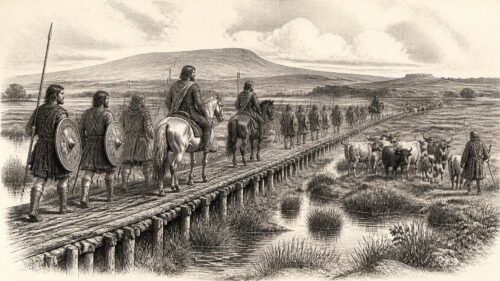
Nothing reliable permits a reconstruction of formations, numbers, weapons used at a particular moment, or the physical appearance of the battlefield. Early Irish annals commonly name the winner and the prominent dead while passing over the experience of ordinary fighters. Nevertheless, kin-groups did not fight as abstract dynasties. A king’s following included relatives, dependent nobles, clients, household warriors and allies whose obligations were tied to land, cattle, hospitality and protection. A defeat could therefore mean bereavement, disrupted lordship and the reassignment of local loyalties as well as a change in the name attached to wider kingship.
Authority Was Still Contested
Cináed’s victory did not settle Ireland’s politics permanently. His immediate rival was gone, but the principal northern Uí Néill kindreds, Cenél Conaill and Cenél nEógain, retained their own military and dynastic resources, while Leinster, Munster, Connacht, the Ulaid and numerous smaller peoples pursued their own interests. The event belongs to a period in which kingship was mobile, competitive and personal. Hostages, tribute, cattle-raiding, marriage ties, church patronage and public assemblies could all be instruments of rule. No record from 724 establishes that Cináed governed every part of the island directly; rather, Cenn Deilgden gave him a claim that contemporaries and later annalists considered important enough to call a kingship of Ireland.
One further notice may belong to this year, but deserves caution. The Fragmentary Annals place a battle between Dúnchad son of Murchad and Laidcnén, king of Uí Cheinnselaig, under a queried 724. Laidcnén was defeated. As the date itself is uncertain and the entry lacks the firm cross-confirmation of Cenn Deilgden, it cannot bear much interpretative weight. It does, however, fit the broader reality that Leinster was also divided by rivalry among ruling groups. It is better treated as a possible contemporary episode than as a securely dated turning point.
Iona’s New Head
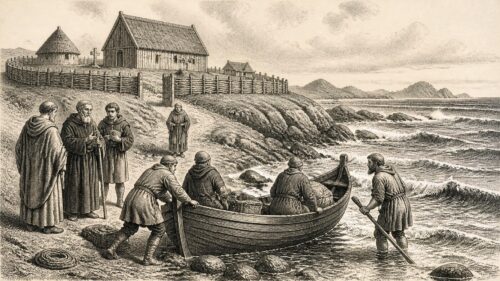
The year also brought a significant change in the Columban church network. Fáelchú son of Dorbéne, abbot of Iona, died, and Cilléne Fota, ‘the Tall’, succeeded to the principatus, or headship, of Iona. Iona lay off the west coast of present-day Scotland, but its history was inseparable from Ireland. Founded by Columba, an Irish churchman of Cenél Conaill, it maintained connections with religious houses, dynasties and sea-routes on both sides of the North Channel. Its abbots mattered to Irish history because their community commanded spiritual authority, learning, landed interests and a wide network of affiliated churches.
The wording of the succession is unusually revealing. In the years after Adomnán’s death in 704, annalistic evidence suggests overlapping or disputed leadership at Iona. A figure named Feidlimid had been recorded as taking the principatus in 722 while Fáelchú was still alive. Modern scholarship cannot determine every detail of this arrangement, but the 724 notice pairs Fáelchú’s death with Cilléne’s succession and is widely read as marking the reunification of the abbacy and headship in one person. This was not merely an internal clerical appointment. Continuity at Iona affected a community whose religious influence reached into Irish political society.
Another entry in the Annals of Tigernach places a change in Pictish kingship in the same year: Nechtan entered clerical life, and Drust ruled afterwards. The annal gives no explanation, so it would be wrong to invent one. Its relevance lies in geography and institutional ties. Iona’s affairs had been entangled with Pictish politics and with disputes over ecclesiastical practice earlier in the eighth century. The simultaneous notices from Iona and Pictland show that the Irish Sea was a zone of connection rather than a barrier: religious personnel, ideas and political consequences moved across it.
Clonmacnoise and the Written Word
Cuinnles, abbot of Clonmacnoise, also died in 724. The annal identifies him as belonging to the Sogain of Connacht, a useful reminder that major monasteries drew leaders from beyond their immediate locality. Clonmacnoise stood on the Shannon, near a major crossing of river and land routes. Its later surviving monuments cannot be projected unchanged back into 724, but archaeology and the site’s long development confirm the advantages of its position. It was a religious enclosure with a substantial lay as well as clerical population, linked to travel, exchange, patronage, craft and political negotiation. The death of its abbot was consequently more than a private loss for a small group of monks.
The annals also record the death of Cáech Scúili, scribe of Daire Calgaig, the early ecclesiastical settlement at Derry. His obituary is brief, yet it is unusually valuable. A scribe’s work involved literacy in Latin and Irish, the copying and correction of religious books, and the maintenance of texts essential to worship, teaching, law, genealogy and historical memory. The notice does not tell us which manuscripts he wrote, and no surviving book can responsibly be attributed to him. It does show, however, that scribal expertise was important enough to be recorded beside kings, abbots and battles.
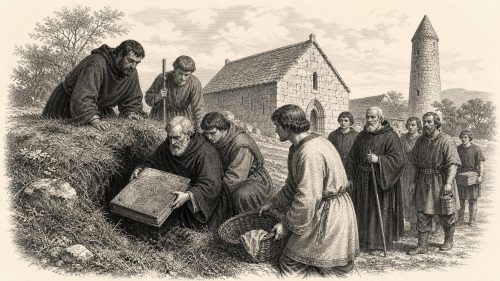
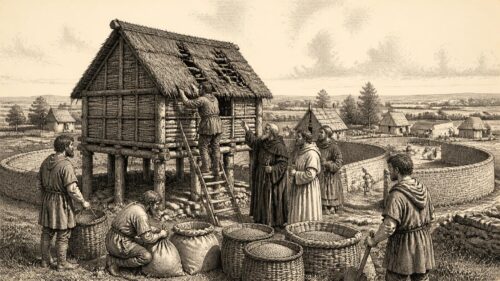
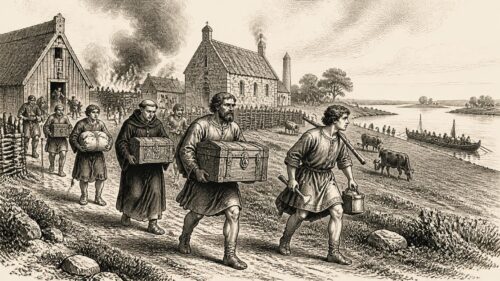
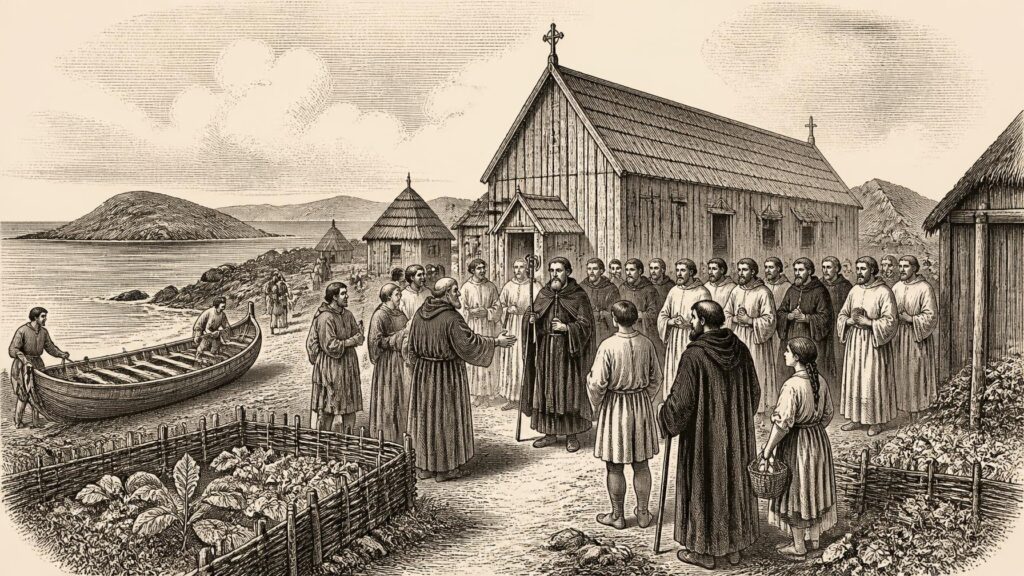
These monastic notices help to place 724 in its social setting. Irish monasteries were not isolated stone complexes inhabited only by contemplatives. Many early buildings were of timber, and communities depended on fields, livestock, food renders, tenants, guests and skilled workers. Clerics, lay families, craftsmen and students could live within or beside the enclosure. The routines of cultivation, food preparation, care of animals, travel by river and road, hospitality and devotional observance continued even when the annals said nothing about them. There is no securely dated report of famine, epidemic, exceptional weather or foreign raiding for Ireland in 724, so none should be manufactured to fill the year.
What the Record Can Bear
724 is consequently a year with a sharp but limited documentary profile. The battle of Cenn Deilgden, Fáelchú’s death and Cilléne’s succession at Iona, the Pictish change of ruler, Cuinnles’s death at Clonmacnoise and the passing of a Derry scribe are all recorded in or securely assigned to this calendar year. They reveal a society in which dynastic violence and ecclesiastical authority were deeply connected, and in which writing preserved the names of those who exercised both secular and religious leadership.
They do not reveal the harvest yield, the price of cattle, the fortunes of every kingdom or the feelings of the people who lived through the fighting. The responsible picture is therefore neither empty nor overconfident. In central Ireland, Fogartach’s fall opened the way for Cináed’s ascendancy. Across the sea, Iona acquired a new head at a sensitive moment in its institutional history. At Clonmacnoise and Derry, the recorded deaths of an abbot and a scribe point to the continuing labour of communities that organised worship, learning and local resources. For one year, those intersecting worlds of battlefield, monastery and manuscript are visible in the surviving record.
Primary Sources
- Annals of Tigernach
- Annals of Tigernach: Irish and Latin Text
- Annals of Ulster
- Fragmentary Annals of Ireland, Part 9
- Fragmentary Annals of Ireland, Part 10
- Annals of the Four Masters
- Annals of Inisfallen
- Chronicon Scotorum, Part 74
- Fogartach
- Fáelán Amlabar [Fillan the Mute, Fáelchú mac Dorbéni, St Fillan]: (641/2–724), abbot of Iona
- Early Mechanisms of Abbatial Succession: The Case of Iona (563–704)
- Contested Succession at Iona (704–26)
- Í > Ioua > Iona
- Exploring the Irish Annals
- The Chronicle of Ireland: Then and Now
- On Reconstructing Medieval Irish Chronicles
- Chronological Synchronisation of the Irish Annals
- Clonmacnoise: Visitor Guide
- Clonmacnoise Monastic Site
- Early Irish Monasticism
- High Crosses
- Irish School of Illumination, c. 650–1100
- The Book of the Dun Cow
- Irish Annals