Togher and the Meath Sheriff1385 CE
In 1385, Ireland comprised overlapping Gaelic and Anglo-Irish jurisdictions, where warfare shaped authority, movement and livelihoods. Murchadh Ó Conchobair of Uí Fhailghe and Cenél Fiachach defeated the English of Meath at Tóchar Cruacháin Brí Eile, killing the sheriff and many others, though lasting consequences remain unknown. Dublin appointed Alexander de Balscot chancellor, while appeals for Richard II’s intervention and Robert de Vere’s lordship grant exposed administrative weakness. Connacht endured organised burnings, cattle raids, crop destruction, killings, captivity and hostage-taking before a negotiated partition and peace. The year also recorded deaths of notable clerics, rulers, women and scholar Tanaide Ó Maolconaire.

Dateline
In 1385, Ireland’s political map was not governed by a single, evenly applied authority. The lordship claimed by Richard II was centred on Dublin and sustained in parts of the east and south-east by Anglo-Irish lordships, towns, courts and ecclesiastical institutions. Beyond and across its shifting frontiers, Gaelic dynasties exercised power through kinship, military followings, tribute, cattle, hostages and negotiated alliances. The year’s surviving notices are especially rich for Connacht and the midlands. They show warfare not as an interruption to ordinary life but as a force that directly shaped settlement, food supplies, lordship and personal security.
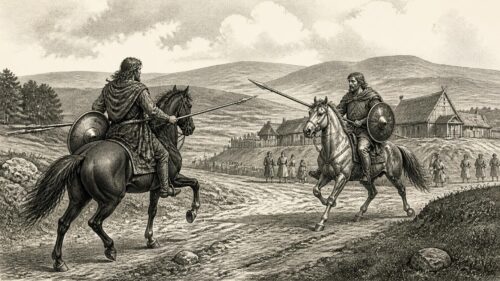
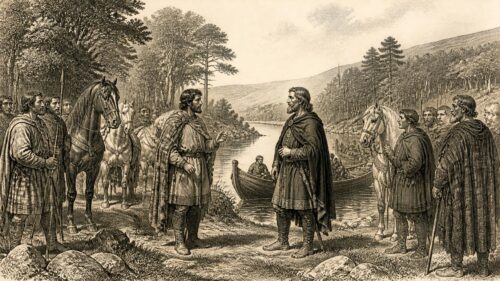
The most consequential recorded encounter was a victory won by Murchadh Ó Conchobair, king of Uí Fhailghe, and the Cenél Fiachach over the English of Meath at Tóchar Cruacháin Brí Eile. The annals do not provide a day or month, troop totals, or a tactical narrative. They do, however, make clear that a sheriff of Meath and many others were killed. A fuller later annalistic account names Chambers and his son, Nugent of Meath, and numerous people described as both prominent and ordinary among the English dead. Such wording should not be treated as a precise casualty list, but it establishes the encounter as a serious defeat for a Meath force rather than a minor raid.
A Causeway Battle
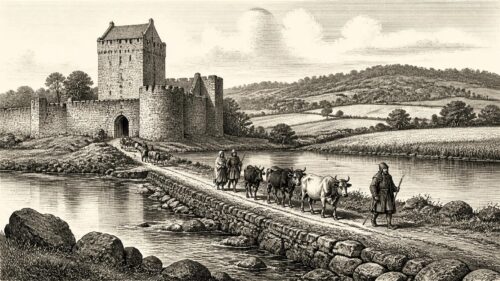
The place-name is important. Tóchar denotes a constructed causeway or raised road, especially valuable where wet or boggy ground complicated travel. The name Cruacháin Brí Eile associates the battle with the Croghan district of present-day County Offaly, although the exact battlefield cannot responsibly be fixed from the surviving record. A fight at such a crossing was not simply a clash in open country. Routes over difficult ground mattered to mounted men, foot soldiers, cattle-drovers and supply parties alike. Control of a passable line of movement could determine whether a raiding force returned safely, whether reinforcements arrived, and whether neighbouring territories remained exposed.
Murchadh’s victory demonstrated that the western and south-western approaches to Meath were contested. The men called the “English of Meath” in the annals were not necessarily newcomers from England: they belonged to the long-established Anglo-Irish political world of the lordship. Their loss, including a sheriff, was therefore a blow to local royal administration as well as to a military party. Yet the sources do not permit the larger claim that Uí Fhailghe permanently expelled English authority from the region in 1385. The achievement was real and politically significant, but its immediate aftermath is not described.
Dublin’s Distant Remedies
Events at Tóchar Cruacháin Brí Eile occurred while the Dublin administration and the English crown were searching for ways to restore authority in Ireland. On 8 March, Alexander de Balscot, bishop of Ossory, was appointed chancellor of Ireland. Balscot was an experienced cleric and royal servant, with previous experience in Irish financial and governmental office. His appointment placed the great seal and the business of formal government in the hands of a man familiar with the lordship’s institutions, but the office could not by itself secure vulnerable frontier districts.
The wider political mood was anxious. In 1385 the prelates, lords and commons of the lordship petitioned Richard II, warning of danger and asking him to come personally to inspect and save his Irish lordship. Their language was designed to obtain royal intervention and must be read as political advocacy, not as a neutral survey of every part of the island. Even so, the petition accords with the year’s evidence of military pressure, weak communications and costly insecurity.
Richard’s response that year was administrative rather than personal. On 1 December he granted the lordship of Ireland for life to his favourite Robert de Vere, earl of Oxford, who was created marquess of Dublin. The grant was remarkable in scale and symbolism, but it did not bring the king to Ireland, nor did it instantly transform conditions on the ground. De Vere’s elevation would become a major source of political controversy in England. For Ireland in 1385, it chiefly underlined the distance between ambitious plans at court and the local conflicts recorded in the annals.
Connacht in Fire and Captivity
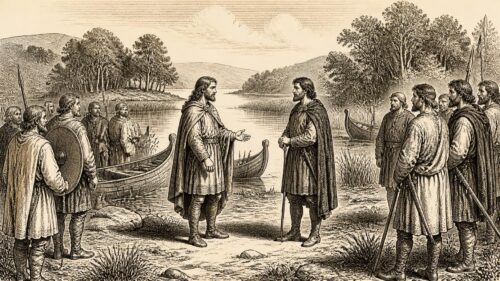
Connacht supplies the year’s clearest picture of the destructive routines of lordship. Mac Donnchada and Ó Ruairc entered Moylurg with a company of gallowglasses, burned Mac Diarmata’s stronghold and devastated the district. The annal adds that a son of Seoan Ó hEgra was killed in the pursuit and his brother captured. Gallowglasses were professional heavily armed fighters, commonly recruited by powerful Irish lords; their presence indicates organised campaigning rather than an impromptu local quarrel.
Other entries show how quickly attack and counter-attack followed. The sons of Aed son of Fedlimid Ó Conchobair burned the residence of Mag Oirechtaig, killed people there and took Mag Oirechtaig captive. Aed Ó Conchobair then captured David, son of Edmund son of Hubert Burke; David died in captivity at Ballintober. In Tír Oilella, Fedlimid Cléirech Ó Conchobair and Conchobhar Óg Mac Diarmata led an invasion, but their opponents had warning and prepared an ambush. As the raiders killed cattle and people, the watchers’ foot and horse forces struck back. Cathal Cairbrech Mac Donnchada was killed, Conchobhar Mac Diarmata was taken, and Fedlimid was wounded.
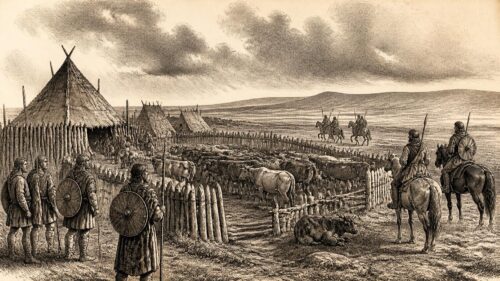
These terse notices reveal the practical targets of war. Residences were burned because they were centres of lordly power and stores; cattle were seized or slaughtered because livestock was mobile wealth and food; crops were cut down because this damaged a rival’s ability to feed dependants and sustain a following. Captivity was equally political. A prisoner could be held for ransom, exchanged, compelled to make terms, or used to enforce a settlement. Hostages appear repeatedly in 1385, not as incidental victims but as instruments through which agreements and compensation were secured.
The violence ranged widely. Men from Brefne and Tír Oilella burned Corca Achlann and cut down its crops. Mac William Burke burned Tír Fhiachrach, then Sligo and the nearby part of Carbury; resistance killed one of his followers, Maidecc Mael, and hostages were taken in relation to the resulting éric, or compensation claim. Domnall son of Muirchertach burned Tír Amhalgaid, killed people, carried off booty and took hostages. These were attacks upon inhabited landscapes, not merely contests between named chiefs. For farming households, herds, grain, buildings and kin could all become part of a rival lord’s military calculation.
Peace, Partition and Learned Memory
Late in the year, the annalist recorded that peace was made among the Connachtmen. Síol Muiredaig was divided between two branches of the Ó Conchobair family, while Aed Ó Conchobair and Conchobhar Mac Diarmata were released. The sequence matters: burning, ambush, imprisonment and negotiation ended in a settlement that acknowledged divided authority. It was a peace of accommodation rather than evidence that Connacht had become tranquil. Its terms were rooted in the balance of lordships created by the year’s campaigning.
1385 also brought a loss to Gaelic learned culture. Tanaide Ó Maolconaire, described as ollam of Síol Muiredaig in history and poetry and as the foremost practitioner of his art in Ireland in his time, died at Lammas in his own house. The annals state that he received unction and penance and was buried at Cluain Coirpthe. An ollam was an acknowledged master in a learned profession. Tanaide’s obituary therefore records more than the death of an individual poet: it marks the passing of a figure whose work belonged to the hereditary scholarly culture that preserved genealogies, historical knowledge, praise-poetry and political memory for leading families.
Religion appears elsewhere in the year not only through institutions but through the vocabulary of death and record. Gilla-Crist Mac Gilla-Finnein, chief of Muintir Peodachain, died on 31 May; Donn Mag Uidhir, son of King Flaithbertach, died on 1 July; and Thomas Ó Corcrain, son of a bishop and a notary general by imperial authority, died on 5 November. The latter notice is a small but telling reminder that Irish ecclesiastical personnel could participate in the documentary and legal culture of Latin Christendom. The deaths of Derborgaill, wife of Ó Conchobair Ruad, in childbirth, and Ben Mide, wife of Ó Néill Mór, also preserve a rare glimpse of women whose marriages linked major ruling families.
The Year’s Scale
The evidence for 1385 is uneven. It tells little directly about weather, harvest levels, craft production or the daily routines of townspeople. It is also shaped by annalists interested chiefly in lordly actions, learned men, churchmen and notable deaths. Nevertheless, its concentration on cattle, crops, strongholds, hostages, roads and captivity makes the material world of conflict unusually visible. Ireland in this year was neither simply divided between “Irish” and “English” nor reducible to an inevitable royal conquest. It was a country of overlapping jurisdictions in which local victories, such as that at Tóchar Cruacháin Brí Eile, could carry immediate weight, while grand policies announced in Westminster still awaited practical force.
Primary Sources
- Annála Connacht: Annal 1385 (English translation)
- Annála Connacht: Annal 1385 (Irish text)
- The Annals of Ulster
- Annals of the Kingdom of Ireland by the Four Masters, Volume IV
- The Annals of Clonmacnoise, Being Annals of Ireland from the Earliest Period to A.D. 1408
- Annals of the Four Masters: CELT Project Description and Edition Information
- Richard II
- Balscot, Alexander
- MacMurrough Kavanagh (Mac Murchadha Caomhánach), Art Mór
- Ireland
- The Mediaeval Irish Chancery
- The ‘Calculus of Faction’ and Richard II’s Irish Policy
- His Majesty’s Castle of Dublin
- Grant from Richard II to City of Dublin, A.D. 1385–6
- The Lives of the Lord Chancellors and Keepers of the Great Seal of Ireland
- Chronicle of the Law Officers of Ireland: Lord Chancellors and Keepers of the Great Seal
- Irish Statute Book: Chronological Table of the Statutes of the Irish Parliament
- Bothar and The Gearán Bán
- Offaly Historic Landscape Character Assessment
- A Gazetteer of Castles: Ballyboy Castle
- Annals of Clonmacnoise
- Annals of Ulster: CELT Project Record
- Annals of the Four Masters: CELT Project Record
- Annála Connacht: CELT Edition