Clonmacnoise’s Burning Year723 CE
In 723, annals recorded the burning of Clonmacnoise, a major Shannon settlement of churches, homes, workshops and stores, without identifying its cause or extent. The destruction nevertheless disrupted a religious, commercial and travel hub whose recovery required broad support. Indrechtach mac Muiredaig, king of Connacht, died there on pilgrimage, demonstrating the monastery’s authority beyond its region, though his succession remains uncertain. Deaths at Monasterboice and Tailtiu further reflect interconnected religious landscapes. Selbach of Dál Riata entered clerical life, linking Irish and Scottish politics. After Almu’s previous-year upheaval, no major battle is securely recorded. Later claims concerning Flaithbertach’s accession require caution.
Dateline
In 723 CE, the most clearly recorded Irish event was the burning of Clonmacnoise, the great ecclesiastical settlement on the River Shannon. The annals give no day, season, cause or account of casualties; they simply register that Cluain Mhic Nóis was burned. That brevity matters. It forbids a confident story of raid, accident or political attack, and it does not prove that every church, dwelling, storehouse or manuscript was lost. Yet even the bare notice marks a grave disruption at a community whose religious prestige, riverine position and connections across Ireland made it far more than an isolated monastery.
A Fire on the Shannon
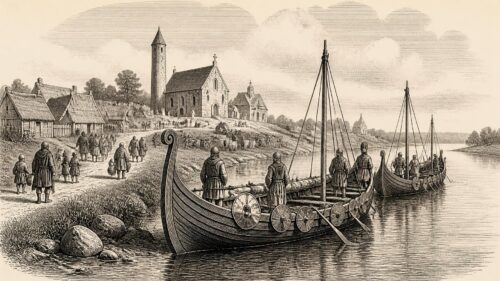
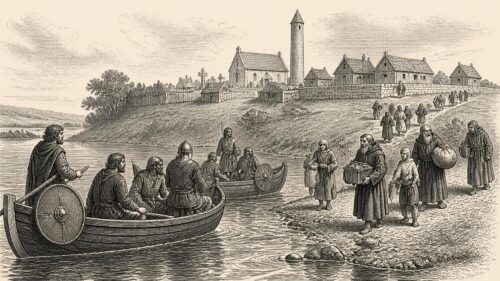
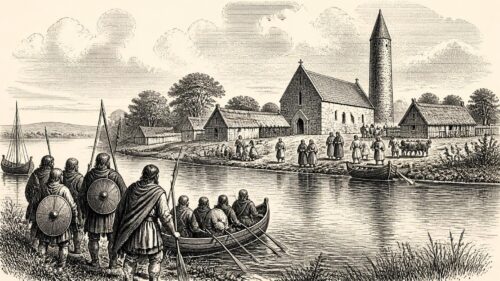
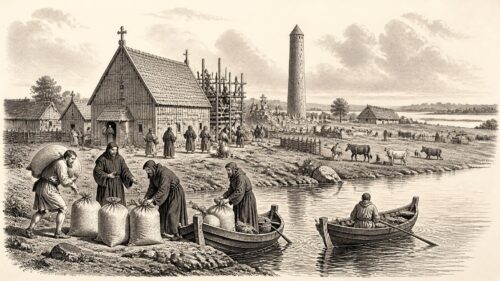
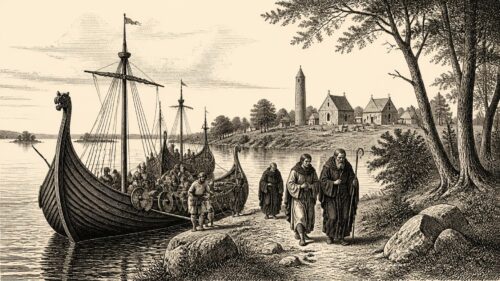
Clonmacnoise stood where the Shannon’s north–south waterway met routes crossing the midlands. Founded in the sixth century in association with St Ciarán, it had become a centre of worship, burial, teaching, craft and exchange. Its importance was rooted not merely in famous clerics or sacred memory, but in its practical geography. Boats could move people and goods along the river; roads and trackways over the surrounding eskers linked the site towards Mide, Connacht and the west. Kings, pilgrims, tenants, travellers and traders all had reasons to pass through or seek the protection of this prominent settlement.
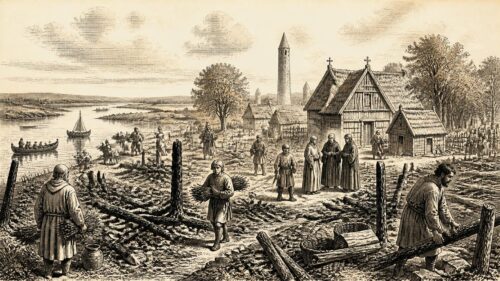
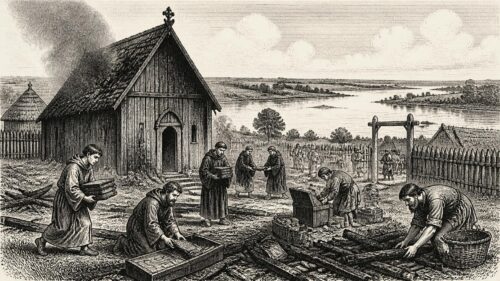
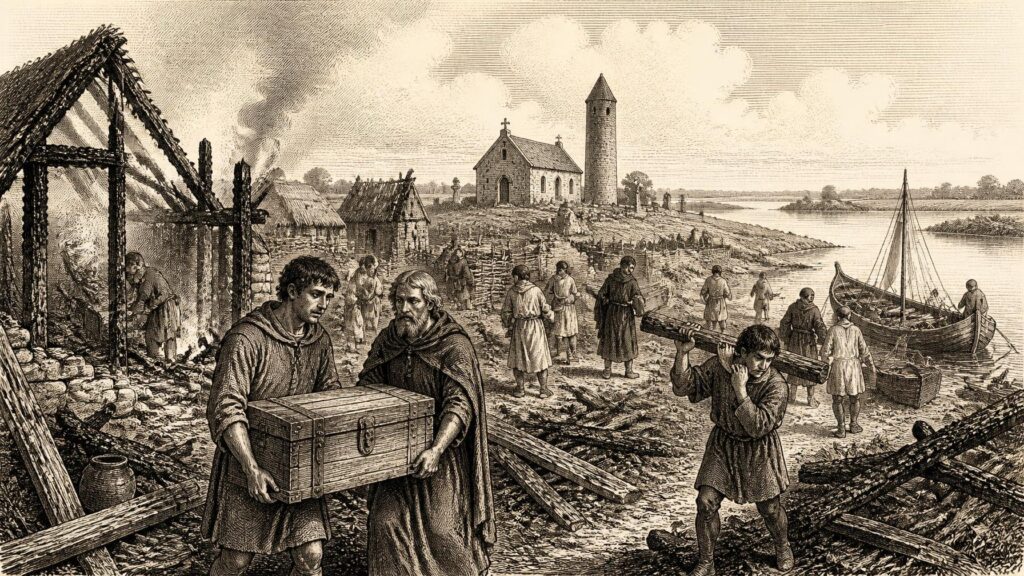
The fire therefore touched a community with a substantial lay as well as clerical population. Early medieval Irish monasteries were not generally self-contained precincts occupied only by monks. They comprised churches and burial grounds, but also kitchens, workshops, guest accommodation, storage buildings and timber homes. Archaeology and later descriptions of Clonmacnoise underline the scale of its inhabited settlement, though they cannot reconstruct the precise layout in 723. Timber buildings, thatch, fuel stores and closely used working spaces made fire an ever-present danger. A blaze could destroy food reserves, tools, textiles, books and shelter as readily as it damaged sacred buildings.
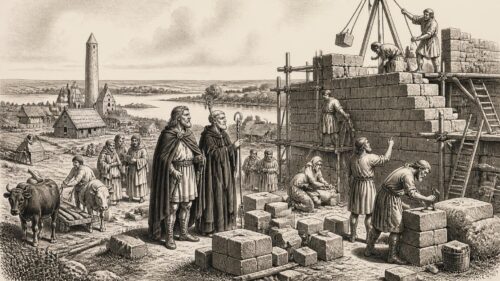
Nothing in the contemporary annal permits the cause to be named. Fire was sometimes a weapon in Irish political conflict, but it could also arise from domestic accident, craftworking or an uncontrolled hearth. Nor should the record be turned into a claim that Clonmacnoise had been annihilated: the community plainly continued. What can responsibly be said is that the burning was memorable enough to enter the annalistic record, an honour usually reserved for occurrences with broad consequence. Recovery would have required labour, timber, food, patronage and the co-operation of people from the monastery’s estates and wider networks.
A Connacht King at Cluain
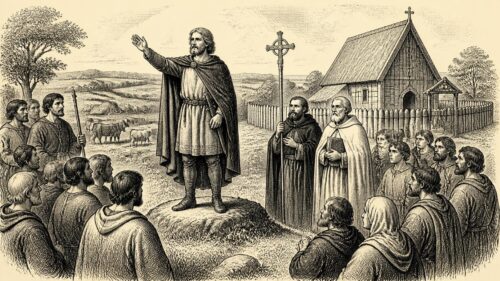
The year’s second major notice ties Clonmacnoise directly to provincial politics and pilgrimage. Indrechtach mac Muiredaig, king of Connacht, died “in pilgrimage at Cluain”, meaning at Clonmacnoise. The wording is unusually revealing. It identifies him both as a ruler and as a pilgrim, showing that royal status and penitential religious practice could coexist in a single public identity. The annal does not name his destination before he reached Clonmacnoise, describe his companions, or explain whether illness or age lay behind his death. It should not be expanded into an invented royal progress or a securely documented journey to Rome.
Indrechtach belonged to the Uí Briúin, a Connacht dynasty whose position was becoming increasingly important in the province. His death at a midland monastery was symbolically significant even if the annalist offered no commentary. Clonmacnoise lay beyond Connacht’s core territories but was accessible from them along the Shannon system, and its spiritual authority crossed regional boundaries. A Connacht king’s final association with the site suggests the standing that such a monastery possessed as a destination for devotion, burial memory and political display. It also reminds us that early Irish kingship operated through relationships as much as through fixed frontiers.
Indrechtach’s death created a problem of succession, but the surviving notice does not tell us how it was resolved in 723. Later king-lists and retrospective histories can make provincial succession appear smoother than it was. In reality, Connacht was a landscape of competing dynastic branches and local lordships, where authority depended on kinship, military followings, church alliances and control of resources. It is safer to see 723 as the end of one king’s recorded career than to attach a neatly dated transfer of power which the evidence does not securely preserve.
Deaths and Religious Networks
Two further Irish deaths were entered beside the fire and Indrechtach’s passing. Faelchú, also rendered Ailchú in the Annals of Ulster, died at Mainistir Buithe, modern Monasterboice in County Louth. The annals do not assign him an office, so he should not automatically be called abbot or bishop. Nevertheless, his commemoration at one of the north-east’s major ecclesiastical centres shows how the annals registered losses within a dispersed religious landscape. Monasterboice was already a place of worship and learning, connected through churches, families and travelling clerics to wider Irish networks.
The death of Sínach of Tailtiu was also recorded. Tailtiu, near modern Teltown in County Meath, carried exceptional political and ceremonial associations as the setting of an ancient assembly and fair. Yet the short entry tells us neither Sínach’s rank nor the nature of his or her connection with the place. It is tempting to turn a named death at Tailtiu into evidence for a particular assembly or royal gathering, but the sources do not allow it. Its value lies instead in showing the annalist’s geographical range: the year’s notices run from the Shannon to Brega and the north-east.
Across the Irish Sea, Selbach, king of Dál Riata, entered clerical life in 723. Dál Riata was centred principally in western Scotland but was bound to Ireland by sea routes, kinship and the shared Gaelic-speaking world. Selbach’s withdrawal from secular rule was consequently relevant to Irish political and ecclesiastical history. The annal does not tell us his motives, the monastery he entered or the detailed arrangements for power after him. Still, it records a striking transition: a ruler known in the language of kingship became a cleric. In this world, religious retirement did not necessarily mean disappearance from networks of influence.
Politics After Almu
Ireland in 723 was living with the consequences of the catastrophic battle of Almu, fought late in the previous year, when Fergal mac Máele Dúin, a leading Uí Néill ruler, was killed by the men of Leinster. The scale and political shock of that defeat were remembered in unusually elaborate annalistic notices. It had removed a dominant claimant to overkingship and left a wider field of rivalry among powerful kindreds. No major Irish battle is securely recorded for 723 itself. That silence should not be mistaken for a year of peace: negotiations, local coercion, tribute demands and competition for hostages rarely received the same notice as a great battle or a royal death.
A later compilation, the Annals of the Four Masters, places the first year of Flaithbertach mac Loingsig’s sovereignty over Ireland in 723 and records the deaths of Gall Lilcaig and Fachtna of Clonfert under that year. These notices deserve attention as part of Ireland’s historical tradition, but not equal confidence as exact contemporary dating. Other annalistic evidence places Flaithbertach’s acquisition of the kingship later, in connection with conflict in 728, while Fachtna’s death is likewise dated later in the Annals of Tigernach. For 723, therefore, Flaithbertach’s supposed uncontested accession should be treated as a retrospective chronological arrangement, not as a firmly dated political event.
What the Year Does Not Reveal
The annals record no harvest failure, epidemic, extraordinary weather, foreign invasion or island-wide legal settlement for 723. It would be wrong to infer drought from the Clonmacnoise fire, famine from its possible destruction of stores, or social collapse from the death of a Connacht king. Nor is there evidence for Viking activity in Ireland at this date; the Scandinavian raids that later transformed the political and economic landscape belong to a subsequent generation. The Ireland of 723 remained a patchwork of kingdoms, churches and kin-groups connected by rivers, roads and sea-lanes.
Even so, the year offers an unusually coherent glimpse of how those connections worked. Fire at Clonmacnoise exposed the vulnerability of a major religious settlement built largely in combustible materials. Indrechtach’s death there brought a provincial king into the orbit of a central Irish shrine. The notices from Monasterboice and Tailtiu locate religious and commemorative life in other important districts, while Selbach’s clerical retirement shows that political change in Gaelic Scotland remained relevant across the water. 723 was not defined by a single victory or new regime. It was a year in which a burning monastery and several carefully noted deaths reveal the interdependence of religion, travel, lordship and place in early medieval Ireland.
Primary Sources
- The Annals of Tigernach
- Annals of Tigernach
- Part 12 of The Annals of Tigernach
- The Annals of Ulster
- Part 55 of Annals of the Four Masters
- Chronicon Scotorum
- Annals of Inisfallen
- Annals of Inisfallen
- Exploring the Irish Annals
- CELT Project: Annals of Tigernach
- CELT Project: The Annals of Ulster
- CELT Project: Annals of the Four Masters
- CELT Project: Annals of Inisfallen
- Flaithbertach | Dictionary of Irish Biography
- Indract (Indrechtach) | Dictionary of Irish Biography
- Clonmacnoise Monastic Site
- Clonmacnoise Visitor Guide
- Case Studies | Digital Atlas of Early Irish Carved Stones
- High Crosses
- Reassessing the Irish ‘monastic town’