
Masonic Ireland
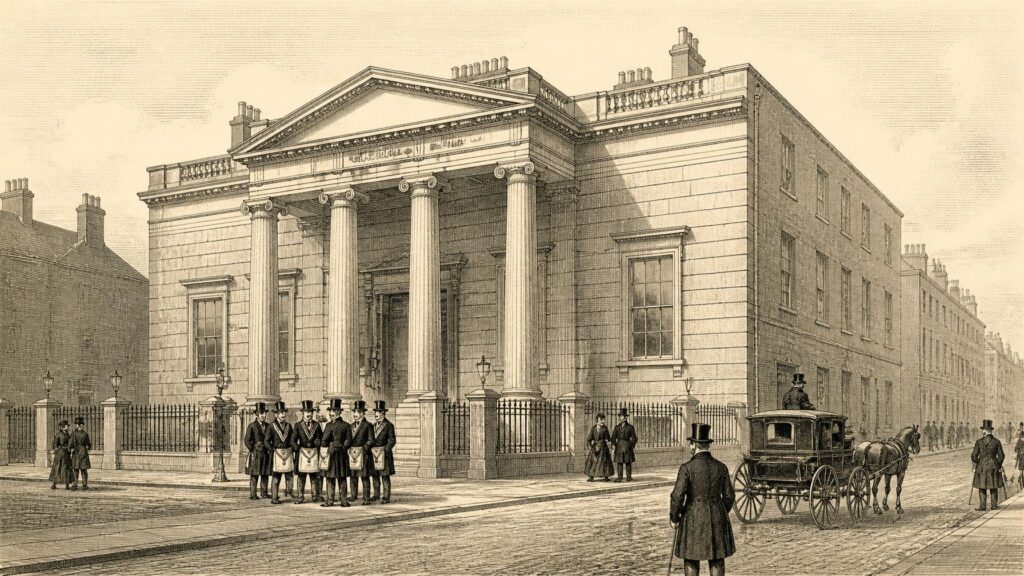
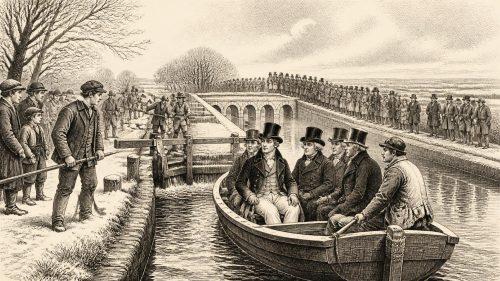
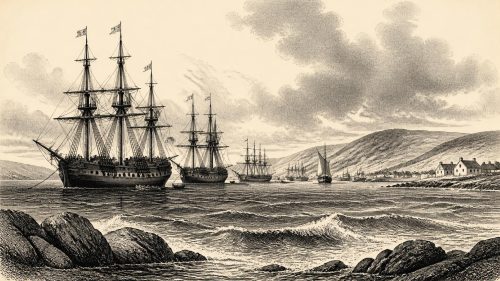
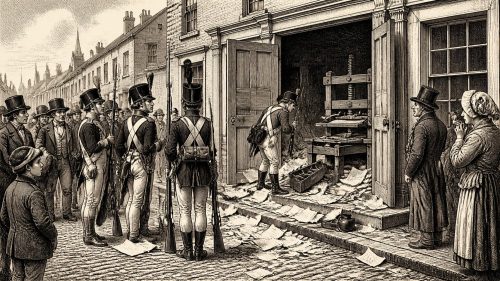
AI generated historical illustration, not a contemporary photograph.
At a Glance
Freemasonry has occupied an unusually visible yet often misunderstood place in Irish history. Its lodges were private institutions, governed by ritual and discretion, but they also left public records: warrants, membership registers, processions, charitable ventures, buildings and a substantial archival inheritance. From eighteenth-century Dublin and Cork to Ulster towns, army regiments and Irish emigrant communities abroad, Irish Masonry was a means by which men of differing occupations, denominations and political sympathies could create networks of sociability. It was neither a secret government nor a simple Protestant adjunct. Its history is instead a changing account of fellowship, hierarchy, charity, controversy and the difficult intersection of religious and political identity.
Early Traces
Claims for the extreme antiquity of Freemasonry are among the first difficulties confronting its historian. Masonic ritual has long used the imagery of Solomon’s Temple, medieval builders and inherited wisdom. Such imagery is meaningful within the fraternity, but it is not documentary proof that modern lodges descend in an unbroken institutional line from biblical craftsmen, the Knights Templar or medieval Irish stonemasons. Those explanations belong to a mixture of moral allegory, antiquarian speculation and folklore. They should not be treated as evidence for prehistoric, ancient or medieval Irish lodges.
The more secure history begins in the later seventeenth and early eighteenth centuries, when forms of organised sociability associated with Masonry were becoming recognisable in Britain and Ireland. Evidence for the earliest Irish activity is sparse. The Ulster Historical Foundation’s account of the records points to manuscripts in Trinity College Dublin dated 1688 and 1711, which indicate knowledge of Masonic forms and the existence of a lodge within the college community. This does not justify a grand claim that Irish Freemasonry began in a particular year or at a single place. It does show that lodge practice preceded the establishment of a national governing body and that it involved a social range wider than the aristocratic portrait galleries often associated with the Craft.
This distinction matters. Early modern Masonry was not simply a gathering of professional builders. It developed as a voluntary association in which the language and symbols of the building trades were used by men who were not necessarily operative masons. In Ireland, as elsewhere, lodges offered ceremony, eating and drinking, mutual recognition, office-holding and rules of conduct. They were part of a broader eighteenth-century world of clubs, learned societies, guilds, coffee-house sociability and associational life. Their privacy could attract suspicion, but their existence was not wholly hidden: meetings, parades and charitable collections were often conspicuous in local life.
Grand Formation
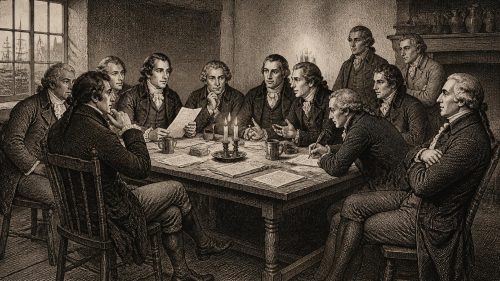
The central institution of Irish Craft Freemasonry is the Grand Lodge of Ireland. Its own modern history describes it as having come into being as an organised body by 1725 and as the second oldest Grand Lodge in the world. More precisely, the first recorded communication of the Irish Grand Lodge took place on 24 June 1725. That date is significant because it rests on contemporary newspaper reporting rather than on an earlier surviving minute book. It records an already organised ceremonial occasion, with officers and a newly installed Grand Master, the Earl of Rosse. The reasonable historical inference is that organisation had developed before the report; the exact moment at which the body was ‘founded’ cannot be recovered with greater certainty.
Grand Lodge did not create every lodge from nothing, nor did it instantly command universal obedience. Its importance lay in giving lodges a centre that could issue warrants, assign numbers, prescribe rules, settle disputes and establish a recognised line of authority. A warrant made a lodge more than an informal circle of acquaintances. It tied the local body to a wider jurisdiction, while allowing a considerable degree of local character. A lodge might meet in a town inn, a private house, a commercial premises or, later, a dedicated hall; its membership could reflect the occupations, kinship networks and religious composition of its district.
The Irish system was unusually influential beyond the island. The National Library of Ireland holds early printed lists of Irish lodges which expressly include military warrants. These remind us that Irish Masonry cannot be understood only through fixed buildings in Dublin, Belfast, Cork or provincial towns. Warrants travelled with regiments and with migrants. In this way, an Irish administrative practice became part of a wider Atlantic and imperial history. Yet that international reach should not be allowed to obscure the local evidence: Irish lodges were rooted in particular communities, and their records must be read in relation to those communities rather than as proof of an all-powerful global network.
Lodge Society
The lodge supplied forms of fellowship that were important in a society marked by status, religious division and uneven economic security. Membership did not abolish hierarchy. Grand Masters and prominent office-holders were frequently noblemen, landowners, senior soldiers and professionals; their names gave prestige to the institution. But local lodges also contained merchants, artisans, shopkeepers, clerks and men connected to the practical trades. The Trinity evidence traditionally cited for the late seventeenth century is striking precisely because it includes ‘gentlemen, mechanics and porters’. It suggests that the idiom of brotherhood could bridge some social boundaries, though it did not erase them.
Historians increasingly caution against describing Irish Masonry as merely an elite club. Petri Mirala’s study of Ulster between 1733 and 1813 stresses that lodges had practical functions alongside ritual and conviviality. They could offer mutual aid, help newcomers enter local networks, encourage respectable behaviour and mediate quarrels. Such functions were valuable in a mobile society, where soldiers moved between garrisons, artisans sought work and emigrants retained connections across the Irish Sea and Atlantic. The language of brotherhood was therefore more than ornamental, even if access to the lodge remained selective and overwhelmingly male.
Membership also needs to be interpreted carefully. A surviving register records that an individual was admitted, paid dues or held office; it does not reveal the whole texture of belief, friendship or political conviction. Nor does it demonstrate that every Mason shared the designs of another Mason. The tendency to infer coordinated action from membership lists has produced many exaggerated accounts. Lodges created connections, certainly, but networks are not the same as conspiracies. Their significance varied with place, period and the particular men involved.
Public Ritual
Secrecy was one element of Freemasonry, but it coexisted with elaborate public display. Eighteenth-century Irish lodges marched on feast days, especially those associated with St John, wearing aprons, jewels and other regalia. Processions made a claim to dignity, order and corporate presence. They also made Masons visible to neighbours who were not admitted to lodge rooms. Music, banners, dinners and speeches situated the fraternity within the public culture of towns and cities rather than beyond it.
Such displays could have several meanings at once. For participants, they marked loyalty to the lodge and reinforced a shared ritual identity. For civic spectators, they could advertise the status of local merchants, magistrates or gentry. For critics, the same ceremony might look ostentatious, exclusionary or politically suggestive. Mirala’s research on Ulster indicates that public processions were central to the social life of Masonry, while also warning against treating them as straightforward evidence of a single political allegiance. A parade can announce confidence and respectability without declaring a party programme.
The visual language of Masonry has helped create the impression that it is inherently occult. Squares, compasses, pillars, eyes, architectural tools and references to a divine creator were intended primarily to frame moral lessons concerning conduct, fidelity, charity and self-command. Their meanings have changed in popular imagination, particularly when detached from their ceremonial context. Historical interpretation should distinguish the fraternity’s own symbolic vocabulary from later sensational readings of it. The existence of private signs and obligations is documented; the claim that these signs demonstrate control over Irish public life is not.
Religious Boundaries
Religion is essential to any account of Freemasonry in Ireland, but broad labels can mislead. The Grand Lodge of Ireland defines admission in terms of belief in a Supreme Being rather than membership of a particular Christian denomination. In formal principle, the Craft was not an exclusively Protestant organisation. In historical practice, participation differed sharply by district and period. Protestant landlords, soldiers, clergymen, businessmen and professionals were prominent in many lodges, helping to form the powerful public association between Masonry, the Protestant interest and later unionism. That association was real in particular settings; it was not the complete story.
Evidence from the eighteenth century suggests considerable Catholic participation, especially in parts of Ulster and among groups for whom lodges offered social or economic connections. Mirala estimates that there may have been as many as 20,000 Freemasons in Ulster by 1800 and notes that many were Catholics. The figure is necessarily an estimate, not a census, and it should not be projected uncritically onto the whole island. Philip Horan’s quantitative study of Dublin Freemasons between 1770 and 1830 likewise finds a membership body whose political preferences were not uniform: both radicals and conservatives appeared in lodge registers.
The Roman Catholic Church’s hostility to Freemasonry had a long international background, beginning with eighteenth-century papal condemnations. In Ireland the issue acquired distinctive force because religious affiliation was inseparable from questions of political power, education, citizenship and national belonging. Clerical criticism, popular distrust and the association of lodges with Protestant elites contributed to declining Catholic involvement in many areas during the nineteenth and twentieth centuries. It would nevertheless be historically false to turn this later pattern into an eternal fact. Irish Masonic membership and reputation changed over time, and the relationship between Catholic communities and lodges was never reducible to a single rule.
Political Worlds
Freemasonry flourished in the age of the Irish Volunteers, debates over parliamentary reform, Catholic relief and the American and French revolutions. Because lodges brought together men who discussed public affairs and maintained disciplined forms of association, they naturally attracted political attention. Their rituals and mutual obligations have also encouraged an enduring assumption that every lodge was politically active. The available evidence requires a narrower conclusion. Individual Masons and, in some cases, particular lodges participated in political life; the fraternity as a whole contained conflicting loyalties.
In late eighteenth-century Ulster, Masonic connections intersected with Volunteer culture and with arguments over emancipation and reform. This did not make the entire organisation revolutionary. Lodge members could be reformers, radicals, conservatives, office-holders or defenders of the established order. The practical value of the lodge was its capacity to put people into contact across local divisions; that capacity could serve many purposes. It might foster a language of fraternity and civic improvement, or it might reinforce local respectability and existing influence.
Political historians must also avoid reasoning backwards from Ireland’s later divisions. A lodge in the 1790s did not necessarily fit the firm nationalist or unionist categories familiar from the twentieth century. Its members lived before the Act of Union came into effect on 1 January 1801, before the modern party system, and before the later institutional development of Irish nationalism and unionism. Their political vocabulary was shaped by monarchy, parliament, empire, religion, property and constitutional reform. Masonry was one setting in which these matters could be encountered, but it was not a substitute for them.
Rebellion Debate
The relationship between Freemasonry and the United Irishmen has generated both serious scholarship and romantic overstatement. There is no doubt that some United Irishmen and other republican activists moved through Masonic circles, and that the organisational resemblance between oath-bound societies has attracted attention. Patrick Fagan’s study of the infiltration of Dublin Masonic lodges by United Irishmen and other republican groups demonstrates that lodges could be targets for political recruitment or influence. Kenneth Dawson and Jim Smyth have likewise explored the intersections between Masonry, radical ideas and the United Irish movement.
Intersection is not identity. The Grand Lodge hierarchy had compelling reasons to reject movements which threatened state authority, especially during the crisis that preceded the rebellion of 1798. Nor can the membership of a lodge be used to prove that the lodge collectively endorsed insurrection. The most defensible interpretation is that Masonry offered a pre-existing language of fraternity, confidence and organised meeting which could sometimes be used by radicals, just as its networks could also contain men opposed to radicalism. Its political significance lay partly in this ambiguity.
The rebellion itself intensified official fear of secret combinations. In the years around 1798, private oaths and associational structures could appear suspicious whether they belonged to Masons, Defenders, United Irishmen or other organisations. Later writers sometimes treated shared forms of secrecy as proof of direct descent or coordinated purpose. That is a folklore of political causation rather than a reliable method. Similar organisational forms can arise in the same political climate without one body being the hidden master of another. The evidence supports overlap, contact and occasional infiltration; it does not support a claim that Freemasonry caused the rebellion.
Military Networks
Irish Freemasonry’s military warrants were among its most consequential contributions to the wider history of the Craft. A stationary lodge served a locality. A military lodge could accompany a regiment, carrying a warrant and rituals across the British Isles, the Atlantic world and imperial stations. Soldiers admitted through these lodges formed relationships that endured beyond a posting or a campaign. The Grand Lodge of Ireland’s early printed lists made this mobile jurisdiction visible by recording military warrants alongside civilian lodges.
The wider consequences are best understood as a history of circulation rather than of Irish control. Irish warrants linked men in regiments, garrison towns and colonial ports, but the people involved came from many backgrounds. The tradition is relevant to the development of Masonry in North America and elsewhere because Irish military lodges could introduce or regularise Masonic practice far from Ireland. It also demonstrates how a body headquartered in Dublin participated in the structures of the British state and empire while remaining an Irish institution with its own jurisdiction and history.
This global dimension complicates later nationalist and unionist interpretations. Irish Masonry cannot be fitted easily into one national narrative. Its members included people who identified strongly with the British imperial world, people interested in Irish constitutional change, people with little overt political ambition, and emigrants whose connections became transnational. The historian’s task is not to impose a single national meaning upon these networks but to trace how Irish institutions operated across changing political boundaries.
Charitable Duties
Charity was a public and durable part of Masonic life. Lodges collected funds for distressed members, widows, children and wider local causes. Benevolence was not unique to Freemasonry; churches, guilds, friendly societies and voluntary associations all practised it. But Masonic charity was important because it translated the fraternity’s moral language into visible action. Benefit events, subscriptions and institutional schemes helped make an organisation associated with private ritual appear publicly useful.
Such work should not be sentimentalised. Charitable systems often reflected the paternal assumptions of their age. Relief could distinguish between the ‘deserving’ and ‘undeserving’, demand evidence of respectability, or centre the needs of members’ families rather than the poor at large. Yet it also provided assistance at a time when state welfare provision was limited and precarious. For men whose livelihoods could be disrupted by illness, death or migration, a lodge connection could have practical value.
Charity also illuminates women’s indirect place in an overwhelmingly male institution. Widows and daughters might be beneficiaries of Masonic aid even when excluded from regular membership. The famous Cork figure Elizabeth St Leger, later Mrs Aldworth, has often been presented as the exception that proves the rule. A nineteenth-century memoir and surviving family material record her Masonic association and her depiction in regalia. The familiar story that she secretly observed a lodge through an unfinished wall and was initiated to preserve its secrets is much repeated, but its dramatic details rest on later tradition rather than contemporary minutes. She is historically significant; the precise circumstances of her initiation remain uncertain.
Civic Architecture
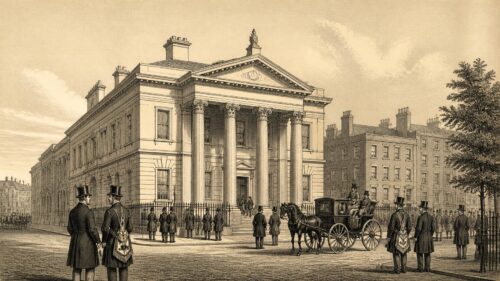
By the nineteenth century, Irish Masonry expressed permanence not only in registers and processions but in architecture. Freemasons’ Hall on Molesworth Street, Dublin, became the most conspicuous physical symbol of the Grand Lodge. Work began in the 1860s, and the hall was completed in 1869. The building survives as a purpose-built Masonic hall, now recognised in the National Inventory of Architectural Heritage for its architectural, artistic and social importance.
The hall’s neo-classical façade and ceremonial rooms made an institutional statement. In a city where churches, banks, clubs, courts and government buildings also deployed architectural grandeur, the building announced stability, disciplined order and cultural confidence. Its prominent position makes a useful corrective to the idea that Masonry operated entirely in shadow. The ceremonial content of lodge life remained restricted, but the institution itself was plainly present in Dublin’s streetscape.
Buildings are not neutral evidence. A grand headquarters tells us much about resources, self-presentation and institutional ambition; it tells us less about the experience of an ordinary member in a rural or small-town lodge. The archive and museum maintained at Freemasons’ Hall are therefore especially important. They preserve artefacts, documents and membership material capable of connecting the imposing central institution to local histories, family research and the changing practice of the Craft.
Northern Continuities
Freemasonry has been particularly visible in the history of Ulster, where local lodges were woven into urban and rural associational culture. Its relationship with the Orange Order is often asserted in simplified terms. There were overlaps of membership and cultural proximity in some settings, especially among Protestant men and within loyalist social worlds. But overlap does not mean that the two bodies were identical, that one controlled the other, or that every Mason was an Orangeman. Their purposes, membership rules and histories were distinct.
Mirala’s work is valuable here because it treats early Ulster Masonry as a varied social phenomenon rather than a precursor to a later political identity. The lodge could be a venue for mutual assistance, public ceremony and local discipline as well as political discussion. Catholics were present in the fraternity in significant numbers during the late eighteenth century, a fact that challenges retrospective claims of an exclusively Protestant inheritance. By the nineteenth and twentieth centuries, however, religious and political polarisation altered public perceptions. In many communities, Masonry came to be read through the lens of unionism, Protestant civic culture and the constitutional division of the island.
That perception has had real consequences, including suspicion among Catholics and nationalists and recurrent allegations of covert influence. Such allegations must be assessed case by case from records, not accepted merely because organisations share members or symbols. The historical importance of Masonry lies partly in its ability to reveal how voluntary association can become entangled with communal identity. It does not follow that the fraternity can explain all of Ulster’s political divisions.
Historical Method
Freemasonry presents unusual methodological challenges because it combines abundant institutional records with deliberate privacy. Minutes, warrants, lists, constitutions, certificates, jewels, buildings and newspapers can establish much about administration, membership and public activity. The Grand Lodge of Ireland’s archive and library are accordingly major resources for researchers. Yet the records are incomplete, unevenly preserved and often strongest for office-holders rather than ordinary members. Silence in a register does not prove that an event never happened, while a later memoir cannot automatically establish what happened decades earlier.
A sound history therefore separates three categories. First is documented evidence: dated manuscripts, newspaper reports, warrants, catalogued volumes, minutes, buildings and contemporary correspondence. Second is interpretation: the reasoned explanation historians offer about social composition, political significance or religious change. Interpretation may be persuasive while still open to revision. Third is folklore: stories of ancient origins, hidden rulers, secret tunnels, Templar descent or spectacular initiations. Folklore can be historically revealing as a record of belief and reputation, but it is not equivalent to proof.
This distinction is particularly necessary in Ireland, where Masonic history has often been drawn into arguments about empire, religion, rebellion and the constitutional status of the island. Sensational claims survive because the fraternity’s privacy makes them difficult to disprove conclusively. But historical standards do not require impossible certainty; they require proportion. A claim should be no larger than the evidence that supports it. The survival of a Masonic symbol in a building proves the symbol’s presence, not an unseen political programme.
Living Archive
The Grand Lodge of Ireland marked the tercentenary of its first recorded communication in 2025. Three centuries after the 1725 gathering, Irish Freemasonry remains an active institution with a headquarters, museum, library and archive. Its continuing existence should not flatten its past into a seamless tradition. The organisation has changed in membership, public standing, geographical reach and relations with Irish society. The Ireland of the eighteenth-century lodge, the Union era, the revolutionary decade, the Free State and contemporary island is not one political or religious world.
What endures is the historical value of the record. Freemasonry opens windows onto sociability, philanthropy, masculinity, ritual, migration, military life, architecture and the relationship between private association and public identity. It shows that organisations often described as ‘secret’ can leave remarkably substantial traces, while still withholding parts of their internal life. It also demonstrates that Irish history cannot be reduced to official institutions alone. Lodges were voluntary communities: sometimes conservative, sometimes hospitable to reform, sometimes socially inclusive in limited ways, and often deeply shaped by the inequalities around them.
Masonic Ireland is therefore best approached neither with credulous reverence nor with conspiracy-minded hostility. The documented story is already compelling. It begins with fragmentary late seventeenth-century evidence, gains institutional definition in 1725, moves through the upheavals of eighteenth-century politics, travels with soldiers and emigrants, acquires a monumental home in Dublin, and continues to generate debate about religion, identity and association. Its mysteries are real in the limited sense that rituals were private. Its historical importance, however, lies in what can be carefully recovered from the evidence.
One of the article’s most intriguing implications is that Irish Freemasonry combined privacy with conspicuous civic activity: lodges guarded rituals while marching publicly, raising charitable funds and connecting towns, regiments and emigrant communities. This complicates portrayals of Masonry as either a covert political force or merely a Protestant social club. The evidence of Catholic participation, diverse occupations and conflicting political loyalties suggests that membership could mean different things in different places and decades. How might closer comparison of local lodge records, procession accounts and charitable activity reshape our understanding of whether Irish Freemasonry bridged divisions, reinforced status, or did both?