
Orr and the Northern Star1797 CE
In 1797, Ireland faced mounting tension between the clandestine United Irishmen and a government anticipating rebellion and French invasion. General Gerard Lake’s Ulster disarmament campaign seized weapons, intimidated communities and weakened northern radical networks. After Monaghan militiamen implicated in United Irish activity were executed at Blaris, fellow soldiers destroyed Belfast’s Northern Star, silencing a major radical newspaper. Arrests also disrupted Cork organisers, while calls for constitutional conciliation gained little ground. William Orr’s contested conviction and hanging made him a powerful martyr. Meanwhile, parliamentary limitations and bank restrictions exposed wider political and economic insecurity, foreshadowing the 1798 rebellion in Ireland itself.
Dateline
Ireland in 1797 was not yet in open rebellion, but it was governed as a country expected to rise. The failed French expedition to Bantry Bay at the end of the previous year had left the administration in Dublin Castle convinced that invasion, domestic conspiracy and war with revolutionary France formed one danger. For the United Irishmen, the episode had been both encouragement and disappointment: French assistance seemed conceivable, yet no army had landed. During 1797, therefore, political argument increasingly gave way to clandestine organisation on one side and coercive security measures on the other. The year’s most resonant events occurred in Ulster, where the campaign to disarm the population, the execution of militiamen, the destruction of Belfast’s radical newspaper and the death of William Orr widened the breach between state and dissenters.
A Province Under Arms
Lord Camden, the lord lieutenant, and his chief secretary, Thomas Pelham, faced an exceptionally difficult problem. The United Irish movement had begun earlier in the decade with demands for parliamentary reform and Catholic inclusion, but repression and the international war had driven much of it underground. Its declared ideal of uniting Protestant, Catholic and Dissenter had found a particularly powerful constituency among Presbyterian radicals in the north, while links with Defender networks brought many Catholic artisans and labourers into a broader revolutionary organisation.
In Ulster, General Gerard Lake was the pivotal military figure. Appointed commander in the province in December 1796 and promoted lieutenant-general in January 1797, he began a determined disarmament campaign in March. A proclamation of 13 March ordered inhabitants of Ulster to surrender arms. Further government measures in May authorised the army to use the utmost force against sedition and to disarm the country. These were not routine policing measures. Troops, militia, fencibles and yeomanry moved through districts where authorities believed weapons were concealed and United Irish oaths administered. Arms were seized, suspects arrested, and communities subjected to pressure intended to make political organisation hazardous.
It is important not to treat all later accounts of the campaign as if they recorded each incident with equal certainty. What is firmly established is that Lake’s operation was vigorous and ruthless, that it collected large numbers of weapons and intimidated or detained many suspected United Irishmen. It seriously weakened the northern organisation before the rising of 1798. It also made the Crown’s forces, especially locally recruited bodies, a conspicuous and unsettling presence in everyday life. Householders had to weigh loyalties, family security and the risks of possession of a firearm; neighbours could be informers, recruits or targets of official suspicion.
The Monaghan Militia Crisis
The government was alarmed not only by civilians. It feared that the United Irishmen had begun to win men inside the forces intended to suppress them. The Monaghan Militia, stationed at the great camp at Blaris near Lisburn, became the most dramatic example. More than seventy men reportedly admitted taking the United Irish oath after an offer of pardon, but four alleged organisers were selected for court martial: Peter Carron, Daniel Gillan, and the brothers William and Owen McKenna.
The four were shot at Blaris on 16 May 1797. The execution was staged before assembled troops, and the condemned men were brought with their coffins: a calculated military warning rather than a quiet judicial proceeding. It demonstrated both the depth of official anxiety over sedition in the ranks and the consequences of associating the army with republican politics. The event also shows why the conflict cannot be reduced to a simple division between Irish civilians and British soldiers. The militia itself was Irish, embedded in local society, and vulnerable to the same political currents, religious affiliations and grievances as the communities around it.
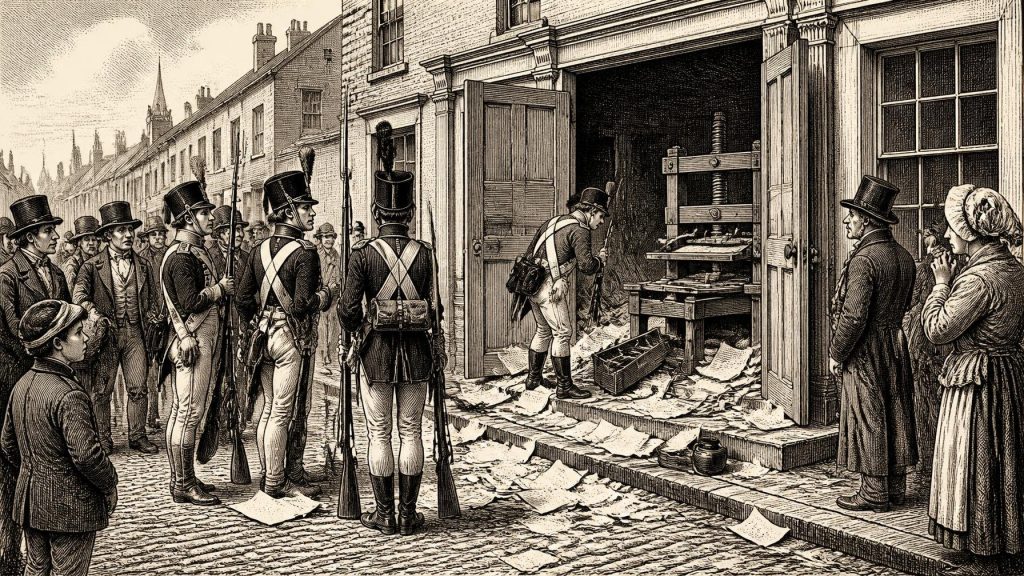
Three days later, on 19 May, men of the Monaghan Militia attacked the Belfast office of the Northern Star, smashing its presses and effectively ending the newspaper. The attack was not a formal legal closure, though the authorities had long regarded the paper as dangerous. Chief secretary Pelham condemned the destruction as an unjustifiable outrage, but the practical outcome favoured the government. The newspaper had been the leading printed voice of Belfast radicalism and one of the most successful Irish papers of its day, with a circulation that exceeded that of its local rival, the Belfast News-Letter, at its height.
Printing, Politics and Silence
The fate of the Northern Star was a cultural and political loss as well as a blow to a particular group of proprietors. Newspapers made possible a public political world extending beyond parliament: they carried reports, arguments, correspondence, notices and language through which readers could imagine themselves members of a wider cause. Belfast’s radical print culture had helped connect merchants, artisans, Presbyterian congregations and reformers with debates in Dublin, Britain, France and America. Its destruction curtailed an open platform precisely when the movement was being compelled into greater secrecy.
That secrecy did not mean inactivity. In May, the United Irish committee established in Cork by Henry and John Sheares was arrested and prosecuted. The setback illustrates the national reach of the government’s effort: the crisis was not confined to Belfast or County Antrim. Yet it also illustrates a central difficulty for the administration. Arresting committees and closing channels of expression could disrupt organisation, but it could not resolve the underlying political dispute over representative government, the remaining civil disabilities of Catholics, or Ireland’s constitutional subordination to Britain.
Seventy-three barristers signed a statement on 17 May urging the government to meet the people’s moderate wishes in order to defeat dangerous designs. Henry Sheares was among them. The gesture did not amount to endorsement of rebellion; rather, it revealed that educated men who were not necessarily committed conspirators could see conciliation as the wiser alternative to escalating force. In the political atmosphere of 1797, such constitutional language struggled to compete with the louder imperatives of security and conspiracy.
William Orr’s Death
The year’s defining martyrdom came in Carrickfergus. William Orr, a Presbyterian farmer and United Irishman from County Antrim, was prosecuted under the Insurrection Act for administering the United Irish oath to soldiers. The charge mattered because it joined the two official fears already exposed at Blaris: a secret oath-bound organisation and the seduction of men in uniform from their allegiance.
Orr’s trial was contentious. His defence, conducted by John Philpot Curran, William Sampson and James McGuckin, challenged both the use of the statute and the evidence against him. The jury found him guilty while recommending mercy. Appeals for commutation came even from figures far from United Irish radicalism, but the administration chose an exemplary punishment. After postponements, Orr was hanged outside Carrickfergus on 14 October 1797.
His execution was widely regarded by contemporaries sympathetic to him as a judicial murder. That judgement was political rather than a neutral legal finding, but its historical importance lies in its reach. Orr became a symbol of a state seen to punish not merely violent action but political association. “Remember Orr” entered United Irish memory and was later used as a cry in the 1798 rebellion. Memorial cards, rosettes and engraved rings circulated in Ulster, while William Drennan’s lament, The Wake of William Orr, gave the dead man an enduring place in nationalist and radical culture. In a society where public meetings and presses were being constrained, commemoration itself became political communication.
Parliament, Money and Daily Confidence
High politics continued alongside the emergency. A general election for the Irish House of Commons took place in 1797, the last before the Union of 1801. The parliament remained an Irish legislature, but it was dominated by a restricted Protestant political nation, patronage and borough influence. Catholic men who met the property qualification had possessed the parliamentary vote since 1793, but Catholics could not sit in parliament. Reformers therefore had reason to see electoral activity as inadequate to the demands made in the early 1790s, while government supporters treated parliamentary stability as essential in wartime.
Financial insecurity added another layer to public anxiety. On 2 March the Irish authorities ordered the Bank of Ireland to cease cash payments until parliament’s view could be taken; Privy Councillors soon declared confidence in the bank’s notes. The Irish Bank Restriction was approved by parliament in April and became law on 3 July. The measure formed part of a wider British and Irish response to wartime pressure on specie. For merchants, revenue officers, landlords and people who used urban credit, it made paper notes more important in ordinary transactions. For poorer households, whose lives depended far more on wages, credit from shopkeepers and the price of food than on banknotes, its effects were indirect; nevertheless, the state’s confidence in currency was itself a matter of public confidence.
By the close of 1797, Ireland had not yet crossed into general insurrection. The United Irishmen retained networks and hopes of French aid, but their northern base had been heavily damaged. The government had demonstrated its capacity for surveillance, disarmament and exemplary punishment, but it had also generated fresh bitterness. Blaris, Belfast and Carrickfergus made the year a decisive prelude: repression disrupted a revolutionary movement, while supplying it with grievances, silenced voices and martyrs that would shape the far more violent year to come.
Primary Sources
- Orr, William | Dictionary of Irish Biography
- Lake, Gerard | Dictionary of Irish Biography
- Neilson, Samuel | Dictionary of Irish Biography
- Pratt, John Jeffreys | Dictionary of Irish Biography
- Drennan, William | Dictionary of Irish Biography
- Sheares, Henry | Dictionary of Irish Biography
- The Rebellion Papers | National Archives of Ireland
- The Rebellion Papers
- The 1798 Rebellion: Documents and Sources | National Archives of Ireland
- The Northern Star: Holdings | National Library of Ireland Catalogue
- Printed Instructions, Regulations and Orders of the Monaghan Militia, 1797–1801 | National Library of Ireland Catalogue
- Monaghan Militia Paper Knife | Monaghan County Museum
- Monaghan Militia | Royal Irish Virtual Military Gallery
- Britain and Ireland: Lives Entwined III
- The United Irishmen: Popular Politics in Ulster and Dublin, 1791–1798, ‘Defenders and Militiamen’ | Oxford Academic
- Militia, United Irishmen and the Nore Mutiny | University of Liverpool Repository
- ‘The leading advocate of every murderer, ruffian and rogue villain’ | History Ireland
- Statute Law Revision Act 2015, Schedule 2 | Irish Statute Book
- Irish Currency: Report of 1804 | Central Bank of Ireland
- Wildcat Bankers or Political Failure? The Irish Financial Pantomime, 1797–1826 | European Review of Economic History
- The United Irishmen in Cork County | Cork Historical and Archaeological Society
- Pre-Union Irish Statutes | Irish Statute Book