Bantry Invasion1796 CE
In 1796, Ireland faced an attempted French invasion that exposed the convergence of revolutionary politics, sectarian tension and wartime insecurity. Theobald Wolfe Tone helped secure French support for an expedition under General Hoche, but storms, dispersal and confused command prevented its 14,000 troops from landing at Bantry Bay. Dublin Castle answered unrest with the Insurrection Act and newly established yeomanry, while Orange organisation strengthened Protestant loyalism. Catholic responses varied, exemplified by Bishop Francis Moylan’s anti-revolutionary pastoral. Meanwhile, the Royal Canal reached Kilcock and Edward Bunting published Irish harp music. The failed invasion intensified repression, mobilisation and republican hopes before 1798.
Dateline
For Ireland, 1796 was the year in which an invasion became visible from shore yet never came ashore. In late December, a great French expedition entered Bantry Bay carrying soldiers, arms and one of the most determined Irish revolutionaries of the age, Theobald Wolfe Tone. Its failure to land was caused chiefly by weather, confusion and the dispersal of the fleet, not by a decisive battle. But the sight and rumour of French warships off the south-west coast transformed political anxiety into immediate alarm. It confirmed to Dublin Castle that revolutionary France, Irish republican organisation and a threatened invasion could no longer be treated as separate problems.
That danger did not arise suddenly in December. Ireland remained a separate kingdom with its own parliament, but was bound to Britain by the Crown and by a political system dominated by the Protestant ascendancy. Catholics had won important concessions in 1793, including the county franchise on the same terms as Protestants, yet they still could not sit in parliament. Presbyterians, Anglicans and Catholics were divided by religion, property and region, but the Society of United Irishmen had sought to unite them behind parliamentary reform and, increasingly, an independent Irish republic. By 1796 its public politics had been driven underground. The state, meanwhile, increasingly treated political association, agrarian unrest and French influence as parts of a single security crisis.
From Exile to French Service
Tone’s journey gave the year its international dimension. Having left the United States at the opening of January, he reached France in early February and devoted himself to persuading the Directory that Ireland was the vulnerable point in Britain’s Atlantic defences. His argument was at once Irish and strategic: a landing might assist an Irish rising, detach Ireland from Britain and weaken British maritime power. French officials already entertained such possibilities, but Tone proved an energetic and unusually well-informed advocate. He gained the support of General Lazare Hoche, an experienced republican commander, and during the summer was appointed a chef de brigade in the French army.
This was not simply a story of a lone exile directing events from Paris. French policy followed the priorities of a state at war with Britain, while its commanders had to assemble men, transports, warships, supplies and intelligence in a hazardous Atlantic port. Nor was Irish support for an invasion a settled fact. The United Irishmen had networks in several regions, especially among Ulster Presbyterians and in areas where Defender organisation had grown, but they could not safely announce a general rising or guarantee that one would follow a French landing. Still, by the end of the year French and Irish expectations had converged sufficiently for an expedition of exceptional scale to sail.
Coercion and Armed Loyalty
In Ireland, Lord Camden’s administration moved in the opposite direction: towards stronger law and more organised loyalism. The Irish parliament passed legislation in 1796 commonly known as the Insurrection Act, formally an amendment of earlier law against tumultuous risings. Its provisions assisted the authorities in treating disturbed districts as exceptional spaces of government. Measures associated with the new regime included tighter scrutiny of arms and enlarged powers against unlawful assembly and nocturnal disorder. The legislation was a response to real violence and clandestine organisation, but it also made ordinary people more vulnerable to official suspicion. In a country of scattered cabins, small market towns and difficult roads, enforcement depended heavily on local magistrates, informers, soldiers and men willing to identify their neighbours.
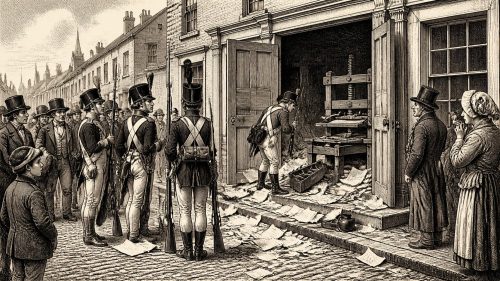
Government also encouraged the formation of yeomanry corps. Their formal establishment in the autumn of 1796 marked an important shift in the organisation of defence. These locally raised volunteer units were intended to make loyal subjects into an immediately available armed reserve under gentry and governmental leadership. The response was uneven. Correspondence preserved among the Rebellion Papers shows enthusiasm in some places and hesitation in others. In County Down, for example, observers stressed the practical difficulty of raising mounted men in a landscape and society where many potential recruits were manufacturers rather than substantial farmers. At Lismore in County Waterford, by contrast, a meeting promoting yeomanry drew a large and reportedly mixed confessional attendance.
The yeomanry therefore should not be imagined as a uniform Protestant militia automatically supported by every community. Catholic participation existed from the beginning, reflecting both the military changes after Catholic relief and the fact that many Catholics had strong reasons to defend property, locality and constitutional order. Yet the corps also helped militarise local loyalties. Their weapons, uniforms, officers and drill tied security to social rank and political allegiance, and their later reputation would be shaped by the violence of the years ahead. In 1796, the more immediate point was that the government feared it did not possess enough dependable force on the ground.
Armagh and the Politics of Memory
In Ulster, the language of defence was inseparable from religious division. The Orange Order had been founded after the Battle of the Diamond in County Armagh in September 1795, amid conflict that had driven many Catholics from parts of the county. On 12 July 1796, the idea of a Grand Orange Lodge was proposed, a step towards giving the young organisation a more coherent structure. The date also carried the memory of the Williamite victory at the Boyne. Such commemorations were not merely antiquarian exercises: they asserted a Protestant and loyal political identity at a time when fears of Catholic mobilisation, French revolution and republican conspiracy were widespread.
It would be misleading, however, to make 1796 a simple contest between two fixed religious blocs. United Irishmen hoped to overcome sectarian categories; the Orange movement insisted on Protestant security; Catholic political leaders could seek further rights while rejecting revolutionary violence; and many people concentrated on work, rents, harvests, trade or safety rather than ideology. The pressure of war made those positions harder to keep apart. A man’s religion, access to arms, membership of an association, employer, landlord and local reputation could all acquire political meaning.
The Fleet in Bantry Bay
The decisive episode began on 16 December, when the French expedition sailed from Brest. Contemporary and later accounts differ somewhat on its precise totals, but it was a formidable armada: roughly forty vessels and close to 14,000 troops, with Hoche commanding the army and Tone aboard the Indomptable. The plan relied on speed, secrecy and the fleet remaining together. It went wrong almost at once. Ships collided or became separated while leaving Brittany; the difficult winter passage scattered squadrons; and Hoche himself was carried away from the main body.
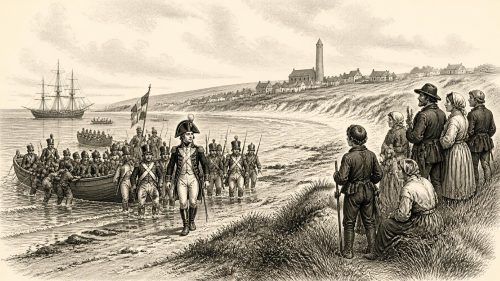
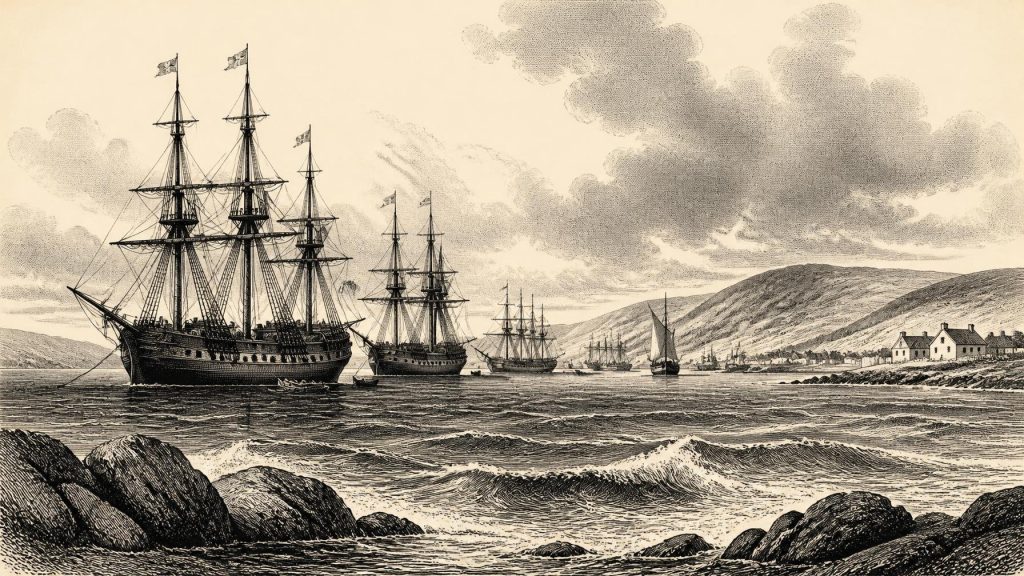
On 22 December, French ships reached Bantry Bay. Their arrival was the closest the expedition came to success. The broad harbour offered anchorage and the coast lay within sight, but severe gales and heavy seas prevented a landing. Command fell upon officers who lacked the authority or confidence to act boldly in Hoche’s absence. For days, soldiers and sailors endured a violent winter anchorage while vessels were damaged, provisions were consumed and communication broke down. Tone later recalled the shore as tantalisingly near. Yet proximity was not possession: no French force established itself on Irish soil, and no coordinated Irish rising began.
The withdrawal unfolded over the closing days of the year and the beginning of 1797. The expedition returned to France battered and incomplete. Its immediate military result was failure, but calling it an inconsequence would miss its effect on Ireland. Bantry Bay demonstrated that British naval power could be evaded, that France was prepared to commit a substantial army, and that Ireland could become an active theatre of the wider Revolutionary War. For loyalists, it justified accelerated mobilisation and repression. For United Irishmen, it was a grievous missed opportunity, but also proof that foreign aid was conceivable. The failed landing became one of the crucial preludes to the rebellion of 1798, without making that later rebellion inevitable in December 1796.
Faith in a Time of Invasion
The crisis also exposed differences within Irish Catholic life. On Christmas Day, while the French presence in Bantry Bay was still known and feared in Cork, Dr Francis Moylan, Roman Catholic bishop of Cork, issued a pastoral address to his diocese. It was read in parishes and emphatically rejected the French revolutionary example. Moylan warned his flock against irreligion, disorder and the seductive promise of an equal division of property. His intervention is important because it shows that Catholic relief did not translate into automatic support for French invasion or republican revolution. A senior Catholic bishop could regard the defence of religious worship, property and social peace as requiring public loyalty to the existing order.
Moylan’s words reached communities close to the threatened coast, where news travelled through clergy, merchants, soldiers, officials and seafarers. They also reveal the revolution’s cultural force. The French were not feared only as foreign soldiers; they were associated with the anti-clerical and socially disruptive aspects of the Revolution. The response of Cork’s bishop was consequently both political and pastoral: he appealed to conscience, but did so amid a contest over who could claim to protect ordinary people.
Canals and Cultural Preservation
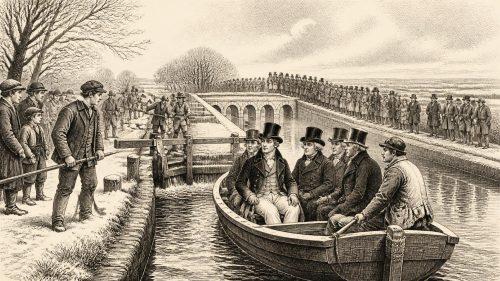
Not every development of 1796 concerned invasion. The Royal Canal reached Kilcock, and the Ryewater Aqueduct was completed after years of difficult work. The canal was still far from its eventual connection to the Shannon, but its opening westwards from Dublin embodied an ambitious commercial hope: that improved inland navigation would carry grain, turf and other goods, lower transport costs and draw the midlands more closely into Dublin’s trading world. Construction itself required capital, contractors and large bodies of labourers working through rock, water and flood-prone ground. In a year dominated by insecurity, such works were a reminder that Ireland’s economy also rested on long-term projects of movement and improvement.
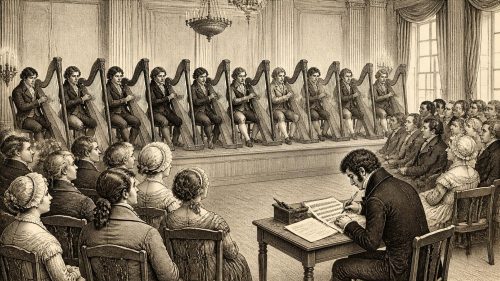
Culture, too, registered a different kind of continuity. Edward Bunting’s A General Collection of the Ancient Irish Music appeared in 1796, drawing on the harp music he had begun recording at the Belfast Harp Festival of 1792 and on later collecting. His printed arrangements inevitably reshaped music performed in older oral and instrumental traditions, yet the publication was a landmark in preserving and circulating a repertory associated with Irish harpers. It joined commercial print, antiquarian curiosity and a developing sense that inherited music was a national cultural resource.
Thus 1796 contained both movement and stasis: canal boats and printed music, oaths and parish sermons, local drill and international strategy. Above all, it left Ireland altered by an invasion that did not happen. The French fleet vanished beyond the horizon, but the fear it generated remained on land. State coercion, loyalist organisation, sectarian mobilisation and republican planning all acquired new urgency. The consequences would not be confined to Bantry Bay, nor to the year’s last stormy week.
Primary Sources
- Rising and Union, 1791–1801
- Irish Invasion Plans
- ‘The first up will carry the day’: the mobilisation and militarisation of Irish loyalism, 1796–8
- Tone, Theobald Wolfe
- ‘Close enough to toss a ship’s biscuit ashore’—the French fleet at Bantry Bay, 1796
- Doctor Francis Moylan, to his beloved flock, the Roman Catholics of the Diocese of Cork, Christmas Day, 1796
- CAIN: Issues: Parades: Parading Organisations
- CAIN: Issues: Parades: Chronology 2: Historical Dates and Events
- The Rebellion Papers
- The Rebellion, State of the Country, and Official Papers Collections
- The History of the Royal Canal
- The Royal Canal – Rise, Fall, Rebirth
- A General Collection of the Ancient Irish Music
- The Ancient Music of Ireland
- Thomas Moore and Edward Bunting: An Exhibition from the Special Collections of Queen’s University Belfast
- A Forgotten Army; The Irish Yeomanry
- Raising the Irish Militia
- Statute Law Revision Act 2015
- Statute Law Revision Bill, 1962
- Holdings: Two memoirs on the plans of defence for Ireland and England respectively, submitted by Wolfe Tone to General Hoche
- 1798, the Year of the French
- Countdown to Rebellion
- The Catholic Question in the Eighteenth Century
- Doneraile Papers